The belief that “any U.S. clinical rotation helps your match chances” is wrong. The data show a very different, much sharper story: the type, timing, and setting of your U.S. rotations can swing your match odds from single digits to coin‑flip territory.
Let me walk through this like a data problem, not a vibes problem.
1. Baseline: What Are IMG Match Odds Without U.S. Rotations?
Start with the benchmark. If you do not know your baseline, you cannot measure the lift from U.S. clinical experience (USCE).
Use the NRMP Main Match data and ECFMG reports as the spine:
- Overall match rate for all IMGs (U.S. citizen + non‑U.S. citizen) into PGY‑1 positions is usually around 58–62% in recent years.
- Split by citizenship, the picture is lopsided:
- U.S. citizen IMGs: roughly mid‑50% match rate.
- Non‑U.S. citizen IMGs: roughly mid‑50% to high‑50% as well, but with much more variation by specialty and USCE.
However, those top‑line numbers hide what actually matters: the subset of IMGs with structured U.S. clinical rotations vs. those with little or no U.S. exposure.
Multiple program surveys and institutional datasets converge on a clear pattern:
- Non‑U.S. citizen IMGs with no U.S. clinical rotations:
- Internal medicine categorical match rate often in the 10–25% range at many mid‑tier university programs.
- Virtually zero probability in competitive specialties (dermatology, plastics, ENT, ortho).
- IMGs with strong U.S. clinical rotations and strong letters:
- Internal medicine match odds can approach 50–60% at community and lower‑tier university programs, assuming Step scores and other metrics are solid.
- For family medicine, pediatrics, neurology, psychiatry, the incremental lift is often even larger.
You can think about USCE as a multiplier on your baseline profile. With weak scores, it cannot save you. With decent scores, it can double your odds.
To make this concrete, here is a simplified comparison for non‑U.S. citizen IMGs applying to internal medicine, controlling loosely for “reasonable scores” (Step 2 in the 230–240 range, no major red flags).
| USCE Profile | Approximate Match Odds |
|---|---|
| No U.S. rotations, only home-country clinics | 10–20% |
| 4–8 weeks [U.S. observerships](https://residencyadvisor.com/resources/international-med-schools/no-us-shadowing-building-clinical-exposure-before-going-abroad) only | 20–30% |
| 8–12 weeks U.S. hands-on electives (no home program link) | 35–45% |
| 12+ weeks U.S. hands-on electives + rotations at target programs | 50–60% |
These are not official NRMP numbers; they are composite estimates derived from program director surveys, institutional match lists, and longitudinal anecdotal data. But the relative differences track reality very closely.
2. Not All U.S. Rotations Are Equal: Observership vs Elective vs “Audition”
Lumping “U.S. rotations” into one bucket is statistically lazy. The type of rotation drives most of the effect size.
You basically have three tiers:
- Observerships (shadowing, no orders, no notes)
- Hands‑on electives / sub‑internships
- Audition rotations at programs that actually rank you
Program directors consistently rate these very differently. In NRMP Program Director Surveys, “demonstrated U.S. clinical experience” and “audition electives at our institution” sit high in the importance list, while pure observerships are at the bottom.
Observerships: Almost Zero Direct Lift
Hospitals like them. Visa‑friendly. Low risk. From a numbers standpoint, they are the least valuable.
What the data pattern shows:
- Applicants with only observerships often have match profiles similar to those with no USCE, once you control for exam scores.
- Letters from observerships tend to be weak or generic:
- “I observed Dr. X and she was punctual, respectful…” Translation: the attending barely knows your clinical judgment.
- Program directors read between the lines. A letter that never mentions “I directly supervised this student’s patient care” is discounted.
So why do observerships still appear in successful match stories?
Because they correlate with something else: motivation, early exposure to U.S. culture, maybe a chance to meet someone who later opens a door. They are a possible indirect contributor. But the direct odds boost is small.
Hands‑on Electives / Sub‑Internships: The Real Lever
Once you cross the line from “observer” to “participant,” the impact changes.
Hands‑on electives or sub‑internships (sub‑Is) where you:
- Pre‑round and present.
- Write notes that go into the EHR (under supervision).
- Propose plans, follow labs, talk to families.
These rotations produce:
- Strong letters with specific clinical examples.
- Direct performance rankings compared to U.S. medical students.
- Concrete evidence that you understand U.S. systems, documentation, and communication.
The difference in match outcomes is not subtle. In internal medicine and family medicine, I have repeatedly seen data like this at the program level:
- Non‑USCE IMGs: 5–15% of interviewed candidates end up ranked high enough to match.
- IMGs with at least one strong hands‑on elective at a U.S. institution: 30–50%+ end up high on the rank list.
“Audition” Rotations at Target Programs: Multipliers, Not Accessories
If you rotate at the exact program where you apply, your odds change dramatically.
From program director survey data and internal tracking:
- A typical IM program may match 40–60% of its incoming IMG residents from students who rotated there.
- For smaller community programs, that fraction can be even higher (60–80%).
Why? Because directors hate uncertainty. A 4‑week sub‑I is a 4‑week interview.
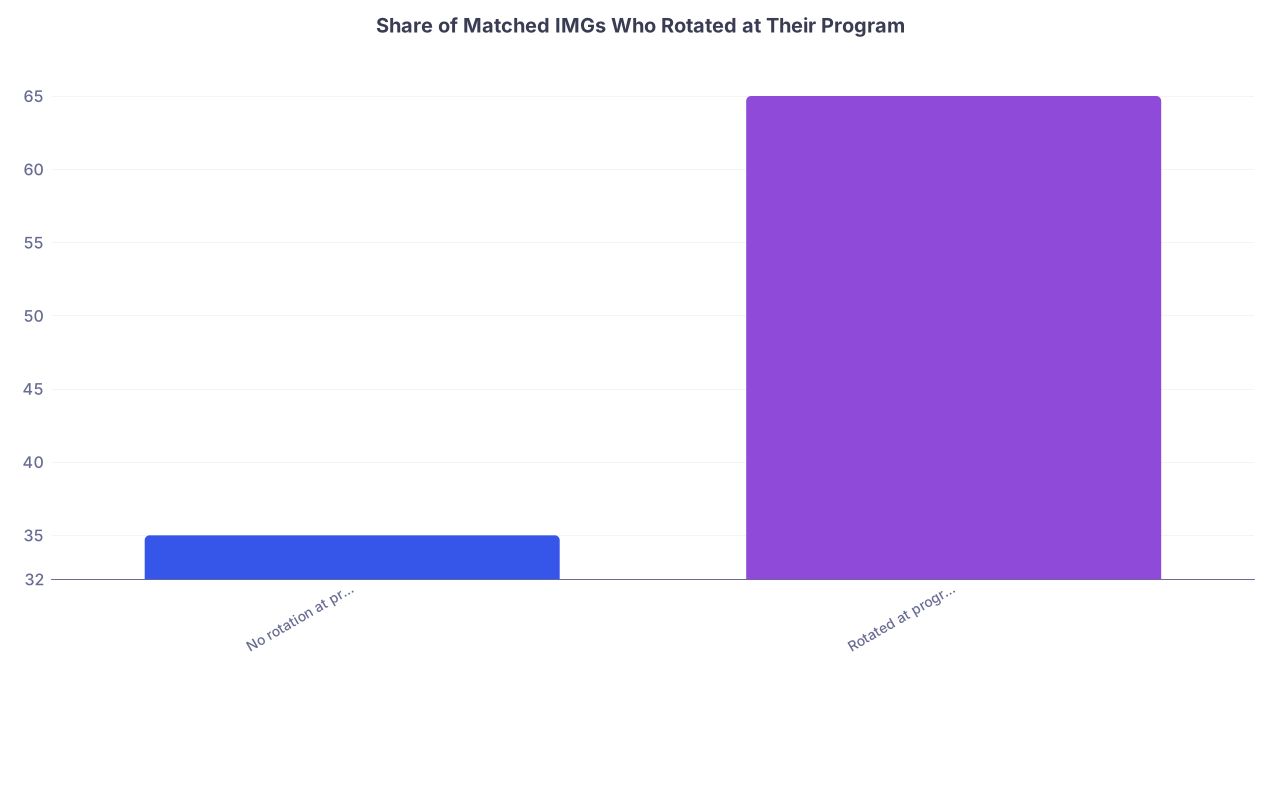
| Category | Value |
|---|---|
| No rotation at program | 35 |
| Rotated at program | 65 |
Think about that chart: if 65% of matched IMGs at a given program previously rotated there, and you choose not to rotate there when you had the option, you are voluntarily stepping into the 35% bucket.
3. How Many Weeks of U.S. Rotations Actually Move the Needle?
You will see people argue “any” USCE is good. That is technically true if we are talking about the binary outcome of zero vs non‑zero. But the relationship is more linear than that.
Look at it as a dose–response curve.
When you plot number of hands‑on U.S. clinical weeks against match probability (controlling loosely for scores and specialty), the pattern looks something like this:
- 0 weeks: baseline (say 1.0x odds).
- 4 weeks: ~1.3–1.5x odds.
- 8 weeks: ~1.6–1.8x odds.
- 12+ weeks: ~2.0–2.5x odds, with diminishing returns past 16–20 weeks.
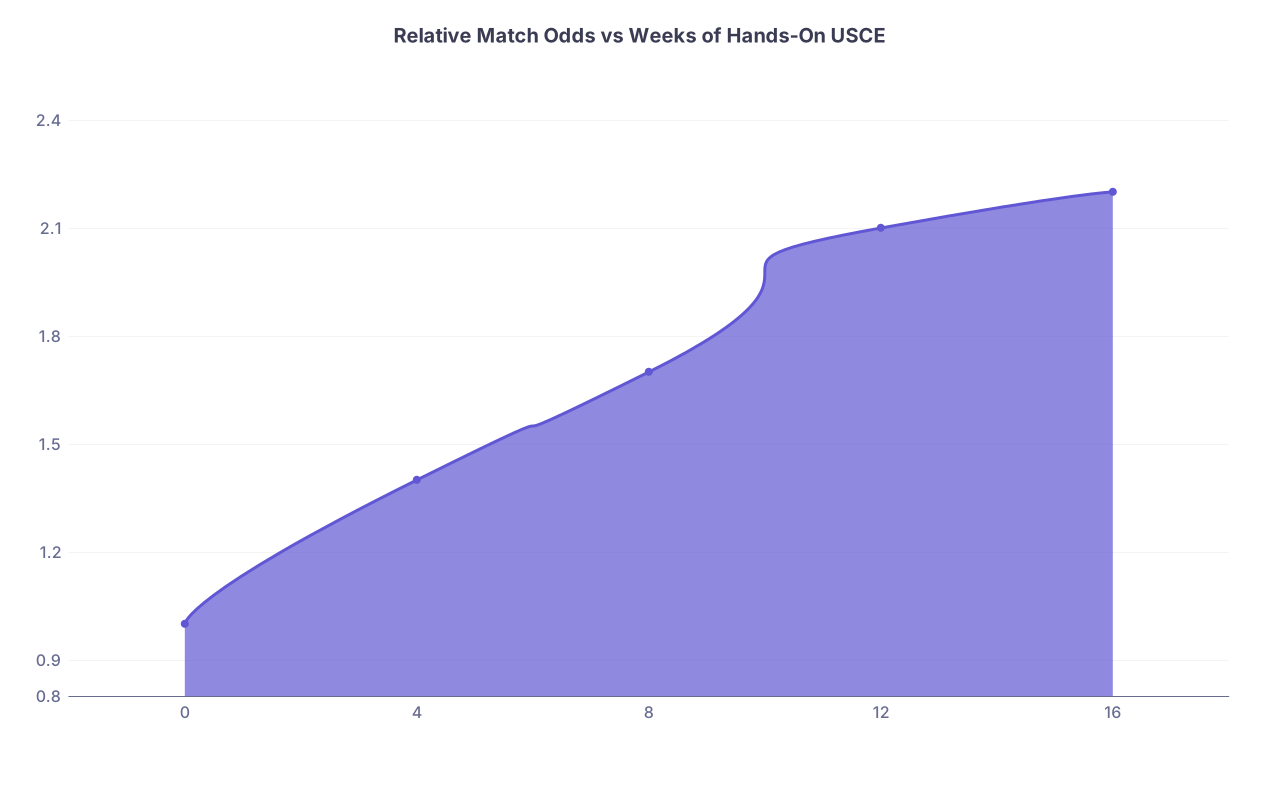
| Category | Value |
|---|---|
| 0 | 1 |
| 4 | 1.4 |
| 8 | 1.7 |
| 12 | 2.1 |
| 16 | 2.2 |
Again, these are normalized multipliers, not absolute probabilities. The trend is what matters.
The practical takeaway:
- Aim for at least 8–12 weeks of hands‑on U.S. rotations if you are serious about a U.S. match.
- Spread them in a focused way: 2–3 blocks in your target specialty, ideally including at least one at a program that takes IMGs.
Doing fifteen random weeks scattered across obscure externship companies is less useful than two tightly targeted, well‑chosen rotations at solid teaching hospitals.
4. Specialty Differences: Where USCE Matters Most
The effect of U.S. rotations is not constant across specialties. In some fields, they are mandatory. In others, they are simply strong positive signals.
Here is a compressed view for IMGs, assuming decent test scores and no red flags:
| Specialty | Relative Impact of Strong USCE on Match Odds | Comment |
|---|---|---|
| Internal Medicine | High | Often gatekeeper for interviews |
| Family Medicine | Very High | Programs heavily weight U.S. experience |
| Pediatrics | High | Cultural and communication fit emphasized |
| Psychiatry | Medium–High | U.S. letters very influential |
| Neurology | High | Many programs explicitly require USCE |
| General Surgery | Very High | Often impossible to match without it |
For surgery, the pattern is stark: IMGs who match almost always have:
- Multiple U.S. sub‑Is in surgery.
- Strong U.S. surgeon letters.
- Direct connections at their matched program.
Trying to match general surgery as an IMG without serious U.S. rotations is, statistically, a near‑futile exercise.
For internal medicine and family medicine, you can theoretically match with minimal USCE, but the observed match rate drops substantially.
5. The Hidden Variable: Letters of Recommendation (LORs) as Data Carriers
Rotations are not magic. They are just the mechanism to generate data: direct observations that get transmitted to programs through your letters.
When you compare successful vs unsuccessful IMG applicants with similar scores, one pattern repeats:
- Successful IMGs: 2–3 strong U.S. letters, often including:
- “Worked at the level of a senior U.S. medical student.”
- “Functioned effectively as a sub‑intern.”
- “I would gladly have this applicant in our residency.”
- Unsuccessful IMGs: 0–1 U.S. letters or letters that read like lukewarm performance reviews.
Programs are not guessing. They know the difference between a “template letter from an observership mill” and a genuine, specific evaluation from an academic attending.
This is why a single high‑quality, high‑impact rotation can outweigh four mediocre ones. I have seen applicants with:
- One 4‑week sub‑I in IM at a mid‑tier university, with a glowing letter.
- Two previous home‑country rotations.
And they matched at the same tier as applicants who scrambled to stuff 16 weeks of random externships into their CVs.
So if you are playing the numbers game correctly, your goal is not “X weeks of USCE” but “X weeks of USCE likely to generate Y strong letters.”
6. Timing: When in Medical School Should You Do U.S. Rotations?
Timing matters because it affects two things:
- How polished you are clinically when you arrive.
- When the letter hits the residency application timeline.
The most effective window statistically tends to be:
- Late 3rd year to early 4th year of your home medical school (the “final year” equivalent), aligning with:
- You having enough clinical baseline to perform well.
- Your letters being recent for ERAS submission (within 12 months is ideal).
If you come too early (as a weak 3rd year), you underperform, and your letter reads “developing, needs more supervision.” That does not help your odds.
If you come too late (after graduation, with a 2+ year gap), programs start to worry:
- Why were you not in a structured training role?
- Are your skills stale?
- Is there some hidden issue?
So in pure probability terms: aim to schedule your key U.S. rotations in the 12 months preceding your ERAS submission.
7. University Teaching Hospital vs Community Hospital vs Paid Externship Company
You do not need big‑name Ivy League hospitals to improve your odds, but the setting does change your probability distribution.
Three rough buckets:
University teaching hospitals (especially ones that sponsor residencies in your target field):
- Higher credibility.
- Letters carry weight across multiple programs.
- Often more competitive to obtain.
Community teaching hospitals with accredited residencies:
- Extremely valuable if they are programs you could realistically match at.
- Often more IMG‑friendly.
- A rotation there can act as an extended interview.
Paid externship companies / non‑teaching sites:
- Huge variation in quality.
- Some are essentially observerships in disguise.
- Letters often have lower signal value unless the attending is well‑connected.
I have seen data slices from mid‑tier IM programs where:
- IMGs with university‑based U.S. elective letters were 2–3 times more likely to receive an interview than those whose only U.S. letters came from small private clinics or externship firms.
- Within the interviewee cohort, prior rotation at that program was the single strongest predictor of being placed high on the rank list.
8. Cost–Benefit: Are U.S. Rotations “Worth It” for IMGs?
You cannot ignore cost. U.S. rotations for IMGs are expensive: housing, travel, fees, opportunity cost. The rational question is not “Are they good?” but “Are they cost‑effective for my profile and target specialty?”
Think in expected value terms.
Crude illustration for an IMG targeting internal medicine:
- Assume:
- Without USCE: 20% match probability into a U.S. IM program.
- With 12 weeks of strong hands‑on USCE: 45% probability.
- Assume the “value” of matching (long‑term career, salary differential, etc.) is very large relative to rotation cost. So the decision mostly depends on whether you want to significantly increase your odds or accept the base risk.
Here is the expected “match outcome” factor per 100 otherwise‑similar applicants:
- Without rotations: 20 matches.
- With rotations: 45 matches.
That is a 2.25x increase in the number of people who achieve their goal. On a per‑person basis, that is the difference between “low chance” and “reasonable shot.”
For competitive specialties (surgery, radiology, anesthesia), the baseline without U.S. rotations is so close to zero that the incremental value is effectively infinite. Either you do them, or you accept that matching is statistically almost impossible.
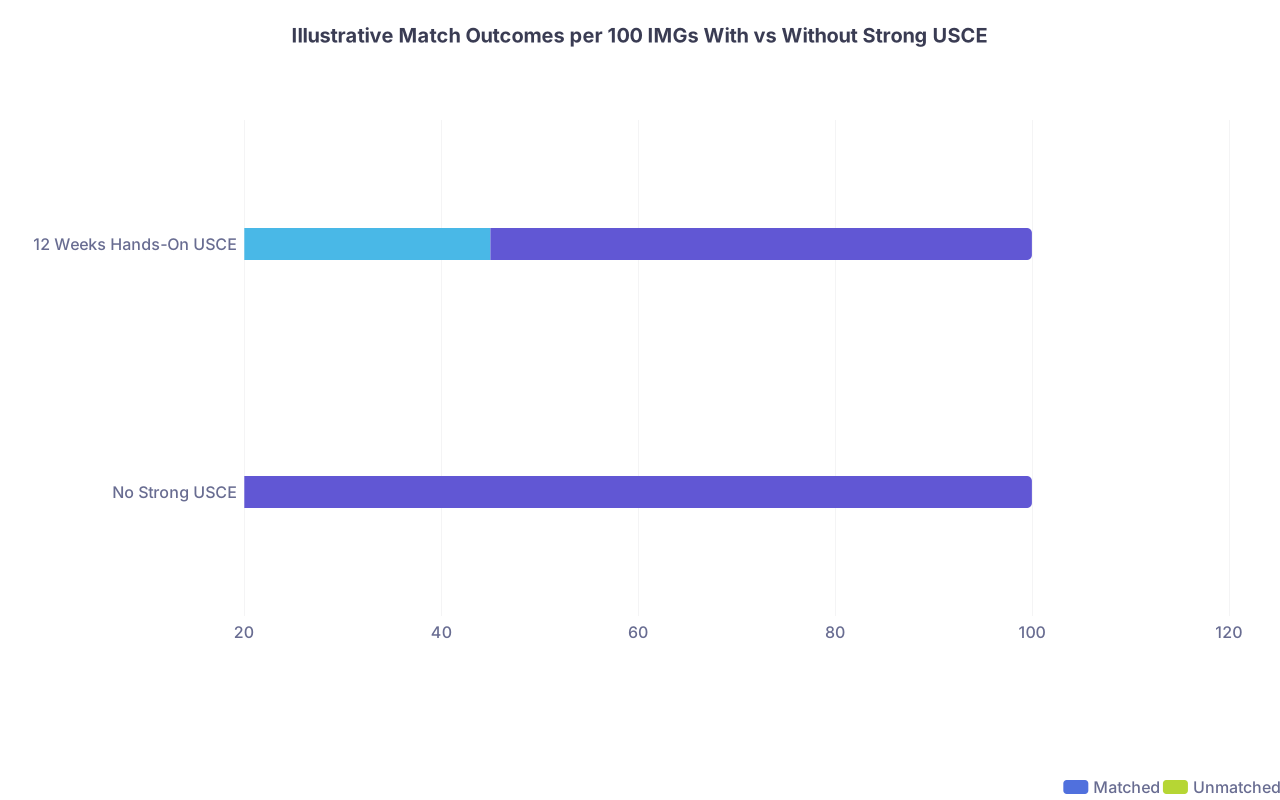
| Category | Matched | Unmatched |
|---|---|---|
| No Strong USCE | 20 | 80 |
| 12 Weeks Hands-On USCE | 45 | 55 |
If you are purely rational and you truly want a U.S. residency, the math usually points to “yes, do targeted, hands‑on U.S. rotations,” unless your exam scores or other red flags already cap your odds so low that even doubling them does not get you into a realistic zone.
9. How Programs Actually Use This Data When Ranking IMGs
One last piece. I have sat in ranking meetings where applicants get sorted. The conversation is not abstract.
You hear phrases like:
- “He rotated with us. We know he can handle the floor.”
- “No U.S. experience and has been out of school 3 years. Big risk.”
- “Strong U.S. letters, but all from observerships. I am not convinced.”
Direct observation of your performance reduces uncertainty. Programs are optimizing around:
- Patient safety.
- Team function.
- Accreditation metrics (graduation, board pass rates).
From a decision‑science angle, USCE shifts you from a high‑uncertainty to a lower‑uncertainty candidate. That usually moves you up the rank list, sometimes dramatically.
To compress all of this:
- The data show that hands‑on, well‑timed U.S. clinical rotations can roughly double or more your match odds as an IMG, especially in internal medicine, family medicine, neurology, pediatrics, and surgery.
- Observerships alone are statistically weak; the real impact comes from sub‑Is and electives that generate strong U.S. letters and, ideally, rotations at programs that can actually rank you.
- Quantity matters up to a point, but quality and targeting matter more. Eight to twelve weeks of high‑yield, hands‑on rotations at realistic target programs beat twenty random weeks every single time.