The brutal truth: once you pick an international medical school, the game gets harder—but it is absolutely still winnable if you treat this like a long, disciplined campaign instead of a vague dream.
You are not “ruined” by going to an international school. You are ruined by drifting through an international school without a plan tailored for the U.S. Match.
I have watched people from Caribbean schools, Eastern Europe, Asia, and the Middle East match into solid U.S. programs in internal medicine, family, peds, psych, even anesthesia and EM. I have also watched others with similar brains and similar schools crash out because they were sloppy, late, or delusional about competitiveness.
This article is for you if:
- You are committed (or basically locked in) to an international medical school
- You want to maximize your chances to match in the U.S. on the first try
- You are willing to work significantly harder than the average U.S. MD student
Let me walk you through how to approach this like a professional, not a hopeful tourist.
1. Understand the Battlefield: What You Are Up Against
Before solutions, you need a clear picture of reality. Otherwise you train for the wrong war.
How programs actually see international grads
Program directors in the U.S. roughly place applicants into four buckets:
- U.S. MD
- U.S. DO
- International medical graduates (IMGs) – non-U.S. citizens
- U.S. international medical graduates (U.S.-IMGs) – U.S. citizens at foreign schools
That last group—U.S.-IMGs—is likely you. It is the hardest route other than non‑U.S.-IMGs with visa issues.
The problem is not that you are international. The problem is:
- Programs know many international schools have weaker clinical training
- They have seen wildly variable quality in students from the same foreign school
- They already have more U.S. MD/DO applicants than spots
So you are starting from a trust deficit. Your entire plan is about fixing that trust deficit with:
- Objective proof (USMLE scores, strong letters, U.S. clinical performance)
- Clear professionalism (no red flags, no sloppiness, no missed emails, no drama)
- A realistic strategy (target specialties and programs that actually take IMGs)
Where IMGs realistically match
If you are locked into an international school, you need to think in tiers.
| Specialty | IMG-Friendly Level | Typical USMLE Step 2 CK Targets* |
|---|---|---|
| Internal Medicine | High | 230–245+ |
| Family Medicine | Very High | 220–235+ |
| Pediatrics | Moderate–High | 225–240+ |
| Psychiatry | Moderate–High | 230–245+ |
| Neurology | Moderate | 230–245+ |
*These are not cutoffs; they are rough ranges that stop your application from getting auto-filtered at most mid-tier places.
Can IMGs match surgery, ortho, derm, ENT, plastics? Rarely. It happens, but those are lottery tickets, not strategies.
If you are already locked in, your mindset has to be:
- Plan for a realistic specialty (IM/FM/Peds/Psych/Neuro)
- If you later become a superstar with insane scores and research, you can reassess
- Do not build your whole plan around being the 1% outlier
2. Fix Your Foundation Before Matriculation (or Immediately If You Already Started)
If you are premed and about to start at an international school, you have a small advantage: you can front-load certain things.
If you are already in school, do a modified version of this starting now.
Step 1: Study the NRMP and program data like a hawk
You need data, not vibes. Before you start school (or now), spend a few hours with:
- NRMP “Charting Outcomes in the Match” for IMGs
- NRMP “Program Director Survey” (latest version)
- FREIDA (AMA’s program database)
Make a simple one-page reference for yourself:
- Specialties you are willing to pursue
- Average Step 2 CK scores for matched IMGs in those fields
- Average number of programs applied to
- Percentage of IMGs in those specialties
Now your entire med school strategy is anchored to numbers, not hope.
Step 2: Build USMLE awareness from Day 1
International schools vary wildly in quality of basic science teaching. Some are fantastic. Many are chaotic. You cannot rely on them to keep you USMLE-ready.
From the first semester, you should:
- Use a USMLE-focused resource alongside your class materials (Boards & Beyond, Pathoma, or equivalent)
- Annotate First Aid or an equivalent resource while you learn, not 6 months before Step 1
- Do a small number of USMLE-style questions early (Kaplan, Amboss, or UWorld later)
Goal in preclinical:
- Pass your school exams
- Gradually align your knowledge to USMLE style
- Avoid failing any course. A single failure is a yellow flag; multiple is red.
Step 3: Set a concrete score strategy early
Step 1 is pass/fail. Step 2 CK is your main weapon.
Your internal rule should look like:
- “If I cannot realistically hit a Step 2 CK ≥ 235–240, I may need to recalibrate specialty or timing.”
That does not mean you are doomed if you do not. But you should treat that range as your baseline target.
So from the start you are not studying “to pass school.” You are studying “to crush Step 2 CK later.” Big difference in how you take notes, how you review, and how seriously you treat weak topics.
3. Turn Your Preclinical Years into a USMLE Launcher
Here is the structure that works for most serious IMGs.
Year 1–2 (or first 4–5 semesters, depending on curriculum)
Your weekly system should include:
- Class lectures / mandatory sessions (you cannot fail your school exams)
- 5–6 days a week of dedicated review with:
- A board-oriented video resource (Boards & Beyond, etc.)
- First Aid / equivalent integrated notes
- 10–20 USMLE-style questions 3–4 days per week (not 200; that just burns you out and wastes questions)
Your exam approach:
- 4–6 weeks before each school exam, shift emphasis toward school content
- But always ask: “How does this map to boards?”
Your goals in preclinical:
- No failed courses
- No professionalism strikes (absences, cheating, late assignments)
- A working “board notebook” or digital system by the end of basic sciences
Before Step 1 (if your school still requires it)
Treat Step 1 as high-stakes even though it is pass/fail:
- Many programs quietly ask, “Did this IMG pass Step 1 on the first attempt?”
- A fail is a huge anchor you will drag into every application
Take a dedicated period seriously:
- 6–10 weeks of full-time study if possible
- UWorld as your primary Qbank, completed at least once
- Two NBME practice exams minimum, and do not sit for Step 1 until you are comfortably >10–15 points above passing on practice
This is not because of the score. It is to avoid a fail and to give you a strong foundation for Step 2 CK.
4. Design Your Clinical Years Around One Objective: Strong U.S. Letters
International clinical rotations can be… variable. Surgical ward in a small Eastern European hospital with no EHR is not what a U.S. PD pictures when they hear “third-year medicine.”
Your job is to extract two things from clinical years:
- Solid clinical skills and knowledge
- Strong, credible letters from U.S.-based physicians
Step 1: Understand your school’s clinical structure early
Within your first year, find out:
- Where do core rotations usually happen? (Country? Hospital level?)
- Does the school have affiliated hospitals in the U.S.?
- Does the school support away rotations / electives in the U.S.? If yes, how many weeks and when?
If the answer to U.S. clinicals is “we do not really know,” that is your red flag to start planning independent U.S. rotations (observerships, externships, etc.) early.
Step 2: Plan U.S. clinical exposure as non‑negotiable
You should aim for:
- At least 8–12 weeks of hands-on U.S. clinical experience in the specialty you are targeting, by the time you apply
- At least 2 strong U.S. letters from physicians who know you well and are used to writing letters for residency
If your school provides some U.S. cores or electives:
- Fight to get those in your target specialty and in reasonably reputable hospitals
- Show up like a sub‑I: pre‑round, know your patients, volunteer for presentations, close the loop on tasks
If your school does not provide U.S. rotations:
- Start looking at paid externship/observership programs by mid‑clinical year 3
- Be extremely picky; some are money-grabs. Prioritize:
- Direct patient contact vs pure shadowing
- Faculty who actively teach residents
- Places that have previously written letters for IMGs who matched
5. Make Step 2 CK Your Calling Card
Step 2 CK is now king for IMGs. Your score will decide how many doors even open.
Timing strategy
You want:
- Step 2 CK done before ERAS submission year, with a score you are not ashamed of
- Enough buffer time that a bad practice test can delay your exam without derailing your entire cycle
Backwards plan:
- ERAS opens mid-September (varies slightly)
- Ideal: Step 2 CK score in by August at the latest
- That means exam in June–July
- That means you need to protect 6–8 weeks of real dedicated time near that window
If your school scheduling is chaotic, start negotiating early:
- Shift lighter rotations before Step 2
- Avoid brutal surgical rotations right before dedicated if you can help it
Study approach that works for serious IMGs
Your dedicated period should look something like:
- UWorld, 100% complete, preferably 1.5–2 passes
- NBME practice tests x3–4 (or more, spaced out)
- At least one self-assessment relatively early to confirm you are on the right planet, not just the last week
- A content review source (Online Med Ed, AMBOSS articles, or similar) for weaker systems
Brutal rule:
- If your NBME scores are repeatedly below 220, you are not ready for a June/July exam for a competitive first attempt. Delay if possible, even if that means pushing your Match year. One high score is better than rushing a mediocre one.
6. Build a U.S.-Facing CV While You Study
People massively underestimate how much “small” things matter for IMGs.
Program directors are looking for:
- Evidence that you understand U.S. medicine
- Proof that you are reliable under stress
- Indicators that you will not crumble when confronted with real responsibility
Concrete steps you should consider
During preclinical:
- Join or start a small research project with someone who has U.S. connections if at all possible
- If your school has no research: contact U.S. faculty at institutions in your home region or who have global health interests
During clinical:
- Target at least one project that can realistically become:
- A poster or abstract at a small conference, or
- A case report, or
- A quality improvement (QI) project you can attach to your U.S. rotations
Not all research is equal. A random “retrospective chart review” done poorly is just noise. Two or three small but completed, presentable projects with your name on them look far better than ten unfinished fantasies.
7. Match-Year Tactics: How to Apply Like a Professional, Not a Tourist
By the time you are ready to apply, you will have:
- A Step 2 CK score (and Step 1 pass)
- Clinical evaluations and hopefully 2–3 U.S. letters
- Some research or scholarly activity
- A specialty plan (ideally IM/FM/Peds/Psych/Neuro for most IMGs)
Now you need to execute on ERAS strategically.
Step 1: Ruthless specialty realism
If you are:
- Step 2 CK < 220 and no strong U.S. letters → You should think very hard about delaying or aiming squarely at family medicine with a broad application list.
- Step 2 CK 225–240 → Realistic for IM, FM, Peds, Psych in many places, assuming good letters.
- Step 2 CK > 245 → You will still face IMG bias, but many more doors open.
What you do not do:
- Apply to 50 internal medicine programs and 2 neurosurgery programs and call it a “backup.” Backup specialties need real applications: full sets of letters targeted to that field, genuine interest, and enough programs to matter.
Step 2: Apply broad enough to matter
Most successful IMGs in medicine or family medicine easily apply to:
- 80–150 programs in their main specialty
Yes, that is a lot of money. The alternative is unmatched + another year of lost attending salary.
Your list should include:
- A backbone of community programs and smaller university-affiliated hospitals with known IMG intake
- Some regionally less popular locations (midwest, rural south, etc.)
- A handful of stretch programs if your scores and letters justify it
Find actual IMG-friendly programs:
- Look at current residents on program websites
- Count how many are IMGs, and specifically how many are from schools like yours
- Do not waste half your list on “IMG-friendly” programs by hearsay; confirm visually
Step 3: Personal statement and letters: stop being generic
Personal statement:
- One page. Clean, direct, specific about why you like the specialty and what you will bring.
- Explicitly address your international route without whining. Example:
- “I chose to attend X University in [country] where I gained exposure to resource-limited medicine and culturally diverse patient populations. Recognizing the additional challenge of returning to the U.S. system, I prioritized early U.S. clinical experiences and sought mentors who could prepare me for residency here.”
Letters:
- You want at least two from U.S. physicians in your specialty.
- Those letters should not be lukewarm “the student was present and passed.” You want:
- “I would rank this student in the top 10–20% of all students I have supervised.”
- Specific examples of your work ethic, reliability, and clinical reasoning.
If you spent an entire U.S. rotation invisible in the back, you will not get those letters. During rotations, behave like someone who knows their whole career depends on this few-week window—because it does.
8. Interview Season: Convert Invitations into Contracts
Interview invites are not guaranteed, even with solid numbers. When they do come, you have to close.
Before interviews
- Practice out loud. Not in your head. With another person or at least recording yourself.
- Prepare succinct answers to:
- “Why this specialty?”
- “Why did you attend an international medical school?”
- “Why should we trust that you will adapt to our healthcare system?”
- “Tell me about a time you had to adapt quickly / handle limited resources / work with diverse teams.”
Be direct about your school but controlled:
- Do not trash your school (red flag)
- Do not oversell it as Harvard-on-a-beach (delusional)
- “The curriculum gave me X Y Z experiences. I recognized I would need additional U.S. exposure, so I did A B C to close that gap.”
During interviews
You want every interviewer to walk away thinking:
- “This person knows exactly what they are walking into.”
- “They seem low-risk: they show up, they work hard, they are not dramatic.”
- “I could hand them a list of notes and be confident they will follow through.”
You demonstrate that by:
- Knowing your own application cold; no fumbling on dates, gaps, projects
- Having a crisp story about transitions (why this school, why this specialty, why U.S.)
- Asking specific, grounded questions about teaching, patient population, and resident responsibilities (not “do you have research?” said in a vague way)
9. Contingency Planning: If You Miss the First Match
You are playing a long game. Sometimes even strong applicants miss the first time due to bad luck, bad location preference, or overreach.
If you do not match, your year cannot be a vague “research year.” It must be intentional repair work.
Priorities:
- Strengthen Step portfolio if possible (e.g., if CK was mediocre and you think you underperformed practice scores, consider a measured plan to retake if rules allow and if it will clearly be better—this is rare and must be considered carefully).
- Get sustained U.S. clinical experience: full-time research with clinic time, or a long-term externship, or a non-resident clinical role where you still see patients and get letters.
- Fix obvious holes: weak letters replaced, personal statement rewritten, apply to more IMG-friendly programs, broaden geography, and specialize realistically.
What you cannot do:
- Sit in your home country running a private clinic with zero U.S. contact, then apply again with an identical application and expect a different outcome. Program directors see that pattern every year. They rarely reward it.
10. Practical Timeline: If You Are Early in the Process
To make this less abstract, here is a rough “if I were you” roadmap for a U.S. citizen locked into an international school, planning for internal medicine.
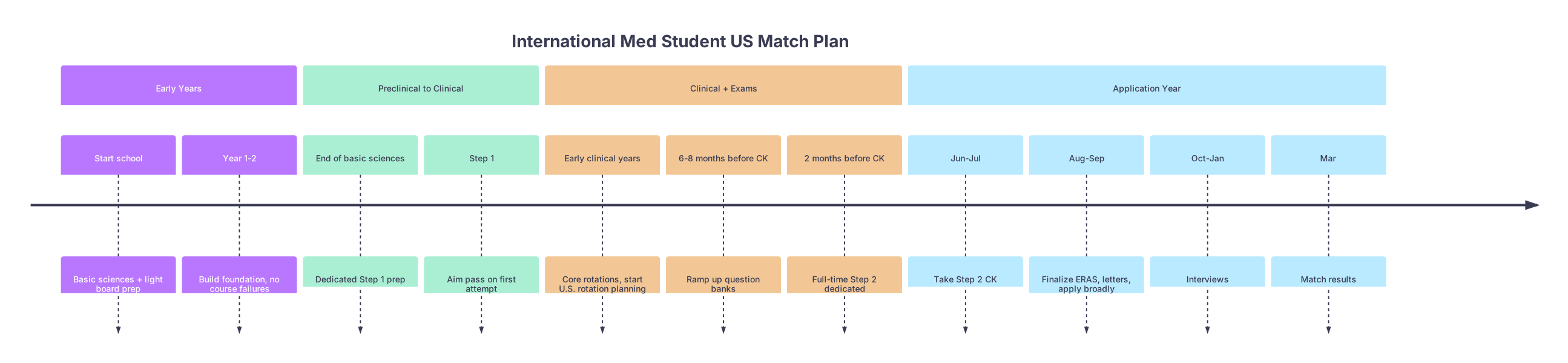
| Period | Event |
|---|---|
| Early Years - Start school | Basic sciences + light board prep |
| Early Years - Year 1-2 | Build foundation, no course failures |
| Preclinical to Clinical - End of basic sciences | Dedicated Step 1 prep |
| Preclinical to Clinical - Step 1 | Aim pass on first attempt |
| Clinical + Exams - Early clinical years | Core rotations, start U.S. rotation planning |
| Clinical + Exams - 6-8 months before CK | Ramp up question banks |
| Clinical + Exams - 2 months before CK | Full-time Step 2 dedicated |
| Application Year - Jun-Jul | Take Step 2 CK |
| Application Year - Aug-Sep | Finalize ERAS, letters, apply broadly |
| Application Year - Oct-Jan | Interviews |
| Application Year - Mar | Match results |
11. Side Details That Quietly Matter
Little things accumulate and either help or hurt you.
- Email professionalism: No late or sloppy replies to programs, coordinators, or faculty.
- Social media: Yes, they sometimes scan. If there is anything wild, lock it down.
- Documentation: Keep copies of every evaluation, every certificate, every project. Lost paperwork has killed more than one IMG’s application.
- Visa status (if non-U.S. citizen): Plan early whether you will need J-1 vs H-1B; target programs that sponsor your type.
12. The Mental Game
You will see U.S. students who appear to do half the work and get twice the results. You cannot let that poison you.
Your reality:
- You chose or accepted a harder path.
- You do not get bonus points for complaining about it.
- You do get massive leverage by out-preparing most of your competition.
The IMGs who match are not always the smartest. They are the ones who:
- Start early
- Avoid self-inflicted wounds (failed exams, scattered applications, unrealistic specialty choices)
- Treat every rotation, every email, every exam like it matters—because for them, it does.
Final Takeaways
- Being locked into an international school is not a death sentence, but it demands a deliberate, data-driven plan focused on Step 2 CK, U.S. clinical experience, and IMG-friendly specialties.
- You must aggressively control what you can: no school failures, serious board prep from Day 1, 8–12 weeks of U.S. rotations, and strong U.S. letters that vouch for your reliability and performance.
- Apply like a professional: realistic specialty choice, broad program list, tailored personal statement, and disciplined interview prep—then be ready with a concrete contingency plan if the first Match does not go your way.