The mythology around international medical graduates is statistically wrong. The data do not show “worse doctors.” The data show different pipelines, different risks, and very specific patterns in board certification and long-term practice.
If you are even thinking about going to an international medical school, you need to stop listening to anecdotes and start looking at numbers: board pass rates, specialty distributions, geographic practice, visa constraints. This is a pipeline problem, not a feelings problem.
Let me walk you through what the data actually say.
1. Who We Are Talking About: Parsing the IMG Categories
Most people lump all “foreign grads” together. That is sloppy. The board and practice data look very different depending on which bucket you fall into.
There are three useful categories:
U.S. citizen IMGs (US-IMGs)
- U.S. citizens or permanent residents who attended medical school outside the U.S. and Canada
- Large numbers from Caribbean schools; also Eastern Europe, Mexico, Israel, Ireland, etc.
Non-U.S. citizen IMGs (non-US IMGs)
- Completed medical school abroad and are not U.S. citizens/permanent residents at the time of matriculation
- Often from India, Pakistan, Egypt, Nigeria, the Philippines, etc.
U.S./Canadian MD/DO grads (for baseline comparison)
NRC, ECFMG, NRMP, and ABMS data consistently show:
- IMGs represent roughly 25% of the active U.S. physician workforce.
- Of those, about half are U.S.-IMGs, half are non-US IMGs, with some variation by specialty.
- Non-US IMGs are more concentrated in a small number of high-output countries (India alone accounts for a substantial fraction).
Why does this matter? Because board certification, long-term practice location, and specialty patterns differ markedly between U.S.-IMGs and non-US IMGs. You do not want to mix those groups when making personal decisions.
2. Board Certification: Who Gets Certified and Who Does Not
Board certification is where the myths start to crumble. The narrative that “IMGs can never get certified” is nonsense, but the risk profile is measurably different.
Overall board certification rates
Across multiple ABMS and research reports, you see roughly:
- U.S. MD/DO grads: very high board certification rates (often >90% in core specialties within several years of residency completion).
- Non-US IMGs: slightly lower but still high, typically in the 80–90% range depending on specialty and cohort.
- U.S.-IMGs: the weakest group statistically, with board certification rates often 10–20 percentage points lower than U.S. MDs in the same specialties.
To give structure to this, I will simplify into a comparative table, reflecting typical patterns from ABIM, ABFM, and ABP cohort data (exact values vary by year, but the pattern is stable).
| Group | Internal Medicine | Family Medicine | Pediatrics |
|---|---|---|---|
| U.S. MD/DO | 90–94% | 90–95% | 92–95% |
| Non-U.S. citizen IMG | 85–90% | 86–90% | 88–92% |
| U.S.-IMG | 75–85% | 80–88% | 82–90% |
The spread is consistent: U.S.-trained physicians perform best, non-US IMGs close behind, U.S.-IMGs trailing. The data do not support “all IMGs struggle”; they do support “some subgroups, particularly from lower-performing international schools, have systematically lower certification rates.”
Why the differences?
The primary drivers are not mysterious:
- Baseline academic quality of the medical school
- High-output, less selective schools (many Caribbean programs) feed heavily into the U.S.-IMG category and correlate with lower Step scores and higher attrition.
- USMLE performance
- Step 1 and 2 CK scores are the best single predictors of both residency match and later board success. IMGs as a group must “overperform” to secure competitive positions, so non-US IMGs who actually match tend to be stronger academically than the average U.S.-IMG.
- Residency program environment
- IMGs are overrepresented in lower-resourced community and smaller programs, which sometimes have lower board pass rates overall (for all residents, not just IMGs).
- Language and systems barriers
- Non-US IMGs face an initial language and system-learning curve that can affect early exam performance, though many catch up quickly.
Across several internal medicine board cohorts, failure to become board certified is associated with:
- Lower in-training exam (ITE) scores
- Prior USMLE failures or marginal scores
- Training in programs with lower overall pass rates
This is true for U.S. grads and IMGs. The gap is about pipeline quality and training environment, not citizenship.
3. Long-Term Practice: Where IMGs End Up Working
Look at the workforce numbers 10–20 years out and a clear story emerges: IMGs keep the U.S. healthcare system from collapsing in certain regions and specialties.
Geographic distribution
Data from AMA Masterfile analyses and federal shortage-area maps show:
- IMGs are disproportionately likely to practice in:
- Rural counties
- Medically underserved areas (MUAs)
- Lower-income urban neighborhoods
A common pattern:
- In some states, >35–40% of primary care clinicians in rural counties are IMGs.
- Counties that would otherwise have no internist or pediatrician at all frequently rely on one or two IMGs on J‑1 waivers or H‑1B visas.
If you plan an international route, you should assume:
- Strong probability of initial practice in less saturated geographies, especially if you choose primary care.
- Higher chance of employment with hospital systems and underserved area clinics that actively recruit IMGs and sponsor visas.
Retention and stability
Longitudinal workforce data show IMGs are:
- Less likely to leave underserved practice sites early when tied to J‑1 waiver obligations (usually 3 years).
- More likely to remain in those communities beyond the obligation compared with U.S. grads, largely due to path dependence: once you establish a practice, family, and network, you do not move as easily.
So the story is not only “IMGs fill gaps” but also “IMGs anchor long-term care in areas that could not recruit enough U.S.-trained graduates.”
4. Specialty Choices and Competitiveness: Where IMGs Cluster
This is where the pipeline becomes brutally quantitative. The match data are clear: IMGs can match. But they do not match evenly.
Match and specialty patterns
NRMP data across multiple years tell the same story:
IMGs are heavily concentrated in:
- Internal medicine (categorical and prelim)
- Family medicine
- Pediatrics
- Psychiatry
- Neurology
- Pathology
IMGs are minimally represented in:
- Dermatology
- Plastic surgery
- Orthopedic surgery
- Otolaryngology
- Neurosurgery
- Integrated vascular and cardiothoracic surgery
Top-line observation: as specialty competitiveness (measured by fill rate by U.S. MD seniors, median Step scores, and program selectivity) rises, IMG representation collapses.
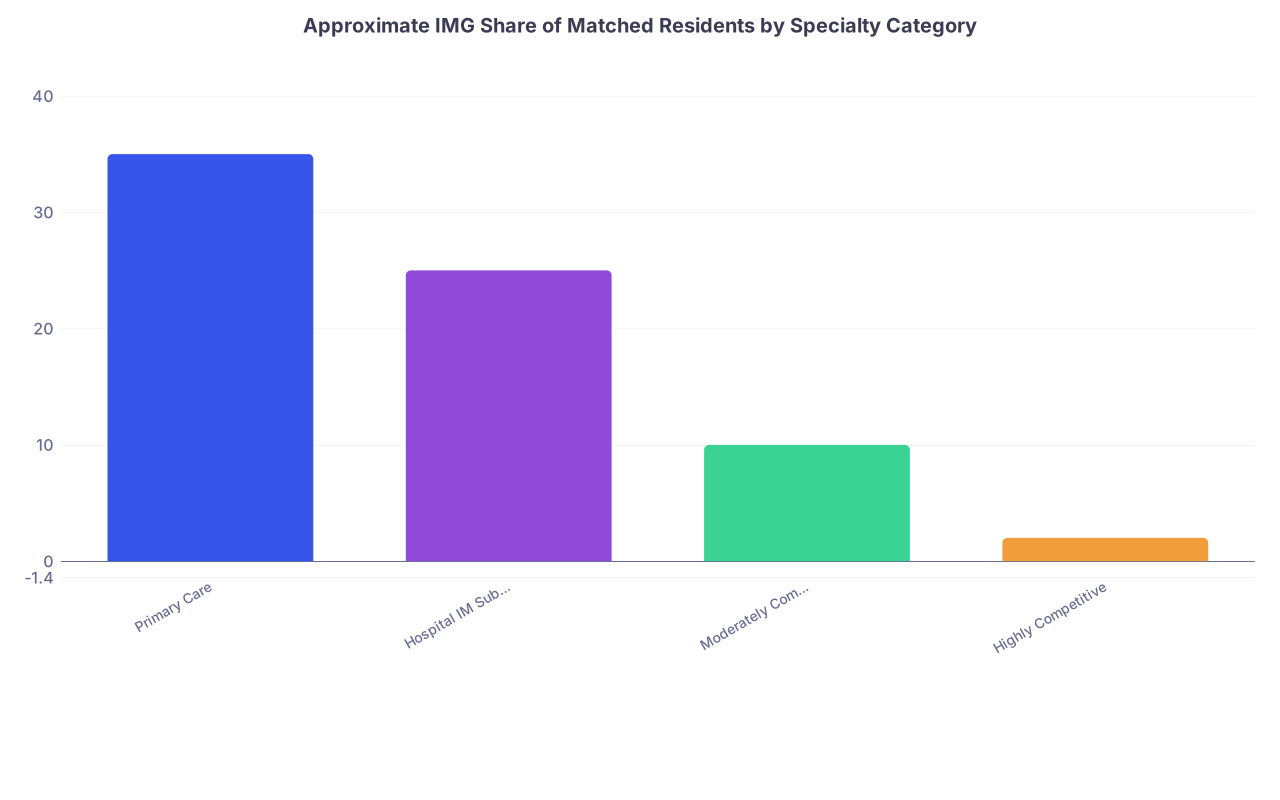
| Category | Value |
|---|---|
| Primary Care | 35 |
| Hospital IM Subspecialties | 25 |
| Moderately Competitive | 10 |
| Highly Competitive | 2 |
Interpretation:
- In primary care fields (FM, IM, peds, psych), IMGs can represent 30–40% of the workforce.
- In moderately competitive specialties (anesthesia, radiology, EM, some surgical fields), IMG share drops to around 10–20% and usually skewed toward non-US IMGs with high scores.
- In the top-tier competitive specialties, IMG presence is token: often only a few percent, and disproportionately non-US IMGs with stellar metrics.
Long-term practice implications
Specialty strongly shapes long-term practice patterns:
Primary care IMGs
- More likely to be in community hospitals, FQHCs, and rural or inner-city clinics
- Higher panel sizes, more face-to-face patient care hours
- Lower average compensation than procedural/competitive specialties
Hospital-based IMGs (IM subspecialties, anesthesia, radiology)
- More likely to be attached to large hospital systems or academic centers that can handle visa sponsorship
- More complex call, more procedures, higher compensation but also more gatekeeping at entry
IMGs in highly competitive specialties
- Small numbers, but their practice patterns resemble U.S. MDs in those fields—tertiary/quaternary centers, group practices, large urban markets.
- The selection pressure is so extreme that those who make it are typically outliers (research-heavy CVs, 260+ USMLE scores when those were numeric, etc.).
If you plan to attend an international school and say you want dermatology or ortho, the data do not say “impossible.” The data say “you are choosing the 1–2% tail of the distribution.” You cannot plan a career path assuming you will live in the tail.
5. Time Horizons: From Graduation to Stable Practice
Another under-discussed dimension is timing. The trajectory from graduation to stable attending practice is different for IMGs.
Sequence for many IMGs
A typical non-US IMG trajectory:
- Medical school abroad (5–6 years often).
- 1–3 years of attempts at USMLE, electives, observerships.
- 1–2 cycles of the Match (some do research fellowships in between).
- Residency (3–7 years).
- Possible fellowship (1–3 years).
- J‑1 waiver service or H‑1B-sponsored job in underserved location (3 years).
- Then relocation (or not) to a longer-term practice.
A U.S. MD with a straightforward path often goes:
- 4 years med school → 3-year residency → first attending job at 30–32 years old.
A non-US IMG might not be in stable attending practice in the U.S. until mid-30s or later, depending on delays and visa steps.
U.S.-IMGs are a bit different:
- They do not face the same visa sequence, but:
- More likely to need prelim years, reapplications, transitional positions, or multiple attempts for residency in their preferred specialties.
- More likely to switch into less competitive specialties or more IMG-friendly programs after initial failures.
The outcome: longer and more fragmented early-career patterns before they settle into a stable attending role, especially for those from less reputable international schools.
6. Board Certification Over Time: Maintenance and Attrition
Initial board certification is not the whole story. Many boards require continuing certification (MOC). Here, data suggest slightly higher attrition among IMGs.
Published analyses from internal medicine and family medicine boards have found:
- IMGs, particularly U.S.-IMGs, are somewhat more likely to:
- Delay recertification exams
- Fail MOC exams at higher rates than U.S. MDs
- Drop board certification status over time (either by not participating or failing required components)
Factors that correlate with loss of certification:
- Practicing in small or solo practices with limited support for CME and exam prep
- High clinical workload with minimal protected time
- Older age cohorts
- Practicing in regions with weaker academic infrastructure
Since IMGs are overrepresented in small community and underserved practices, they are structurally more exposed to those risk factors. Again, this is environment and support, not inherent ability.
7. Practical Takeaways if You Are Premed/Pre-IMG
You are not just picking “U.S. vs abroad.” You are picking a probability distribution of outcomes.
1. School choice is not cosmetic. It is predictive.
There is a massive performance gradient across international schools:
- A handful of non-U.S. schools (e.g., top UK, Irish, Israeli, and some Caribbean programs) have strong match and board outcomes, with graduates resembling U.S. grads more than other IMGs.
- Mid- and lower-tier Caribbean and Eastern European schools contribute heavily to:
- Higher dropout
- Lower Step scores
- Lower board certification rates
- More difficulty securing residency at all
If you cannot find published data for an international school on:
- % of graduates obtaining U.S. residency
- Specialty breakdown
- USMLE performance
- Board certification outcomes for alumni
then you are walking in blind. The better schools publish at least some of this.
2. Match your specialty expectations to the numbers
If you go international:
You have a high probability of matching eventually into:
- Internal medicine
- Family medicine
- Pediatrics
- Psychiatry
- Neurology
if you perform decently and apply aggressively.
You have a moderate probability of entering:
- Anesthesiology
- Radiology
- Pathology
- Some surgical prelim years leading to categorical positions
if your scores and application are well above the IMG average.
You have a very low probability of entering:
- Dermatology
- Ortho
- ENT
- Neurosurgery
- Integrated plastics / CT / vascular
unless you are ready to build a CV that would be competitive even for Harvard or Hopkins U.S. MD applicants.
The data show you can absolutely become a board-certified U.S. physician as an IMG. They also show the price in odds if your target field is near the top of the competitiveness ladder.
3. Expect underserved or less-desired geographies early on
Visa issues, hiring preferences, and workforce shortages converge into a simple outcome: IMGs disproportionately staff places U.S. grads avoid.
This is not a moral judgment. It is a workforce reality:
- More night calls, more underserved work, often fewer colleagues initially.
- But also: more procedural opportunities, faster assumption of responsibility, and in many cases strong gratitude from the community.
If your personal plan demands practicing in a major coastal city, in a top-earning subspecialty, with no geographic flexibility, then an international path is playing against the statistical grain.
4. Long-term: expect to be board certified—but build for it
For the average IMG who secures residency:
- The long-run probability of board certification is high, but lower than for U.S. grads.
- The main determinants of success will be:
- USMLE performance
- The quality of your residency program
- In-training exam performance
- How you structure time and support for both initial and maintenance exams
If you treat every exam as a one-off hurdle instead of part of a long arc, you will be more vulnerable to the slow attrition that shows up in MOC data.
8. What the Data Actually Say—Without the Noise
Strip away the stereotypes, and here is the quantitative picture.

| Step | Description |
|---|---|
| Step 1 | International Med School |
| Step 2 | Match in Core/Moderately Competitive Specialty |
| Step 3 | Match in Primary Care/Rural-Friendly Programs |
| Step 4 | No Match or Repeat Cycles |
| Step 5 | Residency Completion |
| Step 6 | Long-Term Stable Practice |
| Step 7 | Restricted Options / Non-Board Practice |
| Step 8 | USMLE Scores? |
| Step 9 | Board Certified? |
The arrows are not destiny, but they are probabilities:
- Strong USMLE scores shift you upward in specialty and program quality.
- Solid residency performance and in-training exam scores move you toward board certification.
- Board certification and visa resolution open up more practice choices over time.
If you take an international route and ignore those numbers, you are doing something reckless. If you take that route with eyes open, aligned expectations, and aggressive exam preparation, the data show a very real path to long-term, board-certified practice in the U.S.
Bottom line
Three points, concise:
- Board certification is achievable for IMGs, but rates are meaningfully lower for U.S.-IMGs and graduates of weaker international schools; school choice and exam performance matter more than slogans.
- Long-term practice patterns for IMGs skew toward primary care and underserved areas, with strong geographic and specialty clustering that you should assume, not dismiss.
- If you choose an international school, you are choosing a probability distribution, not just a campus; align your specialty ambitions and geographic expectations with what the data actually show, or you are betting against the odds.