
The romantic idea that “an MD is an MD” collapses the minute you run the numbers. Financial outcomes for Caribbean vs U.S. MDs are not remotely equivalent, and the data is brutally clear on that point.
This is not a moral judgment about who deserves to be a doctor. It is a hard-nosed look at debt, income, and probability-weighted return on investment (ROI). If you are deciding between a U.S. MD, a Caribbean MD, or walking away and regrouping, you need to think like an investor, not like a motivational poster.
I will walk through three things:
- What graduates actually owe (debt levels and loan types).
- What they actually earn (residency match odds, specialties, long‑term income).
- How those combine into a realistic ROI, including the “ugly tail” risk that most people ignore.
1. Baseline: Who are we comparing?
We are comparing two groups of students aiming to practice in the United States:
- U.S. MD graduates from LCME-accredited U.S. allopathic schools.
- Caribbean MD graduates from the major offshore schools that feed into the U.S. residency market (St. George’s, Ross, AUC, Saba, etc.), plus smaller programs.
The critical distinction is not just geography. It is accreditation, match probability, and loan structure. Those three variables dominate the financial story.
2. Debt Profiles: How much and what kind?
Let us start with debt, because that is the only thing you are guaranteed to get when you start medical school.
U.S. MD debt: high, but predictable and federally backed
Recent AAMC data (class of 2023/2024 range) puts median medical school debt for U.S. MD graduates roughly in the $200k–$220k range, excluding premed/undergrad debt. Include undergrad and you are routinely looking at $250k–$300k total for many students, but I will keep the med-school-only piece separate for clarity.
Key features:
- Mostly U.S. federal loans (Direct Unsubsidized + Grad PLUS).
- Interest rates often 6–8% depending on year of borrowing.
- Eligible for income-driven repayment (IDR) and Public Service Loan Forgiveness (PSLF).
- Extremely high probability of full-time physician income to support repayment, because match rates are high.
Caribbean MD debt: often higher, more variable, and sometimes riskier
Data is messier here, because schools are private, offshore, and less transparent. But from multiple reports, alumni surveys, and financial aid documents, here is the pattern I see repeatedly:
- Tuition over 4 years often exceeds comparable U.S. MD totals.
- Living expenses can be higher than you think (airfare, relocation, dual housing).
- More frequent use of:
- U.S. federal Direct Loans for some schools only (Title IV eligibility).
- Private loans with higher interest and poorer protections.
- Family financing or home equity.
Representative ranges you actually see in practice:
- Many Caribbean graduates land in the $250k–$350k total educational debt range.
- Not rare to see $400k+ when you include undergrad, failed attempts, or extra time.
To make this concrete:
| Pathway | Median Med School Debt | Common Total Debt (Med + Undergrad) |
|---|---|---|
| U.S. MD | $200k–$220k | $250k–$300k |
| Large Caribbean | $250k–$300k | $300k–$400k+ |
| Smaller Caribbean | $250k–$350k | $325k–$425k+ |
The spread is wide, but the direction is consistent: Caribbean MDs, on average, take on more debt with less protection, while carrying more risk of not getting the earnings they expect.
3. Income Side: Match rate is the choke point
All the income modeling for physicians hinges on one thing: matching into a U.S. residency. Without residency, you are not a practicing U.S. physician with attending-level income. You are a person with a very expensive degree and limited licensure options.
So we start with the match.
Match rates: U.S. MD vs Caribbean grads
The NRMP publishes detailed data every year. The pattern is stable:
- U.S. MD seniors consistently match at ~92–94% in the main Match.
- U.S. DO seniors around the high 80s–low 90s.
- Non-U.S. international medical graduates (non‑US IMGs, which is where most Caribbean grads sit) are far lower.
Recent cycles hover roughly around:
- Non-U.S. citizen IMGs: about 58–62% match rate into some PGY-1 position.
- U.S. citizen IMGs (many from Caribbean schools): higher than that group, roughly 60–70%, depending on year and specialty mix.
These are population numbers. Strong Caribbean students with high Step scores and solid clinical evaluations can and do match. But the risk of ending up with no residency is several times higher than for a U.S. MD.
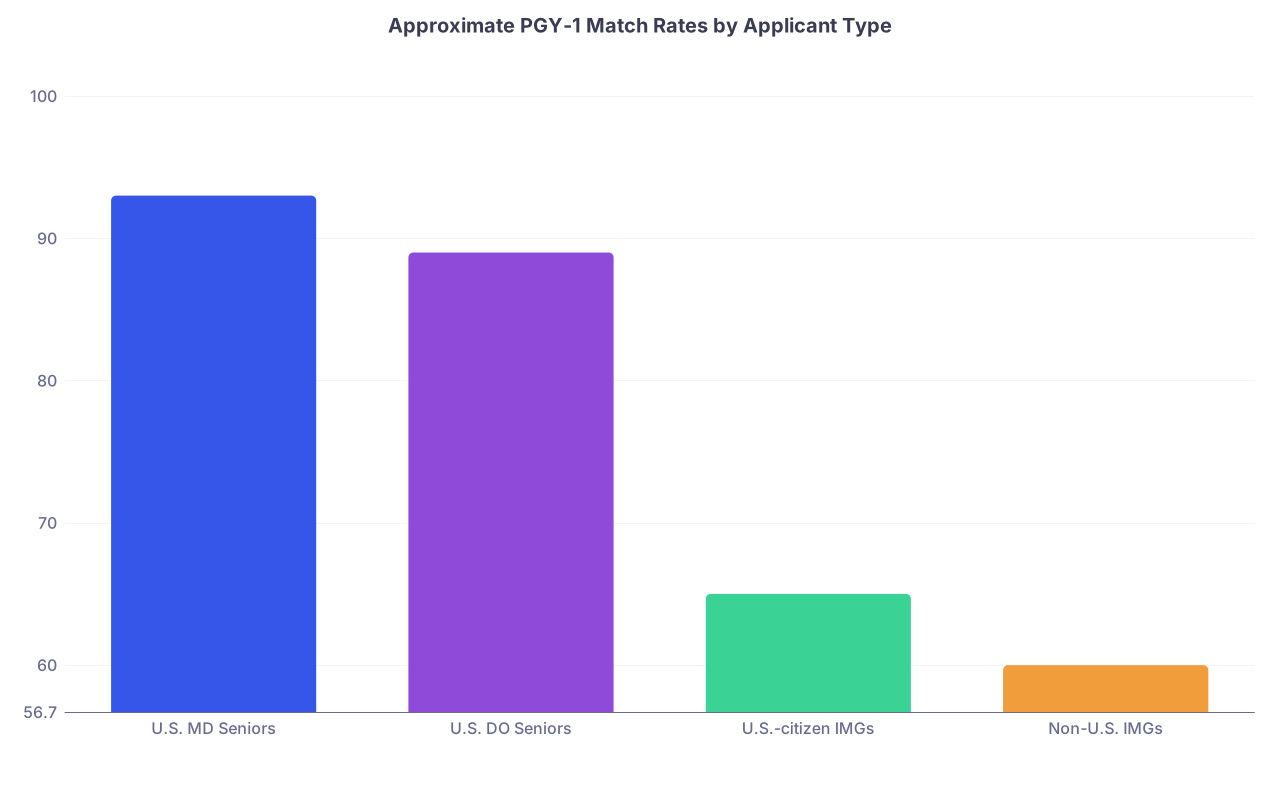
| Category | Value |
|---|---|
| U.S. MD Seniors | 93 |
| U.S. DO Seniors | 89 |
| U.S.-citizen IMGs | 65 |
| Non-U.S. IMGs | 60 |
If you are making a financial decision, you cannot treat those numbers as background noise. You must price that 30+ percentage point gap in match probability directly into your expected ROI.
Specialty distribution and long‑term income
Residency is not binary. The type of residency you match into drives long‑term income.
U.S. MD grads have access to:
- Highly competitive specialties with high lifetime earnings:
- Orthopedic surgery, dermatology, plastic surgery, neurosurgery, radiology, anesthesiology, etc.
- Moderately competitive but still strong-earning fields:
- Emergency medicine, OB/Gyn, general surgery.
Caribbean grads:
- Are heavily concentrated in internal medicine, family medicine, pediatrics, and sometimes psychiatry.
- Rarely match into the most competitive, highest-earning specialties. It happens, but at very low frequencies.
Broad income buckets (in 2023–2024 dollars, approximate national averages):
- Primary care (FM, IM, Peds): $230k–$280k.
- Hospital-focused IM subspecialties, EM, psych: $280k–$350k.
- Surgical and procedural specialties (ortho, GI, cards, derm, radiology, anesthesia): $400k–$700k+.
Average U.S. MD graduate is more evenly distributed across this range. Average Caribbean MD graduate is skewed toward the bottom half.
4. ROI Modeling: Not just “what if I succeed,” but “what if I don’t”
Now to the part people actually care about: am I getting a good financial return?
You can think of this as a probability-weighted net present value (NPV) problem:
Expected ROI = Σ [Probability of Outcome i × (Lifetime Earnings_i − Debt − Cost of Capital)]
That may sound academic. Let me collapse it into practical scenarios.
Step 1: Construct realistic outcome scenarios
For simplicity, assume 3 broad outcomes for each pathway:
For a U.S. MD:
- Match into a primary care / lower‑paying specialty.
- Match into a mid‑tier specialty.
- Match into a high‑earning specialty.
The probability of “no match ever” for a U.S. MD who keeps trying is low enough that, for financial modeling, it is near zero.
For a Caribbean MD:
- Match into primary care in the U.S. (the most likely successful path).
- Match into a mid‑tier specialty (possible, but not common).
- Never match / leave medicine or work in a low-income, non‑US role.
That third outcome is where the financial disaster lives.
Step 2: Put approximate probabilities and incomes on these
The exact numbers will differ by individual, but you must look at base rates.
For U.S. MDs (rough ballpark, not gospel):
- Primary care / lower paying: maybe ~40–50% of grads.
- Mid‑tier specialties: ~30–40%.
- High‑earning subspecialties/surgical/procedural: ~15–25%.
For Caribbean MDs (base‑rate assumption for U.S.-citizen IMGs):
- Match to U.S. residency at all: ~65% in aggregate.
- Of matched:
- ~80–90% into primary care / psych / IM-like roles.
- ~10–20% into mid‑tier or higher-pay specialties.
- Of matched:
- Never match or functionally leave the high-income physician track: ~35%.
To make this explicit for Caribbean grads, you can break it roughly like:
- Outcome A: Match to primary care / similar: ~55–60%.
- Outcome B: Match to mid‑tier / higher pay: ~5–10%.
- Outcome C: No U.S. residency / no equivalent income: ~30–35%.
Are these perfect? No. Are they directionally correct enough to model financial risk? Yes.
Step 3: Income over a career (simplified)
Assume 30 years of attending-level working life. Round numbers:
- Primary care: $250k/year.
- Mid-tier: $325k/year.
- High-earning specialty: $500k/year.
- Non-physician fallback (for unmatched Caribbean grad with a science degree and an MD that does not unlock licensure): maybe $60k–$90k/year depending on what they pivot into (industry, teaching, non-licensed healthcare, etc.).
Do a very rough, non-discounted lifetime earning sum (we are deliberately ignoring inflation and discount rates here to focus on order-of-magnitude differences):
- Primary care: 30 × $250k = $7.5M.
- Mid-tier: 30 × $325k = $9.75M.
- High-earning: 30 × $500k = $15M.
- Non-physician fallback at $75k: 30 × $75k = $2.25M.
Even with brutal simplicity, the relative magnitudes are clear.
Step 4: Expected lifetime earnings by pathway
U.S. MD (very rough expectation using basic weights):
Let us pick:
- 45% primary care ($7.5M).
- 35% mid-tier ($9.75M).
- 20% high-earning ($15M).
Expected lifetime earnings (ignoring taxes, discounting) ≈
0.45×7.5 + 0.35×9.75 + 0.20×15 (all in millions)
= 3.375 + 3.4125 + 3.0
= $9.79M rough expected lifetime pre-tax earnings.
Caribbean MD (using base-rate-style weights):
- 58% primary care-style match ($7.5M).
- 7% mid-tier or higher ($9.75M).
- 35% no U.S. residency, fallback job ($2.25M).
Expected lifetime earnings ≈
0.58×7.5 + 0.07×9.75 + 0.35×2.25
= 4.35 + 0.6825 + 0.7875
= $5.82M rough expected lifetime pre-tax earnings.
You can tweak the inputs, but the structure stays the same: the expected value for a Caribbean MD candidate, as a population, is substantially lower because of that 30–35% unmatched tail.
Step 5: Subtract debt and cost of capital
Now fold in debt.
Let us use:
- U.S. MD median med debt: $220k.
- Caribbean MD typical med debt: $300k.
We also have:
- Interest cost differences (higher for private Caribbean borrowers).
- Reduced ability to use PSLF or IDR effectively if you never match.
Rather than modeling 25 years of repayment cash flows here, I will convert the higher debt and risk into a qualitative adjustment.
The Caribbean path is not just $80k more initial principal. For a significant fraction of students who do not match, that $300k is unserviceable on typical income. You are looking at:
- Chronic negative amortization on IDR plans (if federal).
- Or default/credit destruction (if private).
- Or family bailouts.
In other words: for U.S. MDs, the debt is high but almost always repayable. For Caribbean MDs, the debt is higher and has a meaningful probability of being structurally unmanageable.
5. ROI Comparison: The blunt version
If you compress everything, the picture looks like this:
| Metric | U.S. MD | Caribbean MD (U.S.-oriented) |
|---|---|---|
| Match rate (any PGY-1) | ~93% | ~60–70% |
| Typical med school debt | ~$200k–$220k | ~$250k–$300k+ |
| Expected lifetime earnings | ≈ $9–10M | ≈ $5–6M |
| Risk of catastrophic mismatch | Very low | Substantial (30%+ regionally) |
| Access to high-earning fields | Broad | Very limited |
The numbers are harsh, but they are not complicated:
- U.S. MD: Higher probability of matching, better specialty spread, lower average debt, better protections (federal loans + PSLF). Robust positive ROI for almost everyone.
- Caribbean MD: Higher debt, lower match probability, constrained specialty options, and a significant fraction of students ending up with physician-sized debt and non-physician income.
From a pure financial-risk standpoint, the Caribbean MD path behaves like a leveraged bet with heavy left-tail risk. High potential upside if you match and practice for decades. But a non-trivial chance of blowing up your personal balance sheet.
6. Nuances: Who might rationally choose Caribbean MD?
The data does not say “never go Caribbean.” It says “price the risk correctly.”
I have seen Caribbean paths make sense for:
- Very strong students (high MCAT/strong academics) who were shut out of U.S. admissions for timing or application strategy reasons, not for fundamental capability.
- Students with substantial family financial backing who will not be ruined if the worst case happens.
- Individuals for whom any delay (post-bacc, SMP, MCAT retake, another cycle) is truly not an option due to age, visas, or personal constraints—and who accept the higher tail risk.
The Caribbean can work. Large schools like SGU, Ross, and AUC publish match lists with hundreds of residents every year. But even in those schools, the “denominator” of matriculants is larger than the numerator of eventual U.S. residents, and attrition is real.
The exception does not erase the base rate.
7. Alternative strategy: Improve your U.S. MD (or DO) probability
If you are premed and staring at these numbers with dread, good. That is the correct reaction. You are supposed to feel the weight of a 6‑ or 7‑figure decision.
The data strongly favors the following sequence before you commit to a Caribbean MD:
Maximize your shot at U.S. MD/DO.
- Retake the MCAT if your score is far below median (e.g., sub‑505 applying MD-only is just playing the lottery).
- Consider post‑bacc or SMP if your GPA is the limiting factor and you have not shown academic recovery.
- Expand your school list to include more DO programs and your in-state MDs.
Delay a cycle rather than hopping on the first Caribbean acceptance.
A one-year delay at age 22–24 has almost zero impact on lifetime NPV compared to a 30-year career. Failing to match because you rushed into a high-risk path absolutely does.If you do choose Caribbean, pick strategically.
- Focus on schools with a long track record of U.S. residency placements and Title IV eligibility (for better loan access).
- Go in knowing you will need above-average board scores and clinical performance just to normalize your odds. The median Caribbean performer has mediocre match odds.
8. Psychological traps that wreck financial judgment
Two cognitive errors dominate this decision:
Survivorship bias.
You see the SGU grad happily doing IM in New York. You do not see the classmate who never passed Step 1, went home, and now works outside of medicine with $250k in loans. Your brain anchors to the visible winner and ignores the invisibly crushed.Sunk cost fallacy.
“I already spent 4 years premed, took the MCAT twice, I have to go now.”
No, you do not. You either make a rational bet or you compound your prior mistakes. The market does not reward emotional attachment to a particular timeline.
The numbers do not care that you “always dreamed of being a doctor.” They care whether you can service a $300k loan on a $75k salary if the match does not work out.
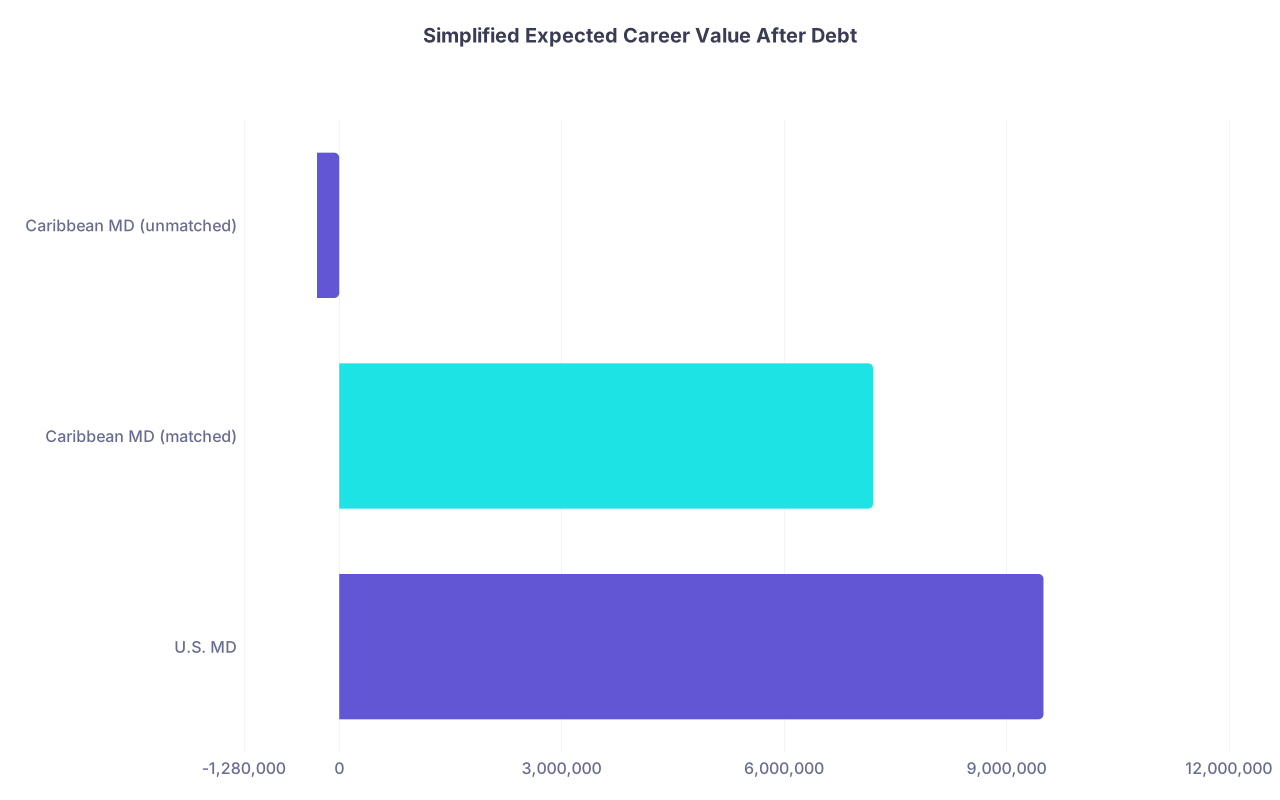
9. Visual summary: risk vs reward
Here is a simple way to picture it.
| Category | Value |
|---|---|
| U.S. MD | 9500000 |
| Caribbean MD (matched) | 7200000 |
| Caribbean MD (unmatched) | -300000 |
Interpretation:
- U.S. MD: expected career value (very rough) still near the high single-digit millions after accounting for debt and realistic specialty mix.
- Caribbean MD who matches: solid positive ROI, but generally lower than U.S. MD because of higher debt and skew to lower-paying specialties.
- Caribbean MD who does not match: strongly negative outcome when debt is subtracted from modest lifetime earnings, especially after interest.
This is why you cannot ignore match probability.
FAQ (exactly 5 questions)
1. If I know I will work really hard, does the Caribbean vs U.S. MD financial gap still matter?
Yes. Hard work is necessary but not sufficient. Residency selection is partly numbers-driven (Step scores, class rank), partly perception-driven (school reputation), and constrained by caps on U.S. training slots. You are competing against thousands of U.S. MD/DO grads who will also work hard. Betting purely on personal effort while ignoring structural odds is not a smart financial decision.
2. Are there specific Caribbean schools that have clearly better ROI than others?
Yes. Larger, long-established schools with consistent match lists into U.S. programs (e.g., SGU, Ross, AUC, Saba) tend to have better outcomes than small, newer, or non-accredited programs. But even at the “best” Caribbean schools, match rates and specialty distributions still lag U.S. MD/DO. So the ROI gap narrows slightly but does not disappear.
3. What if I plan to practice outside the U.S.—does this analysis still apply?
Partially. If your plan is to practice in a country where Caribbean degrees are more widely recognized and the residency bottleneck is less severe, the match-risk penalty may shrink. However, income levels in many non-U.S. systems are lower, which reduces lifetime earnings. You need to redo the same expected-value math using the target country’s training and salary structure.
4. Can loan forgiveness programs like PSLF “fix” the Caribbean financial risk?
Only if you match into a U.S. residency and then work in qualifying public or nonprofit settings for 10 years while making payments. If you never match, PSLF is mostly irrelevant, and many Caribbean students rely heavily on private loans that are not eligible for federal forgiveness. PSLF can improve the ROI for successful Caribbean grads but does nothing for those in the unmatched tail.
5. If I do not get into any U.S. MD schools, is U.S. DO clearly better financially than Caribbean MD?
For most applicants, yes. DO programs are U.S.-accredited, have higher overall match rates than Caribbean schools, and their graduates increasingly access a wide range of specialties. Debt levels are similar to U.S. MD in many cases and generally lower risk than the Caribbean model. From a purely financial and probability-based standpoint, U.S. DO is usually a better bet than Caribbean MD for becoming a practicing U.S. physician.
Key points, condensed:
- U.S. MD degrees carry higher match rates, better specialty access, and lower risk-adjusted debt burden; their ROI is robustly positive for almost everyone.
- Caribbean MD routes involve higher debt and a sizable probability of never matching, which drags down expected lifetime earnings and creates a serious left-tail financial risk.
- Before accepting a Caribbean offer, quantify the odds, model the worst case honestly, and exhaust every pathway to U.S. MD/DO or structured academic improvement first.