

The idea that “any U.S. DO is automatically better than any international MD” is lazy, wrong, and dangerously oversimplified.
If you’re making a six-figure, life-defining decision based on Reddit one-liners and your cousin’s friend’s anecdote, you’re playing with fire. The data tells a much more nuanced story. Some international MDs are clearly worse bets than most U.S. DO programs. Some are absolutely competitive with them. And if you choose badly, either path can wreck your residency chances.
Let’s separate myth from reality.
The Real Question You Should Be Asking
The useful question is not:
“Is international MD worse than U.S. DO?”
The question is:
“Given my stats, goals, and risk tolerance, does a specific international MD program or a specific U.S. DO program give me a better shot at the type of residency I actually want?”
You’re not choosing between “IMG vs DO” in some abstract debate club. You’re choosing between, say:
- Ross vs Nova DO
- SGU vs PCOM
- A mid-tier Caribbean school vs a new, unproven DO program in a saturated region
And those are very different comparisons.
Let’s anchor this with real numbers.
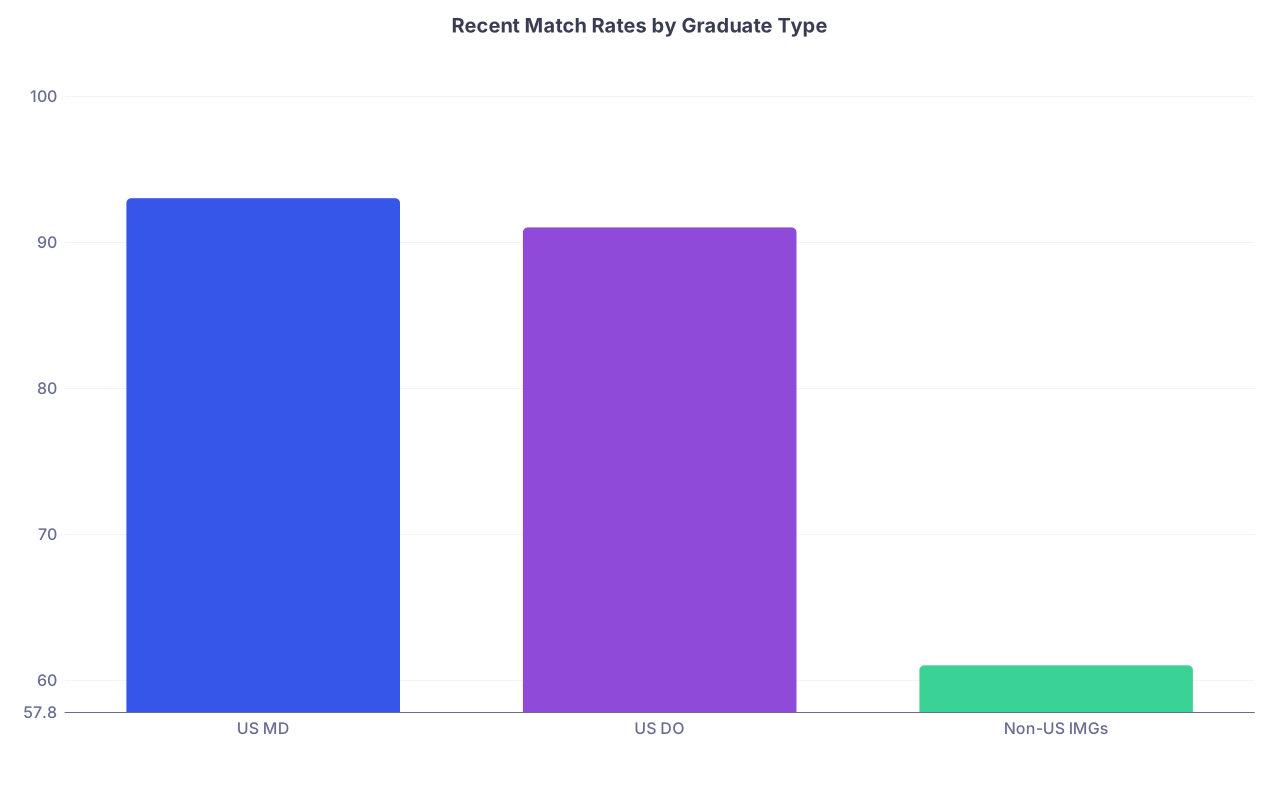
| Category | Value |
|---|---|
| US MD | 93 |
| US DO | 91 |
| Non-US IMGs | 61 |
These are Round 1 Match rates (approximate, varying slightly by year) from NRMP data over recent cycles:
- U.S. MD: ~92–94%
- U.S. DO: ~89–92%
- Non-U.S. IMGs (most international MDs): ~58–62%
At first glance, this seems to crush the discussion. “See? U.S. DO crushes IMGs.” And for the average applicant, that’s often correct.
But averages hide the landmines and the opportunities.
Where the “US DO Is Always Better” Myth Comes From
People cling to the “DO > international MD” rule for three main reasons:
- Match statistics – U.S. DOs match much more consistently than IMGs overall.
- Visa and citizenship issues – Many international MDs are non-U.S. citizens, and their match rates are lower than U.S. citizen IMGs.
- Reputation bias – Caribbean churn-and-burn schools have absolutely earned their bad reputations: huge classes, high attrition, and weak support.
But here’s the trick:
- Not all DO schools are equal.
- Not all international MD schools are equal.
- Not all applicants are equal in risk tolerance, academic strength, and specialty ambition.
You cannot shortcut that complexity with a slogan and expect a good outcome.
U.S. DO vs International MD: What Actually Matters
Let’s compare what really drives residency chances.
| Factor | U.S. DO Graduate | International MD Graduate |
|---|---|---|
| Overall Match Rate | ~89–92% | ~58–62% (non-US IMGs overall) |
| Perceived Reliability | Moderate–High | Highly variable |
| Clinical Rotations | More standardized in U.S. | Often fragmented; quality varies |
| Specialty Competitiveness | Better for most, esp. primary care | Generally worse, except stellar outliers |
| Visa Issues | N/A for U.S. citizens | Big issue if non-U.S. citizen |
| School-to-School Variance | Moderate | Extreme |
Now, let’s actually break this down.
Where U.S. DO Clearly Has the Edge
1. Baseline Match Probability
If you’re an average applicant with average or slightly weaker stats, U.S. DO is usually safer.
NRMP data over recent cycles consistently shows:
- U.S. DO seniors’ match rates are now close to U.S. MDs.
- Non-U.S. IMGs lag far behind.
- Even U.S. citizen IMGs, while better than non-citizen IMGs, still trail U.S. DOs.
Why? Residency programs:
- Understand DO schools better.
- Have more predictable experiences with DO grads.
- See U.S. DOs as “domestic” and less of a logistical/credentialing gamble.
No, this does not mean DOs and MDs are treated identically everywhere. But for getting some residency spot in internal medicine, family, psych, peds, etc., a DO from a reasonably established U.S. school is usually a better bet than being an average student at most Caribbean MD schools.
2. Clinical Rotations and Networking
Most DO schools:
- Place you in U.S.-based clinical sites.
- Have relationships with hospitals that know their students.
- Give you a more predictable 3rd/4th-year structure.
A lot of Caribbean and other offshore schools:
- Scatter students across a mishmash of U.S. affiliate hospitals and community practices.
- May lose rotation sites midstream because contracts fall apart.
- Offer rotations where you’re basically shadowing, not truly functioning as a student on a team.
I’ve seen students show up at residency interviews with paper-thin letters from random community docs who barely remember them. Guess where those came from: unstable, improvised rotation arrangements.
3. Program Bias and Politics
Even though the ACGME-ACOFP merger is done and DOs are “fully integrated,” there’s still some bias. But it’s nothing compared to the skepticism many PDs still have toward generic “Caribbean MD” on a CV.
Some program directors will privately say:
- “I’ll take a DO from X school over a Caribbean MD any day unless the MD applicant is exceptional.”
- “Our last few IMGs struggled; we’re more cautious now.”
That doesn’t mean IMGs cannot match good programs. They do. Every year. But you’re fighting institutional inertia and prior bad experiences.
Where an International MD May Be Competitive – or Better
Now for the part people don’t like to admit.
There are scenarios where an international MD isn’t worse—and might actually be better—than a specific U.S. DO option.
1. High-Tier International MD vs Weak/New DO
Not all DO schools are PCOM, UNECOM, or CCOM.
There are:
- Very new DO schools with thin match histories.
- Schools in regions oversaturated with learners, where clinical experiences are stretched thin.
- Schools with high attrition or students scrambling for decent rotations.
Now compare that to:
- A top Irish, Israeli, or some European MD programs that regularly place graduates into U.S. residencies.
- Certain Caribbean programs (SGU, Ross, AUC, Saba) that, while deeply flawed, still have extensive match lists and support structures—if you are a top-performing student there.
If you’re a strong, disciplined student:
- Top 10–15% of class
- Great board scores (Step 2 now matters even more)
- Strong clinical evaluations
A top-tier international MD may put you in roughly the same ballpark—or occasionally better—than a brand-new DO school with no real track record.
Is this the average outcome? No.
Is it fantasy? Also no.
2. U.S. Citizen at a Solid International MD
Here is a detail people gloss over: NRMP splits IMGs into U.S. citizen vs non-U.S. citizen. U.S. citizen IMGs match at higher rates than non-citizens.
That doesn’t magically equal DO-level outcomes, but it’s not a uniform disaster either.
If you’re a U.S. citizen who:
- Goes to a relatively established international program
- Crushes exams
- Targets realistic specialties
You can absolutely match in internal medicine, family medicine, psych, peds, maybe anesthesia or EM if you are exceptional.
Is it harder than as a U.S. DO grad? Usually yes.
Is it impossible? Absolutely not.
3. Your Long-Term Plan Isn’t U.S.-Centric
If:
- You plan to practice long-term in another country.
- You have citizenship or permanent residency elsewhere.
- The target country values MD over DO (and is hostile or ambiguous toward DO recognition).
Then a reputable international MD might be strategically better than a U.S. DO—even if it makes U.S. residency harder.
This is a small subset of applicants, but for them, the “DO is always better” mantra can be actively harmful.
The Dark Side: Both Paths Have Serious Risks
Let’s be honest. There are ways to lose on both choices.
International MD Worst-Case Scenarios
I’ve seen:
- Students enrolling at no-name offshore schools no one in the U.S. has heard of.
- Attrition rates through the roof.
- People graduating with enormous debt, minimal exam performance, and essentially no realistic U.S. match chance.
You need to understand that:
- Some Caribbean schools admit almost anyone with a pulse and a loan.
- Their business model relies on big first-year classes, then flunking/attriting a huge fraction before graduation.
- Their match lists highlight the top performers and bury the denominator.
If a school won’t give you:
- Honest attrition rates
- USMLE pass rates
- Transparent match list with numerator and denominator
…run away.
DO Worst-Case Scenarios
On the DO side, the story “DO is safe” also has caveats.
Red flags:
- Brand-new DO schools with no real match history.
- Schools heavily dependent on third-party rotation brokers instead of owned/affiliated teaching hospitals.
- Regions with too many med students chasing too few rotation spots.
You do not want to be the first or second class at a school where:
- Clinical sites are untested.
- Program directors have never seen that school on an application before.
- The school leans entirely on “We’re accredited!” as if that magically means anything about quality.
A mediocre student at a weak DO school in 2026 is not living the same reality as a mediocre student at an established DO program in 2012. The game has changed. Competition is up. IMG and DO spots overlap. And PDs are more discerning.
Specialty Ambition: The Brutal Truth
You’re not just choosing a degree. You’re choosing the ceiling on what specialties remain realistically open.
Rough, honest hierarchy for very competitive specialties (derm, plastics, ortho, neurosurg, ENT):
- U.S. MD at a strong school: hard, but possible.
- U.S. DO at a strong program with strong board scores and research: long shot, but increasingly seen.
- International MD (Caribbean or similar): vanishingly rare. Basically lottery-level odds unless your CV is freakishly good.
If you already know you want something extremely competitive and you’re choosing between:
- A solid U.S. DO school
- A mid-tier Caribbean MD
You’re kidding yourself if you think the Caribbean MD gives you an edge because of the “MD” label. It doesn’t. Program directors know exactly what that MD stands for.
For primary care and core specialties (IM, FM, peds, psych, OB/GYN):
- U.S. DO: still clearly better odds in most cases.
- International MD: viable if you perform very well and choose targets realistically—but you’ll still be fighting uphill.
How to Actually Decide Between an International MD and a U.S. DO
Here’s the non-sugarcoated decision framework.

| Step | Description |
|---|---|
| Step 1 | You need to choose |
| Step 2 | US DO is usually better bet |
| Step 3 | High performer? Can tolerate risk? |
| Step 4 | Consider reapplying or different path |
| Step 5 | International MD may be reasonable |
| Step 6 | Any established US DO acceptances? |
| Step 7 | School has stable match & rotations? |
| Step 8 | International MD is reputable & proven? |
Ask yourself, brutally:
Do I have an offer from an established U.S. DO school with a solid match record?
- If yes, that’s generally safer than most international MDs, especially Caribbean.
Is the international MD school:
- Well-known to U.S. residency programs?
- Transparent about USMLE pass rates and match outcomes?
- Not one of the notorious bottom-tier mills?
What’s my realistic specialty target?
- If you’re okay with primary care or general IM and can work hard, both paths are potentially viable.
- If you’re chasing something hyper-competitive, both paths are rough, but DO gives you a less-brutal uphill battle.
What’s my risk tolerance?
- International MD is, on average, higher risk. That doesn’t mean guaranteed failure, but the margin for error is tiny.
- DO still has risk, especially at newer schools, but the floor tends to be higher.
Can I afford to reapply?
- Sometimes, the smartest move is: don’t go offshore, don’t take that sketchy offer, reapply and strengthen your app for another cycle.
- People hate this answer because it delays the dream. But I’ve seen it save careers.
So, Is International MD Always Worse Than U.S. DO?
No. That statement is too blunt, and reality isn’t that clean.
The more accurate version:
- For the average U.S. premed whose main goal is simply to match into some U.S. residency, especially in a core specialty, an established U.S. DO school is usually a safer and better bet than most international MD options—especially Caribbean.
- Top-tier international MD programs with proven match outcomes can be roughly competitive with some DO schools—but only for disciplined, high-performing students who understand the risk and are willing to outperform the average by a lot.
- There are bad choices on both sides: bottom-tier Caribbean MD schools and brand-new, untested DO schools can both destroy your chances if you end up in the bottom half of the class.
If you want a soundbite, here it is:
“US DO usually beats Caribbean MD. But a good international MD with a strong record can beat a weak or new DO. And either path can fail you if you’re average in a high-risk environment.”
Strip away the noise. Look hard at real match data, school history, and your own performance level. Then decide like an adult, not like a forum echo.
Key takeaways:
- “DO > all international MD” is a lazy oversimplification; school quality, match history, and your performance matter more than the letters alone.
- For most U.S. applicants aiming for core specialties, an established U.S. DO is usually safer and more predictable than Caribbean or lower-tier international MD routes.
- High-risk, high-reward exceptions exist, but if you’re counting on being an outlier to justify a questionable school, you’re not busting myths—you’re building one.


