

Most IMGs do not fail in the U.S. because of knowledge. They struggle because of very specific, predictable clinical skills gaps nobody warned them about.
Let me be blunt: I have watched excellent IMGs who could quote Harrison’s chapter and recite obscure syndromes still look lost on a U.S. ward when asked, “What’s your one-liner?” or “What’s your plan for dispo?” The problem is not intelligence. It is mismatch. What your international school trained you for versus what U.S. residency actually demands on Day 1 are not the same thing.
You want to be prepared? You need to know exactly where previous IMGs felt blindsided.
This is not a generic “communication and professionalism” article. I am going to walk through the specific domains where U.S. residents (particularly IMG residents) repeatedly say: “I wish someone had told me this before I started.”
1. The Hidden Curriculum of U.S. Clinical Workflow
The silent truth: U.S. residency is built around workflow, not just knowledge. Many IMGs arrive understanding diseases but not the system they are operating in.
A. Basic Ward Workflow – What Throws IMGs Off
Typical scenario: First month of intern year, morning on an internal medicine service.
You are expected to:
- Pre-round on 6–10 patients.
- Know overnight events, new labs, imaging, vital trends.
- Have a prioritized problem list and plan for each issue.
- Present, adjust orders, write notes, coordinate consults and discharges.
What IMGs often say they felt unprepared for:
- How fast everything moves. There is no 20-minute oral case presentation. You get maybe 3 minutes.
- How much is assumed you will “just know” about logistics: how to place orders, schedule imaging, call consults, arrange SNF placement.
- Juggling multiple active tasks at once, all time-sensitive.
In many international schools, clinical years look like:
- Shadowing attendings.
- Taking histories, maybe doing physicals.
- Rarely writing real notes that matter to billing or legal documentation.
- No responsibility for actual orders or disposition planning.
Then you land in the U.S., where the expectation is that interns are the engines of the system.
B. Rounds: The One-Liner and Problem-Based Thinking
I have seen this repeatedly: an IMG with perfect English completely freezes when asked, “Give me the one-liner.”
They are used to narrative presentations:
- “Mr. X is a 65-year-old male who came to the emergency room yesterday with complaints of chest pain since two days…”
U.S. format is very different:
- “65-year-old man with CAD, DM2, and CKD3 admitted on hospital day 2 for NSTEMI, now s/p PCI, currently stable on dual antiplatelet therapy.”
Residents report feeling unprepared for:
- Condensing the case into a one-liner.
- Presenting by problems, not by organ system or by chronological story.
- Being interrupted constantly and expected not to lose the thread.
If you are early in training, start practicing U.S.-style presentations now. It is not just language. It is structure and speed.
2. Orders, EMR, and “Owning” Patient Management
This is a massive gap, and many IMGs do not even realize it exists until their first week.
A. Writing Orders and Using the EMR
In many countries:
- Students never touch the order system.
- Residents or consultants write all orders.
- Documentation is hand-written and often minimal.
In U.S. residency:
- Interns place almost all day-to-day orders.
- EMR knowledge is part of clinical competence.
What IMGs commonly feel unprepared for:
- CPOE (computerized physician order entry): how to order meds, labs, imaging, consults, blood products.
- Order sets: chest pain, sepsis, DKA, stroke – which ones to use, what they contain.
- Safety checks: weight-based dosing, renal dosing, duplicate orders.
- Documentation for procedures, restraints, blood transfusions, and code status.
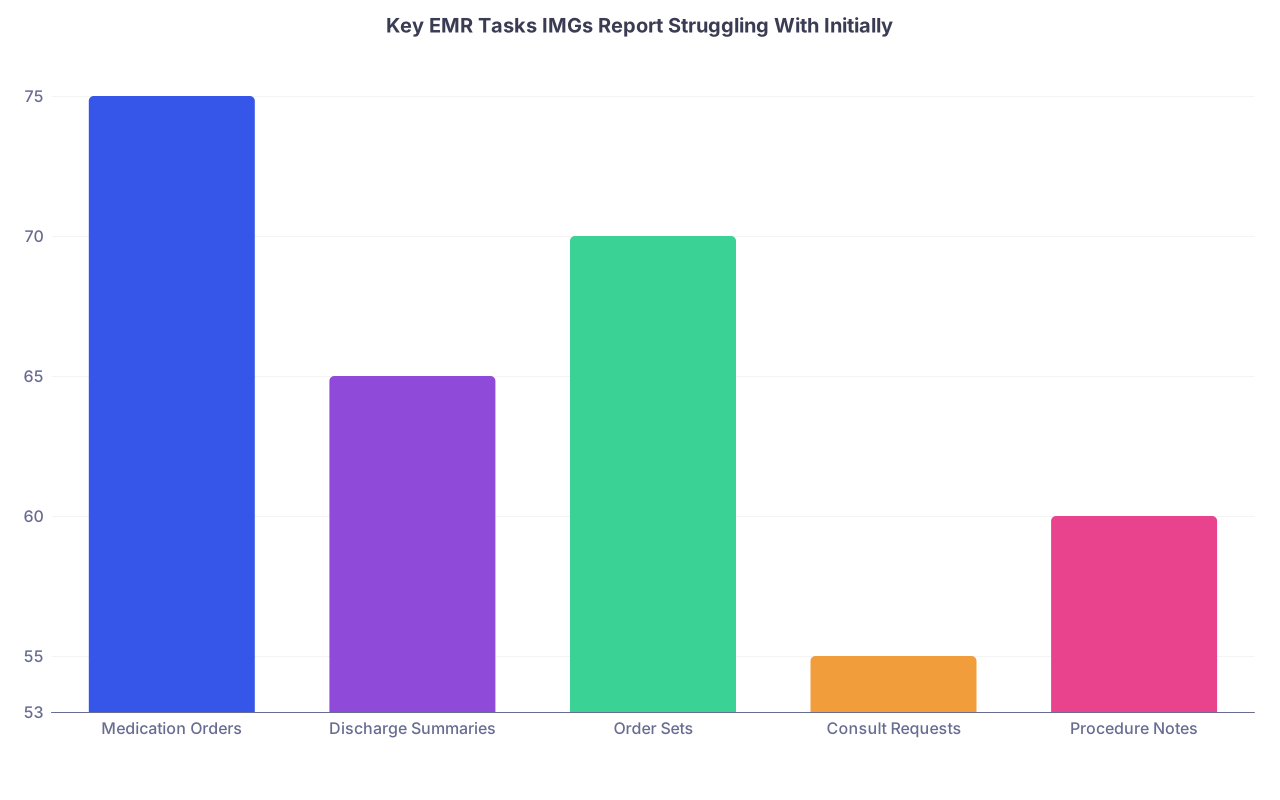
| Category | Value |
|---|---|
| Medication Orders | 75 |
| Discharge Summaries | 65 |
| Order Sets | 70 |
| Consult Requests | 55 |
| Procedure Notes | 60 |
Numbers here reflect what I consistently hear: medication orders and appropriate use of order sets are the top pain points.
B. “Owning” the Plan Instead of Just Reporting
In some systems, students are trained to report and observe. The doctor decides.
U.S. residents are expected to:
- Propose a full assessment and plan.
- Anticipate issues: ICU transfer, discharge barriers, need for rehab.
- Adjust treatment based on labs and vitals – proactively.
IMGs frequently say:
- “I knew the textbook management, but not the real-world sequence: what to do first, who to call, what can wait, what cannot.”
- “I was not used to being asked: ‘Okay, what do you want to do now?’ in real time.”
Example: Hyponatremia on morning labs. You will be asked:
- Etiology? Volume status?
- Immediate action? Additional labs?
- Fluid orders? Fluid restriction? Hypertonic vs isotonic?
- How often do you want sodium checks?
- At what point do you call ICU or nephrology?
You cannot hide behind “I will discuss with my senior” forever. Senior residents expect you to put a stake in the ground.
3. History & Physical: The U.S. Version Is Not Just OSCE 2.0
Many IMGs think: “I passed CS-like OSCEs, I am fine.” I disagree. OSCEs are controlled, predictable, and slow. U.S. inpatient medicine is not.
A. Targeted, High-Yield H&Ps
Common IMG experience:
- Training emphasizes comprehensive, system-by-system histories.
- Physical exams are ritualistic: always full neuro, always full cardio, regardless of complaint.
U.S. practice is more surgical:
- Focused H&P aligned with the chief complaint and relevant differentials.
- Still thorough, but you cut out pointless noise.
Residents say they felt unprepared for:
- Prioritizing questions when time is short.
- Knowing what to skip safely vs what must never be missed.
- Integrating EMR data (old notes, labs, imaging) into your initial assessment right away.
Example: ED calls you to admit “shortness of breath.” You have 10–15 minutes tops to:
- Get a targeted history: onset, orthopnea, PND, sputum, chest pain, risk factors, exposures.
- Perform focused exam: JVP, lung sounds, heart sounds, edema, mental status.
- Have an initial working differential: CHF exacerbation vs pneumonia vs PE vs COPD vs others.
- Place initial orders.
Many IMGs are not trained to move that fast while still being accurate.
B. Physical Exam: Technique vs Interpretation
There is another subtle gap:
- Many IMGs can do the physical maneuvers.
- Fewer can interpret them in the way attendings expect.
Examples:
- JVP: measured in what position, what is “elevated,” how to describe waveform you cannot see well.
- Lung exam: “decreased breath sounds at the bases” is fine, but what does that mean for your plan?
- Volume status: reading the entire picture – skin turgor, mucous membranes, vitals, JVP, edema, urine output – not just one sign.
Residents often say: “I knew the maneuvers, but I was not used to defending my exam in the context of my assessment and plan. In my home country, the consultant re-did everything anyway.”
In U.S. residency, if your exam disagrees with the attending’s exam, they will push you. You need to reason it through.
4. Communication: Not Just English, but “American Clinical”
Fluent English is not enough. Many IMGs underestimate this.
A. Talking to Attendings and Seniors
The norms are different:
- Hierarchy is flatter than in many other countries.
- But expectations for clarity, conciseness, and initiative are higher.
Areas IMGs report difficulty:
- Calling with updates or “FYI” changes: when to call vs when to wait.
- Asking for help early without sounding incompetent.
- Presenting bad news: “The patient is hypotensive and looks worse,” in clear, urgent language.
An attending once said to a new IMG intern: “Do not say, ‘The BP is a little low’ when it is 78/40. That is not ‘a little’ anything.” This is not semantics. This is safety.
B. Patient Communication and Shared Decision-Making
In some systems:
- The physician’s word is final.
- Patients rarely question recommendations.
- Informed consent is more paternalistic.
U.S. culture:
- Patients expect to understand options, benefits, risks.
- They often come with prior research (good or bad).
- They will say no to your recommendation.
IMGs frequently feel unprepared for:
- Explaining uncertainty: “We do not know yet. Here is what we are doing to find out.”
- Handling “Dr. Google” questions without being dismissive.
- Documenting and respecting refusals properly.
C. Interprofessional Communication
This is underrated and kills interns.
You will talk constantly with:
- Nurses
- Pharmacists
- Case managers and social workers
- Physical/occupational therapists
- Respiratory therapists
Typical challenges IMGs report:
- Not understanding what nurses expect from a cross-cover call.
- Underestimating the authority and insight of pharmacists.
- Ignoring case management until day 4 of admission, then panicking about disposition.

In U.S. training, being rude, dismissive, or repeatedly unclear with nurses or support staff will get you labeled quickly, and that label can damage your trajectory much faster than a missed exam question.
5. Acute Care, Emergencies, and Codes
This is one of the most striking gaps IMGs describe after starting residency.
A. First-Response Mindset
In many international hospitals:
- Nurses, senior residents, or consultants run the codes.
- Medical students are bystanders, maybe doing chest compressions when instructed.
In U.S. residency:
- Interns are often the first physician at the bedside when someone crashes.
- Even if a code team exists, you may be the first person making decisions for the first 2–5 minutes.
Common statements from IMGs:
- “I had never truly run an ACLS algorithm on a real patient before residency.”
- “I knew ACLS in theory, but not in the chaos of 10 people shouting and alarms going off.”
Specific areas of unpreparedness:
- Quick recognition of decompensation: reading the room, reading the monitor.
- Immediate actions: airway positioning, calling for help, starting compressions, grabbing the code cart.
- Leadership in chaos: assigning roles, giving clear commands, summarizing every few minutes.
If you are still in medical school abroad and considering U.S. training, you should aggressively seek:
- ED rotations with hands-on triage.
- ICU exposure with real-time management discussions.
- ACLS/BLS not just as certificates, but practicing in simulation with debriefs.
B. Cross-Cover “Night Float” Skills
Night float is unforgiving. You are covering multiple services you do not know well. Nurses page you with problems you must triage in seconds.
IMGs often say: “I was used to calling the senior for almost every acute issue. In the U.S., the expectation was that I would already have a plan when I called.”
Typical situations:
- “Patient with COPD is more short of breath, on 4L now, sat 88%.”
- “Blood sugar 38.”
- “New chest pain in a post-op patient.”
- “Suicidal ideation on the floor.”
You must:
- Ask the right 3–5 questions.
- Decide: go now vs can wait.
- Give immediate orders if needed.
- Know when to escalate to rapid response or ICU.
This is not taught well in many international curricula. You need case-based, scenario-heavy practice.
6. Documentation, Billing, and Medico-Legal Reality
Most IMGs underestimate how central documentation is in U.S. practice. It is not just “extra work.” It is how care is recorded, justified, and paid for.
A. Progress Notes and Discharge Summaries
Residents repeatedly report being unprepared for:
- Writing daily notes that are:
- Concise
- Problem-based
- Legally defensible
- Billing-compliant
- Producing discharge summaries that tell a clear story for the next provider.
Common gaps:
- Overly narrative notes that bury the assessment and plan 15 lines down.
- Vague wording: “patient stable” without vitals, trends, or objective reasoning.
- Missing critical elements: why certain tests were or were not done, why the patient is safe for discharge.
| Area | Typical Problem |
|---|---|
| H&P | Too long, main issues not highlighted |
| Daily Progress Note | No clear problem-based A/P |
| ICU Notes | Incomplete organ-system assessment |
| Discharge Summary | Poor hospital course narrative |
| Procedure Notes | Missing consent/complication statements |
B. Medico-Legal Awareness
Some international systems:
- Have less litigious cultures.
- Do not emphasize “defensive documentation.”
U.S. residents must:
- Document discussions of risks/benefits.
- Record patient refusals explicitly.
- Use careful language when uncertain.
IMGs feel unprepared for:
- How much wording matters.
- What not to write (speculation, blaming).
- The fact that “if it is not documented, it did not happen” is not just a cliché here.
7. Systems-Based Practice and Disposition (Dispo) Planning
Here is where many bright interns quietly drown: they understand the disease but cannot move the patient through the system.
A. Understanding Levels of Care and Discharge Destinations
U.S. residents need practical familiarity with:
- Floor vs step-down vs ICU criteria.
- SNF, acute rehab, LTACH, home with services, hospice.
IMGs often say they had never heard:
- “SNF bed pending.”
- “Needs PT/OT eval before dispo.”
- “Unsafe discharge, family cannot manage at home.”
In many countries:
- Families absorb most post-hospital care.
- Rehab and step-down facilities are limited or very different.
Suddenly you are in morning rounds being asked:
- “What are the dispo barriers?”
- “Is PT on board?”
- “Does the patient have safe housing and insurance?”
And you do not have a good answer because you did not even know those were your responsibilities.
B. Working with Case Management and Social Work
Case managers and social workers are central in U.S. hospitals. They:
- Arrange post-acute placement.
- Address insurance issues.
- Help with transportation, equipment, home health.
New IMG residents often:
- Do not loop them in early.
- Have no idea what they actually do.
- Get blindsided by discharge delays due to logistics.
You should be comfortable:
- Calling case management early for complex patients (stroke, trauma, geriatrics).
- Asking social work about housing instability, domestic violence, substance use follow-up.
- Anticipating these issues from day 1 of admission, not day 4.
8. Cultural, Ethical, and Professional Norms
This is not “soft skills fluff.” This is where IMGs can get into serious trouble if they misread norms.
A. Hierarchy, Feedback, and Evaluation Culture
Differences IMGs often encounter:
- Direct feedback is normal. Sometimes very blunt. It is not always a personal attack.
- You are expected to speak up if something seems unsafe, regardless of seniority.
- 360° evaluations mean nurses and other staff have a real say in your assessment.
Common struggles:
- Interpreting constructive criticism as a sign they are failing.
- Hesitating to ask questions out of fear of “bothering” seniors.
- Over-deferring to authority even when something looks wrong.
B. Boundaries and Professionalism
Specific areas where IMGs may feel off-balance:
- Physical exams and chaperones (breast/genital/rectal exams, trauma exams).
- Use of first names vs titles with attendings and colleagues.
- Interactions and joking with staff that cross into unprofessional territory in a U.S. context, even if normal back home.
I have seen this: a resident using humor that would be fine in their home country but is perceived as insensitive here, generating complaints. One or two of those, and suddenly you are “a professionalism concern.”
9. How to Prepare Before You Start U.S. Residency
You cannot replicate residency as a student abroad. But you can close a significant part of the gap.
A. Targeted Clinical Exposure
If possible:
- Do U.S. clinical electives or observerships that are:
- Inpatient-heavy.
- With residents, not just clinics.
- At places that let you present cases and write draft notes.
Focus on:
- Watching how interns present, write notes, and place orders.
- Copying the structure of their assessments and plans.
- Asking them explicitly: “What surprised you most early on?”
If U.S. electives are not accessible:
- Use high-quality U.S.-based case books and online resources that emphasize:
- Problem-based thinking.
- Realistic ward scenarios.
- Acute care decision-making.
B. Practice the Skills That Actually Matter on Day 1
Make a deliberate plan to practice:
Presentations
Take any patient you see and:- Write a U.S.-style one-liner.
- Present by problem list.
- Time yourself: 3–4 minutes max.
Problem Lists and Plans
For every major diagnosis, practice:- Listing the top 4–6 problems.
- Writing a skeleton A/P in U.S. style.
Simulation
Use:- Online ACLS practice.
- Simulation labs if your school has them.
- Role-play pages/calls with peers: “Nurse paging you for X…”
Documentation
Write mock:- Admission H&Ps.
- Progress notes (SOAP or problem-based).
- Discharge summaries.
Ask someone familiar with U.S. training to critique them if you can.
C. Learn the Language of the U.S. System
Not English. The clinical dialect:
- “Dispo,” “floor,” “step-down,” “attending,” “hospitalist,” “night float,” “cross-cover.”
- “BSO,” “NPO,” “PRN,” “DNR/DNI,” “full code,” “bridging,” “SNF,” “swing bed.”

Even just understanding the vocabulary removes one huge layer of confusion when you start.
D. Be Strategic About Your Final Year of Med School
If you are still in medical school abroad, design your last year intelligently:
- Maximize inpatient rotations (medicine, surgery, ED, ICU).
- Seek rotations where junior doctors do a lot of the daily management and let you observe the “how,” not just the “what.”
- Avoid spending the entire last year in outpatient specialties that will not help you with U.S. intern responsibilities.
10. The Realistic Mindset Shift
Let me end with something unpopular but true: being an IMG in U.S. residency means you must be better prepared than your American-trained peers just to be perceived as “equally competent” early on. That is the bias you are walking into.
You cannot change that bias overnight. What you can change:
- You know the exact skills that blindside most IMGs.
- You can start training specifically for those – not vague “clinical experience,” but:
- Presenting U.S.-style.
- Writing U.S.-style notes.
- Running through ACLS scenarios.
- Understanding EMR logic and workflows.
- Practicing interprofessional communication.
You do not need to be perfect on Day 1. You do need to look like someone who:
- Understands the system’s expectations.
- Learns fast.
- Does not repeat the same mistakes.
That combination is how IMGs not only survive but end up as chiefs, fellows at top programs, and faculty.
FAQ (Exactly 5 Questions)
1. I am an IMG still in basic sciences. Is it too early to worry about these clinical gaps?
No. If you know you want U.S. residency, you should start observing how U.S. medicine is actually practiced as early as possible. During basic sciences, focus on:
- Watching U.S.-based clinical videos and case discussions.
- Learning U.S. terminology and note structure alongside your pathophysiology. You do not need to master everything yet, but you should not wait until the last year of med school to think about workflow and communication.
2. I have done observerships in the U.S., but I only shadowed. Does that help?
It helps with:
- Getting used to U.S. hospital culture.
- Understanding how teams are structured. But pure shadowing without presenting, writing mock notes, or being quizzed is not enough to close the gaps described here. You should convert what you saw into practice:
- Go home and write the H&P or progress note you would have written.
- Rehearse the presentation you would have given.
- Ask your supervising physician for feedback on structure and reasoning, not just on English.
3. How can I practice EMR skills if I do not have access to a U.S. hospital system?
You cannot access real EMRs, but you can:
- Watch tutorials and demos of common EMR systems (Epic, Cerner) available online to understand workflows conceptually.
- Practice “paper EMR” logic: for each case, list what orders you would enter and in what sequence (labs, imaging, meds, consults).
- Use any simulation software or open-source tools your school might have. The point is not memorizing a specific EMR interface; it is learning how to think in orders and workflows rather than just diagnoses.
4. I am worried my accent will hurt my communication with patients and staff. What can I do?
Accent is rarely the core problem. Lack of structure and clarity is. Focus on:
- Clear, standardized phrases for emergencies, pages, and presentations.
- Slowing down slightly and pausing between key points.
- Asking nurses or peers, “If anything I say is unclear, let me know. I want to adjust.” Many IMGs with strong accents are excellent communicators because they organize their thoughts well. That matters more than sounding “American.”
5. What is the single best use of my final year before starting residency?
If you have secured a position and are waiting to start, the highest-yield activities are:
- Doing U.S.-style inpatient electives or subinternships where you present and write notes.
- Running through high-yield emergency and night-float scenarios with peers or mentors.
- Practicing daily: one U.S.-style H&P, one progress note, one discharge summary on real or simulated cases. One focused year like that can erase a large fraction of the IMG clinical skills gap before you ever step into orientation.
Key takeaways:
- Your biggest vulnerabilities as an IMG are not knowledge gaps but workflow, communication, and system-navigation gaps.
- You can target these in advance by practicing U.S.-style presentations, notes, acute care scenarios, and interprofessional communication.
- The goal is not to be perfect on Day 1, but to arrive speaking the “language” of U.S. clinical practice well enough that you can learn fast without drowning.


