

The worst time to decide about an international med school is the week you get all your rejection emails.
But that is exactly when most people start googling “Caribbean medical schools” at 2:00 a.m.
If you’re already rejected from all U.S. MD/DO schools and wondering whether to go international, you’re standing at a real fork in the road. Choose wrong, and you can burn years, six figures, and your ability to practice in the U.S. Choose well, and you might still end up an attending with a white coat and a career you love.
I’m going to be blunt. International medical school is not “Plan B.” It’s more like “different game, higher risk, tighter margin for error.” If you treat it like a shortcut, it will eat you alive.
Let’s walk through this as you are right now: rejected this cycle, confused, maybe embarrassed, maybe panicking. Here’s how to decide, step by step.
First: Stop and Get Oriented
You didn’t get in. That stings. But before you run toward the first offshore brochure that says “U.S.-style curriculum” and “clinical rotations in America,” you need to understand your actual position.
There are three broad paths in front of you:
- Rebuild and reapply in the U.S. (MD, DO, or both)
- Enroll in an international program that still leads realistically to U.S. residency
- Walk away from medicine or pivot into a related field
If you default into option 2 just because the other two feel painful, you’re making a fear-based decision. That’s how people end up at unaccredited schools with a 40% attrition rate and no loans left.
Before you consider going international, you need a cold, honest read on why you were rejected.
Diagnose Why You Were Rejected (Brutally Honestly)
You cannot decide about going international until you know if your U.S. application was:
- Almost competitive, but slightly under
- Fundamentally noncompetitive
- Strong on paper, but sabotaged in execution (timing, school list, essays, interviews)
Here’s a fast diagnostic framework. Be ruthless.
| Factor | Rough Benchmark for U.S. MD/DO |
|---|---|
| GPA | ≥3.5 for MD, ≥3.3 for many DO |
| MCAT | ≥510 for MD, ≥503–505 for many DO |
| Clinical Hours | ≥150–200 solid, recent |
| Shadowing | ≥40+ hrs, including primary care |
| Application Timing | Submitted by June/early July |
If multiple of these are way off, you need to fix those first, not look for a different continent.
Ask yourself:
- Did you apply broadly enough? (20–30 schools for MD, often 30–40+ if lower stats; similar or more for DO-heavy applicants)
- Did you include DO schools at all? If not, that’s a big, obvious gap.
- Were your letters and personal statement generic or rushed?
- Did you submit primaries late (August or later) or secondaries slowly?
If your GPA is 3.1 and MCAT is 496, no amount of essay polish would have saved this cycle. That’s a stats problem, not an “America hates me” problem.
If you’re 3.7/515 with decent activities and still got blanked, something else is broken: school list, timing, essays, or interviews.
You need someone who has actually seen hundreds of applications to review yours. Not your roommate. Not your mom.
At a minimum, book:
- A premed advisor (even if they were useless before, you need their data now)
- A current resident or 4th year med student who has matched, ideally in the U.S.
- If possible, a professional advisor who can do a forensic review of your app
Until you’ve done that, you’re not actually deciding between “U.S. vs international.” You’re just running from a bad result.
The Hard Truth About International Medical Schools
Let me strip the marketing language.
“International medical school” is not one thing. It includes:
- Caribbean schools (big four + many smaller ones)
- Ireland / UK / Australia programs that accept North Americans
- Mexico, Eastern Europe, other Latin America / Asia schools with some U.S.-bound grads
- Offshore “new” schools with glossy sites and almost no match record
Your risk varies massively depending on which bucket you’re in.
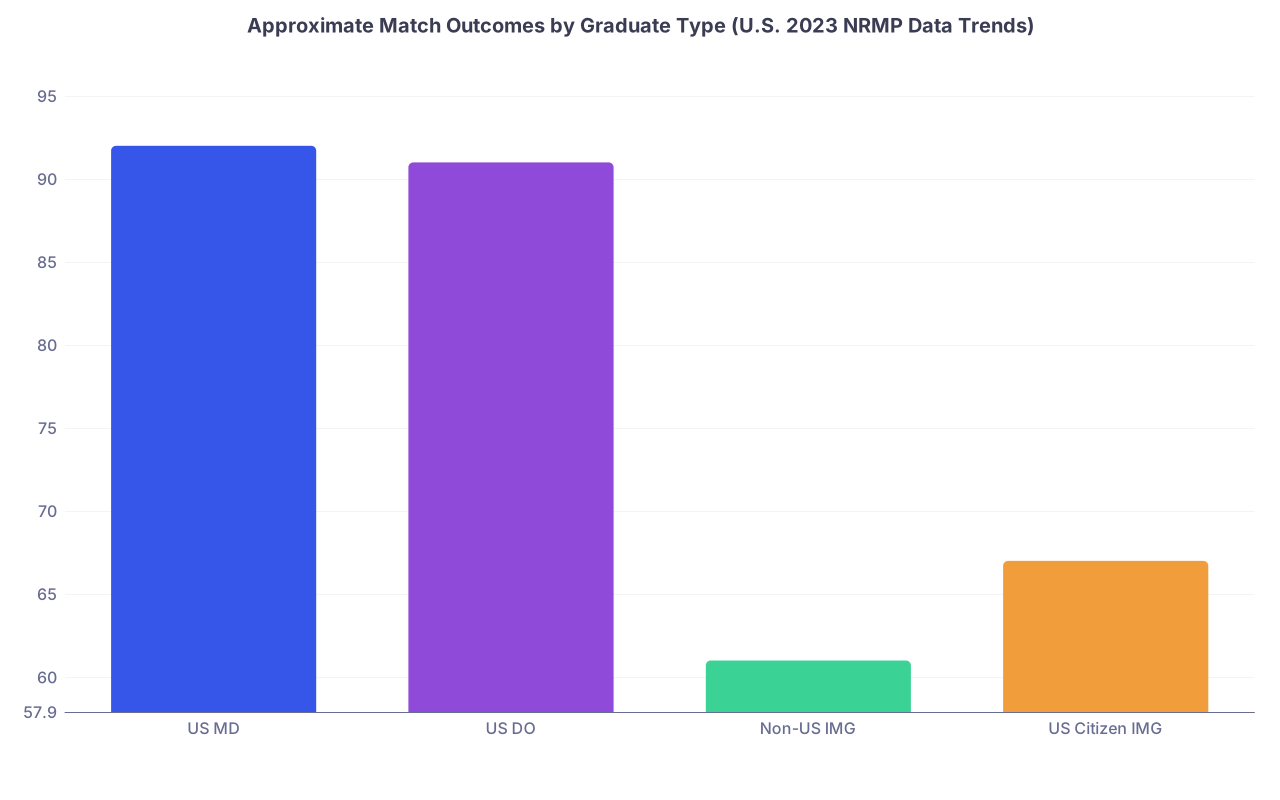
| Category | Value |
|---|---|
| US MD | 92 |
| US DO | 91 |
| Non-US IMG | 61 |
| US Citizen IMG | 67 |
Rough pattern: U.S. MD and DO grads match around 90%+ overall. U.S. citizens who go abroad (Caribbean, etc.) hover around two-thirds. Some schools drag that down heavily.
And that’s overall. Once you cut out primary care and community IM, it gets ugly fast for some international grads.
The main structural risks:
- Attrition: Some Caribbean schools quietly lose 30–50% of students before they even sit for Step 1.
- USMLE performance: You’re often in a crowded environment, sometimes with weak academic support, sometimes with a class full of people who struggled in undergrad. That changes the curve.
- Clinical rotations: Quality, location, and stability vary. Good rotations in the U.S. are a limited commodity.
- Visa / licensure issues: For non–U.S. citizens especially, certain states and programs may be closed or harder to access.
So “Should I go international?” is really three questions:
- Am I willing to accept a meaningfully higher risk of never matching into U.S. residency?
- If yes, can I pick a program where that risk is reasonable rather than catastrophic?
- And is my current U.S. reapplicant potential actually worse than that international risk?
When Going International Might Be Reasonable
There are scenarios where going international can be a rational choice. Not common. But they exist.
Scenario 1: You’ve already done 1–2 serious U.S. reapplication cycles
By “serious,” I mean:
- You improved stats (post-bacc, SMP, retaken MCAT with real improvement)
- You fixed timing (submitted early, secondaries turned around in 1–2 weeks)
- You expanded school list deeply (many MD including lower-tier, many DO)
And you still got nothing.
If you’re now, say, 27–30 years old, have a 3.3–3.4 GPA, a 505–508 MCAT after multiple attempts, and your reapps were clean and comprehensive, the U.S. system may be effectively closed to you.
In that case, you’re not choosing between “Caribbean vs U.S. MD.” You’re choosing between:
- Higher-risk international route with some realistic chance of practicing medicine
- Accepting that an M.D./D.O. may not happen and redirecting your career
Different conversation. Very personal. But at least honest.
Scenario 2: You’re a nontraditional applicant with major constraints
For example:
- You’ve already invested years in a healthcare-adjacent career.
- You cannot afford 2–3 more years of GPA repair due to family, location, or visa issues.
- You’ve researched heavily and are looking at a small set of well-known, older, established international programs with decent match histories to the U.S. or Canada.
Even here, I’d still say: try U.S. DO aggressively first unless your stats are clearly below any realistic DO cutoffs.
Scenario 3: You’re open to practicing outside the U.S.
Some Irish, UK, or Australian schools have pathways that lead to practicing there instead of or before coming to the U.S. If you are genuinely fine living and working long-term outside the U.S., the risk profile shifts.
But most students asking this question are dead set on returning to the U.S. If that’s you, be honest: don’t count “I could just stay in Ireland” as a meaningful backup if that’s never going to happen.
When You Absolutely Should Not Go International (Yet)
If any of this sounds like you, hitting “Enroll” internationally this year is a bad idea:
- You applied late this cycle (August/September) and are surprised by rejections.
- You didn’t apply DO at all.
- Your GPA/MCAT are within striking distance of U.S. schools with 1–2 years of work (e.g., 3.2–3.3 GPA, 502–505 MCAT).
- You have glaring holes in experiences: no clinical exposure, no shadowing, no sustained volunteering.
- You haven’t had anyone qualified review your personal statement, secondaries, or school list.
In all those cases, the smarter move is:
- Take a gap year (or two).
- Repair your application on U.S. soil.
- Reapply once like you actually mean it.
If You’re Seriously Considering International: How to Evaluate Schools
Treat this like a high-risk investment, not a college choice. The glossy brochure is irrelevant. You care about one thing: your odds of becoming a licensed, practicing physician in the U.S.
Ask every school:
- What is your Step 1 and Step 2 first-time pass rate for the last 3–5 years?
- How many students from the matriculating class actually graduate on time?
- What is your NRMP match rate for U.S. citizen grads (by specialty, if you can get it)?
- Where do your grads match? Community IM/FM programs in the U.S. or mostly abroad?
- Are you eligible for U.S. federal loans? (Big indicator of at least some oversight.)
- How long has the school existed? (New = much higher risk.)
Don’t accept vague answers like “Our grads match all over the U.S.!” Demand numbers. Schools that refuse to share transparent, recent data are waving a red flag.

If you’re looking at the Caribbean, there is a rough hierarchy. The “Big 4” (SGU, Ross, AUC, Saba) are not equal, but they’re miles ahead of pop-up schools with no consistent match history. Still risky. Just less catastrophic than the rest.
For non-Caribbean schools (Ireland, UK, Australia, Eastern Europe, etc.), your key questions:
- Does this school and program length make any sense financially, given tuition + cost of living + time?
- Do they have a real history of U.S.-bound grads or is it mostly local practice?
- Will I face visa barriers returning to the U.S. for residency interviews and training?
The Money Problem (You Can’t Ignore This)
I’ve watched people take out $300K+ in loans for offshore schools and then fail Step 1 or never match. That debt doesn’t disappear. It doesn’t care about your dreams.
Think about:
- Tuition (often similar to or higher than U.S. private med schools)
- Cost of living on an island or overseas
- Extra time if you need to delay Step exams
- Interest during school
Then factor in: you’re statistically less likely to match on your first try as an IMG. Every extra year of SOAP, research-only, or postdoc work is another year of attending salary you’re not earning, plus living expenses.
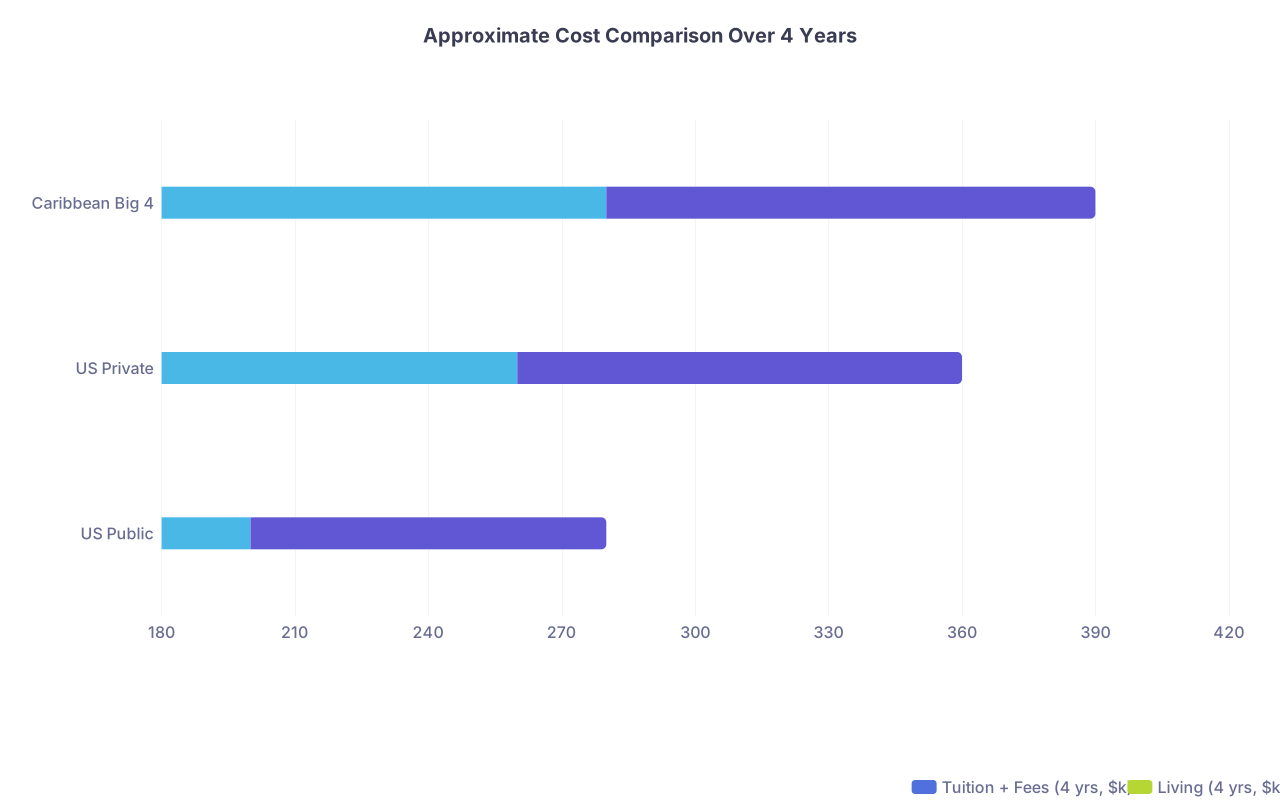
| Category | Tuition + Fees (4 yrs, $k) | Living (4 yrs, $k) |
|---|---|---|
| US Public | 200 | 80 |
| US Private | 260 | 100 |
| Caribbean Big 4 | 280 | 110 |
Is it ever worth it? Yes. For some. If you truly can’t open the U.S. door and medicine is your non-negotiable, the cost might be justified. But that’s a choice you make with eyes wide open, not because you were too impatient to sit out one cycle.
One-Year Pause vs. Jumping Internationally: What Actually Changes?
People underestimate what a focused 12–24 months can do for a U.S. application.
If your current profile is:
- GPA: 3.1–3.3 (with some trend up)
- MCAT: 497–504
- Minimal clinical and shadowing
- Applied late and to 10 “reach” MD schools only
You could reasonably, in 1–2 years:
- Do a structured post-bacc or SMP and pull a strong upward GPA trend (3.7+ in 30–40 credits)
- Retake MCAT to 508–512 with serious prep
- Accumulate 500+ hours of solid clinical work and meaningful, ongoing service
- Apply early to 30–40 schools, including a heavy DO list
Suddenly your odds at U.S. DO and even some lower-tier MD programs are completely different. That’s not theoretical; I’ve seen it, repeatedly.
Skipping that to run to an offshore school because it feels “faster” is like refusing to study for a retake and then complaining the exam was unfair.
If You Do Go International: How to Survive the Path
Let’s say you’ve done the work, looked at the numbers, and still decide: I’m going international.
Then you need to treat the entire process from day one as a fight for residency, not just “passing classes.”
Non-negotiables:
- Aim for top 5–10% of your class. Middle of the pack as an IMG is a very different thing than middle of the pack at a U.S. MD school.
- Lock in a USMLE-focused study plan from semester one. Do not wait until dedicated.
- Chase strong U.S. clinical rotations relentlessly. Location, program reputation, and who you work with matter.
- Be realistic on specialties. Aim for IM, FM, peds, psych, maybe neurology or pathology. Neurosurgery or derm from a random offshore school? Fantasy.
- Protect your mental health. The environment can be brutal—far from home, constant fear about Step, classmates washing out.

| Step | Description |
|---|---|
| Step 1 | Matriculate at Intl School |
| Step 2 | Preclinical Years |
| Step 3 | USMLE Step 1 |
| Step 4 | Clinical Rotations in US if possible |
| Step 5 | USMLE Step 2 |
| Step 6 | Build Letters & CV |
| Step 7 | Apply to Residency as IMG |
| Step 8 | Residency Training |
| Step 9 | Reapply/SOAP/Alternative Paths |
| Step 10 | Match? |
Every misstep—failed course, failed Step, unprofessional behavior on rotation—costs you more as an IMG than it would your U.S. MD counterpart.
A Very Different Option: Pivot Within Healthcare
Some people reading this will, deep down, already know: they don’t want to stake their entire 20s and 30s on a high-risk path overseas.
That doesn’t mean you “failed.” It means you’re making a rational decision.
Real alternatives where you still work in serious, high-impact healthcare roles:
- PA (Physician Assistant)
- NP via accelerated BSN + MSN routes
- Clinical psychology, counseling, social work
- Pharmacy (with eyes wide open about the current market)
- Public health, health policy, hospital administration
- Genetic counseling, PT, OT, anesthesia assistant, etc.
These aren’t consolation prizes. They’re different careers with their own tradeoffs, but many of them are more achievable at this stage than trying to brute-force your way through an offshore MD with shaky odds.
How to Decide: A Simple, Harsh Framework
Put your situation into three sentences:
- Here’s my actual academic profile (GPA, MCAT, major red flags).
- Here’s what I have and haven’t tried yet in the U.S. (including DO).
- Here’s the truth about what I’m willing to risk financially and emotionally.
Then ask yourself four questions:
- Have I done at least one fully optimized U.S. cycle (early, broad, fixed weaknesses)?
- Can I, in 1–2 years, reasonably improve my application enough to change my odds?
- If I go international and never match, will that level of debt and lost time destroy my future?
- Do I want medicine so badly that even a 30–40% chance of “failure” is acceptable to me?
If you can’t say yes to #1 and you can improve for #2, hit pause. Rebuild. Reapply U.S. first.
If you have already done #1 multiple times, #2 is limited, and you’re still okay with #3 and #4—even after reading everything above—then a carefully chosen international program might be your path.
But make it a conscious gamble, not a panic move.
What You Should Do Today
Open a blank document and write, in plain numbers and bullets:
- Your cGPA, sGPA, and MCAT (all attempts, with dates)
- How many schools you applied to (MD and DO, with timing)
- Your clinical, shadowing, research, and volunteering hours
- Any academic red flags (withdrawals, repeats, failures, institutional actions)
Then send that summary to three people:
- A premed advisor or committee at your school
- A current U.S. resident or 4th-year med student
- One international grad who matched in the U.S. and one who didn’t (find them on Reddit, SDN, or alumni groups)
Ask each of them one clear question:
“Based on this, do you think I should reapply in the U.S. after strengthening, or start planning for an international route—and why?”
Do not enroll anywhere, domestic or international, until you’ve read and really sat with those answers.


