
U.S. clinical rotations do not guarantee an IMG match. Not even close. At best, they’re a ticket to play. At worst, they’re an expensive illusion sold as a shortcut to the Match.
Let me be direct: the cottage industry around U.S. clinical experiences for international medical graduates thrives on one quiet assumption—“If I just get enough U.S. rotations, I’ll match.” That assumption is wrong. And a lot of students find that out only after wasting tens of thousands of dollars and a full year of their life.
You want the truth, not the brochure version. So let’s strip this down to what the data actually shows and where U.S. rotations do and do not matter.
What the Match Data Really Shows (Not What the Agents Tell You)
Here’s the core problem. People talk about U.S. rotations like they’re magic keys. Program directors do not.
Every year, the NRMP and the Program Director Survey tell you exactly what matters. Most people don’t read it; they just trust whatever their friend’s cousin’s WhatsApp group claims.
For IMGs, the consistent top factors are:
- USMLE Step scores (especially Step 2 CK now that Step 1 is pass/fail)
- Number of exam failures
- Type and quality of clinical experience
- Letters of recommendation (U.S. vs non-U.S.)
- Visa status
- Graduation year / time since graduation
Notice what’s missing: “Number of U.S. clinical rotations completed: guaranteed pathway to Match.” Because it isn’t there.
Let’s look at something more concrete: overall match rates.
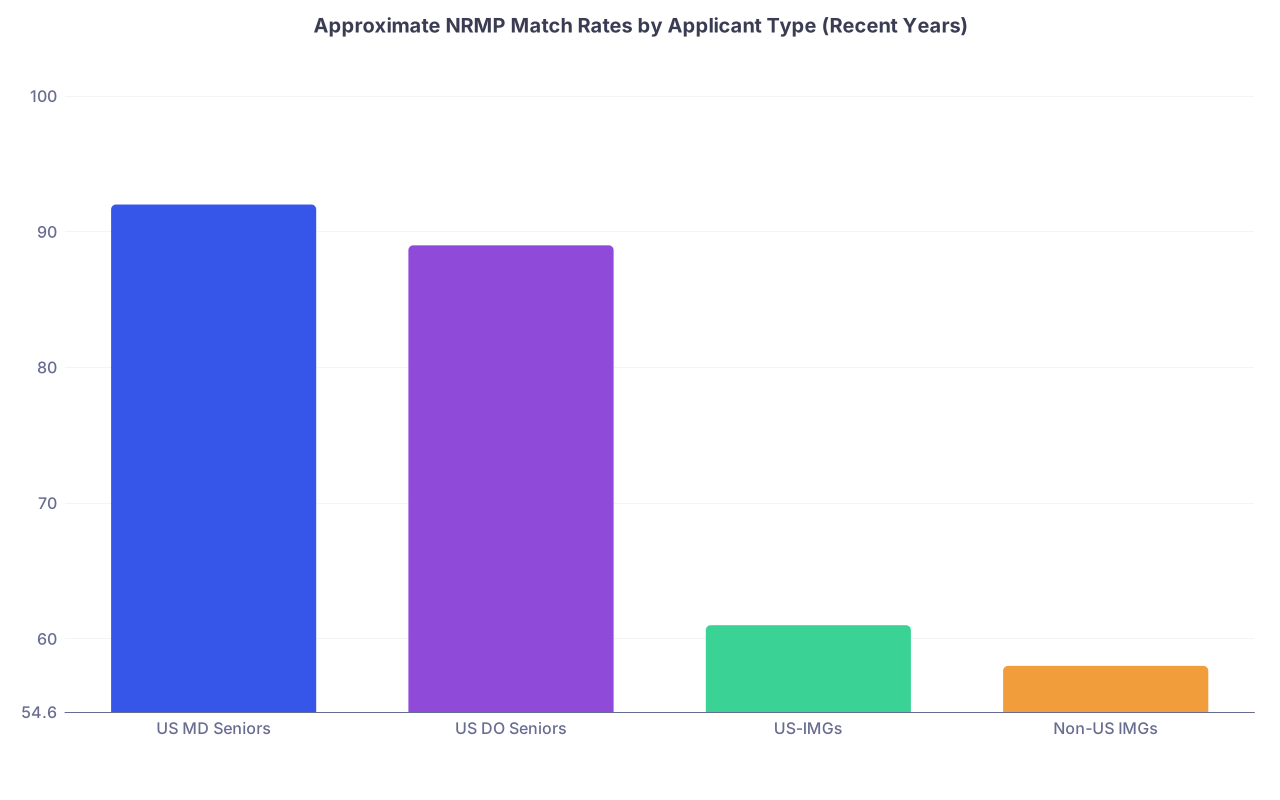
| Category | Value |
|---|---|
| US MD Seniors | 92 |
| US DO Seniors | 89 |
| US-IMGs | 61 |
| Non-US IMGs | 58 |
These are ballpark figures based on recent NRMP data. Now here’s the key:
- A large fraction of both US-IMGs and non-US IMGs have U.S. clinical experience.
- Yet ~40% of them still do not match each year.
If U.S. clinical rotations were anything close to a “guarantee,” we wouldn’t see those numbers. The best you can honestly say is:
U.S. rotations are common among IMGs who match.
They’re also common among IMGs who fail to match.
Correlation, not causation. And definitely not a guarantee.
The Two Very Different “U.S. Clinical Experiences” People Confuse
One reason students get misled is that people use “U.S. clinical experience” as if it’s one uniform thing. It isn’t. Program directors know the difference. Brokers often pretend they don’t.
There are roughly two buckets.
1. Genuine, structured rotations through a real teaching hospital
This is what actually helps:
- Rotations arranged through an affiliated U.S. medical school or a major teaching program.
- Clearly supervised by faculty who routinely work with residents and students.
- Documented in strong, personalized letters from physicians who understand the Match and know how to write for it.
- Integrated into your education, not slapped on as a random side quest.
Think: an ACGME teaching hospital where the attending says in the letter, “I have supervised residents and students at this institution for X years; this student functioned at the level of our U.S. seniors.”
That has credibility.
2. Paid “observerships” and shadowing disguised as “rotations”
Now the ugly side.
You pay $2,000–$4,000 per month to a “placement service” that sends you to:
- A private clinic with minimal teaching
- A physician who’s never written a residency LOR in their life
- A setting where you’re not allowed to touch patients, write notes, or present meaningfully
You might get a one-paragraph generic letter at the end: “Student was punctual and professional.” I’ve seen dozens of these. Program directors have seen hundreds. They go straight into the “neutral” pile.
The market is flooded with this type of “U.S. clinical experience.” That’s why so many IMGs with “4 months of U.S. rotations” still don’t match. Because the details matter more than the buzzword.
What Program Directors Actually Use U.S. Rotations For
Now let’s be fair. U.S. rotations aren’t useless. They’re just overhyped.
Here’s what they really do for you, when done correctly.
1. They validate that you can function in the U.S. system
For IMGs, there are two big questions program directors quietly ask:
- Can you function in a U.S. hospital with its workflows, documentation, EMR, and team dynamics?
- Will your communication and professionalism slow the team down?
Good U.S. rotations give them evidence. They show:
- You’ve presented patients in SOAP format.
- You’ve written notes (even if not in the actual EMR).
- You’ve rounded with multidisciplinary teams.
- You can communicate with patients and staff clearly.
This isn’t glamorous. It’s “baseline safety.” It makes you less risky, not automatically desirable.
2. They generate U.S. letters of recommendation
That’s the real currency. Not the rotation line on your CV, but the letter that comes out of it.
A strong U.S. LOR for an IMG usually has:
- Clear comparison: “At the level of or above our U.S. seniors”
- Concrete examples: “Independently gathered histories, formulated differentials, and revised plans with feedback”
- Some awareness of your IMG status and still vouching strongly
A useless one says:
“X was observant, eager to learn, and attended clinic regularly.”
Same number of months. Very different impact.
3. They occasionally open doors at that same institution
Occasionally, not routinely. The fantasy is:
“I’ll rotate there, impress them, and they’ll rank me highly.”
Reality:
- At some community programs with heavy IMG presence, this actually happens. I’ve seen students match where they did sub-I level rotations.
- At big-name university programs, rotating as an IMG often does not move the needle as much as you think—especially if they don’t routinely take IMGs.
So yes, a rotation can give you a small local boost. But that is not a guaranteed golden ticket, it’s a slight shift in probability.
The Expensive Myth That Rotations Fix Weak Applications
Here’s where people really get burned.
An IMG with:
- Multiple Step failures
- Old year of graduation (YOG 2015, for example)
- Minimal research or scholarly work
- Weak English communication
then dumps $15,000–$25,000 into “U.S. rotations” thinking that’s the missing ingredient.
Programs do not use U.S. rotations to overlook glaring risk factors. A line that says “4 months U.S. clinical experience” doesn’t outweigh failures or a decade-old graduation date. It may simply get ignored.
| Factor | Impact on Match Odds |
|---|---|
| Strong Step 2 CK score | Very High |
| No exam failures | Very High |
| Recent graduation (≤3 yrs) | High |
| Solid U.S. LORs | High |
| Quality U.S. rotations | Moderate |
| [Paid observerships only](https://residencyadvisor.com/resources/international-med-schools/no-us-shadowing-building-clinical-exposure-before-going-abroad) | Low |
U.S. experience is moderate. Not trivial, but not dominant. The obsession with stacking month after month of low-yield observerships is misplaced.
I’ve watched applicants with one good U.S. inpatient rotation and outstanding scores beat out those with six months of random clinics and mediocre exams. Consistently.
When U.S. Rotations Actually Make Strategic Sense
So when should you pursue them? Not as a reflex. As a targeted move.
They’re worthwhile if:
- Your exams are already solid (Step 2 CK competitive for your target specialty).
- Your graduation year is recent or you’ve been clinically active.
- You can secure real hands-on or at least closely supervised teaching experiences.
- You’re aiming for IMG-friendly fields like internal medicine, family medicine, psych, pediatrics, where programs actually care about USCE.
They’re less valuable if:
- You’re applying to hyper-competitive specialties that rarely take IMGs (derm, plastics, neurosurgery).
- You already have strong U.S. experience and letters; an extra month in the same type of clinic adds diminishing returns.
- The rotation is expensive, strictly observership-only, with vague promises about letters.
Notice the pattern: rotations amplify a solid foundation. They don’t replace it.
The Financial Reality No One Selling Rotations Wants to Discuss
Let’s talk money, because this part gets swept under the rug.
Common costs I’ve seen for “U.S. rotations”:
- $2,000–$4,000 per month in fees
- Plus housing, transport, food in a U.S. city (easily $1,500–$2,500/month)
- Exam fees, ERAS fees, travel to interviews on top of that
A 4-month U.S. rotation block can easily cross $15,000–$20,000 all-in.
Now ask a harder question: what’s the marginal gain from month 3 vs month 1?
The first solid U.S. inpatient rotation that yields a strong letter? High value.
The fifth similar low-yield outpatient month arranged through the same agency? You’re mostly burning cash to feel like you’re “doing something.”
If you’re choosing between:
- Another generic 4-week paid clinic observership, or
- Retaking Step 2 CK seriously, or
- Doing a meaningful research year that yields publications and U.S. contacts
You need to stop and admit: another checkbox month is not always the smartest play.
Red Flags: When “U.S. Rotations” Are Mostly Marketing
Watch for these signs you’re being sold a product, not an opportunity:
- Guaranteed placement in any city, no mention of actual hospital names or departments.
- “Hands-on” used very loosely, but contracts and websites mention “observation only” in the fine print.
- No clear institutional affiliation (no med school or teaching hospital clearly listed).
- Vague LOR promises: “Certificate and letter provided” with no indication the physician actually knows the Match landscape.
I’ve seen agencies brag “100% of our students get U.S. letters.” That’s a meaningless stat. The question is: do those letters get attention, or are they the kind program directors skim in 5 seconds and forget?
How to Make Rotations Actually Work For You
If you’re going to invest the time and money, treat rotations like a job audition, not a tourism package.
A few things that actually matter:
- Aim for at least one strong inpatient rotation in your target specialty at a program that takes IMGs.
- Go where attendings work with residents—your performance will be judged in context.
- Ask, politely and early, how feedback and letters are usually handled for visiting students.
- Show you can think, not just memorize. Present coherent assessments and plans. Ask smart, not show-off, questions.
- Follow up with letter writers, send your CV, and remind them of specific cases you worked on together.
Do that, and a rotation can transform into one or two powerful letters and a real advocate on your side. Skip that, and it becomes an expensive line item that looks exactly like thousands of other CVs.
Common Misconceptions: Quick Reality Check
Let’s knock down a few recurring myths I keep hearing from IMGs:
“I heard 3–4 months of U.S. rotations is the minimum to match.”
No. There’s no magic number. One month with a stellar LOR at the right place can outweigh four months of vague clinics.“Programs won’t even consider you without U.S. clinical experience.”
Some won’t. Many will, especially if your scores, recency, and home clinical experience are strong. U.S. experience helps, but it’s not an absolute gate for all programs.“Everyone who rotated at X community program matched there.”
Survivor bias. You’re hearing from the ones who matched, not the ones who silently didn’t.
Visualizing the Timeline: Where Rotations Actually Fit
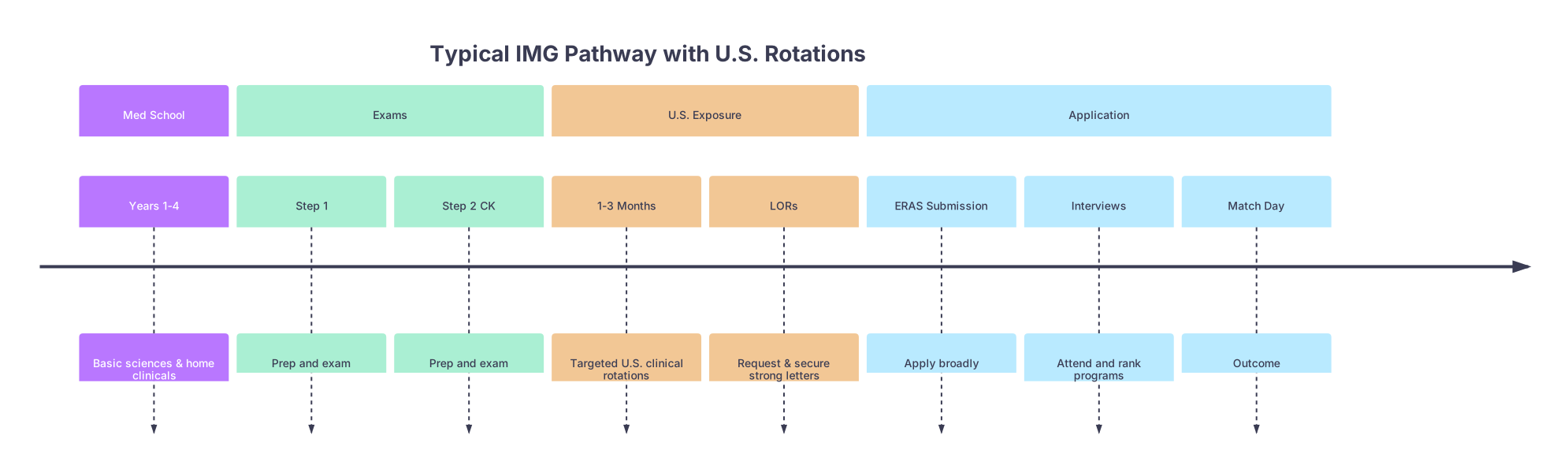
| Period | Event |
|---|---|
| Med School - Years 1-4 | Basic sciences & home clinicals |
| Exams - Step 1 | Prep and exam |
| Exams - Step 2 CK | Prep and exam |
| U.S. Exposure - 1-3 Months | Targeted U.S. clinical rotations |
| U.S. Exposure - LORs | Request & secure strong letters |
| Application - ERAS Submission | Apply broadly |
| Application - Interviews | Attend and rank programs |
| Application - Match Day | Outcome |
Notice how U.S. rotations are one part of a much larger system, not the centerpiece.
FAQs
1. As an IMG, how many months of U.S. clinical experience do I actually need?
There’s no universal “correct” number, but for most IMGs aiming at internal medicine, family medicine, or pediatrics, 1–3 months of solid, well-chosen U.S. rotations with strong letters is usually enough to show you’re functional in the U.S. system. More than that only helps if each additional month adds something new—different setting, stronger letter writer, more responsibility. Stacking 6–8 similar low-yield months doesn’t transform your application.
2. Are observerships useless compared to hands-on rotations?
Not automatically, but they’re often oversold. A pure shadowing observership where you silently follow a doctor and rarely interact with patients is low-yield. An observership where you present cases, discuss plans daily, and the attending truly sees how you think can still produce a valuable letter. That said, hands-on elective or sub-I style experiences in real teaching hospitals generally carry more weight than office-based shadowing.
3. If I have weak scores, can strong U.S. rotations make up for it?
They can soften the blow a little, but they do not erase low or failed exam scores. A glowing letter can make a program take a second look at your file, but it won’t magically overwrite red flags. If your scores are significantly below the typical range for your target specialty, your priority should be improving exam performance (where possible) and choosing more realistic specialties and program lists—then using U.S. rotations and letters to complement that, not to compensate for it.
Bottom line:
- U.S. clinical rotations help, but they don’t guarantee a match—and they’re nowhere near the most important factor.
- Quality, context, and letters from rotations matter far more than the number of months you’ve paid for.
- If you treat rotations as a strategic tool inside a broader, data-driven application plan, they’re useful. If you treat them as a magic cure, they’ll just drain your bank account and leave you wondering what went wrong.


