

The idea that international medical schools are a safe “backup plan” for US premeds is not just wrong. It’s how a lot of smart people quietly blow up their career before it even starts.
You’ve probably heard the script:
“If med school in the US doesn’t work out, I’ll just go Caribbean. Worst case, I still become a doctor.”
That statement used to be naive. Now, with the current match environment and scrutiny on international grads, it’s reckless.
Let me walk through what the data actually shows, because the marketing brochures and Reddit anecdotes are not giving you the full picture.
The “You’ll Still Be a Doctor” Illusion
There’s a comforting fantasy baked into the backup-plan narrative:
If you get into any medical school, you’ll graduate, pass your boards, match somewhere, and eventually practice. Maybe not Derm at UCSF, but something. Family. Internal. Whatever. White coat achieved.
That’s not how the numbers look.
Every year, the NRMP (National Resident Matching Program) publishes data on Match outcomes. One table in particular shatters the backup myth: match rates by applicant type.
| Applicant Type | Match Rate (%) |
|---|---|
| US MD Seniors | ~92–94 |
| US DO Seniors | ~89–91 |
| US Citizen IMGs | ~58–62 |
| Non-US Citizen IMGs | ~55–60 |
Put plainly: as a US citizen who goes offshore, you’re cutting your odds of matching into any residency from the low 90s to roughly a coin flip.
And that’s not “Derm vs Ortho” odds. That’s “doctor vs not a doctor” odds.
Now layer in one more quiet problem: attrition. Many big-name offshore schools do not graduate most of the people they enroll. You don’t see glossy brochures that say: “We accept 100, graduate 50, maybe 30 match.”
You’re not just spinning the wheel once. You’re spinning it at every step:
Will you make it through the program?
Will you pass Step 1/Step 2?
Will you get US clinical spots?
Will you match?
“Backup plan” implies reduced risk. The actual risk profile is higher at almost every stage.
Marketing vs Match Data: Who’s Telling the Truth?
The most dangerous part of the international-school pipeline isn’t the schools themselves. It’s the way they’re sold to you.
I’ve seen the pitch decks. I’ve heard the enrollment reps’ lines:
- “Our grads match into US residencies every year.”
- “We have alumni at top programs.”
- “We follow a US-style curriculum.”
All technically true. All wildly misleading.
Here’s the trick: they highlight success stories, not base rates.
Yes, SGU, AUC, Ross, Saba, and others do place some graduates into solid US residencies. Every year you’ll see screenshots: “Matched IM – Mayo!” “Anesthesia – Brown!” That doesn’t tell you how many started, how many dropped, how many failed Steps, and how many never matched.
If you only look at the students who made it all the way to Match Day, you’re already looking at a survivor-biased subset. It’s like a casino posting photos of jackpot winners while quietly pocketing the losses of everyone else.
Here’s the angle you actually care about as an applicant:
Out of 100 people like you who enroll there, how many end up as practicing US physicians?
That number is almost always lower than what you think. Frequently much lower than what you could achieve by taking an extra year to improve your application and reapply in the US.
The Specialty Trap: “I Don’t Care What I Match Into”
Another common rationalization:
“I don’t care about specialty. I just want to be a doctor.”
I don’t buy it. Almost nobody who says that in sophomore year of college still says it when they’re an MS3 and realize some specialties have:
- 2×–3× the salary
- Way more control over hours
- Far less burnout and night call
But even if I take that statement at face value, the data still doesn’t support offshore as a low-risk route.
International medical graduates (IMGs) are heavily clustered in:
- Internal Medicine (often prelim or community programs)
- Family Medicine
- Pediatrics
- Psychiatry (less so now as it’s getting more competitive)
And significantly underrepresented in:
- Dermatology
- Orthopedic Surgery
- ENT
- Plastic Surgery
- Ophthalmology
- Radiation Oncology
- Competitive academic programs in any field
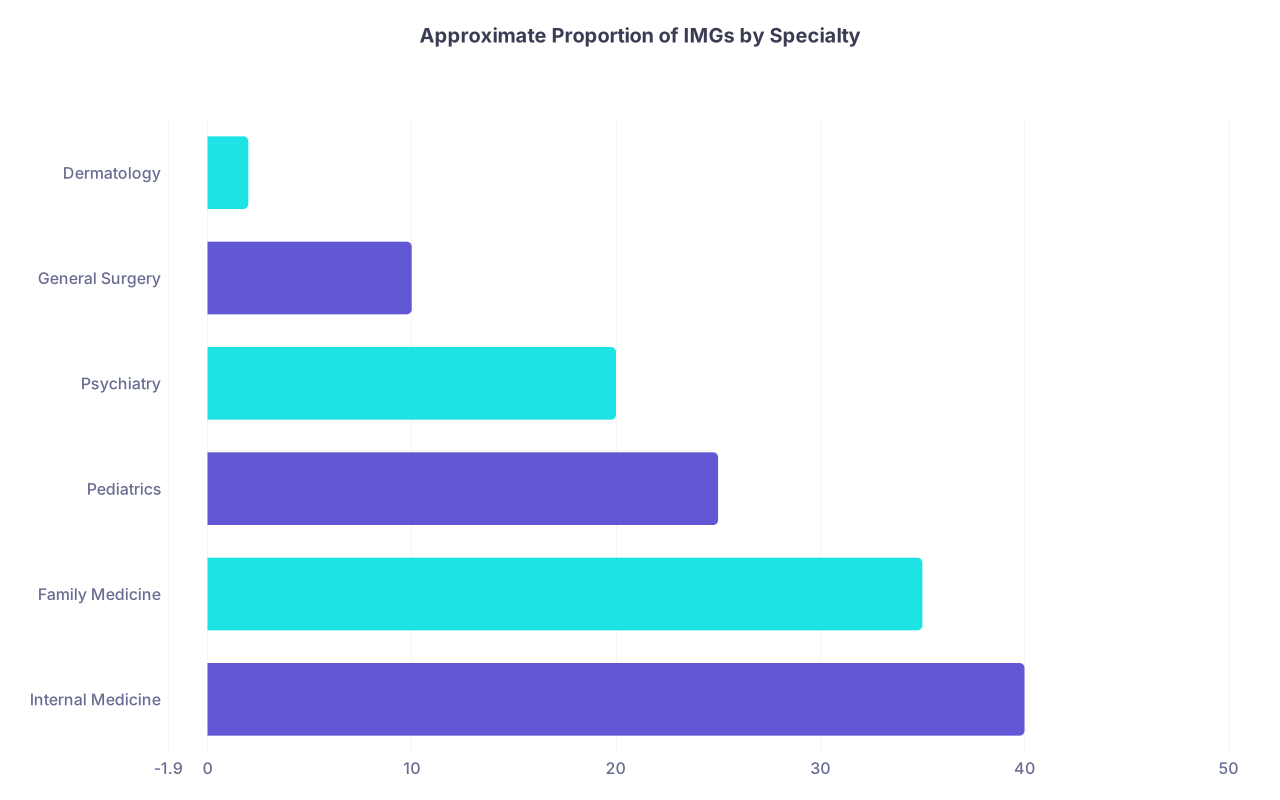
| Category | Value |
|---|---|
| Internal Medicine | 40 |
| Family Medicine | 35 |
| Pediatrics | 25 |
| Psychiatry | 20 |
| General Surgery | 10 |
| Dermatology | 2 |
These are rough illustrative numbers, but the pattern is real: IMGs get funneled into a narrow set of less competitive fields, often at less resourced programs.
And even within those specialties, US grads get first pass at interviews and top programs. You’re competing from behind before you ever show up.
So no, going offshore doesn’t just risk “not matching Derm.” It risks:
- Not matching at all
- Matching into a last-ditch prelim or less supportive program
- Ending up geographically locked in places you’d never have chosen if you had more options
The “I don’t care what I match into” line sounds noble. It’s usually just uninformed.
Hidden Landmines: Attrition, Loans, and Clinical Rotations
Backup plans are supposed to protect you from catastrophe, not create a new set of failures that are harder to recover from. Offshore schools come with some brutal hidden landmines.
1. Attrition and “Academic Standards”
Many international schools maintain superficially high USMLE pass rates by quietly shedding a huge percentage of students before they ever take Step 1 or Step 2.
You’ll see numbers like: “Our Step 1 pass rate is 95%.”
Here’s the question they don’t answer: “95% of whom?”
The top half that survived, or the whole entering class?
I’ve watched this pattern: first semester, classes are crowded. By the time the cohort hits clinical years, the room feels half-empty. People didn’t all “transfer.” They washed out.
At a US MD or DO school, attrition is relatively low and usually linked to truly significant academic or personal problems. At offshore schools, attrition is almost baked into the business model.
2. Loans You Can’t Outrun
Most US students going international finance with federal loans (where eligible) or brutal private loans. Either way, you’re likely staring at $250k–$400k+ of debt by the time you’re done. Perhaps more.
If you match, you have income and options. Hard, but survivable.
If you don’t match, you’re in a uniquely ugly position: you owe physician-level debt without physician-level income.
You can’t discharge federal loans in bankruptcy. They stick.
A “backup plan” that potentially leaves you with six-figure debt and no license is not insurance. It’s leverage—against you.
3. Clinical Rotations: You’re a Guest in Someone Else’s House
US clinical rotations for IMGs are not guaranteed, universal, or equal. They’re dependent on:
- Limited affiliation agreements
- The whims of hospital administrators
- Visa and regulatory issues
- Competition from US DO/MD schools expanding their own class sizes
I’ve seen students rotated through a patchwork of community hospitals with minimal teaching, constantly moving, trying to impress attendings who already have US students to evaluate.
Your clinical letters of recommendation are heavily shaped by where you rotate and what those sites think of your school. That matters when your application is already tagged “IMG.”
If your school loses a rotation site, merges, or gets bad press, you pay the price. Often without warning.
Backup plan? Or hostage situation?
Time: The One Cost Premeds Constantly Misprice
Here’s the part nobody bothers to quantify: the opportunity cost of going offshore vs regrouping and strengthening your US application.
Let’s compare two paths for a student with a borderline US profile.
You have:
- GPA: 3.3
- MCAT: 505
- Decent clinical exposure, spotty research, average letters
You apply late, get no US MD or DO acceptances, and you’re panicking in May.
You see ads: “Start medical school this fall in the Caribbean – rolling admissions!”
And it sounds like salvation.
Now compare two scenarios.
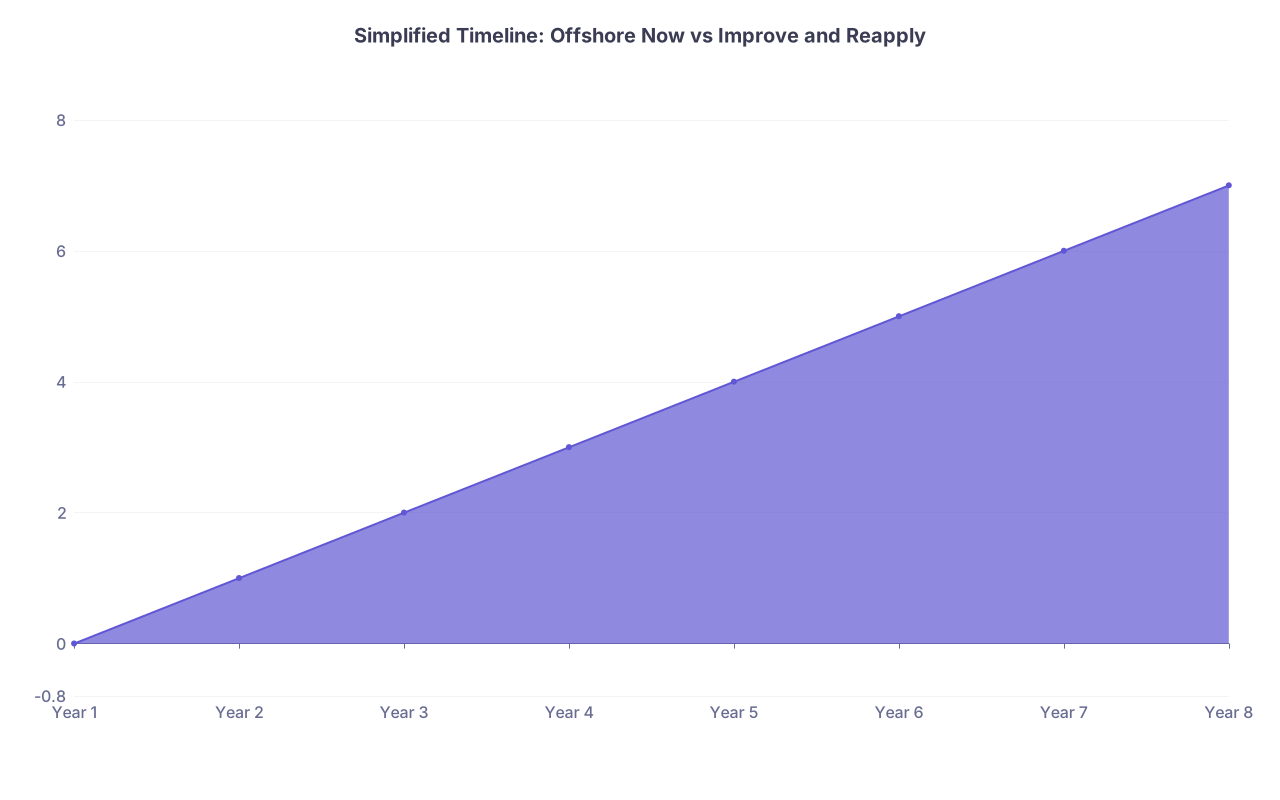
| Category | Value |
|---|---|
| Year 1 | 0 |
| Year 2 | 1 |
| Year 3 | 2 |
| Year 4 | 3 |
| Year 5 | 4 |
| Year 6 | 5 |
| Year 7 | 6 |
| Year 8 | 7 |
Ignore the exact numbers in that chart; focus on the concept: you’re trading time and risk.
Scenario A: Go Offshore Immediately
- Start med school this fall
- 4–5 years of school, then apply for residency
- Maybe you match. Maybe you don’t.
- If you fail out, fail boards, or don’t match, you’ve burned 4–7 years and accrued massive debt with no MD/DO job at the end
Scenario B: Take 1–2 Years, Fix the Application, Reapply US
You use 1–2 years to:
- Retake the MCAT properly
- Fix GPA narrative with post-bacc or SMP
- Get real, longitudinal clinical experience
- Build stronger letters and a coherent story
Worst case, you still do not get in. But now:
- You have far less debt
- You have stronger credentials for adjacent careers (PA, NP, research, public health, biotech, etc.)
- You haven’t committed to a high-risk offshore track that can trap you
Best case, you get into a US MD or DO program, and your odds of actually becoming a practicing physician skyrocket.
Backup plans should reduce overall risk exposure over time. International schools often do the opposite.
So When Does an International School Make Sense?
Notice I’m not saying no one should ever go to an international school. That would be lazy and false. I’m saying it’s not a generic safety net for any premed with a bruised ego and a 3.2.
Offshore or foreign schools are closer to a high-variance, high-risk play that might work if:
- You have truly exhausted realistic US MD and DO options
- You fully understand the match statistics and are prepared to live with the downside risk
- You are willing to work disproportionately hard, early, and consistently to be in the top tier at your school
- You’re okay with possibly practicing in a narrower range of specialties and locations
In other words: it can make sense as a deliberate, eyes-open gamble for a small slice of applicants.
Not as “well, if this cycle doesn’t work out, I’ll just go Caribbean.”
One more thing: not all international schools are equal.
- Established Caribbean schools with long track records and known match histories are very different from random “new” schools that popped up on a small island with slick websites and almost no alumni.
- Reputable foreign schools in countries like the UK, Ireland, Australia, or Canada are a different conversation altogether—but they come with their own challenges getting back into the US system.
If you’re considering an international route, you need to drill into specific, program-level data, not generic “IMG” outcomes.
What a Real Backup Plan Looks Like
A serious backup plan for a US premed should:
- Preserve optionality
- Limit unbounded downside risk
- Keep you employable and financially functional even if Plan A fails
That might look like:
- A structured post-bacc or SMP with known linkage outcomes
- A gap year or two with real clinical and research work while you strategically reapply
- Parallel plans into PA, NP, or other health professions if you decide MD/DO odds are not where you need them to be
- Accepting that medicine may not work out and building a life that does not depend on an M.D. or D.O. after your name
Notice what’s missing:
“Send $2,000 deposit to a school that accepted you in 48 hours after a 20-minute phone interview and a scanned transcript.”
If the admissions process feels easier than your college honors program, it’s not because you’re suddenly a superstar. It’s because you are the business model.
The Bottom Line
Let’s strip this down.
- International medical schools are not a risk-free “backup plan”; they’re a higher-risk, lower-odds route where failure is common, expensive, and hard to recover from.
- Match rates, attrition, debt burden, and limited specialty options all tilt against you once you leave the US MD/DO pipeline, especially if you enrolled offshore just to avoid reapplying.
- A real backup plan may sting your pride in the short term—extra years, more studying, or even a change of path—but it does not quietly lock you into a coin-flip gamble with your entire future.


