
The biggest myth about “English-taught” European medical schools is simple: people think English on the website means English in real life. It usually does not.
If you are planning to study medicine in Europe as a non‑native, the language requirements are the make‑or‑break detail almost nobody reads carefully. They look at tuition, they look at recognition, they ignore the line that matters: “clinical years conducted in the language of the host country.”
Let me walk you through this properly.
1. The core reality: three different “languages” you have to think about
You are not just asking “Will they teach me in English?” You are asking three different questions:
What language is used:
- for pre‑clinical teaching (lectures, exams, anatomy, biochem, etc.)?
- for clinical rotations (ward rounds, history taking, OSCEs)?
- for paperwork + daily life (immigration, housing, bank, hospital HR)?
What language level is officially required (B1? B2? C1?) and at which year?
What language level is actually needed to function without being dead weight on the ward?
Those are three different answers in most non‑English European med schools.
Broad pattern:
- Years 1–2: often in English on “international tracks”
- Years 3–6: patients and staff speak the national language; your bedside exams and real assessment depend on that
- Hidden requirement: if you want local licensure or EU mobility, you usually end up needing B2–C1 in the local language by graduation, whether or not the brochure screams about it
2. CEFR levels and what they really mean in a hospital
European programs almost always quote CEFR levels (A1–C2). They sound abstract until you are in internal medicine trying to take a history from a 78‑year‑old who mumbles.
Here is what those levels translate to in actual clinical work:
| Level | What You Can Realistically Do With Patients |
|---|---|
| A2 | Basic phrases, introductions, simple questions with help |
| B1 | Simple history with cooperation, lots of gaps, you miss nuances |
| B2 | Functional history/physical, manage follow-up questions, handle most routine situations |
| C1 | Work almost like a local junior doctor, catch subtleties, manage complex conversations |
| C2 | Native-like; extremely rare among foreign students |
Most universities write B1 or B2 as a requirement for clinical years. In practice:
- B1: You will survive. You will not shine. You will rely on colleagues and English‑speaking patients.
- B2: You can actually function, present, write notes with supervision.
- C1: You can fully integrate into the system, have tough conversations, talk to family members.
If your long‑term goal is local residency training in that country, mentally target B2–C1 by graduation. Anything less is self‑sabotage.
3. The main models across Europe: not all “English programs” are equal
European med schools fall into a handful of language-setup patterns. You need to know which is which.
Model 1: Fully local-language programs (Germany, France, Italy local track, etc.)
These are traditional national programs:
- Entry exams and instruction: local language from day 1
- Clinical years: 100% local language
- Official requirement: usually C1 before starting or soon after Year 1 (e.g., TestDaF C1 for Germany, C1 DALF for France, C1 Italian for most public programs)
For non‑EU students, these are brutal to enter unless you:
- Already have high-level proficiency (often from schooling in that country), or
- Commit 1–2 years beforehand to intensive language study + certification
For most international premeds starting from zero, these are not realistic “next year” options. They are a 2–3 year plan.
Model 2: English-taught preclinical + local-language clinical years (very common in Central/Eastern Europe)
Think: Poland, Czech Republic, Hungary, Slovakia, Romania, Bulgaria, some Italian “English tracks.”
Pattern:
- Years 1–2: lectures, exams, basic sciences in English
- Concurrently: mandatory local language courses (2–4 hours/week)
- Year 3 onwards: hospital rotations where:
- Patients speak only the national language
- Ward rounds, orders, nursing communication are in the local language
- Some attendings switch to English for you; many do not
Official line: often “we require B1/B2 in [local language] by year 3” or “clinical interaction in local language.”
Reality: I have watched third‑year students in Prague and Budapest freeze because they cannot ask “Do you have chest pain at rest or only with exertion?” without translating on their phone.
Model 3: Mostly English instruction, mixed-language clinical reality (Northern and some Western Europe)
Think: some tracks in Sweden, Netherlands, Belgium, some private schools.
- Lectures: largely in English for international cohorts
- Hospitals: complex
- University hospitals may have some staff fluent in English
- Patients overwhelmingly use the national language
- Often there is an expectation (sometimes unwritten) that you will reach B2 in the national language by the time you hit the wards
The dangerous trap here is the “everyone speaks English, you’ll be fine” narrative. Staff might, patients usually do not. And ethical practice demands you talk to the patient, not only to your consultant.
Model 4: Truly English-medium programs with English-speaking patient populations (very few)
Examples: some Cyprus programs, certain offshore schools that base clinical years in the UK/US/Caribbean.
- Preclinical: English
- Clinical: possibly English-speaking patients (or rotations done in the UK/Ireland/US)
- Local language: optional or minor
This is the smallest category and usually comes with trade‑offs:
- Higher tuition
- Recognition/licensing issues in some countries
- Less integration with local health systems
Do not assume a program is in this group unless you see explicit language about clinical rotations in English-speaking environments.
4. Country-specific patterns: what actually happens on the ground
Let me break down some commonly targeted regions. I will focus on non‑English systems that attract a lot of international applicants.
Central and Eastern Europe (Poland, Czech Republic, Hungary, Slovakia, Romania, Bulgaria)
These are the classic “English program in Europe” destinations.
Common universities:
- Poland: Jagiellonian (Kraków), Medical University of Warsaw, Gdańsk, Poznań
- Czech Republic: Charles University (multiple faculties), Masaryk
- Hungary: Semmelweis (Budapest), Szeged, Debrecen
- Romania/Bulgaria: Carol Davila, Cluj, Iasi, Sofia, Plovdiv, Varna, etc.
Language setup:
- Years 1–2
- Medium: English (lectures, exams)
- Local language: mandatory classes, often A1 → A2/B1 by Year 2
- Year 3+
- Clinical contact: patients in Polish/Czech/Hungarian/Romanian/Bulgarian
- You are expected to:
- Take histories in the local language
- Present to staff (often allowed in English) but answer patient questions locally
- Write at least simple documentation in the local language in some hospitals
Typical official requirement:
- Entry: English proficiency (if you are not from an Anglophone system)
- Before clinical years: B1 or B2 in the national language, sometimes tested by the university’s internal exam
Actual bar to function:
- Aim for B2. B1 “passes the exam” but does not make you competent in a busy clinic.
Student reality:
- I have seen two types of foreign students here:
- Those who treat language as a core subject: they reach B2, can banter with nurses, get good evals
- Those who cram vocabulary for language tests: they survive, but their clinical training is hollow; they often struggle if they try to work locally afterward
If your goal is:
- Return to UK/US/Canada: you might escape high-level local fluency, but your clinical years will be less effective.
- Stay in country / in EU for residency: take the language deadly seriously from day 1.
Germany and Austria
There are practically no genuine, recognized English-language full medical programs in public German/Austrian universities.
- Main medium: German
- Required level: typically C1 (TestDaF, telc C1 Medizin, DSH, ÖSD C1, etc.)
- Clinical language: 100% German with patients, colleagues, nursing staff
Private or hybrid options sometimes advertise English, but:
- Either they are pre‑med/Foundation‑year pipelines, or
- They still require high-level German by clinical years, or
- They have recognition/licensing limitations
If your dream is “study in Germany, then work there as a doctor,” your realistic route:
- 1–2 years language (A1 → C1)
- Pass medical language exams
- Then apply like any local student
You cannot bypass German in this system.
France, Spain, Italy (public tracks)
All three follow a similar pattern for their core national programs:
- Entry exams: in French / Spanish / Italian
- Language requirement: essentially C1 before entry
- Clinical years: fully local language
However, Italy is a partial exception because of English-taught MD programs (IMAT programs):
- Examples: University of Milan, Pavia, Rome “La Sapienza”, Naples, etc.
- Preclinical years: English
- Official line: clinical teaching can be in English for international cohorts, but…
- Patients: Italian
- Hospitals: mostly Italian in daily work
- Students: routinely report that B1–B2 Italian is needed by the time serious clinical years begin
France and Spain have tiny or no fully recognized English MD options in their public systems; most “English” offerings are postgraduate or partial.
Netherlands, Scandinavia, Belgium
These regions have high general English proficiency. That misleads many applicants.
Reality:
- Core MD programs in Dutch, Swedish, Danish, Norwegian, Finnish, Flemish.
- Admission: typically requires local-language fluency (B2–C1).
- Some early coursework: may be partially in English.
- Clinical years: local language dominates.
Private or limited‑enrollment “international tracks” sometimes teach preclinicals in English, but again:
- Clinical contact needs local language
- Long‑term licensing often requires high local-language proficiency
The only exceptions where English is truly dominant are narrow, competitive, and often not suitable for non‑EU students without serious language investment.
5. Official requirement vs. functional reality
Many brochures throw casual lines like:
- “Students are encouraged to learn the local language.”
- “Basic knowledge of [language] is recommended for clinical years.”
- “Communication with patients will be in [language].”
Translate that into actual stakes:
- Your clinical grades may depend on how well you can handle patient interviews.
- Your OSCEs could be assessed in the local language.
- Your internship / pre‑registration year (often required for local licensing) will be conducted fully in the national language, at something close to C1.
Also, think about:
Professional liability and ethics:
Relying on ad hoc translation by family members or nurses for everything is unacceptable long term. Good programs and hospitals will not be comfortable with a trainee who chronically cannot speak to patients.Your learning curve:
If your cognitive load is 90% “what is this word” and 10% “what is this disease process,” your learning suffers.
My blunt view: if an English-taught program expects you in local hospitals, you either commit to becoming conversationally strong (B2) or you accept that your clinical training will be superficial.
6. How schools actually structure the language requirement
Let me spell out the usual progression across many programs:
Year 1:
- Local language classes: basic phrases, alphabet/pronunciation, introductory medical vocabulary.
- Level goal: A1–A2.
Year 2:
- More grammar, everyday conversation, anatomy and organ-system vocab.
- First simple hospital visits, maybe with standardized patients.
- Level goal: A2–B1.
Year 3:
- Transition to clinical: histories with real patients (supervised).
- Some schools run an internal B1/B2 exam as a gate to begin full clinical rotations.
- Level goal: solid B1 or weak B2.
Year 4–6:
- Fewer classroom lessons; you are expected to self‑improve via immersion.
- History, physical exam, and some oral exams in the local language.
- By graduation, effective programs aim to bring you to B2, at least in spoken interaction.
A common failure mode: students treat language courses like low‑stakes side classes. They pass exams, but they never build real spoken fluency, because:
- They socialize mostly with other internationals
- They default to English whenever possible
- They “study” the language like biology: cram, pass, forget
Those are the people who, in Year 4, ask the nurse to “translate” a blood pressure reading because they still cannot parse fast speech.
7. Verification: how to check a school’s real language demands
Do not rely on the glossy PDF. Here is how you verify the actual language situation.
Read the study plan in detail
Look for:- “Foreign language – X ECTS per semester”
- “Communication with patients in [language] from year Y”
- “Prerequisite language exam before clinical rotations”
Search in the local language section of the university website
The English subsite often sanitizes things. The local-language pages for the same faculty may clearly state:- Required level for internship
- Language exams integrated with OSCEs
- Rules for clinical placements
Contact current students – not just official ambassadors
Ask very precise questions:- In what language do you take histories on internal medicine?
- Are nurses/doctors willing to switch to English on the ward?
- Is there a language exam before third year?
- How many students actually reach good local fluency?
Ask the admissions office bluntly
“If I arrive with zero [local language], and only do the compulsory classes, will I be able to function in clinical years without extra classes?”
Watch their wording. Hesitation or vagueness is a red flag.Check licensing requirements for that country
Even if the MD is mostly in English, to work there you will probably need:- A national medical board exam that is in the local language
- Official B2 or C1 certification in the national language (not just internal university exams)
8. Practical study strategy: how to hit B2 while doing med school
Reaching B2 in a European language during med school is absolutely doable if you are methodical. What does it really take?
Timeline and volume
If you start from zero:
- 600–800 hours of active study + immersion to get to B2 in an “average” European language (Polish/Hungarian is on the harder side; Romance languages a bit easier).
- Spread over 3–4 years, that is:
- Formal classes: 3–4 hours/week during semesters
- Self-study: another 3–5 hours/week (ideally daily small blocks)
- Clinical practice: from Year 3 on, every single patient interaction is practice
What actually works (and what does not)
What works:
- Daily contact: even 20–30 minutes matters more than a 4‑hour Sunday cramming session.
- Speaking early: language exchanges with locals, conversation clubs, paid tutors.
- Clinical shadowing focused on listening: in your first hospital exposures, stand next to the doctor and silently map what you hear to what you know in English.
What does not:
- Only doing textbook grammar exercises
- Relying solely on university courses
- Staying inside an English‑speaking bubble of international students
I have seen Hungarian- and Czech-taught students from Nigeria, India, UK, and Canada hit B2+/C1 level within 3–4 years because they treated the language like a core subject, not an elective. The ones who treat it like “annoying extra work” never get past tourist level.
9. Strategic decisions: how language should shape your school choice
This is where you need to be brutally honest with yourself.
Question 1: Do you actually want to practice in that country or region?
If yes:
- You must factor full professional language proficiency into your plan.
- Picking a country with a language you find more learnable or personally interesting is not trivial—it affects your success.
- Example: An English speaker usually climbs faster in Italian/Spanish than Hungarian/Polish, all else equal.
If no (you plan to return home for residency):
- You can still go to a program with strong local-language demands, but:
- Accept that your life will be harder for 6 years.
- Your clinical skills may be hampered if you never truly engage linguistically.
- Some licensing bodies back home may still want proof of local language for certain rotations or evaluations abroad.
Question 2: How much time are you honestly willing to give to language learning?
If your answer is “I just want to pass med school and then leave” and you are not willing to invest 3–5 hours a week long term into the language, then:
- Programs with heavy local-language clinical reliance will feel like constant friction.
- You might be better off in:
- Programs that send you to English-speaking clinical sites
- Regions where your own language is more widely used among patients (limited)
Question 3: Do you have any prior language base?
- If you already have B1 in a Romance language, choosing Italy/Spain/France‑adjacent systems might accelerate progress.
- If you speak a Slavic language, Polish/Czech/Slovak become less intimidating.
- Use your base. It matters.
10. Red flags and green flags in school marketing
Let me give you some concrete phrasing to watch.
Red flags:
- “Classes are in English; however, students are encouraged to learn the local language for communication with patients.”
Translation: you will not function on the wards without the local language. - “Basic language skills are recommended for clinical practice.”
Translation: they will not spoon-feed you; your rotation quality will sink if you neglect it. - “No formal language requirement for admission.”
Translation: they will push the pain to Years 3–4, not eliminate it.
Green(er) flags:
- “B2 proficiency in [local language] required before starting clinical years; university provides structured pathway to this level.”
Translation: they at least acknowledge reality and build a track for it. - “Clinical rotations partly in partner hospitals in English-speaking countries for international students.”
Translation: partial escape hatch, but still check details and recognition. - “Dedicated medical language courses with simulated patient encounters in years 1–3.”
Translation: better preparation than generic language classes.
11. One concrete example comparison
To make this less abstract, here is a simplified comparison of two common program types:
| Feature | Central/Eastern Europe English Track | Italian IMAT English Track |
|---|---|---|
| Preclinical language | English | English |
| Local language teaching | 2–4 hrs/week, Years 1–3 | 2–3 hrs/week, Years 1–2 |
| Official local language requirement for clinical years | B1–B2 internal exam | Often B1 Italian “recommended” |
| Clinical patient language | National language only | Italian only |
| Realistic functional target | B2 by Year 4 | B2 Italian by Year 4 for comfortable practice |
Notice: both advertise “English degree.” Neither frees you from needing the local language once you touch a real patient.
12. How language intersects with future licensing (US, UK, elsewhere)
A few quick but important points:
US/Canada:
They do not care about your foreign language level directly, but:- USMLE prep and clinical letters depend on quality clinical exposure. If you are lost in translation, you will not get strong letters or solid hands‑on skills.
- Some US observerships want proof that your core med school clinical curriculum was in a language you fully understood.
UK/Ireland:
You may end up needing local language in addition to English if you later seek training in a non-English EU country. Also, GMC looks at the quality of your clinical training; being a passenger on wards because of language issues is not ideal.Practicing in the country of study:
Expect formal language exams (B2 or C1), medical vocabulary tests, and sometimes national clinical exams entirely in the local language before full registration.
13. What I would personally do if I were choosing now
If I were an English-speaking premed looking at non‑English European med schools, here is my honest strategy:
Decide whether I am willing to treat the local language as a parallel major. If not, I narrow down to the very few English‑only clinical setups or reconsider the entire region.
If I am willing:
- I pick a country where:
- I have at least some motivational interest in the language/culture
- The language is not unusually difficult for my background
- I start learning before I land. A1/A2 before Year 1 makes everything easier.
- I pick a country where:
During preclinical years, I give language 3–5 hours per week, every week. No off‑seasons.
By the time clinical years begin, I want to be at strong B1 → B2:
- Can hold a 10‑minute conversation about non‑medical topics without English.
- Can take a basic history from a cooperative patient with some repetition.
If that level of commitment feels absurd to you, then the entire idea of a non‑English European medical school is misaligned with what you are actually willing to do.
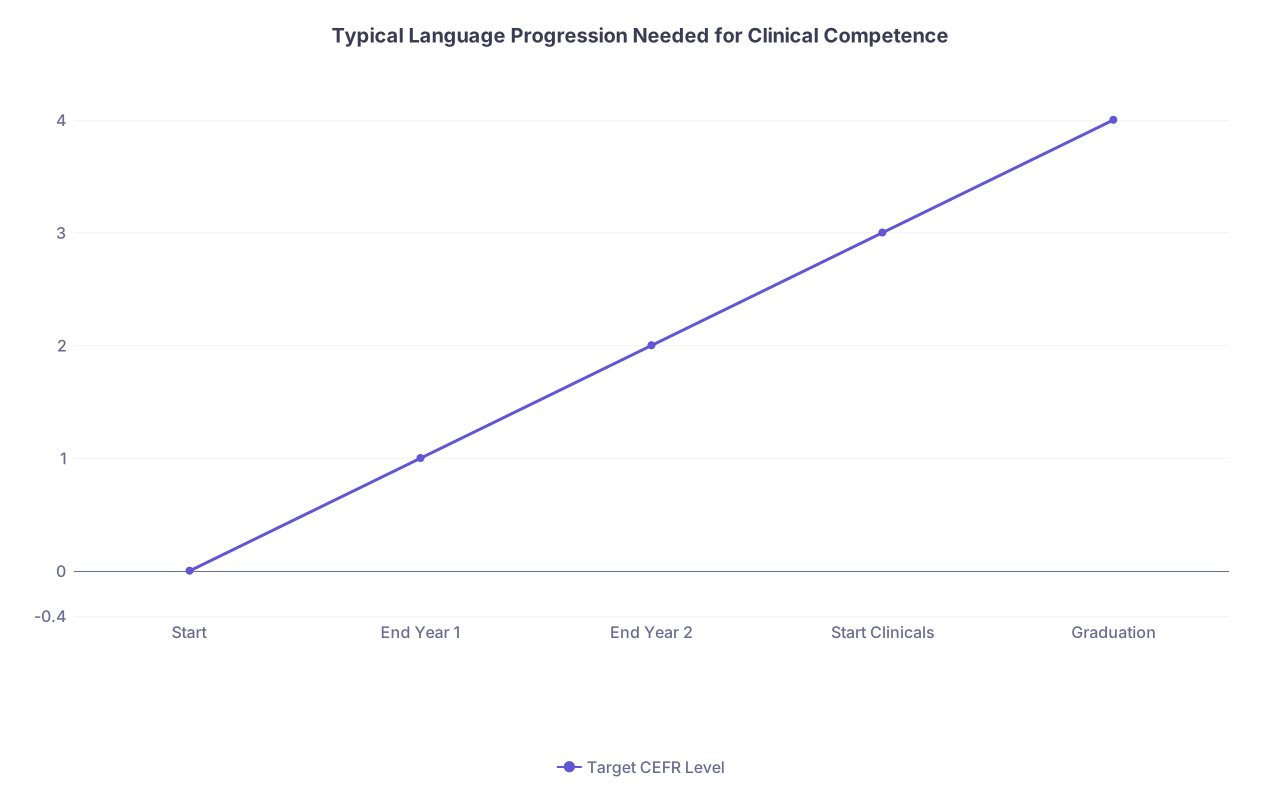
| Category | Target CEFR Level |
|---|---|
| Start | 0 |
| End Year 1 | 1 |
| End Year 2 | 2 |
| Start Clinicals | 3 |
| Graduation | 4 |
(Where 0 = no knowledge, 1 = A1/A2, 2 = B1, 3 = B2, 4 = C1.)

| Step | Description |
|---|---|
| Step 1 | Want to study in Europe? |
| Step 2 | Look for English-only clinical programs or reconsider |
| Step 3 | Target B2-C1 before graduation; pick integrated language-heavy program |
| Step 4 | Still aim for B2 for effective clinical training |
| Step 5 | Willing to learn local language seriously? |
| Step 6 | Want to work in that country? |
Key takeaways
- “English-taught” does not mean “English-used-in-clinical-years.” Patients and real life run on the local language almost everywhere in Europe.
- If you choose a non‑English European med school, you are effectively signing up to learn a second professional language to at least B2 level, often higher if you want to practice there.
- The students who thrive are the ones who treat language as a core part of their medical training, not as a side course to tolerate. If you will not do that, choose your school and country accordingly.


