
Most premeds are asking the wrong question about Caribbean vs Eastern European programs. The issue is not “which is better?”—it is “which structural disadvantages am I willing to live with, and can I actually overcome them?”
Let me be blunt: both routes are uphill compared with a solid U.S. or Canadian MD/DO. But the way they are uphill is very different. If you do not understand those structural differences—curriculum design, clinical access, visa status, accreditation, and match strategy—you are essentially choosing blind.
I am going to walk you through the parts that actually matter for your future ability to practice in the U.S., Canada, or Western Europe. Not the marketing fluff. Not the Reddit mythology. The concrete, structural pieces that determine how hard your life will be from M1 through residency match.
1. What “Caribbean MD” And “Eastern European MD” Really Mean
Forget the marketing brochures for a moment. Structurally, these two pathways are built on completely different models.
Caribbean MD: US-Style, Export-Oriented, Exam-Driven
Most large Caribbean schools exist almost entirely to funnel graduates into U.S. (and to a lesser extent Canadian) residency positions. They are designed around that export function.
Typical Caribbean MD structure:
- Location: Island campus (basic sciences) + U.S. (and some Canadian/UK) clinical sites
- Language: English instruction and exams
- Curriculum: US-style, organ systems-based, Step/USMLE focused
- Students: Majority U.S./Canadian citizens, often with weaker stats or red flags
- Clinical years: Core and elective rotations often spread across multiple U.S. hospitals, many community-based, some low-prestige academic affiliates
- Regulatory dependence: Entire business model depends on U.S. licensing bodies and state approvals
In practice: You do your preclinical years on an island, then bounce between U.S. hospitals doing core and elective rotations. Everything—from lecture content to practice exams—is oriented around USMLE Step performance and U.S. match outcomes.
Eastern European MD: Local Systems With an English-Language Layer
Eastern European programs (Poland, Hungary, Czech Republic, Romania, Bulgaria, etc.) are national medical schools that have grafted an English-language track on top of their domestic medical education system. Their primary obligation is to their own health system and EU standards, not the U.S. match process.
Typical Eastern European MD structure:
- Location: Entirely in one country (e.g., Warsaw, Budapest, Prague)
- Language: English-program cohort, but hospital and daily life are often in the local language
- Curriculum: European 6-year program (or 4/5-year graduate entry), Bologna/EU-aligned, not USMLE-centric
- Students: Very international—EU, Middle East, Asia, North America mix
- Clinical years: Done mainly in local teaching hospitals, under that country’s system and language
- Regulatory orientation: Designed for EU/host-country practice, with U.S. as a side possibility for a minority
In practice: You live in one city for 6 years, attend lectures with your English-track cohort, and do clinicals in local teaching hospitals. Faculty care about their national licensing exams and EU standards first, USMLE second or third.
These root differences drive almost everything else: how you study, where you rotate, what exams you focus on, and how programs see your training.
2. Curriculum Structure: USMLE-Engineered vs. EU-Standard
Here is where a lot of students underestimate the consequences.
Caribbean: Condensed, High-Pace, USMLE-Framed
Most big Caribbean schools run a compressed, high-intensity curriculum to push you toward Step 1 quickly.
Common features:
- 2 basic science years divided into 3–4 trimesters per year (not 2 semesters)
- Heavy reliance on U.S. prep resources (NBME-style questions, UWorld-like banks)
- Integrated organ systems model mirroring U.S. schools
- Internal promotion policies directly tied to Step readiness
- Mandatory “NBME comps” or school-made comprehensive exams before you are allowed to sit Step 1
Day-to-day reality: You are on a treadmill. No summers. Short breaks. Constant assessment. The Step 1 calendar basically runs your life, and the school is very explicit about it.
Eastern Europe: Longer, Broader, Not Built Around USMLE
Eastern European curriculums follow a 6-year model (with some 4-year graduate entry options):
Years 1–3: Heavy on basic sciences, anatomy, physiology, histology, biochemistry, public health, often more old-school, discipline-based rather than system-based integration.
Years 4–6: Clinical rotations in internal medicine, surgery, pediatrics, OB/GYN, psychiatry, family medicine, etc. Structured to satisfy national licensing exam requirements.
USMLE-specific content? Often minimal:
- Pathology, pharm, micro are taught, but not in “First Aid for the USMLE Step 1” language
- Clinical reasoning is aligned with local guidelines, not necessarily American guidelines
- You usually self-study for USMLE on top of your coursework if you plan to go to the U.S.
So structurally:
- Caribbean schools: Sacrifice breadth, research depth, and academic “fluff” to maximize Step 1/2 performance and U.S. competitiveness.
- Eastern European schools: Maintain a broad, often more theoretical curriculum that satisfies EU standards, and USMLE preparation is your responsibility, not theirs.
3. Clinical Rotations: Geography, Quality, and Perception
Clinical structure is where these pathways truly diverge in ways that matter for residency directors.
Caribbean: Distributed U.S. Rotations, Patchwork Experience
Caribbean schools buy or contract clinical slots in U.S. hospitals. That has pros and cons.
Common pattern:
- Core rotations (IM, surgery, peds, OB/GYN, psych, family) in community hospitals or lower-tier academic centers in the U.S.
- Electives sometimes in larger academic programs if the school has decent relationships
- Rotations scattered: 6 weeks in Brooklyn, 8 in Chicago, 4 in Miami, etc. Lots of moving, short leases, and instability
- Some sites are high-yield, well-organized; others are glorified shadowing with minimal teaching
Residency director perspective: They know your core clinical training was at U.S. hospitals, but also know:
- Supervision and evaluation are variable
- Some Caribbean-affiliated sites are notorious for poor documentation and weak letters
- Students may have less continuity and less longitudinal patient care experience
You can absolutely get strong clinical experiences as a Caribbean student—but you will fight site variability and scheduling instability structurally baked into the model.
Eastern Europe: Stable, Local Teaching Hospitals, But Not U.S.-Context
Now Eastern Europe flips that.
Structure:
- Almost all clinical rotations in one or a few local university-affiliated hospitals
- Longitudinal exposure to services, more stable teams, more chance to be “known” by faculty
- Clinical hierarchies and expectations similar to European systems—more observation early, more responsibility late
- But: Care is delivered under local protocols, with local language, in a health system quite unlike the U.S.
Residency director perspective (U.S.):
- You have solid, sustained clinical experience, but not in the U.S. system
- They worry about your adjustment to U.S. documentation, EMR, billing, and practice norms
- LORs from Eastern European professors are often read as less predictive of how you will function in a U.S. residency
So, structurally:
- Caribbean: U.S. context, fragmented experiences. Looks more “familiar” but less stable.
- Eastern Europe: Stable, teaching-hospital-based experiences. But foreign context, foreign system.
4. Licensing, Accreditation, and Regulatory Structures
Here is where people get burned because they did not pay attention to the fine print.
U.S. State Approvals & ECFMG
To practice in the U.S., both paths must:
- Graduate from a school recognized in the World Directory of Medical Schools (WDOMS).
- Be eligible for ECFMG certification (which itself is tightening under the 2024 accreditation requirements).
- Be accepted by specific states you may want to train or practice in.
Caribbean programs:
- The big 4–6 schools (SGU, AUC, Ross, Saba, etc.) usually have New York, California, and sometimes Texas approvals, or at least recognition that allows clinicals and licensure.
- Lower-tier Caribbean schools often lack these, or have partial / limited approvals.
Eastern European programs:
- Generally recognized in WDOMS
- Typically run under national accreditation systems that will satisfy ECFMG 2024 requirements (EU accreditation is broadly acceptable)
- State-by-state quirks still exist, but outright bans are less common than with low-tier Caribbean schools
Bottom line: The accreditation risk is usually higher with no-name Caribbean programs than with established Eastern European universities. For Caribbean, “tier” matters structurally; for Eastern Europe, the main structural barrier is not accreditation but the downstream exam and visa realities.
Exam Orientation: USMLE vs National Exams
Caribbean schools:
- Entire progression is mapped to USMLE Step 1 → Step 2 CK.
- Many students never take another country’s licensing exam. Their degree is functionally “U.S.-or-bust.”
Eastern European schools:
- Oriented toward the national licensing exam (or EU frameworks), which vary by country.
- Many grads never sit USMLE; they stay in the EU, UK, or home country.
If you are North American and you know you want U.S. residency, the Caribbean structure is exam-aligned with your goal. Eastern Europe forces you to essentially maintain dual prep: pass local exams plus self-study for USMLE.
5. Language, Culture, and Daily Functioning
People severely underestimate the structural impact of language on clinical training.
Caribbean: English Everywhere, Culturally Mixed But U.S.-Tilted
- Instruction, exams, patient communication (mostly) in English
- Clinical staff often used to American and Canadian students
- Cultural diversity on islands, but the academic and hospital language is not an obstacle
This means your cognitive bandwidth is spent on medicine and exams, not on decoding the chart or understanding the nurse.
Eastern Europe: English in Class, Local Language in Real Life
On paper: “English-language MD program.”
In reality:
- Lectures and some small groups in English
- Many bedside rounds, patient interactions, and team discussions in local language
- Medical records sometimes partly or fully in the local language
- Nurses, ancillary staff, and some senior physicians may have limited English
You are often expected to learn enough of the local language to function clinically. That is structurally demanding. Your growth as a clinician is bottlenecked until your language improves.
Does this make you worse long-term? Not necessarily. Many become very adaptable. But during school, it is extra cognitive load and can limit how deeply involved you get in patient care.
6. Match Outcomes: Numbers, Bias, and Specialty Ceiling
Residency directors do not evaluate all non-U.S. schools equally. Caribbean and Eastern European grads get lumped under “IMG,” but there are real structural differences.
The Harsh Reality: Both Are IMGs, But Not The Same Kind
In the U.S. NRMP data, both groups show up in “non-U.S. citizen IMGs” and “U.S. citizen IMGs.” Caribbean has more U.S. citizens; Eastern Europe more non-U.S. citizens.
Caribbean structure advantage:
- U.S.-based rotations → U.S. LORs, U.S. clinical context, more observership-free applications
- USMLE focus → Higher chance of at least adequate Step scores if you survive the attrition gauntlet
Caribbean structural disadvantage:
- Reputation. Some PDs equate “Caribbean” with “could not get into anything else.”
- Known high attrition and Step failure rates at many schools → suspicion about the average graduate
- Often steered toward primary care and community programs, less likely to get into competitive specialties
Eastern Europe structure advantage:
- Some schools have good reputations in specific countries (e.g., Charles University, Semmelweis, Jagiellonian)
- Longer, more academic training with more research opportunities in some settings
- For those targeting EU/UK, often smoother recognition and more predictable pathways than Caribbean
Eastern Europe structural disadvantage:
- For U.S. match: lack of U.S. clinical experience unless you aggressively organize electives
- PDs may see your letters as “non-U.S., not sure how to interpret performance”
- Extra friction with visa sponsorship and unfamiliar school names
Let me put it plainly:
- If your absolute, non-negotiable goal is U.S. residency in an IM/FM/psych/peds-type field, a top-tier, well-established Caribbean school will generally give you a more structurally aligned path than a random Eastern European school—provided you perform well and do not wash out.
- If you are open to EU practice, UK routes, or home-country practice outside North America, Eastern European schools are often structurally safer long-term and less dependent on U.S. whims.
7. Visas, Citizenship, and Where You Can Actually Work
This is not about vibes. It is about what your passport, degree, and visa status let you legally do.
Caribbean Programs
Typical student profile: U.S. or Canadian citizen.
Implications:
- You do not need a visa to train in the U.S.
- You are competing as a U.S. citizen IMG, which statistically has higher match rates than non-U.S. citizen IMGs
- If you fail to match, your options abroad can be limited because Caribbean degrees are sometimes looked at skeptically by some EU/National authorities
Eastern European Programs
Student body is heavily international.
Implications:
- If you are a non-U.S. citizen, you need J-1 or H-1B sponsorship for residency. Not all programs sponsor.
- Some Eastern European schools are better recognized by EU and UK regulators; easier to get registered there than with a Caribbean degree.
- For U.S./Canadian citizens who study there, you are still “U.S. citizen IMG,” but your training context is foreign and you may need to build U.S. clinical experience through electives and observerships.
Structurally: Caribbean is more “U.S.-entry optimized,” Eastern Europe is more “multi-region option preserved” if you are willing to navigate languages and local systems.
8. Attrition, Support, And Institutional Priorities
You are not just picking a curriculum. You are picking how much the institution is invested in you succeeding versus replacing you with the next tuition check.
Caribbean: High Attrition Built Into The Business Model
Hard truth:
- Many for-profit Caribbean programs admit large classes with low admission thresholds.
- Attrition rates (failures, dismissals, voluntary withdrawals) can be very high, sometimes >30–40% from M1 entry to graduation at lower-tier schools.
- The structural financial model: admit many, keep the ones who can pass Step 1 and make the school look good.
Support exists—tutoring, remediation, counseling—but it is often reactive, and there is a constant sense of “produce a Step score or you are gone.”
Eastern Europe: Variable Selectivity, Usually Lower Attrition Once In
Eastern European universities:
- Tend to have more stable admission numbers and less of a high-churn for-profit model, though some private schools in the region are exceptions.
- Entrance exams (chem/bio/English) and sometimes interviews funnel out the obviously unprepared.
- Attrition still happens (especially around language and early basic sciences), but once integrated, students are generally carried through the 6 years unless they completely disengage.
The priority is to produce physicians for their system and foreign markets; not to use Step 1 pass rates as marketing.
9. Structural Differences That Should Drive Your Decision
Let me condense this into the structural levers that actually matter.
| Dimension | Caribbean MD | Eastern European MD |
|---|---|---|
| Primary Exam Focus | USMLE (Step 1/2) | National/EU exams |
| Clinical Location | Mostly U.S. hospitals | Local teaching hospitals |
| Language in Clinic | English | Local language + English |
| Curriculum Length | 4 years (often accelerated) | Usually 6 years |
| Match Orientation | Strongly U.S.-oriented | EU/UK/Local first, U.S. optional |
| Typical Student Citizenship | Mostly U.S./Canada | Highly international |
Now overlay your situation:
- If you are North American, completely U.S.-residency focused, willing to accept higher attrition risk and stigma in exchange for U.S.-based clinicals and USMLE-centric teaching → A top-tier Caribbean MD can be structurally aligned with your goals.
- If you want a wider geographic safety net (EU/UK), can handle living and learning in a foreign language environment, and are self-disciplined enough to add USMLE prep on top of a non-US curriculum → An established Eastern European MD program may be structurally safer.
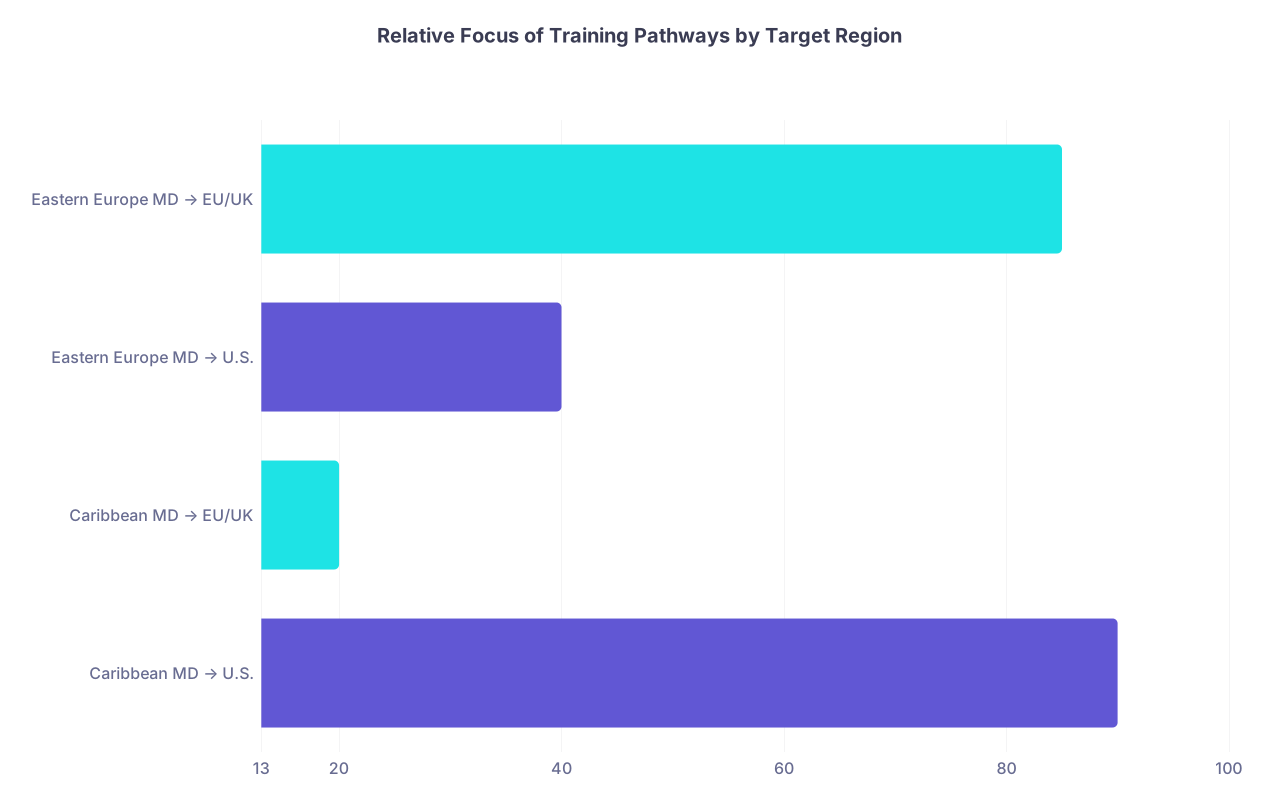
| Category | Value |
|---|---|
| Caribbean MD → U.S. | 90 |
| Caribbean MD → EU/UK | 20 |
| Eastern Europe MD → U.S. | 40 |
| Eastern Europe MD → EU/UK | 85 |
10. How To Vet Specific Schools (Not Just Regions)
Do not choose “Caribbean vs Eastern Europe” in the abstract. Choose a specific school with a specific structure.
Non-negotiable checks for Caribbean MD:
- State approvals: NY, CA, others. If missing, that is a serious structural handicap.
- Published match lists with verifiable U.S. residency placements (hospital names, specialties).
- Step 1 and Step 2 CK pass rates, not just cherry-picked top scores.
- Clinical site stability: How many core hospitals, where, and how long have they been affiliated?
Non-negotiable checks for Eastern European MD:
- University age and status: national public university vs newer private school
- Language policy in clinical years: Is there formal language training? Required proficiency?
- Track record: How many alumni in U.S. or UK training? Any structured USMLE prep or U.S. electives?
- Local recognition: Fully recognized in host country? Issues with registration elsewhere?
You are not buying a brand. You are buying a very specific structural package that will either support or sabotage your goals.

| Step | Description |
|---|---|
| Step 1 | Primary Goal: U.S. Residency? |
| Step 2 | Consider top-tier Caribbean MD |
| Step 3 | Reconsider U.S./DO or EU with strong U.S. support |
| Step 4 | Consider established Eastern European MD |
| Step 5 | Reassess goals; avoid both paths |
| Step 6 | Yes |
| Step 7 | No or Unsure |
| Step 8 | Comfort with stigma & high attrition? |
| Step 9 | Open to EU/UK practice? |
FAQ (Exactly 6 Questions)
1. Are Caribbean MD schools or Eastern European MD programs more “respected” by U.S. residency programs?
Neither group is truly “respected” the way a U.S. MD/DO is, but they are not equal either. U.S. programs are more familiar with Caribbean IMGs because of decades of exposure, especially from top-tier Caribbean schools that send large numbers of applicants every year. Eastern European grads are often less familiar and may trigger more uncertainty in program directors, unless the specific school has a known track record. Structurally, Caribbean graduates benefit from U.S. clinicals and U.S. letters; Eastern European graduates benefit from more traditional teaching-hospital training but lose points on familiarity and U.S. system experience.
2. If I want to practice in the UK or EU, is a Caribbean MD a bad idea?
Structurally, yes, it is usually a poor choice if your primary goal is EU or UK practice. Caribbean programs are built to feed the U.S. (and sometimes Canadian) residency market and may face additional scrutiny or recognition issues in parts of Europe. Many Eastern European schools, especially within the EU, have automatic or streamlined recognition across multiple European states under EU directives, making onward mobility easier. A Caribbean MD locks you more tightly into a U.S.-or-nothing scenario.
3. Can an Eastern European MD graduate realistically match into a U.S. residency without U.S. clinical rotations?
It is possible but significantly harder. Without U.S. clinical experience, your application lacks U.S.-based letters of recommendation and evidence that you can function in the American system. Structurally, you should assume that for a competitive U.S. application from Eastern Europe, you will need to organize U.S. electives or observerships (ideally core-type electives like internal medicine or surgery sub-internships), score very well on USMLE Step 1 (if available) and Step 2 CK, and target IMG-friendly programs. Some Eastern European graduates do this successfully each year, but it requires deliberate planning, not wishful thinking.
4. Are six-year Eastern European MD programs a disadvantage compared with four-year Caribbean MD programs?
The extra two years are not inherently a disadvantage. They reflect a different system: integrated undergraduate + medical education. For someone starting directly from high school, six-year programs are standard internationally. From a U.S. residency perspective, what matters more is: your exam scores, your clinical abilities, your language and communication skills in English, and your U.S. clinical exposure. The real structural “cost” is time and opportunity: two more years before you can earn an attending salary, and two more years of tuition and living expenses. But in exchange, you may get a more stable, less attrition-heavy path.
5. Which path is better for someone with weaker academic stats but strong determination: Caribbean or Eastern Europe?
If you are a U.S. or Canadian citizen with weaker stats, a top-tier Caribbean school can be more forgiving on entry but brutal afterward. The gate moves from “admission” to “Step performance.” Eastern European schools may also accept weaker applicants via private or international tracks, but once there, you must survive demanding basic science courses and potential language barriers. If your only real path to the U.S. is via IMG status, Caribbean structures your entire experience around that outcome, but with a serious risk of attrition. Eastern Europe offers a potentially more stable progression but with less built-in support for U.S. exams. Your own discipline and ability to self-study will decide more than the region.
6. How should I think about long-term flexibility if I am unsure where I want to practice?
If you genuinely do not know whether you want to end up in the U.S., UK, or EU, you should prioritize programs that preserve options rather than trap you. Structurally, established Eastern European universities with solid EU recognition provide more geographic flexibility: you can aim for EU practice, UK pathways like the UKMLA / PLAB-equivalents, or still chase U.S. via USMLE plus electives. A Caribbean MD narrows your realistic options heavily toward the U.S. and Canada. If you fail to match there, pivoting to Europe can be bureaucratically messy and sometimes impossible. When in doubt, choose the structure that closes the fewest doors.
With these structural differences clear, you are no longer just choosing a school; you are choosing a system, a set of constraints, and an entire style of training. Once you understand that, you can stop asking “Caribbean or Eastern Europe?” and start asking the only question that matters: “Which structure sets me up for the future I actually want?” The next step is to take a hard look at your own risk tolerance, academic record, and target country—and map them, honestly, onto these realities. The rest of your career flows from that decision.


