Only 42% of IMGs who start the ECFMG process actually complete every step and become certified in a reasonable time frame.
That number should scare you a little. Not because the exams are impossible, but because most people underestimate the logistical and regional nuances that derail applications. The differences between graduating in India versus Eastern Europe versus the Caribbean versus China are not cosmetic. They drive how long this takes, how much you will spend, and how many times you will want to throw your laptop against the wall while chasing documents and dean’s signatures.
Let me break this down specifically, region by region, with the actual obstacles I have seen trip people up.
1. Core ECFMG Framework (Same For Everyone, But…)
Before talking about regional quirks, you need the skeleton: what is universally required for ECFMG certification.
At a high level, you must:
- Graduate (or be near graduation) from a medical school listed in the World Directory of Medical Schools (WDOMS) with an ECFMG-eligible note.
- Create an EPIC/ECFMG account and get your identity verified.
- Have your medical school credentials (degree, final diploma, sometimes transcripts) primary-source verified by ECFMG.
- Pass the required exams (currently USMLE Step 1 and Step 2 CK; Step 2 CS is gone, replaced by pathways/OSCE-equivalent for licensure).
- Fulfill an ECFMG “pathway” for clinical/communication skills if you do not have certain credentials.
- Meet any additional country or state-specific requirements downstream (for residency or licensure).
That is the “simple” part. Where it stops being simple is how each region’s educational bureaucracy interacts with ECFMG’s obsession with direct verification, sealed envelopes, and exact name matching.
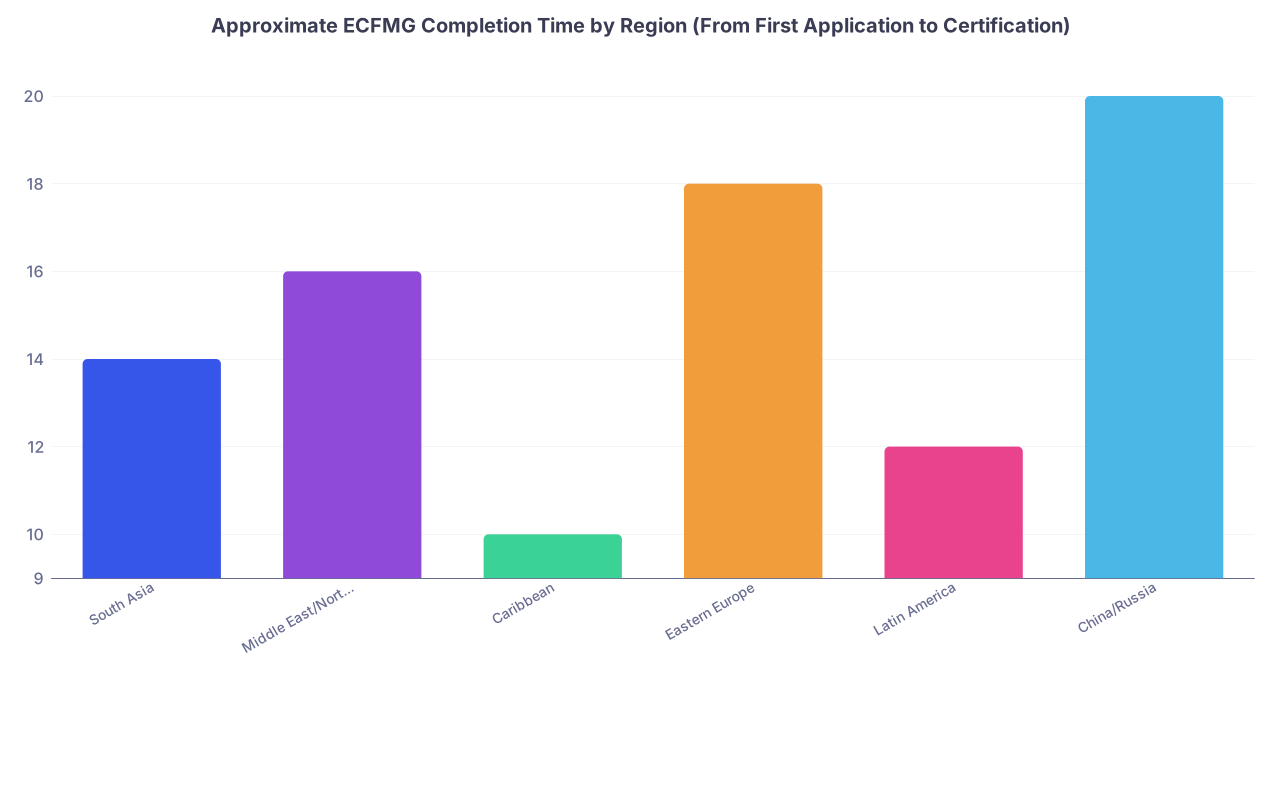
| Category | Value |
|---|---|
| South Asia | 14 |
| Middle East/North Africa | 16 |
| Caribbean | 10 |
| Eastern Europe | 18 |
| Latin America | 12 |
| China/Russia | 20 |
Those are rough averages in months. I have seen faster. I have also seen people stuck for 3+ years because their dean’s office “does not understand what ECFMG wants.”
2. South Asia (India, Pakistan, Bangladesh, Nepal, Sri Lanka)
This region produces a massive share of IMGs. The system is well known to ECFMG, which helps. But there are very specific landmines.
Common strengths
You usually get:
- A recognized MBBS/MD from a WDOMS-listed school.
- Well-established history of alumni going to the US.
- Administrations that have at least heard of ECFMG, USMLE, and “Form 186.”
Typical pain points
Name mismatches
Different order or spelling of names on:- Passport
- MBBS certificate
- University enrollment records
I have seen “Mohammad/Muhammad/Mohammed” or middle names dropped on one document delay verification for months. Fix this early. Get affidavits or corrected documents if possible, rather than hoping ECFMG “will understand.”
University vs. college confusion
ECFMG recognizes the university that awards the degree, not the affiliated teaching hospital or college alone. In India and Pakistan, you may:- Study at “XYZ Medical College,” but your degree is from “ABC Health Sciences University.”
- Your diploma must clearly show the awarding university.
If your college is new or your university recently changed names, check the WDOMS listing and make sure the ECFMG “Sponsor Note” explicitly matches your current institution.
Transcript and diploma issuance delays
Indian and Pakistani universities are notorious for taking months to:- Issue final diplomas
- Correct mistakes (wrong graduation date, misspelled names)
- Add signatures and seals acceptable to ECFMG
You need to build this lag into your USMLE and Match planning. If you want to apply for a Match in September, do not wait until June to request your final diploma.
FMGE/NExT confusion (India-specific)
Many Indian graduates now ask: “Do I need FMGE or NExT for ECFMG?”
Short answer: For US ECFMG certification, the requirement is your medical school graduation from an eligible institution. FMGE/NExT is for Indian practice licensure. ECFMG does not require you to be licensed in India. But if your university delays or conditions your degree on passing national exams, that becomes your problem indirectly.
What to do if you are in South Asia
- Confirm your school’s WDOMS entry and ECFMG eligibility note in the first year of MBBS/MD.
- Standardize your name across passport, national ID, and college records by the second year.
- Talk to seniors who recently obtained ECFMG certification from your exact college. Ask which clerk/registrar actually processes ECFMG forms.
3. Middle East & North Africa (Egypt, Jordan, Saudi, Gulf, etc.)
MENA has a broad spread: from very US-friendly private universities to opaque state-run behemoths.
Unique advantages
- Some Gulf universities (e.g., in UAE, Qatar, KSA) have direct partnerships with US institutions, English curricula, and admin staff who are used to sending documents abroad.
- Many schools use relatively standardized transcripts and English documentation.
Key obstacles
Language and dual-document issues
Some universities issue:- Arabic-only diplomas + English transcripts.
- Or official Arabic documents with unofficial English translations.
ECFMG will insist on: - Official English documents, or
- Certified translations from an acceptable translation service
Do not send your own translated doc stamped by a random notary. Use a credentialed translator recognized in your country, and follow ECFMG’s translation requirements meticulously.
Ministry layers
In Egypt, Jordan, and some Gulf countries, your diploma may need:- University approval
- Ministry of Higher Education stamp
- Sometimes Foreign Affairs legalization
ECFMG does not require every ministry stamp, but your university often will not issue or send documents without following their own chain. This is where applications die in queues. Expect weeks-to-months here.
Private vs. public universities
Well-known private schools (e.g., some in Lebanon, Jordan, KSA) often:- Have better English documentation
- Respond faster to ECFMG forms
Large state-run universities might: - Have one “international office” that handles all foreign requests, very slowly
- Require in-person follow‑up or a local representative walking the paper between offices
4. Caribbean Schools (Offshore “US-Style” Programs)
People assume Caribbean = easy ECFMG. That is wrong. Some schools are smooth. Others are absolute chaos.
The reality spectrum
Top-tier Caribbean schools (you know the names: SGU, Ross, AUC, Saba, etc.) typically:
- Are well established in the WDOMS with clear ECFMG eligibility.
- Have entire offices dedicated to USMLE, ECFMG, and NRMP processes.
- Send transcripts and credential forms almost automatically for you.
Mid- and lower-tier schools can be completely different:
- WDOMS listing may be recent or patchy.
- Clinical years might be scattered across multiple countries.
- Administration might change policies yearly.
Regulatory trap: 2024 ECFMG accreditation rule
ECFMG now requires that:
- Your medical school must be accredited by an agency recognized by WFME (World Federation for Medical Education), or
- You risk losing ECFMG eligibility.
Many Caribbean schools scrambled to get WFME-linked accreditation in time. Some did; some did not.
You must:
- Check the ECFMG status for your graduating year, not just current year.
- Understand that starting at a non-accredited school in 2026 may be suicide for US plans.
Specific Caribbean quirks
Multiple campuses / multiple countries
You might:- Do basic sciences in one country.
- Clinicals in the US, UK, or another location.
ECFMG cares about the degree-granting institution, not where you did rotations. But US state medical boards might care a lot about where and how long you rotated. That is not directly part of certification, but it affects where you can eventually get a license.
“Provisional” recognition
I have seen schools claim: “We are in the WDOMS, so you are safe.” That is not enough. You must check:- Sponsor note: does it specify ECFMG eligibility?
- Accreditation: is there WFME-recognized status?
Aggressive recruitment, soft on admin
Some smaller Caribbean schools are great at marketing and terrible at documentation. They happily enroll you, then take 6–9 months to send a simple diploma verification. That can kill your Match year.
5. Eastern Europe & Former Soviet Bloc (Poland, Ukraine, Russia, Romania, etc.)
This region is a bureaucratic maze. Not impossible. But you need higher tolerance for paperwork games.
Strengths
- Many schools have long traditions of training international students in English.
- Common pipelines to the UK and Germany mean some admin familiarity with foreign medical regulators.
Persistent problems
Language and translation layers
Diplomas often issued in:- Local language (e.g., Polish, Russian, Romanian)
- Separate English translation sometimes exists, sometimes not.
ECFMG expects: - Official documents OR
- Certified translation with source document
Your university must send the original (local language) and possibly an official English version if available. Student-supplied translations rarely fly.
Institutional restructuring
Post-Soviet space is full of:- Universities merging
- Faculties renamed
- Institutional status changing (e.g., academy → university)
WDOMS may show an old name. Your diploma may show a new name. ECFMG might ask for clarifications, additional letters, or official confirmation of name change. This drags out timelines.
War and instability (Ukraine, some Russian regions)
For Ukrainian grads:- Universities relocating
- Records moved or partially destroyed
- Administrations functioning remotely
ECFMG has been somewhat flexible, but you will need: - Patience
- Alternative contact routes
- Possibly embassy or ministry assistance to confirm credentials
Six-year MD format confusion
These are often straight-from-high-school 6-year degrees. ECFMG accepts them as long as:- WDOMS lists them as basic medical qualification
- Curriculum meets usual medical training standards
But some state boards in the US are suspicious of such programs, especially if preclinical content looks thin on paper. That is a downstream licensure nuance, not ECFMG directly, but you should be aware.
6. Latin America (Mexico, Brazil, Colombia, Caribbean Latin, etc.)
Latin America is a mixed bag of excellent training systems and wildly inconsistent admin habits.
Typical patterns
- Degrees like “Médico Cirujano,” “Médico General,” “Médico y Cirujano,” etc.
- Some are 6–7 year programs with integrated internships.
- Internship (internado rotatorio) and social service may be part of graduation or separate.
Nuances that matter for ECFMG
What counts as “graduated”
In Mexico, for example:- You may finish classroom and clinical requirements.
- Then need a 1-year internship.
- Then social service.
- Only after all that do you get final title and cedula.
ECFMG certification is tied to the final medical diploma, not intermediate certificates. If you leave early to chase USMLEs, you may not have a verifiable primary medical qualification at all.
Title vs. license
ECFMG cares about:- Medical diploma (title), not necessarily national license.
But some Latin American schools will refuse to issue the final title until: - You complete state-mandated service.
- You register with the ministry.
That can delay your ECFMG timeline by 1–2 years beyond what you expected.
- Medical diploma (title), not necessarily national license.
Spanish/Portuguese documentation
Same story: official translations or dual-language diplomas make your life easier.
Use professional, recognized translators. Check ECFMG’s list of acceptable translation practices.
7. East Asia (China, some SE Asia), Russia, and Others with High Bureaucratic Drag
China and Russia deserve their own category because the friction is different.
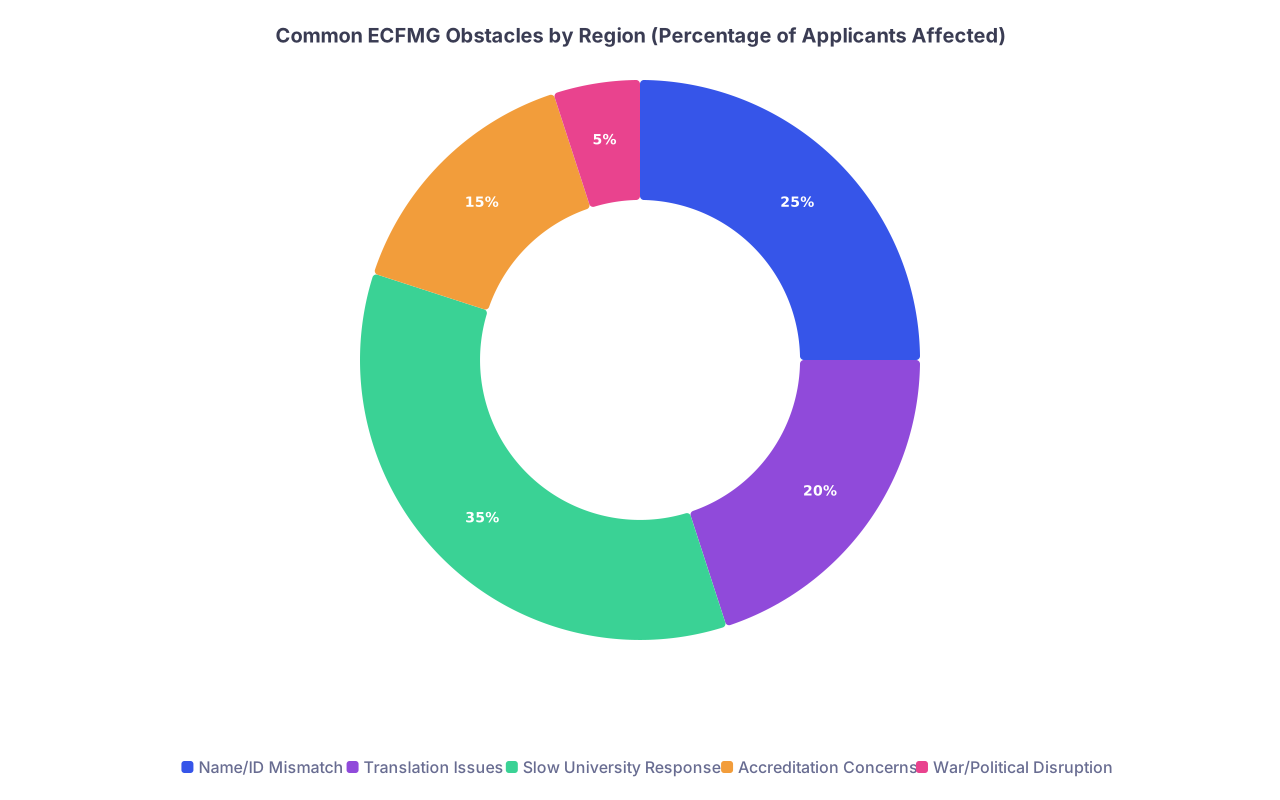
| Category | Value |
|---|---|
| Name/ID Mismatch | 25 |
| Translation Issues | 20 |
| Slow University Response | 35 |
| Accreditation Concerns | 15 |
| War/Political Disruption | 5 |
China
International medical programs in China exploded in the 2000s:
- MBBS in English for foreign students.
- Reasonable tuition, big cities, lots of marketing.
However:
MOE-approved lists
China’s Ministry of Education periodically publishes lists of universities authorized to admit foreign students for clinical MBBS programs. Not all:- Are consistently listed in WDOMS in a way that clearly spells out ECFMG eligibility.
- Maintain stable policies over time.
Internship location
Some programs send you:- Back to your home country for internship
- Or allow you to complete internship in non-teaching hospitals
US state boards and some credentialers scrutinize where and how you did your clinical training. ECFMG mainly looks at the diploma and school listing, but messy clinical training histories can cause downstream issues.
Rigid, centralized admin
Chinese universities can be:- Perfectly capable of sending ECFMG forms
- Or completely unresponsive, requiring in-person visits, local contacts, or brokers to move paper from one office to another.
Russia
- Longstanding tradition of training foreign students.
- Well-known schools (e.g., in Moscow, St. Petersburg, Kazan) with big international offices.
Problems:
- Diplomas only in Russian, often using terms that do not map cleanly to “MD” or “MBBS.”
- Sanctions and political issues increasingly complicate communications, courier services, and sometimes credential verification.
- Institutional renamings are common and may not be well updated in WDOMS.
8. Practical ECFMG Steps with Regional Strategy
Now let me get concrete. Here is how you should sequence your ECFMG-related actions, adjusted for regional headaches.

| Step | Description |
|---|---|
| Step 1 | Year 1-2: Verify School Eligibility |
| Step 2 | Standardize Legal Name Documents |
| Step 3 | Create EPIC/ECFMG Account |
| Step 4 | Request Primary Source Verification |
| Step 5 | Prepare and Take USMLE Step 1 |
| Step 6 | Take USMLE Step 2 CK |
| Step 7 | Complete Required Pathway/Clinical Skills |
| Step 8 | ECFMG Issues Certification |
Step 1: Verify your school’s long-term eligibility
By the end of your first preclinical year, you should know:
- Is my school listed in WDOMS?
- Does the Sponsor Note mention ECFMG eligibility?
- Is the school accredited (or on track to be) by a WFME-recognized agency for my graduation year?
If any answer is “unclear,” you have three options:
- Transfer to a more secure school.
- Accept that your US pathway is speculative.
- Spend real time contacting ECFMG and your administration to clarify.
Step 2: Lock your identity alignment early
Before you even touch USMLE:
- Get your passport.
- Make sure your name matches across:
- Passport
- National ID (if used)
- Medical school records
- If there is a discrepancy, fix it on the institution side while you still have time.
Name mismatches are one of the dumbest reasons people lose a Match cycle.
Step 3: Build a relationship with your dean’s/registrar’s office
Region-specific reality:
- South Asia/MENA/Eastern Europe: paperwork often needs a “champion” in the office.
- Caribbean big schools: they have systems, but you must follow instructions exactly.
- China/Russia: you may need local classmates or agents to help push documents.
Get the names of:
- The person who handles international credential requests.
- The registrar or dean who signs ECFMG forms.
Do this before you need anything from them.
Step 4: Time your credential verification around your exams
You do not need ECFMG certification to take Step 1 or CK. But:
- You must be ECFMG-registered and your status appropriately verified to sit USMLEs as an IMG.
- Full certification (for residency start) will require all:
- Exam passes
- Diploma verification
- Pathway completion
Strategy by region:
- South Asia / Latin America: request your final diploma and initiate ECFMG verification as early as graduation is confirmed. Do not wait for perfect USMLE scores before you start paperwork.
- Eastern Europe / MENA / China / Russia: assume that degree verification might take 6–12 months. Start the process slightly earlier than you think is “logical.”
- Caribbean: big schools usually prompt you automatically; smaller ones require you to nag admin.
Step 5: Understand ECFMG pathways and local alternatives
Since Step 2 CS died, ECFMG introduced several “pathways” to demonstrate clinical/communication competence. Some hinge on being licensed in another country. Others involve school-based assessments or OSCE-style documentation.
Regional nuance:
- If your country offers a national licensing exam with OSCE/clinical components and recognized standards, that may support certain pathways.
- If your school has its own robust OSCE with documentation, it can sometimes qualify as an approved clinical skills assessment.
You cannot assume your pathway is automatic. You must:
- Read current ECFMG pathway requirements on their site.
- Confirm with your school whether they participate or can provide required documents.
9. Comparison Snapshot: Regions vs. Typical ECFMG Friction
| Region | Biggest Bottleneck | Typical Delay | Admin Responsiveness |
|---|---|---|---|
| South Asia | University document delays | 3–9 months | Variable |
| MENA | Translation & ministry steps | 4–10 months | Moderate |
| Top-tier Caribbean | None major | 2–6 months | High |
| Eastern Europe/FSU | Language + restructuring | 6–12 months | Low–Moderate |
| Latin America | Final title issuance | 6–18 months | Variable |
| China/Russia | Bureaucracy & translation | 8–20 months | Low–Moderate |
This is why two graduates with identical Step scores can end up in very different places. One has documents verified by May and enters the Match. The other is still waiting for a registrar’s stamp in November.
10. Tactical Advice by Phase (Premed, Early Med, Late Med)
If you are premed and choosing an international school
You should be ruthless.
For US plans, do not choose a school unless:
- It is WDOMS-listed with clear ECFMG eligibility.
- It is already accredited by a WFME-recognized body, or obviously on track publicly.
- You can talk to at least 2–3 recent alumni who:
- Obtained ECFMG certification
- Matched into US residency
- Tell you admin is slow-but-functional at worst
Red flags:
- School representatives dodge questions about ECFMG or WFME.
- “We expect to be accredited soon” with no timeline, no public documentation.
- No graduates in US residency in the last 5 years.
If you are in early medical school (Years 1–3 of a 5–6 year program)
Your job:
- Fix identity documents.
- Start understanding your internship / social service / house job structure and how that ties to your final diploma.
- Collect seniors’ stories:
- How long did their ECFMG verification take?
- Which office actually sent documents?
- Any chronic issues (missing seals, wrong dates, etc.)?
If you are in clinical years or final year
You should already be:
- Registered with ECFMG.
- Planning USMLE exam dates aligned with your expected degree issuance.
For regions with long bureaucratic lags (Eastern Europe, Latin America, China, Russia):
- Consider front-loading:
- Requesting preliminary letters or certificates your school is willing to send.
- Confirming exact timeline for diplomas and transcripts.
For South Asia and MENA:
- Harass (politely) your college/university at least 3–6 months before graduation with:
- Written requests
- Clear mention that forms must be sent directly to ECFMG
FAQ (Exactly 5 Questions)
1. Do I need to be licensed in my home country before I can get ECFMG certified?
No. ECFMG certification is based on your primary medical qualification (final diploma) from an eligible medical school and your USMLE / pathway completion. Some countries bundle diploma issuance with licensing steps, which indirectly forces you to clear local requirements, but ECFMG itself does not require you to hold a home-country license.
2. My school is listed in WDOMS, but there is no mention of ECFMG eligibility. Am I safe?
You are not safe until the WDOMS “Sponsor Note” explicitly references ECFMG/ECFMG eligibility for certain graduation years. A simple listing means “this is a medical school.” It does not guarantee that ECFMG will accept its graduates. You must verify that sponsor note and, if needed, contact ECFMG directly.
3. What if my university will not respond to ECFMG’s primary source verification requests?
You have a serious problem. ECFMG will not certify you without direct verification. Practically, you must escalate locally: go up the chain (registrar → dean → rector), involve international office staff, and sometimes use alumni or local legal support. If, after multiple attempts, the university simply refuses to cooperate, your US path may be blocked.
4. Can I use unofficial translations of my diploma or transcript if they are accurate?
No. ECFMG is strict about translation standards. Translations must be done by an acceptable translator (often a professional service or court-certified translator), and the process must follow ECFMG’s published rules. Student-made or random-notary translations are common reasons for delays or rejections.
5. How early should I start the ECFMG process if I want to match in a specific year?
As a rule of thumb, start serious ECFMG paperwork (beyond basic registration) at least 12–18 months before your intended Match. That gives breathing room for slow universities, translation issues, and repeat USMLE attempts. If you are in a high-bureaucracy region (Eastern Europe, Latin America, China, Russia), 18–24 months is safer.
Two things to walk away with.
First, ECFMG certification is not just about passing USMLEs. It is about managing the friction between one very rigid American system and whatever chaotic bureaucracy your region runs on. The smarter you are about that interface, the less likely you are to lose years in limbo.
Second, where you study matters less than how transparent and responsive your school is to ECFMG. Get that data early. If the alumni horror stories are consistent, believe them—and adjust your path before you are the next one stuck waiting on a stamp.