

Overlooking Language Barriers: How Pre-Meds Misjudge European Schools
What happens when you arrive at your “English-taught” European medical school…and discover the patients, nurses, and half the exams are not in English?
If that sounds dramatic, it is not. I have watched this exact scenario unfold more than once. American and Canadian pre-meds who thought they had gamed the system: “I will skip the MCAT headache, go to Europe, and come back for residency.” Then week three they are in a ward round where the attending refuses to switch to English, the patient barely speaks the country’s official language, and they are standing there useless, reduced to watching.
Language is the quiet landmine of international medical education. Everyone obsesses about accreditation, USMLE, Match rates. Meanwhile, language quietly destroys clinical training, exam performance, and mental health.
Let me walk you through the specific mistakes that keep repeating—and how to avoid being the next case study.
Mistake #1: Believing “Program Language = Life Language”
The brochure says: “Program taught fully in English.” You relax. Huge mistake.
There are three different languages that matter in a European medical school context:
| Area | Often Advertised As | Reality in Many Schools |
|---|---|---|
| Lecture language | English | Frequently true in basic years |
| Exam/admin language | Mixed / local | Can be partially in local lang |
| Clinical / hospital use | Local language | Rarely English outside big hubs |
Pre-meds commonly confuse these. They hear “English-taught” and assume:
- All lectures in English
- All exams in English
- All patient contact possible in English
- Faculty happy to switch to English
That is not how it works.
What I have actually seen:
- PowerPoints in English, but the professor slips into local language for explanations, side comments, and Q&A.
- Official exams technically “allowed” in English, but the default exam bank is in the local language, and translations are sloppy or late.
- Clerkship paperwork, evaluation forms, and hospital systems all in the local language.
- Nurses and many residents not comfortable speaking English quickly during emergencies.
If you do not separate these three domains in your research, you will get blindsided later. The school will insist: “We never said the hospital works in English. Only the curriculum.”
They will be right. And you will still be stuck.
How to avoid this
When you talk to current students, you need to ask three different questions, clearly:
- “Are all pre-clinical lectures truly delivered in English, or does faculty switch back and forth?”
- “Are exams and written assessments fully available in English, in a timely way, with the same question bank as local students?”
- “During clinical years, what percentage of your daily interactions (patients, nurses, notes, orders) is realistically in English?”
If the answers are vague, over-optimistic, or inconsistent between students, treat that as a red flag. Because it usually means the school itself has not solved the language problem. They have just outsourced it to you.
Mistake #2: Underestimating the Language Needed for Real Clinical Work
Being “conversational” in a language is not even close to what you need to function as a doctor. You are not ordering coffee. You are decoding subtle patient narratives about chest pain, suicidal ideation, or child abuse.
I have watched students with B2-level certificates (upper-intermediate) flounder in clinics, because:
- Patients speak with strong regional dialects.
- Elderly patients use outdated or colloquial terms for diseases and body parts.
- People speak fast when they are scared or in pain.
You need language skills beyond whatever scored you a certificate at a testing center.
Where language really crushes students
The same pattern comes up again and again:
Year 1–2:
They are fine. Classes are mostly factual, lecture-based, friends speak English, and exams are multiple choice with limited oral components.
Year 3–4 (starting clinical exposure):
Suddenly:
- They cannot take an adequate history from a non-English-speaking patient without another student acting as a translator.
- They miss half the teaching during ward rounds because questions and bedside teaching are done in the local language.
- Oral exams become a minefield when examiners slip into local language or expect you to know terminology in both English and local.
Year 5–6:
The gap just widens. Local students gain confidence seeing patients independently. The English-only student stays on the margins. Watching, not doing.
If you think you will “just pick it up” after arrival, you are relying on hope, not a plan. Medicine is not the context where you want to test that theory.
Minimum realistic targets
For most European countries, if the program is legitimately integrating you into their local healthcare system, you should aim for:
- B2 at matriculation (even if not required)
- C1 (advanced fluency) by start of clinical years
Anything less, and you are depending on exceptions, kindness, and luck. Those three things are rarely stable foundations for medical training.
Mistake #3: Ignoring the Hidden Exam Language Trap
Exams are where language quietly ruins careers.
I have seen students fail major exams not because they did not know the medicine, but because of:
- Poorly translated exam questions with ambiguous wording.
- Oral examiners who suddenly switch into local language for complex follow-up questions.
- OSCE stations where standardized patients act in the local language, regardless of your program’s “English-taught” branding.
You will not see this in marketing materials. You will hear about it in whispered group chats and upper-year rants.
Typical patterns you should question
“We can request English exam versions, but they sometimes arrive late.”
Translation: You will be studying from local-language question banks you barely understand, or depending on unofficial translations.“The content is the same as local students, just translated.”
Translation: When there are errors (and there will be), they will be in your version, and you will have less ability to argue.“Oral exams are officially in English, but professors may clarify things in the local language.”
Translation: If you look confused, they switch language for local students, not for you. You get left behind.
What to do before committing
Ask current students very specifically:
- “Have you ever had exam questions that were clearly mistranslated or confusing due to language?”
- “How many of your practical or OSCE stations use only the local language?”
- “Do any high-stakes exams (progression exams, state exams) require local language?”
If they hesitate or say “it depends on professor,” assume you could be the unlucky cohort.
Mistake #4: Assuming You Can Survive Clinical Years Without the Local Language
Some pre-meds confidently claim: “I just care about passing exams and then matching back to the US. I don’t need to be fluent with patients there.”
That is reckless. Programs that let you “accidentally” avoid patient contact because of language are not doing you a favor. They are graduating weak clinicians.
You will run into three big problems:
Skill development
You simply cannot learn physical exam, clinical reasoning, and bedside manner by watching others. If language keeps you from independent histories and counseling, your skills will lag badly.Letters of recommendation
Attending physicians are less likely to write strong, detailed letters for a student they barely know because language blocked deeper interaction.Residency interviews
Try explaining in an internal medicine or pediatrics interview why you did six years of medical school but struggle with basic patient interviews. Program directors are not naive. They know what that signals.
If your plan is to practice in an English-speaking country long-term, you still need solid, hands-on clinical training somewhere. Letting language wall you off from meaningful patient contact for three years is sabotage.
Mistake #5: Believing the School Will “Provide Language Training” That Actually Works
Many European schools advertise: “Local language courses included!” It sounds like the problem is solved. It is not.
Typical reality of these classes:
- 1–2 hours per week
- Taught by generic language instructors, not medical professionals
- Focused on grammar and basic conversation, not focused, high-yield medical language
- Minimal immersion, no systematic clinical role-play, zero exposure to dialects
In other words: Enough to pass an A2/B1 certificate. Not enough to handle a distressed parent in pediatrics at 2 a.m.
How to evaluate the language support honestly
Ask:
- “By the time you started clinical years, could you independently take a full history in the local language?”
- “Did the school’s language classes alone get you that far, or did you need tutors, apps, immersion, extra classes?”
- “What happens to students who fail the hospital’s required language exam?”
You will usually hear one of two stories:
- Serious students invest tons of extra time and money into language, on top of an already full med school schedule.
- Others avoid using the language as much as possible and end up half-competent clinically.
Neither group is simply “carried” by institutional language resources. Do not assume you will be the special exception.
Mistake #6: Not Connecting Language Barriers to Match and Licensing Outcomes
Pre-meds love to obsess over “Is this school recognized by ECFMG?” or “Can I sit for USMLE?” Good. Necessary questions. But they stop there.
Language affects:
- Your ability to get strong, detailed letters to impress residency programs.
- Your clinical confidence during US or Canadian electives.
- Your capacity to pass local state exams (required at some schools before graduation).
- Your mental stamina and burnout risk, which absolutely leak into performance on USMLE or other high-stakes exams.
A student who has spent three years constantly half-understanding ward rounds and struggling through local-language consults often shows up burned out, under-confident, and behind their peers clinically.
Residency programs notice. They might not articulate it as “language issue,” but they experience it as: weaker clinical stories, shallower letters, less convincing bedside depth during interviews and US rotations.
Mistake #7: Not Testing Your Assumptions With Current Students
The school will always say the right words:
- “Fully English-taught program”
- “International-friendly environment”
- “Strong support for non-local speakers”
You need to hear from people who had to get through pharmacology oral exams with a professor who mumbles in the local language and refuses to repeat himself.
Do this:
- Ask to join unofficial WhatsApp or Facebook groups for current students from your home country.
- Talk to at least 3–5 students in clinical years, not just bright-eyed first-years.
- Ask them to describe one recent situation where language directly limited their learning or exam performance.
If multiple students have stories like:
- “I failed OSCE because I could not understand the standardized patient’s accent.”
- “The attending refused to conduct ward round in English for just one student.”
- “Our final exam was 70% local language questions with last-minute translations.”
Then do not tell yourself you will magically be immune to those problems.
A Simple Reality Check Before You Commit
Use this mental checklist. If you answer “no” or “I do not know” to several, you are walking toward a serious language problem.
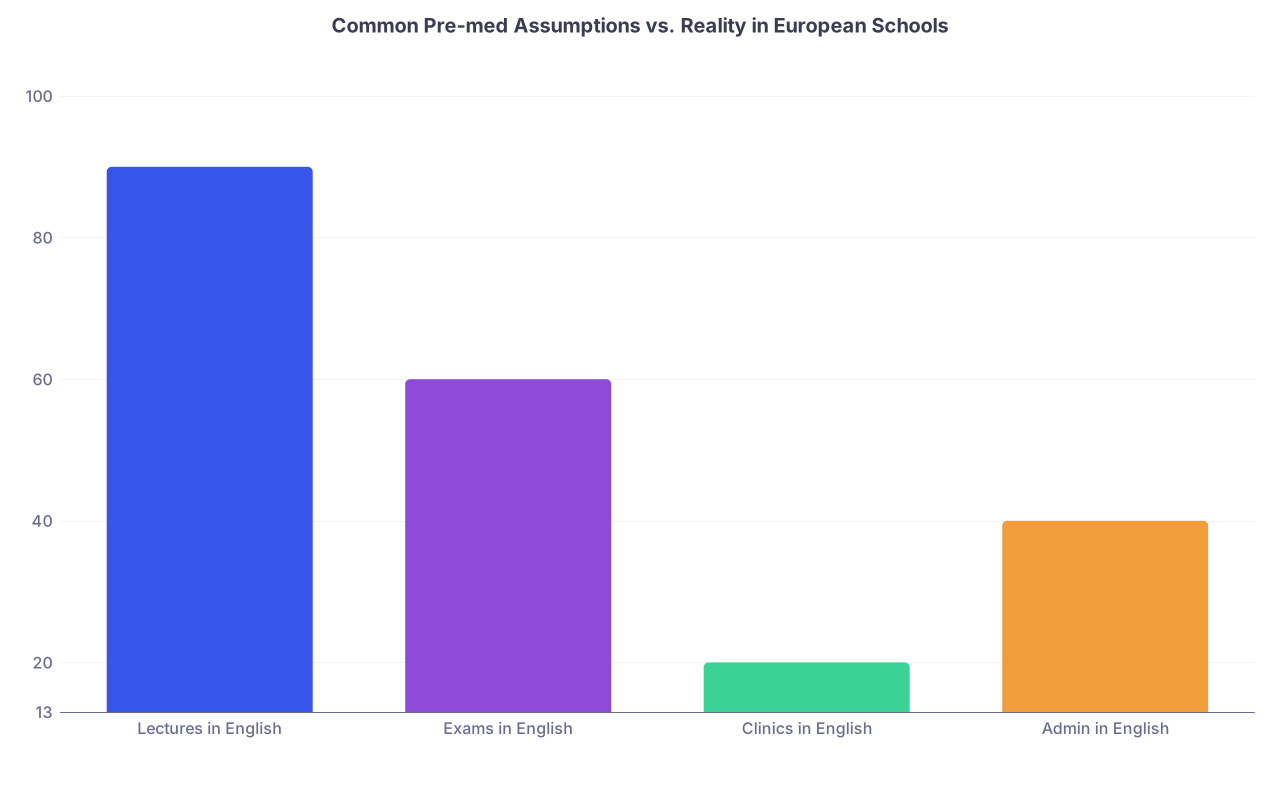
| Category | Value |
|---|---|
| Lectures in English | 90 |
| Exams in English | 60 |
| Clinics in English | 20 |
| Admin in English | 40 |
(Those percentages are not from a specific study; they roughly reflect what I have consistently seen and heard across multiple programs.)
Ask yourself:
- Do I have a concrete plan to reach at least B2 before clinical years, including time, resources, and accountability?
- Have I verified, with upper-year students, that high-stakes exams are actually accessible in English without major translation issues?
- Am I comfortable spending 2–3 years practicing medicine primarily in a language that is not English?
- Would I choose this school if the language were the only challenge? Or am I downplaying it because I am anxious about getting into any medical school?
If that last one made you uncomfortable, pay attention to that. Many students treat language as a negotiable fee to pay for “a guaranteed seat.” Later they discover the cost is far higher than they expected.
What Doing It Right Actually Looks Like
If you still want a European route—and there are legitimate reasons some people choose it—then do it deliberately, not blindly.
- Choose countries where you are realistically willing to learn the language to advanced level. Do not commit to a language you secretly dislike and have no interest in using long-term.
- Start the language before you apply. If you are truly serious, you should have at least A2–B1 by the time you are starting. Not day one of med school.
- Prioritize programs where:
- Clinical training is well-structured for internationals, not an afterthought.
- There are clear, written policies about English exam versions.
- You have multiple senior students confirming those policies are actually followed.
- Budget time. Realistically, language will add 5–10 hours per week of extra work if you want to reach clinical fluency. If you are already barely surviving academically, this will break you.
If none of that sounds feasible, then do not lie to yourself. Look for alternatives: post-baccs, improving your MCAT, DO schools, Caribbean options with their own separate risks—anything where you are at least operating in your native language.
Because the one thing worse than not getting into medical school quickly is starting one in the wrong conditions and failing years later.

| Step | Description |
|---|---|
| Step 1 | Considering European Med School |
| Step 2 | Target Integrated Programs |
| Step 3 | High Risk: Avoid Non-English Systems |
| Step 4 | Verify Exams & Clinics in English |
| Step 5 | Proceed Cautiously with Plan |
| Step 6 | Local Language Strong? |
| Step 7 | Willing to Invest 5-10 hrs/week? |
| Step 8 | Upper-year Students Confirm? |
FAQ (Exactly 5 Questions)
1. If the school is listed in the World Directory and ECFMG-eligible, does language still matter for US residency?
Yes. ECFMG eligibility only means you can apply for certification and sit for exams. It says nothing about the quality of your clinical training, your ability to generate strong letters, or your performance on US rotations. Language barriers erode all three. Program directors care about how you function with patients and teams, not just whether your school appears on a list.
2. Can I realistically reach clinical-level fluency while in medical school if I start from zero?
Possible, but demanding. You would need consistent, intensive effort for several years: daily practice, immersion, targeted medical language learning, and real conversations outside the expat bubble. Many students say they will do this, then drown in anatomy, biochem, and path and let the language slide. If you have never successfully learned a foreign language before, assume this will be harder than you think.
3. Are there any European programs where I truly can do almost everything in English?
A few come close—usually in countries with strong English proficiency and specific “international tracks” that cluster English-speaking students together and arrange English-friendly clinics. Even in those, though, you will almost always need local language for at least some patient contact and hospital tasks. Treat any claim of “100% English, no need for local language ever” as marketing fiction.
4. If I only want to return to the US, does it matter if I am weak with local-language patients abroad?
Yes, because weakness in one language usually reflects weakness in clinical process, not just vocab. If you cannot take thorough histories, handle nuanced conversations, or function independently in any real-world setting, you will arrive in US electives behind your peers in core skills. Residency programs pick up on that quickly.
5. What is the biggest red flag when researching a European medical school’s language situation?
Inconsistent stories. If admissions staff claim everything is smoothly handled in English, but current students describe ad hoc translations, professors who refuse to use English, or exams partly in the local language, believe the students. Mixed, contradictory answers about language are usually your clearest sign that the problem has been pushed onto you to solve, not systematically addressed by the school.
Key points: Do not confuse “English-taught” on paper with English in clinics, exams, and daily life. Do not bet your medical career on the fantasy that you will “just pick up” a difficult language under maximum academic stress. And never enroll before you have verified, with multiple upper-year students, exactly how language plays out where it matters most: on the wards and in high-stakes exams.


