

The name of your foreign medical school matters less than you think—and much more than anyone tells you.
Let me tell you what actually happens when a program director sees “University of X, Country Y” instead of “Harvard” or “State U SOM” on that ERAS screen. Because it is not some holistic, soul-searching review. It’s a series of very fast, very practical, and often very biased checks that determine in under 20 seconds whether you even get looked at.
The First 10 Seconds: The Snap Judgment
Here’s the part people gloss over: most PDs do not “research” your school. They recognize it instantly… or they don’t. And that alone sets the tone.
When a PD or APD (associate program director) scrolls through apps, here’s the internal monologue I’ve heard dozens of times, verbatim:
- “Oh, St. George’s. Fine.”
- “AUC… okay, another Caribbean.”
- “Some Eastern European school… where is that again?”
- “Is that even a real school?”
They are not being polite. They do this very quickly. The foreign school name triggers a checklist in their brain. They’ve built this checklist over years of:
- Residents they’ve had from that school (good, bad, disastrous)
- Word-of-mouth from other PDs
- USMLE pass/fail patterns
- Visa headaches
- Communication problems with deans’ offices
So what do they actually check when that unfamiliar or foreign school name appears?
Here’s the real list.
1. Is This School in My Mental “Known Bucket”?
The single biggest invisible factor: whether your school is in their mental Rolodex.
PDs essentially have three internal buckets:
| Bucket | What It Means | Typical Reaction |
|---|---|---|
| Known & Trusted | School has produced solid residents here or at peer programs | More willing to review in depth |
| Known & Problematic | Past grads struggled (scores, performance, communication) | Needs a very strong application to overcome bias |
| Unknown | PD has no real experience or pattern | Suspicion by default; more filters applied |
If you’re from a Caribbean “Big 4” school, major Israeli, Irish, or UK schools, or a historically common Indian/Pakistani institution, you’re usually in the Known category. That does not mean “loved,” but at least you’re not mysterious.
If your school is somewhere in Eastern Europe, smaller Latin American universities, newer Caribbean schools, private schools in Georgia/Ukraine/Armenia/etc., you’re often “Unknown” at best.
Here’s the uncomfortable truth: Unknown is usually treated as “high risk until proven otherwise.”
No one will say this in a brochure. I’ve heard it in PD meetings:
“I don’t know this school, and I’m not going to spend time figuring it out unless the scores are phenomenal.”
So the first real check is not a database lookup. It’s:
“Do I recognize this school, and what happened last time we took someone from there?”
If your school has never sent anyone to that program or its peer institutions, you are walking in without institutional credit. That’s your starting point.
2. Does This School Have a Track Record with Our Program (or Friends’ Programs)?
Second layer: program-specific memory and gossip.
This is where the behind-the-scenes conversations decide your fate. I’ve sat in rank meetings where a single previous resident from one foreign school basically poisoned that school’s name for a decade.
Things I’ve heard:
- “We will not take anyone from ____ again. Their dean’s office was a nightmare.”
- “Every grad we’ve had from ___ struggled to pass Step 3.”
- “The last two from that school were outstanding. I’ll always interview one or two.”
So when your school name appears, someone in the room often asks:
- “Have we had anyone from there before?”
- “How did they do?”
- “What do they say at ___ Hospital about that school?”
If the answer is “we had one and they were painful to remediate,” your school name has a quiet black mark. Not official. Not written anywhere. But absolutely real.
If the answer is “Dr. X from that school is now chief or faculty,” you just moved up a tier.
This is also where regional patterns matter. Programs in New York and New Jersey know certain Caribbean and South Asian schools better. Midwest community programs may know specific Eastern European schools because local attendings trained there. West Coast might have relationships with certain Latin American schools.
You’re not just dealing with “US vs foreign.” You’re dealing with local institutional memory.
3. Is This School Recognized and Legitimate on Paper?
Once you’re not instantly discarded, someone occasionally does a quick legitimacy check. Especially for very unfamiliar schools or newer Caribbean institutions.
No, they don’t do deep research. They do a fast sanity check, usually once, then remember it going forward.
What they or their coordinator actually check:
- Is the school listed in the World Directory of Medical Schools?
- Did ECFMG recognize this school for the year the applicant graduated?
- Is there any known scandal or controversy they’ve heard (mass expulsions, exam cheating, accreditation drama)?
They’re not reading your school’s mission statement. They’re answering one question:
“Is this a school we’re comfortable defending if something goes wrong?”
If your school has had ECFMG status issues, weird name changes, or a history of moving campuses/jurisdictions, that raises quiet red flags. They hate risk. Accreditation drama = risk.
4. What Country Is This, and What Does That Signal Clinically?
Fair or not, PDs absolutely stereotype by country and region.
When they see your foreign school name, they notice:
- Country
- Language
- Political stability
- Perceived rigor of medical training
This is the rough mental map I’ve watched play out countless times:
- UK/Ireland/Australia/Canada: usually seen as closest to US-style training, decent clinical expectations.
- Western Europe: reasonable baseline, but variable exposure to US-like systems.
- Israel: generally respected, especially if they’ve had good prior experiences.
- India/Pakistan/Egypt: seen as extremely clinically heavy environments, but concerns about documentation style, English nuance, and systems differences.
- Eastern Europe/Caribbean “second-tier”: often viewed as question marks—“USMLE mills” without guaranteed clinical rigor.
- Latin America: variable; some schools highly respected locally but not well understood in the US.
Program directors won’t say this on the record. Off the record, I’ve heard:
“I trust clinical skills from X country but I worry about notes and communication,”
or
“Those schools basically exist to get kids to the US exams; I need proof this person can handle real patients.”
So when your school name appears, they’re not just thinking: “What’s that place?”
They’re thinking: “What does this region’s training give me—or fail to give me—by default?”
5. Does the School’s Reputation Match the Applicant’s Metrics?
Here’s a nuance most applicants miss.
PDs look at the fit between your school’s “tier” (in their head) and your metrics: USMLE scores, research, clinical evaluations. In other words: does your file make sense?
I’ve watched this exact conversation:
“He’s from [very low-name-recognition Caribbean school] and has a 255 Step 2? That’s… interesting. Let’s look closer.”
They’re suspicious of outliers in both directions:
- Very weak board scores from a supposedly “strong” foreign school
- Extremely strong board scores from a school they mentally label as “soft”
They’re asking themselves:
“Is this student an exception to their environment, or is something off?”
That can help you if your performance is clearly excellent. A high USMLE score from an unknown school sometimes gets a second look precisely because it’s unusual. But then they start checking more aggressively everything around that number: clerkship grades, letters, US clinical experience.
Bottom line: a foreign school name makes them more likely to scrutinize inconsistencies.
6. Can This School Actually Provide What We Need Logistically?
This one almost no premed advisor talks about, but PDs care a lot: logistics.
When a PD or coordinator sees an unfamiliar foreign school, they think:
- “Will their dean’s office answer emails?”
- “Can we get transcripts and verification easily?”
- “Will they understand our forms, deadlines, background checks?”
- “Do they always run late on documentation?”
If a previous resident from that school caused months of email ping-pong for simple forms, or if ECFMG verification was a nightmare, you’re starting from a deficit.
There’s also the LCME/non-LCME reality. Graduates of non-LCME schools (which is almost all foreign schools) often need:
- Extra documentation
- Visa support
- ECFMG coordination
All of that lives in the PD and GME office’s pain file. If your school is associated with logistical pain, your name suffers by association.
7. Visa & Pathway Headaches Triggered by Your School Name
The moment they see a foreign school, a second thought runs in parallel:
“Are we about to walk into a visa issue?”
It’s not just “IMG vs AMG.” It’s:
- Does this school typically send US citizens who studied abroad (US-IMG)?
- Or non-US citizens needing J-1 or H-1B (FMG)?
Your school’s location often correlates with this. Caribbean schools: lots of US grads. Many European schools: mixed. South Asian schools: often non-US citizens.
I’ve heard PDs say:
- “I don’t want to deal with H-1Bs this year.”
- “We can’t sponsor visas at all; filter them out.”
- “J-1 only. Too many H-1B denials recently.”
They’re not discriminating by school name here, but the foreign school name is the trigger that makes them check your citizenship/visa status. If your school is known for primarily non-US grads, that biases their anticipation: “Probably needs a visa.”
If a program had a bad experience—last-minute visa denial, delayed start, piles of legal forms—they become quietly more hostile to applicants whose school name suggests complicated visa issues.
8. Does This School Have a US Clinical Pipeline We Trust?
One of the biggest “hidden” checks: whether your school has a known pattern of sending students to US clinical rotations in decent hospitals.
A lot of foreign schools sell “US clinical rotations” aggressively. PDs know this. They mentally rate schools partly on where their students end up rotating:
- Are they in reputable teaching hospitals?
- Are they in random community clinics with weak supervision?
- Are the attendings writing meaningful letters—or template fluff?
So when they see your school name, some PDs immediately scan your clinical experience section:
- Are the US rotations meaningful or sketchy?
- Are the letters from known US faculty or obscure outpatient preceptors?
- Have we seen students from this school rotate at our hospital before?
Programs that’ve hosted your school’s clerks or sub-I students absolutely build real opinions based on those interactions. One excellent student can open a door. One unprepared, unsafe student can close it for years.
I’ve seen emails like:
“Do not approve more students from ___ for electives; last two were not at the level of our students.”
That kind of line spreads between PDs and clerkship directors.
9. How Does This School Compare to Other Foreign Schools on Our Rank Lists?
This part is more subtle, but it shapes the long-term pattern: how your school performs historically on their rank lists and in their programs.
They remember:
- Who matched there and how they performed
- Who failed Step 3
- Who had professionalism issues
- Who excelled and became chief
Over time, they build their own internal “tier list” of foreign schools. Totally unofficial, often completely out of sync with global academic reputation.
So when your school pops up, especially during rank meetings, you’ll hear comments like:
- “Our grad from that school last year is doing very well.”
- “We had to fire someone from that school in 2016; I’m wary.”
- “Compare this applicant from X school vs our applicant from Y school, same scores—who do we trust more?”
You are not competing in a vacuum. You’re competing against the ghosts of prior graduates from your school.
10. The Quiet “Would I Want This Person Explaining to Patients Where They Trained?” Factor
Finally, there’s a softer, almost subconscious layer: image.
Attendings and PDs know patients sometimes ask,
“Doctor, where did you go to medical school?”
If they’ve never heard of your school and it sounds obscure or “off-brand,” some PDs worry about optics. They shouldn’t—but they do.
I’ve heard versions of this:
- “If the resident introduces themselves and the patient says, ‘Is that a real medical school?’ I don’t want that conversation.”
- “We already have two from unknown schools; balance matters for our reputation.”
Is this rational? Not really. Is it real? Yes.
This is why you’ll sometimes see PDs lean toward foreign schools with at least some international visibility or English-language websites that look professional. It signals “this place exists in the modern world” rather than “mystery diploma mill.”
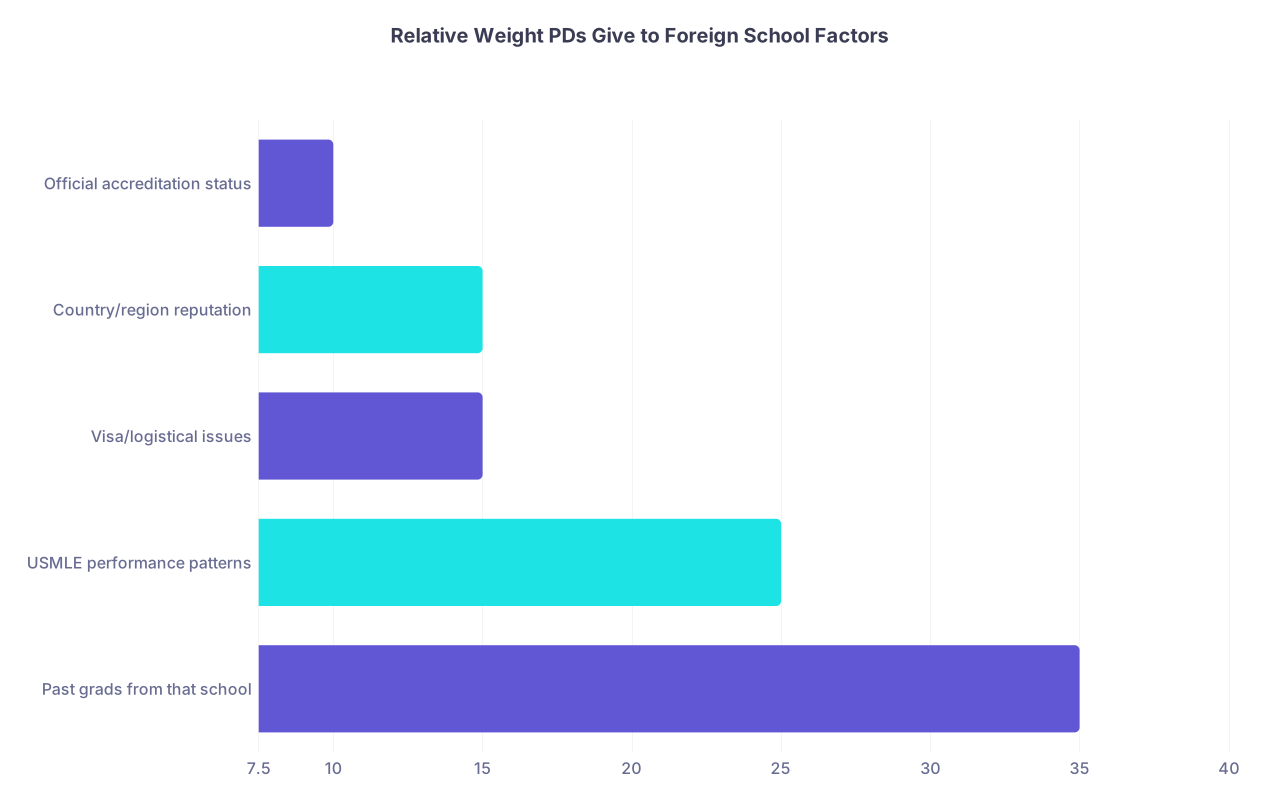
| Category | Value |
|---|---|
| Past grads from that school | 35 |
| USMLE performance patterns | 25 |
| Visa/logistical issues | 15 |
| Country/region reputation | 15 |
| Official accreditation status | 10 |
So What Do You Do If You’re Still Choosing a Foreign School?
If you haven’t enrolled yet and you’re reading this, you’re ahead of most people. Here’s what actually matters from the PD side, not the marketing brochure side.
You want a school that:
- Has multiple graduates in US residency programs you can identify, especially in the specialties and cities you care about.
- Sends students to real US teaching hospitals for core or sub-I level rotations, not just “observerships in some clinic in New Jersey.”
- Has a dean’s office that responds to emails quickly and can produce detailed MSPE-equivalent documents in English.
- Is stable in accreditation and ECFMG status. No name changes every few years. No “provisional recognition” drama.
Talk to residents, not just students. Ask them what PDs said about their school. Whether anyone had heard of it. Whether they needed to “overcompensate” with scores and research to be taken seriously.
If You’re Already at a Foreign School: How to Offset the Name
You cannot change the words printed on your diploma. But you can change what a PD thinks the second they see that name by stacking evidence that you’re the exception they want.
Your counter-moves:
- Destroy Step 2. For many foreign grads now, Step 2 is the currency. A strong score makes them pause long enough to actually look at the rest of your file.
- Get US-based letters from people PDs recognize or respect. If they see a LoR from a faculty member at a known US program, it helps counterbalance an unknown school name.
- Do real, substantial rotations in US teaching hospitals. Sub-I’s where you’re judged side-by-side with US students. Then earn strong narrative comments.
- Build a track record at a single institution. If you rotate, do research, and get to know faculty at one hospital, you’re no longer just “that school”; you’re “the student Dr. X strongly recommended.”
And if your school is truly unknown, assume you must hit harder on everything—scores, letters, research, communication skills—because the baseline trust isn’t there.

| Step | Description |
|---|---|
| Step 1 | See Foreign School Name |
| Step 2 | More likely to review fully |
| Step 3 | Needs exceptional metrics |
| Step 4 | Check Scores & US Experience |
| Step 5 | Filtered Out Early |
| Step 6 | Recognize School? |
| Step 7 | Past Experience? |
| Step 8 | Strong Scores/Letters? |
Bottom Line: What PDs Actually Check
Strip away the politically correct language and committee-speak, and this is what PDs are really doing when they see a foreign medical school name:
They’re asking:
- Do we know this school, and did their past grads make our lives easier or harder?
- Does this applicant look so strong that I’m willing to “take a risk” on an unknown or lower-prestige school?
- Will this choice cause logistical, academic, or reputational problems for my program?
You cannot fully control their biases, but you can absolutely understand them and work around them. And you should—because pretending everyone evaluates all schools equally is how applicants end up blindsided on Match Day.
FAQ
1. My foreign school is totally unknown in the US. Am I doomed for residency?
No, but you’re not on equal footing. You’ll need noticeably higher Step 2 scores, stronger US clinical letters, and usually more hustle (research, networking, away rotations) than a similar applicant from a better-known foreign school. Unknown isn’t a death sentence—but it does mean the burden of proof is on you.
2. Do PDs actually look up my school in some ranking list or database?
Rarely. They rely more on personal and institutional experience, gossip from other PDs, and the performance of prior grads. The World Directory and ECFMG status are checked mainly for legitimacy, not for “ranking.” Their internal ranking is based on lived experience, not some published list.
3. I’m a US citizen planning to go Caribbean. Which matters more to PDs—Caribbean vs Europe vs Asia?
They care less about the continent and more about three things: your school’s track record sending grads to US residencies, the strength of its US clinical rotation network, and how prior grads from that school performed in their orbit. A Caribbean “Big 4” with a proven US pipeline usually fares better than a random European or Asian school nobody in the US has ever heard of. But once you’re in the “foreign” bucket, your individual performance becomes the real deciding factor.


