

Most IMG residency dreams are not killed by Step scores. They’re killed by avoidable visa and immigration mistakes.
I’ve watched strong applicants—250+ Step scores, great letters, solid clinical experience—end up scrambling for backup plans because they misunderstood one line on a visa rule, or trusted bad advice from a friend, or waited “just a few weeks” too long to start the process.
You’re aiming at U.S. residency from abroad. That means you’re not just doing medical training—you’re also playing a second, parallel game: immigration. And that second game has its own rules, timelines, and penalties. Ignore them and you lose, no matter how good you look on paper.
Let’s walk through the most common errors that derail IMG residency plans—and how to avoid stepping on any of these landmines.
Mistake #1: Treating Visa Planning as an Afterthought
If you start thinking seriously about visas only after you get your first interview invite, you’re already late.
Residency programs do not like uncertainty. When they see “requires complicated visa” and a candidate who clearly hasn’t thought through their status, they move on. Silently.
Here’s what I see over and over:
- A student in 5th year at a Caribbean or foreign med school says: “I’ll worry about visas when I have an offer.”
- They can’t even clearly answer, “What visa are you planning to use?” on an interview.
- Programs interpret that as risk and hassle.
You should be thinking about immigration as early as:
- Late medical school (4th/5th year) if you’re abroad.
- Even in premed, if you’re considering studying medicine outside the U.S. and then coming back.
At a minimum, you need to know, before ERAS:
- Whether you’ll need J‑1 or H‑1B (or if you have another status like a green card, EAD, etc.)
- What visa types the programs you’re targeting typically sponsor.
- Whether your exams/credentials fit those visa requirements (more on that below).
Waiting until Match season to sort this out is like trying to buy malpractice insurance in the middle of a lawsuit. Too late.
Mistake #2: Not Understanding the Difference Between J‑1 and H‑1B
If you cannot explain the basics of J‑1 vs H‑1B to another person, you’re not ready to apply as an IMG.
Here’s where people mess up: they treat all visas as interchangeable. They are not. The choice changes your career trajectory.
| Feature | J-1 (ECFMG Sponsored) | H-1B (Employer Sponsored) |
|---|---|---|
| Step 3 Required? | No | Usually Yes (before start date) |
| Home Residency Rule | 2-year return requirement common | No automatic 2-year requirement |
| Sponsoring Entity | ECFMG | Individual residency program |
| Program Willingness | More common | Fewer programs sponsor |
| Typical Duration | Up to 7 years total | Up to 6 years total (3+3) |
Where people shoot themselves in the foot:
Saying “I must have H‑1B” with Step 3 incomplete
I’ve heard this exact sentence: “I’m only interested in H‑1B, I don’t want the J‑1 obligation.” Fine. But the candidate hadn’t taken Step 3 yet. Many H‑1B‑sponsoring programs require Step 3 before they can file the petition. That inflexibility knocked them off interview lists at programs that might have otherwise considered them.Assuming every program will sponsor either one
Many community programs: J‑1 only. Some academic programs: prefer H‑1B for competitive specialties. Some: no visa sponsorship at all. If you’re blindly applying without mapping visa policies, you’re wasting fees on programs that can’t or won’t take you.Ignoring the J‑1 home residency rule
That 2‑year home-country physical presence requirement isn’t theoretical. It can absolutely delay your ability to get a green card or switch to H‑1B later unless you get a waiver. I’ve seen people panic about this in PGY‑3 when it’s already late to shape their path toward a waiver job.
Do not just repeat: “I’ll take whatever visa the program offers.” That sounds flexible but ignorant. Know the trade-offs, have a preference if appropriate, and be ready to articulate it in a way that doesn’t sound like you’ll refuse a reasonable offer.
Mistake #3: Assuming Your School or Friends Know Immigration Law
“Don’t worry, everyone from our school gets J‑1s.”
I’ve heard this from students at offshore schools, Eastern European schools, you name it. Then I watch 10–20% of that same group run into unexpected issues because their specific situation isn’t like “everyone’s.”
Stop outsourcing your immigration strategy to:
- WhatsApp groups
- Upperclassmen stories
- Other IMGs on Reddit or Telegram
- “That one guy who matched last year”
You can use them for anecdotes. Not for rules.
- “My friend did it this way”—from 2017, pre‑Step 1 P/F, different rules.
- “Our dean said it’s fine”—the dean is not an immigration attorney.
- “The program coordinator told me verbally”—verbal assurances mean nothing against USCIS regulations.
You need to:
- Read ECFMG’s official J‑1 information yourself.
- Read the program’s official visa policy on their website or ask the coordinator in writing.
- For anything complex (prior J‑1, status changes, dependents, prior overstays): consult an actual immigration attorney, not your group chat.
I’ve seen someone lose an entire match cycle because a clerk at a local immigration office gave them casual but wrong advice about changing status. They believed it because “she works there.” Working behind a window doesn’t make someone an expert.
Mistake #4: Ignoring the Timeline Reality (USCIS Doesn’t Care About Your Start Date)
Residency has a strict start date. Immigration processing times do not care.
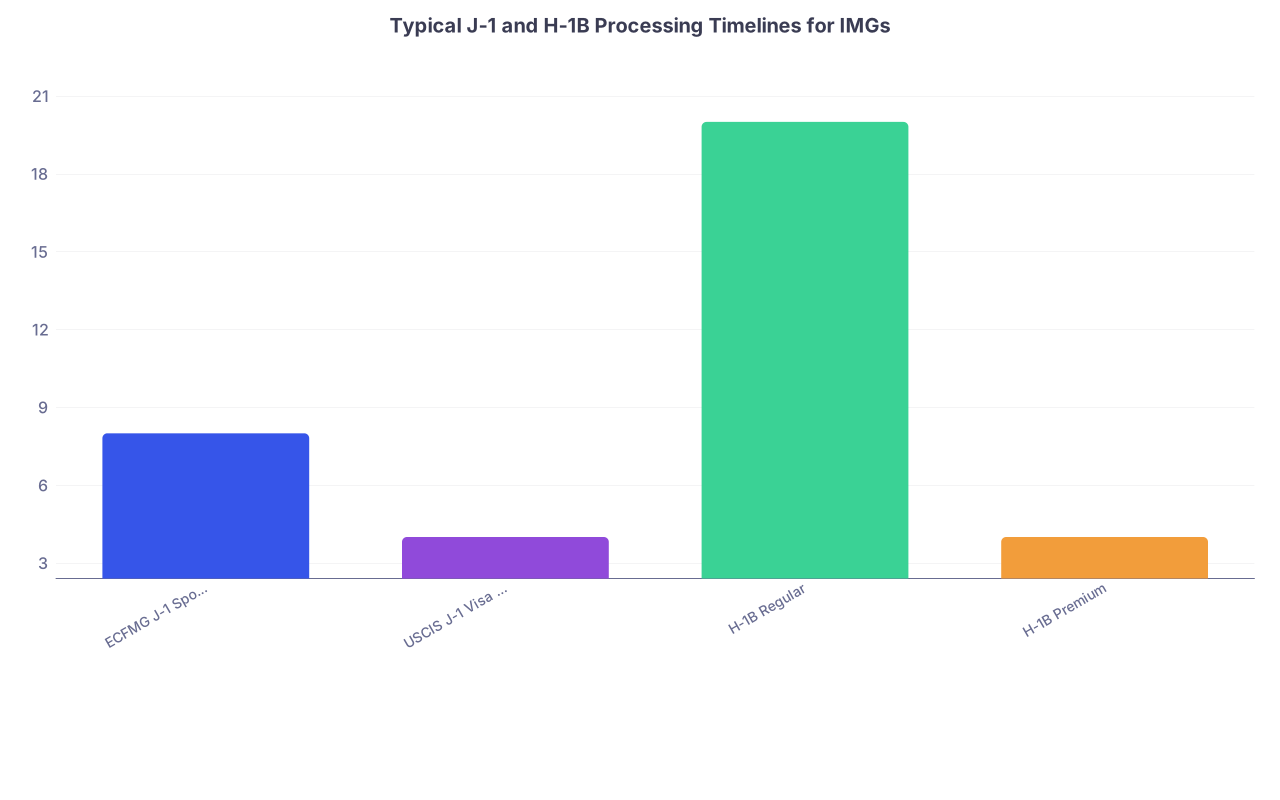
| Category | Value |
|---|---|
| ECFMG J-1 Sponsorship | 8 |
| USCIS J-1 Visa Processing | 4 |
| H-1B Regular | 20 |
| H-1B Premium | 4 |
(Values in weeks—ballpark, can vary.)
Here’s how people sabotage themselves:
- They delay Step 3 (for H‑1B hopefuls) until January or February of the Match year.
- They don’t send documents to ECFMG for J‑1 sponsorship until early summer.
- They book visa interviews at consulates too late to get their passport back in time.
Programs see this and get nervous: “Will this person actually be able to start orientation on July 1?” No program wants a resident who can’t physically arrive.
You avoid this by working backwards:
For J‑1:
- Confirm ECFMG requirements and document list early.
- Build in buffer for delays—transcripts, license verifications, background checks.
- Aim to have sponsorship approved and visa appointment booked well before June.
For H‑1B:
- Recognize that you probably need Step 3 done and reported months before July 1.
- Factor in USCIS processing (and whether the program uses premium processing).
- Understand cap‑exempt vs cap‑subject H‑1B (most teaching hospitals are cap‑exempt, but don’t assume—verify).
If you’re planning US clinical experiences before residency (electives, observerships), that also intersects with visa status (B‑1/B‑2, F‑1, etc.). Overstaying or misusing a visitor visa in med school can absolutely haunt you later when a residency wants to sponsor something more serious.
Mistake #5: Messy Status History, Overstays, or “Small” Violations
Immigration officers do not think in “small” violations. It’s either compliant or not.
Common ways students quietly tank their future:
- Overstaying a B‑1/B‑2 visit for observerships or exams by “just a few weeks.”
- Working in the U.S. without authorization (paid or sometimes even “volunteer” work that looks like employment).
- Doing hands‑on clinical work in the U.S. on the wrong status (for example, beyond what’s permitted on a B‑1 for limited clerkships).
- Multiple entries and exits with inconsistent explanations at the border.
Residency programs increasingly ask:
- “Do you currently have valid status?”
- “Have you ever overstayed or violated your status?”
If your history is messy, some programs simply won’t touch the risk. Others will try but later hit a brick wall with USCIS when filing J‑1 or H‑1B.
If you’ve already messed up:
- Don’t lie. Lying about immigration history is almost always worse than the violation itself.
- Talk to an immigration lawyer before you apply. There are sometimes ways to mitigate past issues or at least prepare a coherent explanation.
And if you haven’t yet: stop listening to casual “it’s fine, nobody checks” comments. They do check. Eventually.
Mistake #6: Failing to Align Exams, ECFMG Certification, and Visa Requirements
Visa eligibility doesn’t begin with “I got a residency offer.” It starts way earlier—with your exam and certification timeline.
Typical self‑sabotage:
- Taking Step 2 too late to get ECFMG certified before ranking or contract signing.
- Not realizing that some programs require ECFMG certification before they rank you, especially for H‑1B.
- Ignoring that H‑1B may require Step 3 already passed by the time of petition filing.
For IMGs, the sequence matters:
- Pass Step 1 and Step 2 CK.
- Complete clinical and credentialing requirements for ECFMG.
- Obtain ECFMG certification (official, documented).
- For H‑1B: pass Step 3 in time for a program to use it in their petition.
- Match.
- Initiate visa sponsorship (J‑1 via ECFMG, H‑1B via program + USCIS).
If you push Step 2 CK into late fall or winter and your application shows “ECFMG Certification: pending,” some programs quietly screen you out. Not for academic reasons—for administrative risk.
You want your file to scream: “Low visa hassle.” That means:
- ECFMG certification done early.
- Step 3 done early if you’re serious about H‑1B.
- Clear documentation ready to go.
Mistake #7: Applying Broadly Without Checking Visa Sponsorship Policies
Throwing ERAS applications everywhere without checking whether the program even sponsors visas is just burning money.
Most IMGs repeat this line: “I applied to 200+ programs.” Then admit they never checked:
- Which ones sponsor J‑1 only
- Which sponsor H‑1B
- Which sponsor nothing at all
Do a basic filter:
- Use FREIDA and program websites to verify if they sponsor visas, and which type.
- Make a spreadsheet and note J‑1, H‑1B, both, or none.
Then tailor:
- If you’re J‑1‑flexible: target J‑1‑friendly programs heavily.
- If you’re Step 3‑ready and truly need H‑1B: focus on programs that clearly say they sponsor H‑1B; don’t waste 80% of your budget on J‑1‑only hospitals.
| Program | J-1 Sponsorship | H-1B Sponsorship | Notes |
|---|---|---|---|
| Community Hospital A | Yes | No | J-1 only, no exceptions |
| University Program B | Yes | Yes | Prefers H-1B if Step 3 |
| Community Program C | No | No | Citizens/GC only |
Too many IMGs treat this as “I’ll deal with it later.” Programs don’t. They filter you out long before you can explain yourself.
Mistake #8: Going to the Wrong Kind of “Advisor”
There are two types of bad advisors that cause the most damage:
The overconfident unofficial advisor
- “I matched on H‑1B, trust me, you don’t need a lawyer.”
- “Everyone gets their J‑1, ECFMG is super chill.”
- “Just tell them you’ll switch to a green card soon.”
The clueless school office
- They’re great at transcripts and forms.
- Often terrible at nuanced U.S. immigration, especially if your school is in a different country with different norms.
If your situation involves:
- Dependents (spouse/children)
- Prior U.S. stays on other visas
- Any past denial, overstay, or status change
- Switching between F‑1, B‑1/B‑2, J‑1, H‑1B, etc.
You need an actual immigration attorney who deals with physicians. Not just any lawyer. Not the guy who did your cousin’s tourist visa.
Yes, it costs money. So does losing a full match cycle because your petition got denied for a technicality you didn’t understand.
Mistake #9: Poor Communication About Visa Status in Interviews
Programs know IMGs need visas. That’s not the problem. The problem is when you sound naive or rigid about it.
Common interview mistakes:
- Saying, “I only want H‑1B, I will not take J‑1” in a program that usually sponsors J‑1 only. They’ll move on. They can’t restructure their entire GME visa system for you.
- Being vague: “I’m not totally sure, I think I can do either, my friend did J‑1.” That reads as poorly prepared.
- Overpromising: “I’ll handle everything, it won’t be an issue” without understanding the timeline constraints.
Better approach:
- Be honest about your preference and your flexibility. For example:
“I understand your program primarily sponsors J‑1 visas. I’m eligible for J‑1 and comfortable with that path. I’ve also completed Step 3, so if H‑1B is an option your institution considers, I’d be open to that as well.”
That signals:
- You’ve done your homework.
- You’re not demanding special rules.
- You reduce their administrative anxiety instead of increasing it.
Mistake #10: Ignoring the Long-Term Immigration Path While Choosing Visa Type
You’re not just choosing a visa for PGY‑1. You’re choosing a trajectory for the next 5–10 years.
Where people go wrong:
- Accepting J‑1 without understanding they’ll likely need a J‑1 waiver job in an underserved area afterward (Conrad 30 or similar).
- Assuming they’ll “figure out a green card later” without considering that J‑1’s home residency rule can complicate or delay that.
- Choosing H‑1B without realizing it still has a time limit (6 years in most standard cases) and they’ll need a path to permanent residency, especially if they plan fellowship + practice in the U.S.
You don’t need a 30‑page life plan. But you do need to think:
- If I go J‑1, am I prepared to do a waiver job after training?
- If I go H‑1B, is my specialty and likely employer type realistic for sponsorship beyond residency?
- Is my ultimate plan to stay in the U.S. long‑term, or return home? The answer absolutely affects which trade‑offs make sense.
Too many IMGs only realize these issues in PGY‑3. That’s late. Not impossible, but harder.
Mistake #11: Leaving Your Family’s Status as an Afterthought
If you have a spouse, children, or a partner who may need status too, do not treat them as a side project.
Common disasters:
- Resident secures J‑1 but didn’t plan J‑2 timelines for spouse and kids; family arrival is delayed for months.
- H‑1B resident doesn’t understand H‑4 work limitations, which blows up finances and family expectations.
- Dual‑career couples (both physicians) don’t coordinate strategies and end up with visa combinations that complicate fellowships or waiver jobs.
If family is in the picture:
- Research J‑2 work authorization vs H‑4 (with or without EAD).
- Think about schooling for kids and whether delays in their visas will matter.
- Make sure the lawyer or program’s legal team knows, early, that you have dependents.
I’ve watched residents try to manage night float, ICU rotations, and a spouse stuck abroad waiting for a delayed interview. It can break people.
Mistake #12: Underestimating How Fast Rules Change
Immigration and graduate medical education policies change. Sometimes quietly. Sometimes abruptly.
Examples I’ve seen:
- Programs that used to sponsor H‑1B stop doing so after internal legal review.
- Consulates changing their interpretation of “observership” vs “clerkship” on B‑1/B‑2 entries.
- ECFMG updating documentation or training requirements for J‑1 sponsorship.
If you’re relying on a 2018 blog post or your cousin’s experience from 2015, you’re playing with outdated rules.
What you should do:
- Check ECFMG and USCIS websites directly for current guidance.
- Confirm visa sponsorship policies each application cycle, not just once.
- Treat any advice older than 2–3 years as suspect until verified.
A Visual Reality Check: Where IMG Plans Break Down

| Step | Description |
|---|---|
| Step 1 | Med School Abroad |
| Step 2 | USMLE Exams |
| Step 3 | ECFMG Certification |
| Step 4 | Residency Applications |
| Step 5 | Interviews |
| Step 6 | Match |
| Step 7 | Visa Sponsorship Process |
| Step 8 | Consulate/Status Approval |
| Step 9 | Residency Start |
| Step 10 | Denied/Delayed Visa |
| Step 11 | Late Certification - Not Ranked |
| Step 12 | Delayed Exams - Miss Cycle |
Most people obsess over B–F (exams, applications, interviews, Match). Smart IMGs put as much energy into C–H (certification, sponsorship, approval).
Final Takeaways
If you remember nothing else, keep these in your head:
- Visa planning is not a side task. Start early, understand J‑1 vs H‑1B, and align your exams and ECFMG certification with those requirements.
- Don’t trust casual advice with legal consequences. For anything beyond a straightforward case, verify with official sources or a real immigration attorney.
- Programs hate risk. Your job is to present yourself as academically strong and administratively easy to sponsor—clear status history, realistic visa expectations, and no last‑minute surprises.
Avoid these mistakes, and your immigration situation will stop being the hidden weak link in an otherwise strong IMG residency application.


