
The dirty secret is this: some Caribbean schools do not have “clinical sites.” They have rented access. And residency directors can smell the difference in thirty seconds.
You see “Clinical Sciences – U.S. teaching hospitals” on the brochure and think you’re set. They see “random third‑tier community hospitals that will sell time to anyone with a checkbook” and immediately put your application in the risk pile. Not always the reject pile. But the “we need to be very careful here” pile.
Let me walk you through why.
What Program Directors See When They Read “Caribbean Clinical Rotations”
From your side, it’s simple: first two years on an island, last two years “in the States.” On paper, that sounds reassuring. Stateside hospitals. U.S. patients. U.S. attendings.
From the program director’s chair, the first question isn’t “Did you rotate in the U.S.?” The real questions are:
- Who owned the rotation – the school or a for‑profit broker?
- Who else was on that team – U.S. MD/DO students or only offshore IMGs?
- Was this a real teaching environment or a shadowing circus?
- Did this hospital even know your name, or were you just “that Caribbean kid in the corner”?
They do not ask these questions out loud in the interview, of course. They know the answers from experience, not from your brochure.
I’ve sat in rooms where PDs flip through applications and see:
“Clinical rotations: XYZ Caribbean SOM – various U.S. affiliated hospitals (NY, MI, IL, FL).”
One director at a midwestern IM program literally said, “Translation: no home program, paid spots, God knows who was supervising.”
That is the lens you’re up against.
The Two Types of “Clinical Sites” – And Why One Terrifies PDs
There are essentially two buckets of clinical environments for Caribbean schools. The labels on websites are intentionally vague, but program directors have spent years decoding them.
| Type of Site | Typical Setup | Who Else Is There | PD Reaction |
|---|---|---|---|
| Integrated Teaching Hospital | Core site with MD/DO students, residents, structured clerkships | U.S. students + residents | Cautiously acceptable |
| [Contracted/“Rented” Site](https://residencyadvisor.com/resources/international-med-schools/7-caribbean-medical-school-red-flags-pre-meds-ignore-at-their-peril) | School or broker buys rotation slots at small hospitals/clinics | Mostly IMGs, few or no residents | High suspicion/fear |
1. Integrated teaching hospitals
These are genuine teaching environments:
- ACGME‑accredited residency programs on site
- Existing clerkship structures for U.S. MD/DO schools
- A real “medical education office” that tracks evaluations, learning objectives, case logs
If a Caribbean school has a long‑standing, transparent core affiliation with one of these, PDs may not love the offshore component, but they at least understand the structure.
Example: A busy Brooklyn hospital that trains U.S. IMGs, Caribbean students, and has internal medicine and surgery residencies. The director knows the environment, may know faculty there, and has seen multiple students from that site. That’s workable.
2. Contracted or “rented” sites
This is where the fear comes in.
Here’s what actually happens behind the scenes: a for‑profit company (or sometimes the school itself) signs a contract with a struggling community hospital or a private doc’s practice. They pay per student, per week, to let “students” come “rotate.”
No residents. No teaching service. Often no curriculum beyond: “Follow Dr. X around and don’t get in the way.”
I’ve seen students who did “internal medicine core” at:
- A four‑physician private group rounding at two tiny hospitals
- A hospital with no residency programs at all
- A place where the “evaluation” was faxed in as a one‑sentence note: “Student did fine.”
Program directors hate this. They don’t trust the training, the grading, or even the honesty of the evals. And they’re right to question it.
The Real Reasons These Sites Scare Residency Directors
It’s not xenophobia. It’s not snobbery about geography. It’s pattern recognition after years of half‑prepared interns showing up from the same kinds of places.
1. Unpredictable clinical exposure
At a real teaching hospital, a third‑year internal medicine clerkship has some baseline: admits, discharges, progress notes, call, night float, structured didactics, and case mix.
At many rented sites, what you get depends entirely on who “takes students.”
I’ve seen:
- IM “cores” that were 90% clinic with minimal inpatient
- Surgery “cores” where the student never scrubbed because the attending found them “annoying”
- Psychiatry “cores” at a 10‑bed unit where the student saw the same three stable patients for four weeks
Residency directors get burned when these students match and then can’t manage a basic cross‑cover call. They remember where those students came from.
2. No real peer comparison
Program directors want to know: how did you perform relative to other students?
At U.S. schools or strong IMG‑heavy teaching hospitals, attendings routinely work with multiple learners from multiple schools. They know what a “solid” student looks like. They know what “top 10% of the class” means.
At many Caribbean contracted sites, you’re the only student. Maybe the only one they’ve had in months. The attending has no frame of reference and often no incentive to be rigorous.
So those glowing evaluations? “Excellent, outstanding, superior in all domains.” PDs treat them like fluff. Because they’ve read hundreds of them from shy, undertrained students who then struggled as interns.
3. Questionable oversight and evaluation integrity
Let me be blunt: some of these rotations are rubber stamps. Everyone in the system knows it.
I’ve heard attendings at those sites say things like:
- “I don’t fail students; the school gets mad.”
- “They’re paying the hospital. I’m not going to ruin their career.”
- “As long as you show up and don’t do anything crazy, you’re getting honors.”
Now imagine you’re a PD comparing:
- A “High Pass” from a rigorous university hospital where failing is a real possibility
versus - “Honors” from a rented site where no one has failed in five years
You’d be skeptical too.
4. No home program = no long‑term vetting
This part residents rarely understand until they’re on the other side of the table.
U.S. MD/DO schools have “home programs” – their own IM, surgery, peds, etc. Students rotate there, get watched over time, and faculty send nuanced feedback up the chain. Problem learners are often quietly managed before residency applications even go out.
Many Caribbean schools have zero true home programs in the U.S. So there’s no single department chair of IM who’s known you for years and can say, “I’ve watched this student on wards, clinic, electives. They’re safe. They’re ready.”
Instead, PDs get scattered, short‑term evals from random hospitals whose standards they don’t know and don’t trust.
That’s why “no home clinical site” sets off alarms.
The Patterns PDs Whisper About (But Rarely Publish)
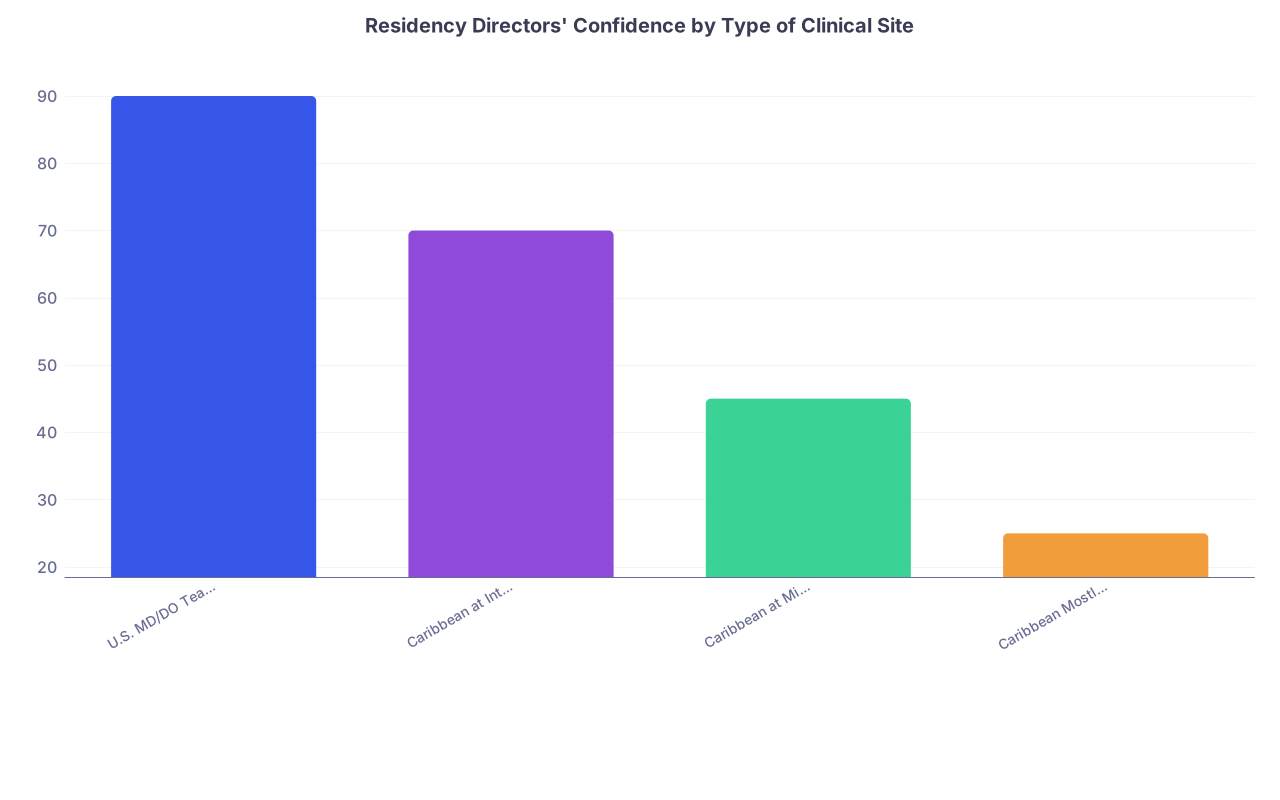
| Category | Value |
|---|---|
| U.S. MD/DO Teaching Hospital | 90 |
| Caribbean at Integrated Teaching Hospital | 70 |
| Caribbean at Mixed Sites | 45 |
| Caribbean Mostly Rented Sites | 25 |
No, there’s no official chart like this. But if you put 20 program directors in a room and asked them, anonymously, to rate their confidence, you’d get something close.
What they actually say, off the record:
- “Our worst interns, year after year, came from X, Y, Z Caribbean schools with itinerant rotations.”
- “I’ll take a Caribbean grad from a known NYC teaching hospital over one who rotated in five states I’ve never heard of.”
- “If their ‘core sites’ are private practices and tiny hospitals, I pass unless there’s something extraordinary about the rest of the app.”
They remember the intern who didn’t know how to write a proper admission note after “doing IM core.” They remember the one who had never placed an order in the EMR because “students weren’t allowed to” at their rotation sites.
And quietly, they start to blacklist certain patterns.
Red Flags in Caribbean Clinical Rotations That PDs Notice Instantly
Here’s what makes directors push your file aside or interrogate you more harshly in interviews.
1. Fragmented, multi‑state cores
When I see:
- IM: 4 weeks Texas, 4 weeks Illinois
- Surgery: 4 weeks Michigan, 4 weeks Florida
- Peds: 6 weeks New York
- Psych: 4 weeks “outpatient clinic, New Jersey”
I know exactly what happened: the school doesn’t really own stable core sites. They’re patching together whatever their broker can buy this month. That usually means low‑quality, low‑structure rotations.
A PD sees that and thinks, “No consistent team, no longitudinal mentorship, no stable assessment.”
2. Cores done mostly in outpatient or non‑teaching environments
An “internal medicine core” should be heavily inpatient. A “surgery core” should have real OR time. Psychiatry should involve acute care, not just a chronic outpatient clinic.
When the MSPE or transcript lists:
- IM – Downtown Internal Medicine Associates
- Surgery – Lakeside Surgical Group
- Psych – Serenity Behavioral Clinic
Alarm bells. Those aren’t clerkships. That’s shadowing with billing attached.
3. Absence of residents at your sites
PDs know which hospitals have ACGME residencies. They know the usual suspects, especially in their region.
If a hospital isn’t a known teaching site with residents, then your “clerkship” is basically an apprenticeship in a random practice. You might see patients. You might learn something. But you didn’t train in the environment you’re about to enter: resident‑run, team‑based inpatient care.
That gap scares them.
How This Hits You on Match Day – Concrete Consequences

| Step | Description |
|---|---|
| Step 1 | Caribbean School Choice |
| Step 2 | Solid Clerkship Training |
| Step 3 | Weak Clinical Prep |
| Step 4 | Stronger Letters & Trust |
| Step 5 | Generic Letters & Doubt |
| Step 6 | More Interviews |
| Step 7 | Fewer Interviews |
| Step 8 | Higher Match Chance |
| Step 9 | Lower Match, Risky Scramble |
| Step 10 | Quality of Clinical Sites |
Let me make this tangible.
Two Caribbean grads apply to the same internal medicine program:
- Both have Step 2 scores around 240
- Both have decent research and some volunteer work
- Both interview OK
But Applicant A did:
- Cores at a known Brooklyn hospital with an IM residency and lots of U.S. students
- Sub-I at that same hospital with a strong letter from the IM program director
Applicant B did:
- Cores scattered: two months in Ohio, one in Florida, one in Chicago, all small hospitals
- Sub-I at a private community site with unknown attendings
The PD looks at both and thinks:
- Applicant A: I know that hospital. I’ve worked with their grads. This letter writer trained people I trust.
- Applicant B: I have no idea what their “cores” meant. Their letters are all from places I don’t know. Higher risk.
You don’t need a spreadsheet to know who gets ranked higher.
And if you’re in that second category, the risk compounds across every program you apply to. Maybe one PD takes a chance. Most will not.
How to Vet Caribbean Clinical Sites BEFORE You Enroll
This is the part almost no one does properly. They ask the school, “Do you have U.S. clinical sites?” The school says yes. End of investigation.
That’s how people get burned.

You need to interrogate the clinical structure like your future depends on it. Because it does.
Here’s what you actually ask, in specific terms:
“List your core rotation sites by name and city, and specify which are true core sites versus occasional or elective sites.”
For each core hospital, ask:
- Does this hospital have ACGME‑accredited residency programs? In which specialties?
- Are U.S. MD/DO students also rotating there? From which schools?
- How long has your school had an affiliation there?
“Are your cores guaranteed at a single main teaching site, or are students routinely moved across multiple states to complete required clerkships?”
“Who technically employs the attendings who evaluate us – the hospital or an outside company/affiliate?”
“Can I speak with current M3/M4 students doing cores in the U.S. right now?”
And then you ask those students:- “How many residents are on your team?”
- “How many students from U.S. schools are there?”
- “How much hands‑on responsibility do you actually have?”
If you get vague, evasive, or defensive answers, that’s your sign.
Specific Patterns That Are Less Dangerous (And Ones That Are)
Not all Caribbean setups are equally radioactive. Let me draw some real lines for you.
| Pattern | Description | Risk Level |
|---|---|---|
| Cores at 1–2 big teaching hospitals with residencies | Stable, known sites, other med schools present | Lower |
| Cores at mix of teaching and smaller hospitals, mostly in 1 metro area | Some variability but some structure | Moderate |
| Cores fragmented across 4+ states, many private practice/clinic sites | Inconsistent, broker-driven | High |
| Electives only at big centers; cores all at tiny contracted sites | Shiny window-dressing, weak foundation | Very high |
The one that really tricks students is this: “We offer electives at [famous hospital names].”
You get dazzled by the elective list: Cleveland Clinic, Mayo, Miami, etc. But then you learn:
- Cores are all at random small hospitals and clinics
- Only a handful of top students win those big‑name electives
- PDs care far more about your core training than a 4‑week name‑brand observership
Residency directors can tell when you’re a product of a solid core system who did a capstone elective versus when you’re a product of rotating chaos who bought a shiny 4‑week line on your CV.
Guess which one they trust.
What You Can Do If You’re Already in a Weak Clinical Setup
You might be reading this as a current M2 or M3 thinking, “Too late, I’m already in this mess.” It’s not completely hopeless, but you don’t have much margin for error.
Here’s the unvarnished playbook:
- Fight to get your cores at the best teaching hospitals your school uses, even if it means moving or delaying. Do not passively accept whatever junk site the scheduler hands you.
- Load your fourth year with serious, hands‑on sub‑internships at ACGME teaching hospitals with residency programs in your target specialty.
- Get at least one letter from a U.S. academic department where the letter writer is known or easily Google‑verified as faculty in that specialty.
- Be ready, in interviews, to talk concretely about your clinical experiences. Not “I learned a lot,” but: “At [Hospital X] I was on a team with two residents, we carried 8–10 patients each, I wrote daily notes, pre‑rounded independently, and presented on rounds.”
Because if your school’s sites are on the questionable end, the only way you overcome that fear is by convincing PDs that you personally are an exception.
Harsh, but that’s the game.


