

Most Caribbean medical schools will happily cash your deposit even if you have almost no chance of ever practicing medicine in the United States.
That is the uncomfortable truth you need to work from.
You are already accepted. Maybe you put down a deposit. Maybe your family is excited. Maybe your GPA/MCAT is not where U.S. MD/DO schools want it and this felt like your only shot.
Pause. Before you get on a plane, you need a hard, structured reality check. Not vibes. Not hope. Data, risk, and a concrete plan.
This is that plan—6 steps, in order. If you walk through all of this honestly, you will either:
- Commit to the Caribbean with a specific, disciplined survival strategy, or
- Decide not to go and build a far better path forward.
Both outcomes are wins. Blindly boarding the flight is the only real loss.
Step 1: Get Clear on the Actual Numbers, Not the Marketing
Caribbean schools market like tech startups, not like traditional medical schools. They cherry-pick the success stories and bury the base rates.
You cannot make a sane decision until you see the risk profile clearly.
1.1 Understand the three big drop-off points
There are three cliffs most Caribbean students fall off:
Attrition (not finishing basic sciences / preclinical)
- Some schools quietly lose 20–40% of a starting class before Step 1.
- Reasons: failed courses, “academic dismissal,” voluntary withdrawal, financial issues.
Step 1 / Step 2 failure or delay
- If you cannot pass USMLE Step 1 and Step 2 CK on time and with decent scores, your residency odds plummet.
- Caribbean students are overrepresented among repeat USMLE takers.
Residency match failure
- This is the killer. You can graduate with an MD and never practice.
- Match rates for Caribbean schools vary wildly and are often misleading.
Here is how you cut through the marketing.
1.2 Demand hard data from your specific school
Email or call admissions. Ask for the following for your specific campus/program over the last 3–5 years:
| Metric | What You Want to See |
|---|---|
| 4-year on-time graduation rate | ≥ 60% is decent, < 50% is a serious red flag |
| USMLE Step 1 first-time pass rate | ≥ 90% is acceptable, avoid < 80% |
| USMLE Step 2 CK first-time pass rate | ≥ 90% preferred |
| Overall residency match rate | Ask explicitly: all grads, not “participants” only |
| Match rate to ACGME-accredited US residencies | This is the real target |
Do not accept:
- “Our top students match into…” stories
- Single-year cherry-picked numbers
- “Our alumni are at Mayo, Hopkins, etc.” — that means nothing about probabilities
If they dodge, give vague answers, or only quote old or pre-COVID data, assume the numbers are bad.
1.3 Compare to U.S. MD/DO baselines
You need context.
U.S. MD schools:
- Step 1 pass rates: often 95–98%
- Match rate: ~92–95% for seniors
U.S. DO schools:
- Match rates: often > 90% for seniors
Caribbean schools:
- Many operate in the 40–60% match range if you look at all graduates, not just “participants.”
- Some lower-tier schools are far worse. Single digits for certain cohorts.
If your school is not in the top tier (SGU, Ross, AUC, Saba) and even they are not close to U.S. outcomes, you are signing up for a stacked deck.
Step 2: Audit Yourself Ruthlessly – Can You Beat the Odds?
The Caribbean can work, but not for “average” effort students. You need to be the top of a risky pool, not someone “hoping it works out.”
This is personal. You must be brutally honest.
2.1 Study history: your real track record
Look at:
Undergrad GPA trend
- Did you have an upward trajectory (e.g., 2.8 → 3.5 by senior year)?
- Or did you bounce around and scrape by?
Science GPA specifically (BCPM)
- Strong Caribbean candidates often have:
- Overall GPA ~3.0–3.4
- But recent science coursework 3.5+
- Strong Caribbean candidates often have:
MCAT score and how you got it
- MCAT < 500 usually signals core content gaps or inconsistent study habits.
- If you took it more than once, did you improve with focused effort, or stall?
If your pattern is:
- Chronic procrastination
- Repeated exam failures
- Bare-minimum effort until panic week
You are walking into the worst environment for those habits. Caribbean med school will not fix them. It will punish them.
2.2 Personality and life circumstances
Caribbean success usually requires:
- Extreme self-discipline in an isolated, high-stress environment
- Minimal external distractions (family drama, financial chaos, health issues)
- Ability to study 8–12 hours daily for months, consistently, without hand-holding
Ask yourself concrete questions:
- Have you ever maintained a 50–60 hour study/work week for 6+ months?
- Can you move away from all family/friends and function?
- Do you hold up under high-stakes exam pressure, or do you crumble?
If the honest answer is “I have never proven I can do that,” then you need to either:
- Build that capability before going (post-bacc, SMP, MCAT retake, etc.), or
- Accept that the Caribbean is essentially a lottery ticket, not a plan.
Step 3: Map the Real Financial Risk – Including the Worst Case
Caribbean schools will take federal loans (for many programs), but that does not mean the debt is safe. It just means it is easy.
You are potentially looking at:
- $250,000–$400,000+ in total debt
- Interest accruing while you are still in school
- No guarantee of residency = no guarantee of physician income
You need numbers, not hand-waving.
3.1 Run a simple, harsh financial scenario
Build two scenarios for yourself:
Best reasonable case (not fantasy)
- You graduate on time (4 years)
- You pass Step 1 and Step 2 CK on first attempt
- You match into a primary care residency (FM/IM)
- You start a PGY-1 making ~$60–70k
Bad but very possible case
- You do 2–3 years
- Fail Step 1 once or twice
- Get dismissed or withdraw
- Result: $120k–200k debt, no MD, no residency
Then ask:
- Can you service the worst-case debt on a non-physician salary?
- What will that do to:
- Your ability to buy a home
- Support a family
- Change careers later
Here is a simple anchor:
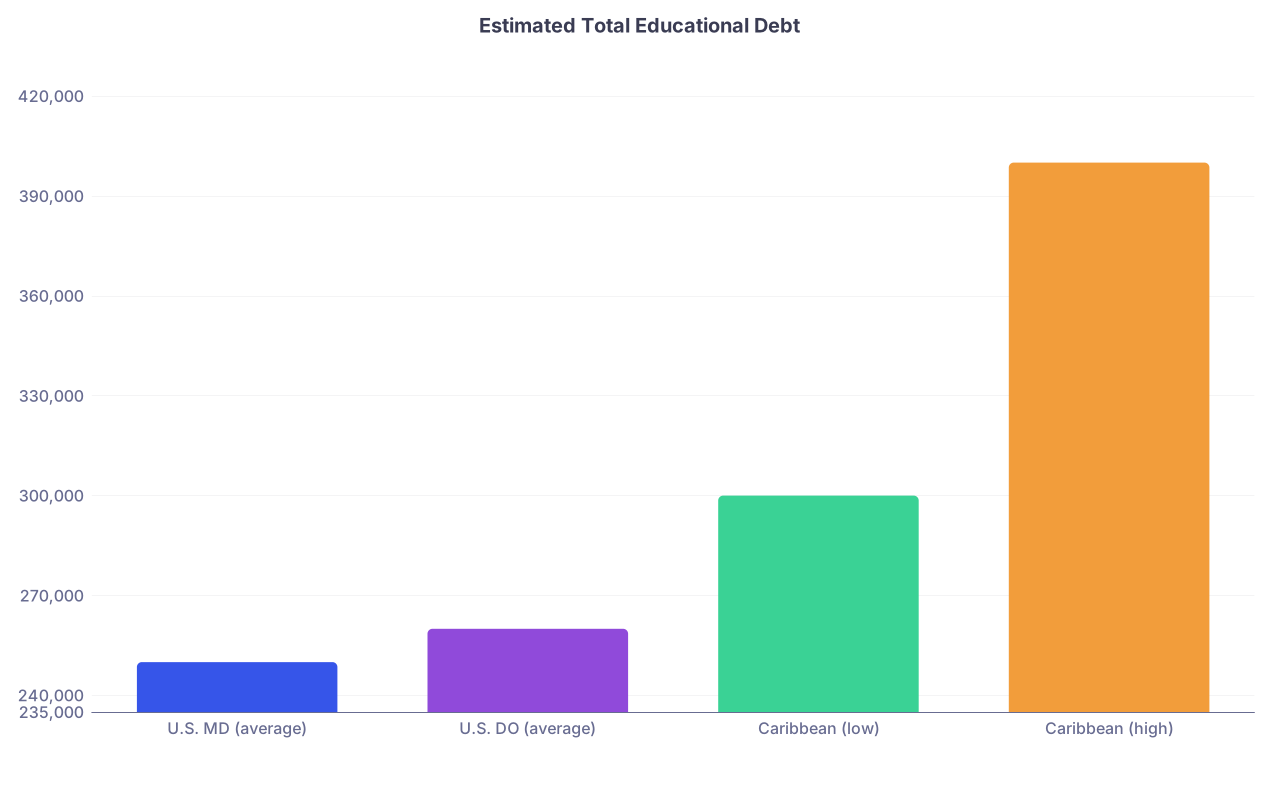
| Category | Value |
|---|---|
| U.S. MD (average) | 250000 |
| U.S. DO (average) | 260000 |
| Caribbean (low) | 300000 |
| Caribbean (high) | 400000 |
Now layer on match risk:
- U.S. MD: high match probability
- U.S. DO: still high
- Caribbean: dramatically lower, highly variable by school and student performance
Debt with a $230k attending income is survivable. Debt without that income can wreck your financial life for decades.
Step 4: Identify Your Alternatives Before You Commit
The biggest psychological trap: “This is my only chance to become a doctor.”
In most cases, that line is false. It is just easier. Less waiting. Less ego pain. More instant gratification.
List your alternatives explicitly so you are choosing between options, not just running toward the first open door.
4.1 Possible alternatives if you have not exhausted them
Formal post-bacc with linkage or strong advising
- For low GPA with no strong upward trend
- Use 1–2 years to prove you can do high-level science work
- Target: 3.6+ in post-bacc science coursework
Special Master’s Program (SMP) linked to a med school
- Designed as “med school lite” where performance can offset a weaker undergrad GPA
- Strong SMP performance (top 20–30%) can open U.S. MD/DO doors
-
- If your GPA is salvageable (e.g., 3.2–3.4) but MCAT is sub-505
- A deliberate 6–9 month dedicated MCAT plan can completely change your competitiveness
- I have watched students go from 498 → 510+ with real structure and accountability
Re-apply more intelligently to U.S. DO schools
- Many people under-apply or apply poorly
- Concrete upgrades you can do in 1–2 years:
- Strong MCAT retake
- Better clinical exposure
- Stronger letters
- Tight personal statement and secondaries
4.2 When Caribbean is not crazy
Caribbean may be a defensible option if:
- You have already:
- Done a serious post-bacc or SMP and did solidly (3.5+),
- Repaired a low GPA trend,
- Taken MCAT more than once and reached your realistic ceiling (e.g., 500–503), and
- Applied broadly to U.S. MD/DO with a rational list and got shut out.
AND:
- You are accepted at a relatively higher-tier Caribbean school with:
- Documented > 80–85% Step pass rates
- Reasonable ≥ 60%+ 4-year graduation rates
- Transparent clinical placements
AND:
- You are psychologically and financially prepared to treat this as climbing a mountain with a real chance of falling, not like a guaranteed path.
If you cannot honestly check most of those boxes, your “only chance” story needs rework.
Step 5: If You Still Go, Create a 6-Step Survival Protocol
Let us say you do the math, you know the risk, and you still decide to attend. Then you do not go as a regular student. You go like someone walking into a war zone with a battle plan.
Here is the 6-part protocol I would use with any student I actually care about.
5.1 Step A: Clarify your exact target specialties early
You do not have the luxury of drifting. For most Caribbean grads, the realistic target lanes are:
- Family Medicine
- Internal Medicine (categorical)
- Pediatrics
- Psychiatry
- Possibly Neurology / Pathology in some cases
Hyper-competitive fields (Derm, Ortho, Plastic, ENT, Neurosurgery, etc.) should not be your planning base. If they happen, fine. But build your entire structure around matching, not “dream specialties.”
5.2 Step B: Do not mess around during basic sciences
Your first 18–24 months will set your whole trajectory. You must:
- Treat med school like a full-time job + overtime
- 8–10 hours of focused study daily, 6 days a week
- Start Step 1 prep from day 1 of M1
- Use Anki (or another spaced repetition tool) for every course
- Do board-style questions early, not “later”
You should have a defined study structure:
- Morning: new content (lectures, notes, small group, etc.)
- Afternoon: active review (Anki, concept mapping, question banks)
- Evening: consolidation, pre-read for next day
If you are not already comfortable with intense, regular repetition and board-style questions, you must train that before flying out or in your first month at most.
5.3 Step C: Build a USMLE plan on day one
You cannot wing Step 1 or Step 2. You must build:
Resource list (limited, not 15 things)
- Step 1:
- First Aid or similar comprehensive review
- UWorld
- Pathoma / Boards and Beyond / similar for path/phys
- Step 2:
- UWorld Step 2 CK
- NBME practice exams / UWSAs
- Step 1:
Testing timeline
- When are you allowed to take Step 1 by your school policy?
- What NBME target will trigger “okay, schedule it”? (e.g., ≥ 230 on at least two practice exams)
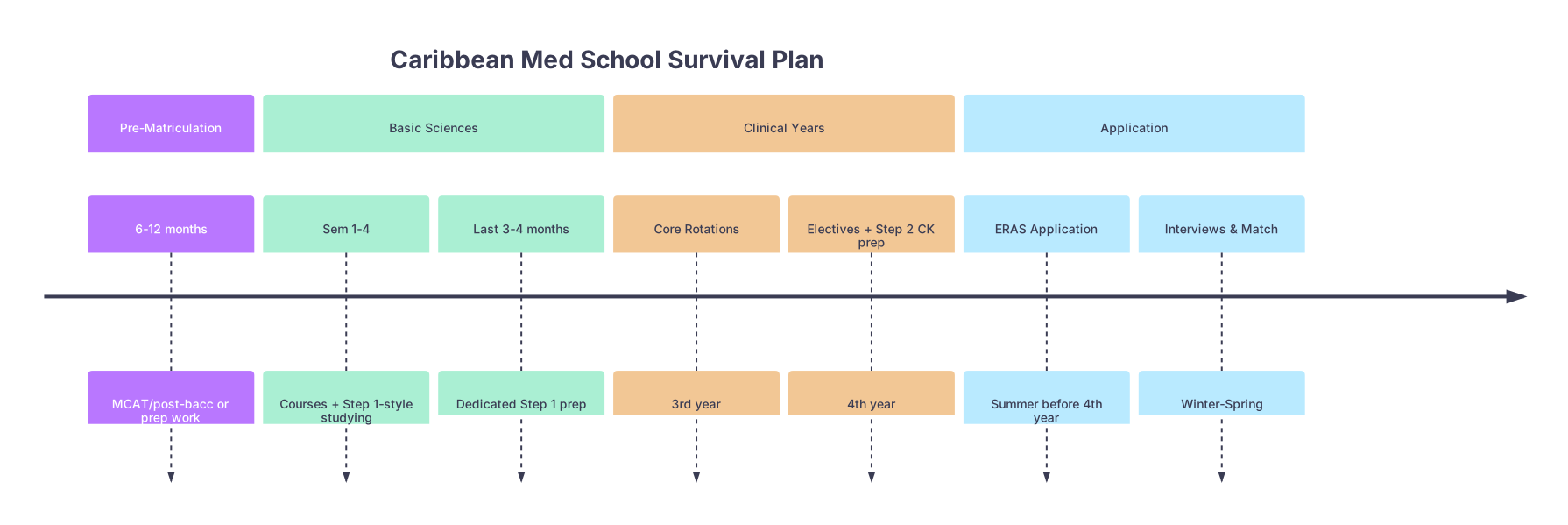
| Period | Event |
|---|---|
| Pre-Matriculation - 6-12 months | MCAT/post-bacc or prep work |
| Basic Sciences - Sem 1-4 | Courses + Step 1-style studying |
| Basic Sciences - Last 3-4 months | Dedicated Step 1 prep |
| Clinical Years - Core Rotations | 3rd year |
| Clinical Years - Electives + Step 2 CK prep | 4th year |
| Application - ERAS Application | Summer before 4th year |
| Application - Interviews & Match | Winter-Spring |
If your school pushes you to take Step 1 with weak practice scores “to keep on schedule,” that is a red flag. Sacrificing Step 1 just to stay on their timeline is how students get wrecked.
5.4 Step D: Plan your clinical years like a campaign
Rotations for Caribbean students are a minefield. Some are excellent. Some are a joke. You want:
- A maximum number of U.S.-based ACGME-affiliated clinicals
- Rotations in locations with:
- Known residency programs
- Good teaching attendings
- A track record of taking Caribbean students seriously
Ask explicitly:
- Where are the core rotations?
- Are they all green-book / ACGME-affiliated?
- How long do students wait for rotations after basic sciences? (Gap months kill momentum.)
You should aim to:
- Do core rotations at solid U.S. teaching hospitals
- Use electives to:
- Rotate at institutions where you want to apply
- Show your face and work ethic
- Grab strong letters of recommendation
5.5 Step E: Become impossible to ignore on paper
As an international medical graduate (IMG) from a Caribbean school, your application has to scream: “Despite the school, this person is outstanding.”
You want:
Very strong Step scores
- Step 1: At or above the average of U.S. MD students for your target specialty
- Step 2 CK: High enough to erase Step 1 concerns
Clean academic record
- No failures, no repeats, no professionalism issues
High-quality letters
- From U.S. faculty who routinely work with U.S. med students
- Letters saying “Top 5–10% of all students I have worked with in the last X years,” not just “hard-working and pleasant”
Evidence of maturity
- Solid personal statement
- Coherent story about why medicine, why this specialty, what you bring
5.6 Step F: Apply like an underdog
As a Caribbean grad, your residency application strategy must be aggressive and targeted.
That means:
- Apply widely (often 80–120+ programs in primary care specialties)
- Include:
- Community programs
- Less “prestigious” regions
- Programs known to take IMGs historically
You will:
- Prepare for interviews early (practice behavioral questions, tell your story clearly)
- Have a plan if you do not match the first time:
- SOAP (Supplemental Offer and Acceptance Program)
- Possibly a research year or prelim year if strategically sensible
- But not endless, aimless reapplication without changing the inputs
Step 6: Decide With Eyes Open – And Own It
After you walk through all this, you will be in one of three positions.
6.1 Scenario 1: “This is too risky, and I have alternatives”
If you conclude:
- The school’s data is weak or sketchy
- Your own academic habits are not where they need to be
- You have realistic paths to strengthen your U.S. MD/DO chances
Then the right move is not complicated: do not go.
Recover your deposit if you can. If not, treat it as a relatively cheap lesson compared to the six-figure disaster you just avoided.
Focus on:
- MCAT repair
- Post-bacc / SMP
- Rebuilding your application systematically over 1–3 years
6.2 Scenario 2: “I have no realistic U.S. path and accept the risk”
If you are older, have already done serious repair work, reapplied intelligently, and still have no U.S. acceptance, the calculation is different. Caribbean might be your last viable path.
If that is you:
- Go in knowing you must be top-tier within your school
- Follow the survival protocol like your career depends on it (because it does)
- Stay obsessed with Step scores, clinical performance, and professional reputation
No illusions. Just execution.
6.3 Scenario 3: “I am unsure and just scared of waiting”
This is where many students sit:
- You could delay and improve your profile
- But you hate the idea of more years of uncertainty
- Caribbean is the “fastest” path, emotionally
Be careful. Decisions driven by discomfort with waiting are usually bad. Medicine is a long game. A one- or two-year delay to massively improve your odds is not a detour. It is usually the smart play.
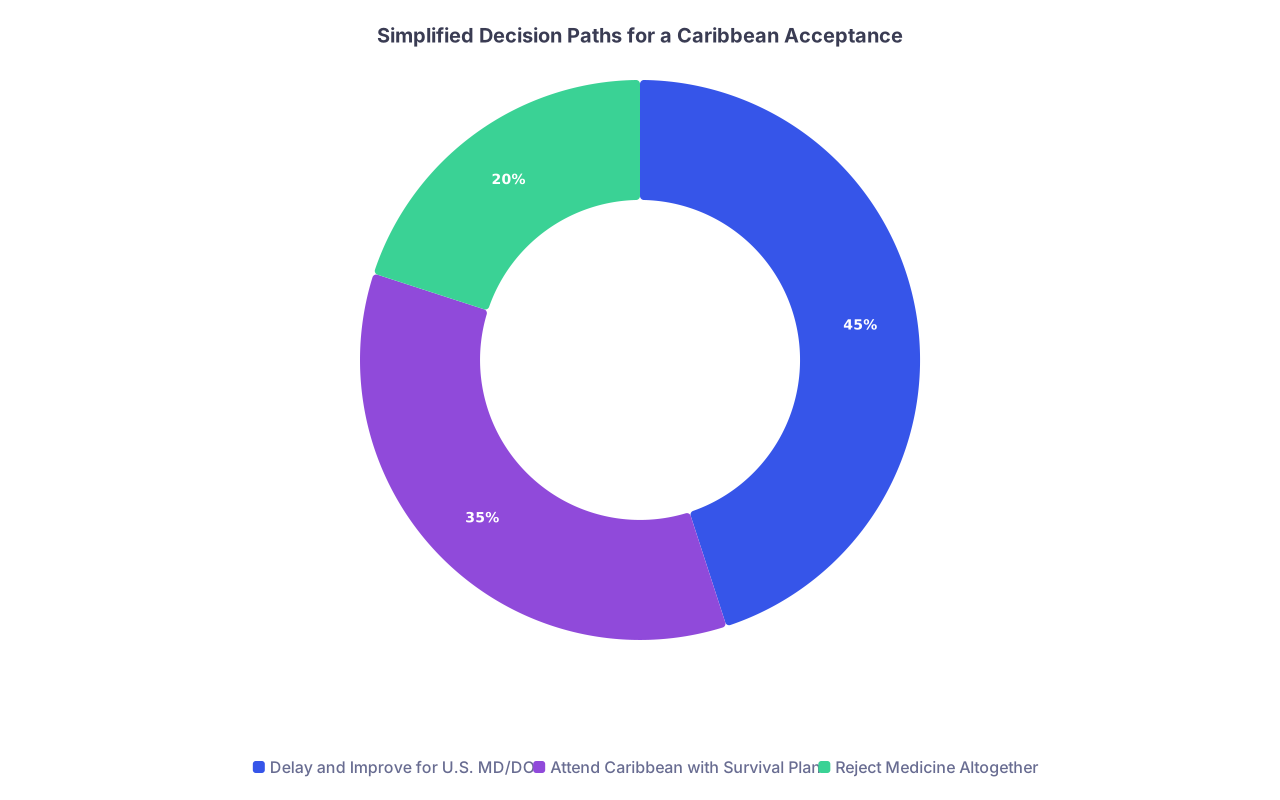
| Category | Value |
|---|---|
| Delay and Improve for U.S. MD/DO | 45 |
| Attend Caribbean with Survival Plan | 35 |
| Reject Medicine Altogether | 20 |
(Not scientific data, but a reasonable distribution of what should happen if people ran this reality check honestly.)
One Last Structural Check: Red Flags That Should Make You Walk Away
If any of this is true of your acceptance, I would walk:
- School will not provide real attrition, Step, and match data
- You are admitted with:
- No MCAT
- Extremely low GPA and no remediation discussion
- They pressure you with:
- “Seats are limited, you must pay the deposit now”
- Heavy sales calls, repeated emails
- You see large numbers of:
- Students failing out
- Long gaps between semesters
- Bitter upperclassmen warning you off on forums or Reddit
You are not buying a used car. You are placing your twenties (and probably thirties) on the line.




| Step | Description |
|---|---|
| Step 1 | Caribbean Acceptance in Hand |
| Step 2 | Step 1: Get the Real Numbers |
| Step 3 | Step 2: Audit Yourself Ruthlessly |
| Step 4 | Step 3: Map Financial Risk |
| Step 5 | Step 4: Identify Alternatives |
| Step 6 | Step 6: Delay, Repair, Reapply |
| Step 7 | Step 5: Survival Protocol |
| Step 8 | Step 6: Own the Decision and Execute |
| Step 9 | Still Going? |
Boiled Down: What You Actually Need to Do
Three key points to walk away with:
- Stop guessing; get hard data about your specific Caribbean school’s attrition, Step pass, and match rates, and compare those to U.S. MD/DO baselines.
- Audit yourself with zero denial—your past study behavior, MCAT/GPA record, mental resilience, and financial tolerance have to match the risk.
- If you still go, treat it like a high-risk, all-in campaign, not a backup plan: top performance from day one, aggressive Step prep, targeted clinicals, and a realistic residency strategy.
Make the decision slow, informed, and intentional. The plane ticket can wait.


