

The Caribbean will not save you. But you can still save yourself.
If your start at a Caribbean med school has gone sideways—failed classes, academic probation, leaves of absence—you are not doomed. You are, however, out of slack. You need a protocol, not vibes. Hope is not a plan.
This is that plan.
You are not going to “try harder.” You are going to overhaul how you study, how you schedule, how you interact with your school, and how you think about the next five years. Step by step. No illusions.
Step 1: Get Completely Honest About Where You Stand
You cannot fix what you only half understand.
Most struggling Caribbean students misjudge how bad things actually are. They either minimize (“It’s just one fail, I’ll bounce back”) or catastrophize (“My career is over”). Both are useless.
Do this in writing. Today.
List your actual academic status
- Courses failed (with grades and term)
- Courses passed but barely (C-/70–75 range)
- Current status:
- Good standing
- Academic warning
- Probation
- Dismissal under appeal
- Any official letters or emails from the Dean’s office
Pull your policies
- Go to your school’s academic handbook or policies PDF.
- Find sections on:
- Course failures
- Remediation rules
- Maximum repeats allowed
- Dismissal thresholds
- Leave of absence
- Screenshot or print the relevant pages.
Create a one-page reality snapshot Write a short, factual summary:
- “I have failed X courses: [course, term, grade].”
- “I am on [warning/probation]. If I fail one more [block/term], policy says [consequence].”
- “School allows [#] total failures/attempts before dismissal.”
- “USMLE Step 1 must be taken by [deadline/semester].”
This is not for motivation. It is operational intel. Every decision you make from here must line up with this sheet.
Step 2: Understand the Unique Caribbean Trap You’re In
Caribbean schools are not like your in-state MD program. Different incentives, different risks.
Here is the uncomfortable truth: your school’s business model depends on large entering classes and much smaller graduating classes. There is less hand-holding. Less institutional pressure to rescue you if you tank early.
Common patterns I see over and over:
- Students arrive shell-shocked by the volume.
- They keep using undergrad study tactics (re-reading, highlighting, group “study” that’s really social time).
- First exam hits—50s and 60s.
- They tell themselves they just need to “adjust.”
- By the time they realize this is systemic, not random, they are one failure away from being done.
You avoid that spiral by treating every term as if you are on thin ice. Because you are.
Step 3: Do a Ruthless Post-Mortem on Why You Struggled
Not “I didn’t study enough.” That is lazy analysis. You need diagnostic-level detail.
Take your worst term or course and break it down:
A. Time use (the ugly truth)
For 7 days, log your time in 30-minute blocks:
- Lectures (live/recorded)
- Anki or spaced repetition
- Question banks (UWorld, AMBOSS, school Qs)
- Passive review (reading, re-watching lectures)
- Admin/chores
- Sleep
- Social/media/gaming
What usually shows up:
- 6–8 hours “studying” with only 2–3 hours of real active work.
- Massive time wastage in:
- Rewatching lectures at 1x
- Making pretty notes
- Group “reviews” where nobody can explain mechanisms
B. Methods (what you actually do when you “study”)
Be specific:
- How do you take notes in lecture?
- How soon do you review them?
- How many practice questions do you do per week?
- How are you using Anki (if at all)?
- Do you test yourself daily without looking at notes?
Common failure modes:
- 90% passive input, 10% active recall (should be the reverse)
- No spaced repetition system; everything is cramming
- Questions saved “for later” instead of used from week one
C. Assessment performance patterns
Pull 2–3 old exams:
- What domains did you miss most? (concepts vs details vs application)
- Did you run out of time?
- Did you change right answers to wrong ones frequently?
- Were most misses “I had no idea” or “I thought it was something else”?
You are trying to answer: Was this a knowledge deficit, a strategy deficit, or an execution deficit? Usually it is two of the three.
Write your conclusions in 5–10 bullet points. Example:
- I spend too much time passively re-watching lectures.
- I barely do practice questions until the week before exams.
- I do not re-expose myself to content enough; by week 3 I have forgotten week 1.
- On exams I miss mechanism and multi-step reasoning questions.
Now we know what to fix.
Step 4: Decide: Stay, Pause, Or Cut Losses
Brutal but necessary: not everyone should stay.
Do not base this on emotion. Base it on:
- Your current status
- Your ability to radically change behavior
- Your financial tolerance for risk
- Your long-term goals
Here is a simplified decision guide:
| Situation | Risk Level | Recommended Move |
|---|---|---|
| 1–2 borderline passes, no fails, early terms | Moderate | Stay, implement aggressive overhaul |
| 1 fail, not on probation, early basic sciences | High | Stay with strict protocol and faculty support |
| 2+ fails, on probation, limited allowed repeats left | Very High | Strongly consider LOA to rebuild skills before resuming |
| Near dismissal, multiple repeats, debt rising | Critical | Consider exit strategy or complete career pivot |
If you are in the “Very High” or “Critical” boxes and you know, honestly, that:
- You will not actually follow a strict schedule.
- You are already financially drowning.
- Medicine was a lukewarm choice to begin with.
Then yes—stopping now may save you years and six figures.
If you choose to stay, though, you are committing to changing how you operate. Not tinkering. Overhaul.
Step 5: Build a 12-Week Academic Recovery Protocol
Treat the next term like a rehabilitation block. Everything is designed to:
- Maximize active recall
- Force spaced repetition
- Lock in fundamentals for Step 1, not just pass the block
Here is the backbone structure.
A. Daily non-negotiables
2–3 hours of pure active recall
- Closed-notes questions:
- End-of-chapter questions
- School-provided question banks
- Boards-style questions if appropriate (not as your only source)
- Self-quizzing without notes:
- Sketch out pathways from memory
- List differentials from memory
- Draw anatomy diagrams from memory
- Closed-notes questions:
At least 1–1.5 hours of spaced repetition
- Use Anki or a similar spaced repetition tool.
- Cards should be:
- Short and focused
- One fact or concept per card
- Minimum daily goal: all due reviews + 20–40 new cards (depending on volume).
Lecture strategy Stop trying to be a court stenographer.
- Watch lectures at 1.5–2x if recorded.
- During lecture:
- Write minimal notes focused on:
- Key mechanisms
- High-yield facts
- Anything repeated or emphasized
- Write minimal notes focused on:
- Within 24 hours:
- Convert notes directly into:
- Anki cards
- 1-page concept maps
- Convert notes directly into:
B. Weekly structure that actually works
Use this simple weekly framework:
Monday–Friday
- 6–8 hours total academic time:
- 2–3 hours active recall / questions
- 1–1.5 hours spaced repetition / Anki
- 3–4 hours lecture + directed note processing
- Protect 7–8 hours of sleep. Non-negotiable.
- 6–8 hours total academic time:
Saturday
- 3–4 hour “mock exam” block:
- 40–80 questions (school or NBME-style if appropriate)
- Timed conditions
- Full review afterwards
- 2–3 hours content gap-filling after you see patterns in missed questions.
- 3–4 hour “mock exam” block:
Sunday
- 2–4 hours:
- System-level review (e.g., all cardio for the week)
- Planning the next week
- Half day off. Your brain is not a machine.
- 2–4 hours:
Use a simple spreadsheet or calendar to block these. Color-code:
- Green: active recall
- Blue: lectures
- Orange: spaced repetition
- Red: exams
If your calendar is 80% green/blue and almost no orange, you are failing future-you.
Step 6: Align Everything With Step 1 From Day 1 of Recovery
You are not just trying to pass Caribbean exams. You are building Step 1 viability.
The danger: some students “recover” by gaming school exams—memorizing slide decks, ignoring mechanisms—and then get destroyed by boards. Do not be that person.
Here is how to integrate Step 1 without overextending:
Use one primary board resource per subject Examples:
- Pathoma for pathology
- Sketchy for micro/pharm
- Boards & Beyond for physiology
- First Aid or similar as a roadmap, not a Bible
Coordinate board resources with your curriculum Each week:
- Look at what the school is teaching (e.g., renal).
- Watch the corresponding board lectures that same week.
- Make integrated cards/questions that tie school content to board-style framing.
Limit board Qbanks early
- For basic sciences:
- You can start with subject-specific blocks once you have covered the basics.
- 10–20 high-quality questions per day aligned with current topics is enough initially.
- The goal now is pattern recognition and reasoning, not score flexing.
- For basic sciences:
As you stabilize and your exam performance improves, you can increase question volume.
Step 7: Fix How You Interact With Your School
Most struggling students operate in isolation and only talk to administration when they are already in trouble. That is backwards.
You need a visible recovery narrative with your school. That means:
- Meet with key people early in the term
- Academic dean or student affairs
- Course directors for the classes you failed or struggled in
- Learning specialist if your school has one
Go in with:
- Your one-page reality snapshot
- Your analysis of what went wrong
- A draft of your new study protocol
Say something like:
“Last term I failed X and barely passed Y. I have gone through my exams and time logs and realized my study approach was far too passive and last-minute. I have built this new weekly schedule focused on active recall and questions. I want your input on whether this is realistic and if I am missing anything.”
That is the opposite of making excuses. Faculty notice.
Ask specific, operational questions
- “What does a student who scores >85 in your course typically do each week?”
- “How many practice questions per week do your top students complete?”
- “Are there any high-yield resources or old exams you recommend I focus on?”
Follow up after each major exam
- Brief email:
- Your score
- What changed in your approach
- What you will adjust next
- You are building a documented trail of effort and improvement. This matters later if you hit a borderline situation.
- Brief email:
Step 8: Tighten Your Exam Strategy: Before, During, After
Passing exams is not mystical. It is a skill set.
Before the exam: 7–10 day ramp
- Switch to:
- 60–70% questions
- 30–40% targeted content review
- On missed questions:
- Write down why you missed it:
- Did not know the fact.
- Misread the question.
- Knew it but second-guessed.
- Fix the underlying issue:
- Add 1–2 cards.
- Build a small concept sheet.
- Practice reading stems slower.
- Write down why you missed it:
During the exam
Use a simple protocol:
- First pass:
- Answer every question you know quickly.
- Mark those you are unsure about.
- Do not burn time on one brutal question:
- If you have no idea after 30–45 seconds, eliminate obviously wrong answers, pick your best guess, mark, move on.
- Second pass:
- Return to marked questions.
- Spend remaining time methodically eliminating options.
Most failing students waste huge chunks of time trying to brute-force a few questions and then guess blindly at the end.
After the exam
Here is where most of the learning opportunity gets thrown away.
Within 48 hours:
- Go through every missed question.
- Categorize misses:
- Knowledge gap
- Misread / rushed
- Changed right to wrong
- Careless calculation
- Look for patterns across courses. Then adjust your daily habits accordingly.
If you are failing but not reviewing your exams in detail with the answer key and, ideally, the professor, you are choosing to stay lost.
Step 9: Reinforce Mental Stability Without Wasting Time
You know this already: Caribbean school can be isolating, depressing, and financially terrifying. Anxiety melts working memory. Burnout makes you stupid.
You do not have to become a wellness influencer. You do need a minimal viable mental health protocol that supports cognition.
Here is a simple version:
- Sleep: Aim for 7–8 hours. Protect it like an exam.
- Movement: 20–30 minutes of walking or basic exercise 4–5 days per week.
- Food: Avoid the all-junk diet. Basic rule—real meals twice a day with some protein.
- Social: One non-medical interaction per week that is not just venting. Call someone from home you actually like.
- Phone: Hard boundaries:
- No social media during core study blocks.
- Phone in another room for 90-minute deep work sessions.
If you are sliding toward clinical depression or panic attacks, do not wait:
- Check if your school offers counseling.
- If not, find a telehealth provider in your home country who can see you regularly.
- Be honest about what is happening.
Repeating a term while depressed and untreated rarely ends well.
Step 10: Keep One Eye on the Long Game: Clinicals and Match
Recovery is not only about passing the next block. You are building credibility for:
- Clinical placement (core rotations in the US or elsewhere)
- Letters of recommendation
- Residency application (ERAS)
Here is the hierarchy:
Stabilize basic science performance
- No more failures.
- Trend upward in exam averages.
- Demonstrate that early struggles were a phase, not a pattern.
Plan for Step 1 timing strategically
- Do not rush Step 1 to “catch up” if your foundations are shaky.
- But do not delay so long you hit school deadlines or visa issues.
- Use NBME self-assessments realistically. Not vibes. If you are nowhere near passing, you are not “almost ready.”
Shape a redemption narrative When you eventually apply to residency, program directors will see:
- Caribbean school
- Any repeats/LOAs in your transcript
- Your Step scores
- Clinical grades and comments
You want to be able to say, with documents to back it up:
- “I struggled initially because X. Then I overhauled my approach, and from that term forward my performance improved steadily. My Step scores and clinical evaluations reflect that growth.”
That narrative is believable if:
- The inflection point is clear.
- There are no later crashes.
- Your letters mention work ethic and improvement.
Concrete 30-Day Action Plan
If you need someone to tell you exactly what to do next month, here it is.
Days 1–3
- Complete:
- Reality snapshot (status + policies)
- Post-mortem of prior term
- Draft weekly schedule
- Schedule meetings:
- Academic dean / advisor
- At least two key course directors
- Set up tools:
- Anki or equivalent
- Digital or paper calendar with daily time blocks
Days 4–14
- Implement:
- Daily non-negotiables (questions + spaced repetition)
- Lecture processing within 24 hours
- Track:
- Actual hours spent on:
- Active recall
- Lectures
- Spaced repetition
- Actual hours spent on:
- Adjust:
- If you are not hitting 2+ hours of active recall per day, cut something else.
Days 15–21
- First major exam or quiz cycle:
- Do a 40–80 question timed practice block before each exam.
- Use the before/during/after exam protocol.
- Meet again (if possible) with at least one professor:
- Show your process.
- Get feedback on exam performance and study approach.
Days 22–30
- Look at trend:
- Are quiz/exam grades moving upward?
- Is your schedule realistic or do you need to prune?
- Decide:
- Double down on what is working.
- Cut ineffective time sinks (re-watching full lectures, endless note decorating).
- Re-run a mini post-mortem:
- What has improved since Day 1?
- Where are you still failing to execute?
If, at 30 days, you have kept to your protocol at least 80% of the time and early assessments are improving, you are likely salvageable academically at that school.
If you have blown off your own plan and things look the same or worse, you have your answer too. That is when you revisit Step 4 honestly.
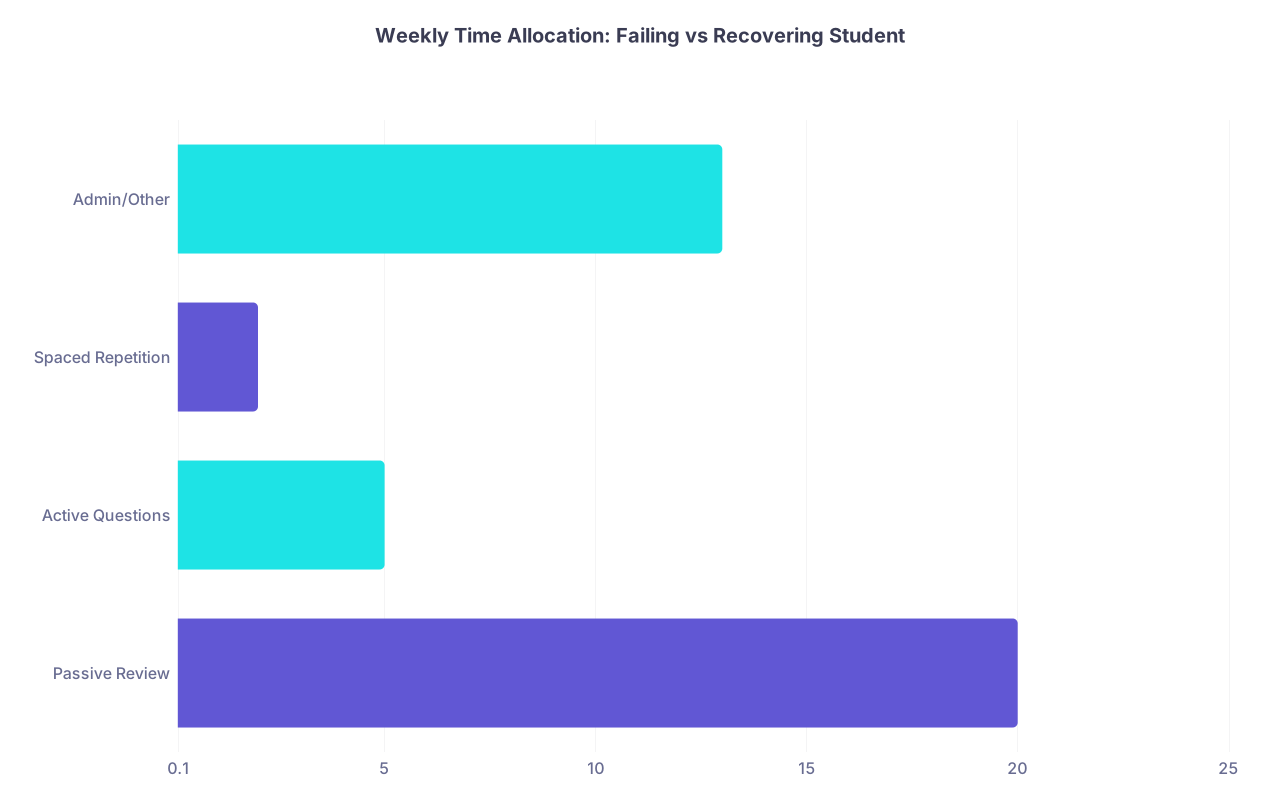
| Category | Value |
|---|---|
| Passive Review | 20 |
| Active Questions | 5 |
| Spaced Repetition | 2 |
| Admin/Other | 13 |
Example Week: From Chaos to Controlled
To make this less abstract, here is a rough before/after.
Before (what I see all the time):
- Mon–Fri:
- 6–8 hours “studying”
- 4 hours lectures (live, no rewatch)
- 2–3 hours re-reading notes, watching YouTube explanations
- 0–10 questions total until 3 days pre-exam
- Week before exam:
- Panic
- All-nighters
- 100–200 questions crammed
- Massive forgetting, shallow understanding
After (what a recovery week looks like):
- Mon–Fri:
- 2 hours lecture
- 1 hour processing lecture into Anki/concept maps
- 2 hours questions (40–60 questions / day across courses)
- 1–1.5 hours spaced repetition
- Week before exam:
- 60–70% time on timed questions, targeted to weak areas
- Sleep preserved
- Systematic post-question review and targeted card creation
The difference is not magical intelligence. It is structure.

| Step | Description |
|---|---|
| Step 1 | Recognize Failure or Probation |
| Step 2 | Reality Snapshot & Policy Review |
| Step 3 | Post-mortem: Why You Struggled |
| Step 4 | Design 12-week Recovery Protocol |
| Step 5 | LOA & Skills Rebuild Plan |
| Step 6 | Career Pivot Planning |
| Step 7 | Meet Faculty & Dean |
| Step 8 | Execute Daily & Weekly Structure |
| Step 9 | Assess Early Exam Trends |
| Step 10 | Reinforce & Scale for Step 1 |
| Step 11 | Stay, Pause, or Exit? |
| Step 12 | Improving? |
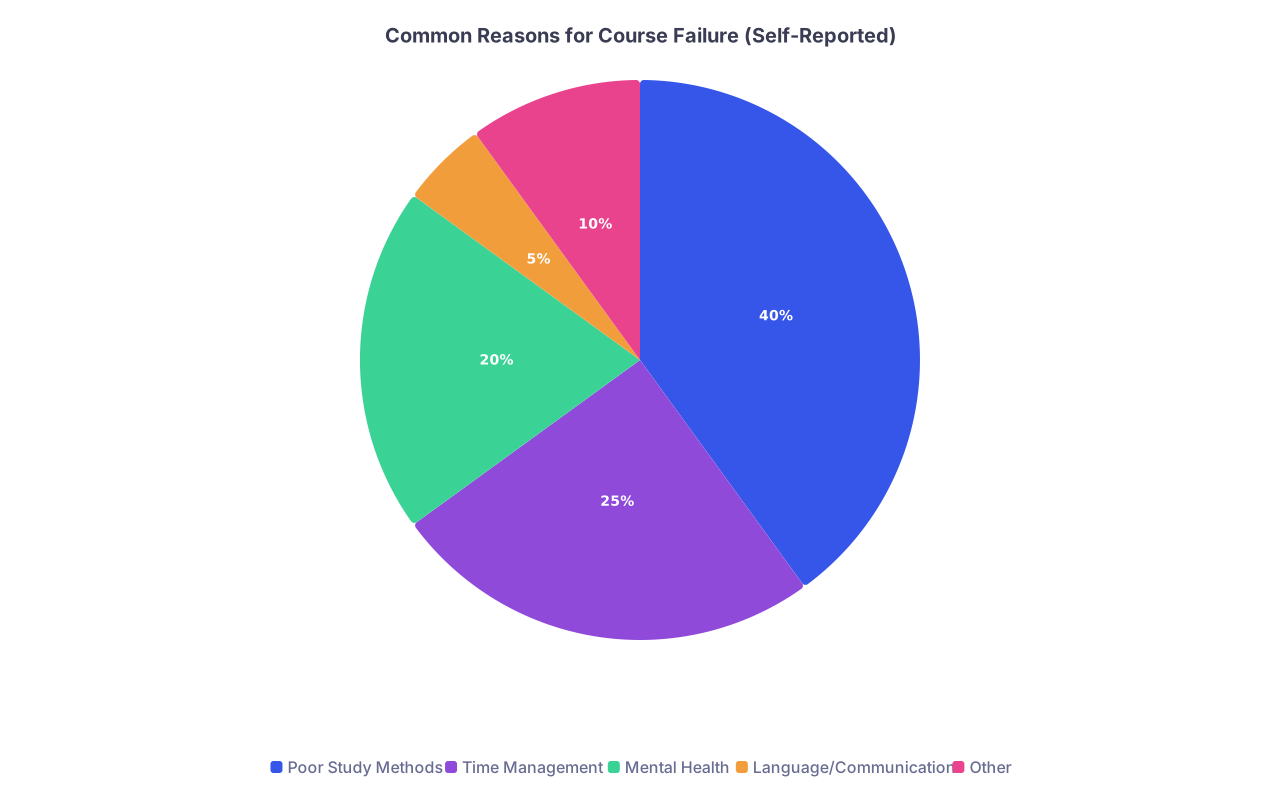
| Category | Value |
|---|---|
| Poor Study Methods | 40 |
| Time Management | 25 |
| Mental Health | 20 |
| Language/Communication | 5 |
| Other | 10 |
Final Thoughts: What Actually Saves You
Three things, not thirty.
- Radical honesty about your situation and your habits. No sugarcoating. Write it down. Own it.
- A disciplined, question-centered weekly structure you actually follow. Active recall and spaced repetition are not optional; they are your life raft.
- Visible engagement with your school and a clear upward trend. Faculty and deans are far more willing to back the student who falls, changes, and climbs than the student who hides and hopes.
You cannot fix the reputation issues of Caribbean schools. You can fix your process, your trajectory, and your odds. That is enough to fight for.


