

The unspoken rule in U.S. residency selection is simple: “Caribbean MD” is a red flag on your application. Not an automatic rejection. But a red flag that has to be actively overcome.
I’m going to tell you how program directors actually talk about Caribbean grads when the door is closed and the Zoom is “faculty only.” Because what you hear on Reddit, from school recruiters, or in glossy brochures doesn’t match what PDs say at rank meetings, CCC meetings, and selection retreats.
If you’re premed or early in medical school and you’re even vaguely considering a Caribbean MD, you need to know what you’re really signing up for in the eyes of U.S. programs.
The Real PD Mindset About Caribbean MDs
Let me start with the part nobody at those “information sessions” will tell you: most U.S. program directors start skeptical of Caribbean applicants by default.
Not furious. Not hateful. Just skeptical.
The mental checklist goes something like this:
“Caribbean.”
– Couldn’t get into a U.S. MD or DO.
– Questionable school quality?
– Board scores?
– Clinical training environment?
– How much are we going to have to remediate?
I’ve heard versions of this in internal medicine rank meetings at mid-tier university programs, community FM programs, and even in a surgery selection committee meeting. It’s almost always framed as risk: “We’re already taking a risk here.”
You need to understand: residency programs are not trying to be fair. They are trying to avoid problems. PDs are judged on resident performance, board pass rates, ACGME citations, and how many fires they have to put out at 2 a.m. They optimize for predictability, not opportunity.
Caribbean grads are seen as less predictable. That’s the core of it.
The Hidden Hierarchy: Where Caribbean Fits
People pretend there’s just “U.S. vs International.” That’s not how PDs think. Inside the room, there’s a very explicit mental hierarchy.
Here’s the rough order at many programs, whether they admit it or not:
- U.S. MD (especially home institution)
- U.S. MD (other schools)
- U.S. DO
- Non-Caribbean IMG from strong schools (Germany, UK, Israel, India top schools, etc.)
- Caribbean MD (Big 4)
- Other offshore / lesser-known international schools
At some programs, U.S. DO and strong non-Caribbean IMG trade spots depending on specialty and culture. But Caribbean almost always sits near the bottom of the list.
And yes, PDs explicitly say things like:
- “If we’re going to take an IMG, I’d rather take the guy from Tel Aviv than a Caribbean grad.”
- “We burned ourselves with Caribbean schools before. I’d rather avoid them this year.”
- “If they were strong enough, why didn’t they get into a U.S. DO at least?”
Is that always rational? No. Is it common? Very.
Caribbean MDs are treated as a high-variance group. A few absolute rock stars. A huge middle chunk that PDs worry about. And a tail of people who crash and burn.
Why PDs Are So Wary: The Patterns They Actually See
Program directors don’t sit around reading marketing websites. They see what lands in their programs. And over years, patterns set in.
Here are the main ones that shape their private opinions.
1. Board Exam Landmines
The single biggest reason PDs side-eye Caribbean schools: board performance.
They’ve seen:
- Step 1 fails. Multiple times.
- Step 2 CK scores that just barely clear the cutoff.
- Residents who struggle with in-training exams and barely squeak through boards.
At one medicine program I know, the PD pulled up a spreadsheet in a faculty meeting: every resident’s med school vs in-training exam scores over 5 years. The bottom cluster? Overrepresented by Caribbean schools. He didn’t say a word. Just clicked to the next slide and said, “This is why I’m tightening our filters.”
That’s exactly how it happens.
With Step 1 now pass/fail, programs lean even harder on Step 2 CK and internal exam performance. Caribbean students often come in weaker academically to begin with, and the quality of basic science teaching is wildly variable. PDs are not blind to that.
So the private assumption becomes: “Caribbean = higher risk of low Step 2 / poor exam performance, unless proven otherwise.”
2. Clinical Training Quality (And the Rotating Circus)
Another quiet concern: the clinical years.
Caribbean schools scatter students across dozens of hospitals, clinics, and systems. Some are solid teaching sites. Others are glorified warm‑body shadowing.
PDs complain about:
- Students who have “done a ton of rotations” but can’t write a coherent note.
- Lack of continuity – three hospitals in six months, five EMR systems, no stable mentors.
- Weak letters from community attendings who clearly barely know the student.
I’ve heard attendings in academic centers say things like:
“I had a student from [Big 4 Caribbean school] last month. Nice kid, but he’d clearly never been properly taught how to present a patient. End of third year. That’s a problem.”
Multiply that over years, and PDs build mental models of schools. Certain Caribbean school names get associated with weak clinical prep.
The flip side is also true. Every PD can name one or two Caribbean grads who were phenomenal. But they remember them as exceptions, not representatives.
3. Attrition and “Ghost Residents”
Here’s a dirty secret Caribbean schools won’t talk about: PDs know how many of their students wash out before even reaching residency.
They see it indirectly:
- Applicants in their late 20s or 30s with “gaps” in training, repeats of semesters, repeated Step attempts.
- Inconsistencies in transcripts and timelines.
- Personal statements that quietly admit: “I had to take some time off due to academic struggles.”
PDs also talk to each other. Word travels:
“That school had a huge fail rate on Step 1 a few years ago.”
“Did you hear how many of those students didn’t match last year?”
So when a Caribbean applicant lands in their ERAS list, the question isn’t just “Are they good enough?” It’s “Are we about to adopt the survivor of a messy system?”
What PDs Say Out Loud vs Off the Record
Publicly, PDs will give you the polished line:
“We take a holistic approach. We welcome qualified applicants from a variety of backgrounds and schools.”
Off the record, in the selection committee meeting, the tone changes.
I’ve sat in rooms where these exact phrases were used:
- “I don’t want to deal with a visa and a Caribbean graduate. Pick one risk factor.”
- “If we’re going to fill with IMGs, I’d rather focus on DOs and strong foreign schools.”
- “We matched a couple from [School X] before. One was good, the other was a disaster. Let’s be cautious.”
They’ll set hard filters that are never stated publicly:
- No Caribbean grads below X on Step 2.
- No first‑time Step fails.
- Only from specific Caribbean schools they’ve had good experiences with.
- No gaps longer than 6–12 months without a clean explanation.
Sometimes the coordinator quietly filters out entire batches before faculty ever see them. “Per PD’s preference, we did not route these candidates forward.”
You won’t see that policy on the website. But it’s how the sausage gets made.
The “Big 4” Myth: How Much It Actually Helps
Caribbean marketing loves the “Big 4” branding: SGU, Ross, AUC, Saba. As if those names magically neutralize U.S. program skepticism.
Reality: PDs care a bit. Not as much as you think.
They absolutely know those schools. They know:
- Their match lists are heavily padded with preliminary, low‑tier, or non‑categorical positions.
- Their board pass rates look fine on the surface but have huge attrition built in (students who never make it to the exam).
- They’ve had a mix of strong and very weak trainees from those schools.
One PD I know in family medicine put it this way:
“If I see SGU with a 250+ Step 2, I’m interested. If I see SGU with a 220 and average everything else, I’d rather just pick a U.S. DO or a solid non‑Caribbean IMG.”
That’s the real “Big 4 discount”: you get a little benefit of familiarity, not a free pass.
Here’s how PDs roughly stack things internally when comparing a Caribbean grad to others.
| Applicant Type | Baseline Trust Level | Needs Exceptional Metrics? |
|---|---|---|
| U.S. MD (any) | High | No |
| U.S. DO | Moderately high | Sometimes |
| Non-Caribbean IMG, strong school | Moderate | Often |
| Caribbean MD (Big 4) | Low | Usually |
| Other offshore / unknown school | Very low | Almost always |
Notice the pattern: Caribbean MDs can absolutely be ranked, but only if they come in overpowered in other areas.
What Actually Makes a PD Take a Caribbean Grad Seriously
You want to know the truth? Most PDs will consider a Caribbean applicant if they check all of these at once. Not some. All.
- Strong Step 2 CK – Think “comfortably above the program’s average,” not scraping by. For many IM programs, that means 240–250+. For competitive specialties, even higher.
- No exam failures – A single Step fail plus “Caribbean” is almost an automatic no at many places.
- Clean, efficient timeline – No big unexplained gaps, no endless extensions, no patchwork of half attempts.
- U.S. clinical experience with real, strong letters – Rotations at recognizable U.S. teaching hospitals with letters that clearly state: “This person functions at or above the level of our U.S. students.”
- Evidence of actual competence – Research, publications, leadership, standout narratives. Something that convinces them you’re not just someone who escaped grade inflation and multiple do‑overs.
When all of that lines up, the conversation in the room sounds very different:
“He’s Caribbean, but look at that Step 2. And this letter from our own cardiology faculty is glowing. I’d be comfortable ranking him.”
Notice the “but.” You’re overcoming a default assumption. Not starting on even ground.
The Specialty Factor: Where Caribbean Grads Are (Quietly) Shut Out
You’ve probably seen the match statistics. Let me translate them into how PDs think.
There are specialties where Caribbean grads are practically dead on arrival unless they are truly exceptional and have strong U.S. connections:
- Dermatology
- Plastic surgery
- Orthopedic surgery
- ENT
- Neurosurgery
- Radiation oncology
- Ophthalmology
- Urology (for the most part)
In those rooms, I’ve heard versions of:
“Caribbean? No. We don’t need to go there. We have 400 U.S. MDs for 4 slots.”
They don’t say that publicly. They just never send interview invites.
Then you’ve got specialties where there is some, but limited, openness:
- Anesthesiology
- EM (less open than students think)
- OB/GYN
- General surgery (mostly community, not high-powered academic)
And then the more accepting:
- Internal medicine (especially community and low‑mid academic)
- Family medicine
- Pediatrics (depending on region)
- Psychiatry
- PM&R at some programs
Even there, “accepting” doesn’t mean “equal.” It means: “We’ll look at them if they’re clearly strong.”
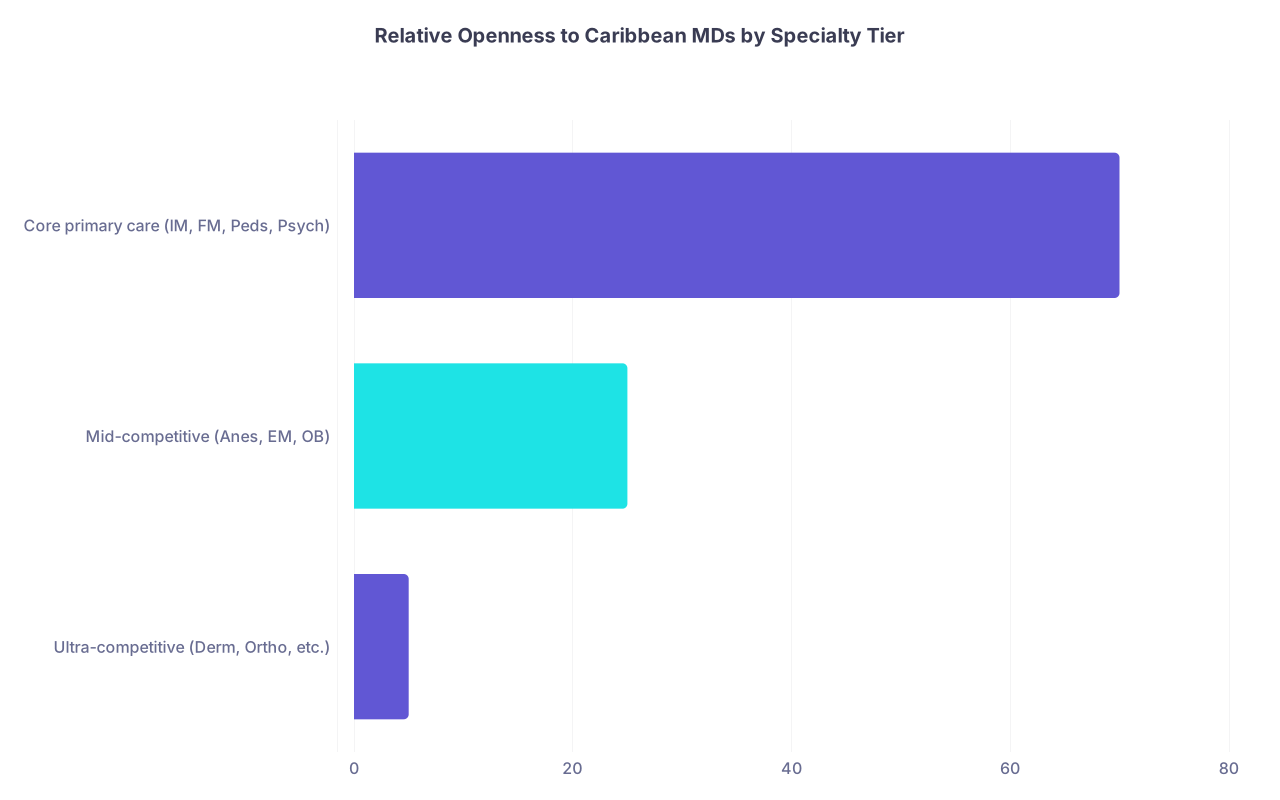
| Category | Value |
|---|---|
| Ultra-competitive (Derm, Ortho, etc.) | 5 |
| Mid-competitive (Anes, EM, OB) | 25 |
| Core primary care (IM, FM, Peds, Psych) | 70 |
Those numbers aren’t literal percentages, but they capture the mood. Doors get narrower as specialties become more coveted.
How PDs React to Caribbean MDs vs Non-Caribbean IMGs
There’s a quiet bias I see a lot: if a PD is going to “take a chance” on a non‑U.S. graduate, many would rather bet on a high‑performing non‑Caribbean IMG from a rigorous system.
I’ve heard:
“The guy from India scored 255 on Step 2, has three publications, and trained at a real academic hospital. Why would we take the Caribbean grad with a 235 and an okay letter?”
Or:
“The German grad already completed two years of internal medicine there. They’ve functioned as a physician. That’s value.”
Caribbean schools market themselves as “the backdoor to U.S. medicine.” PDs don’t see it that way. To them, it’s often: “the fallback for people who couldn’t get in elsewhere.”
Fair or not, that’s the mental label many of them attach.
So if you’re a U.S. citizen thinking, “Well, at least I won’t be treated like an IMG from abroad,” understand this: in many programs, you’d actually be treated better on paper if you were a strong non‑Caribbean IMG with killer scores and real clinical depth.
Red Flags PDs Look For Specifically in Caribbean Apps
There are certain patterns that, when a PD sees them combined with “Caribbean MD,” move you straight to the discard pile.
I’ve seen entire small-group review sessions where these were auto‑nos:
Multiple attempts on Step 1 or 2
Caribbean + repeated failure = “This will be our remediation project for 3 years.”Graduation > 2–3 years ago with ongoing attempts to match
“If nobody has picked them up in 3 cycles, there’s probably a reason.”No substantial U.S. clinical experience after graduation
“Have they even seen a patient recently?”Vague or evasive explanations for gaps or failures
PDs hate feeling like information is being hidden.Letters only from obscure outpatient clinics or unfamiliar sites
“They couldn’t get a single letter from a substantial U.S. institution?”
This is the harsh calculus: if there are 800 applicants on the list, nobody is going to take 20 minutes to parse out your life story to see if maybe you’re the exception. If your application layout screams “high maintenance,” it dies in the first pass.
Where PDs Admit Caribbean Grads Have an Edge
Here’s the part most students never hear: PDs actually do respect one thing a lot of Caribbean grads often show—grit.
I’ve sat in meetings where an attending says:
“He clearly had a rough path. But look at what he’s done with it. High Step 2, chief resident at his prelim program, great letters. I like that level of persistence.”
There are PDs, especially in IM, FM, psych, who say openly:
“I’m okay with non-traditional and Caribbean paths if they’ve clearly outgrown the limitations of their school.”
But don’t confuse that with charity. They’re not balancing scales. They’re hiring workers. If your story of resilience comes on top of high scores and proven performance, that’s compelling.
If your story of resilience is the main selling point and everything else is average, it isn’t enough.
So Should You Go Caribbean? What PDs Would Tell You Off the Record
If you cornered a candid U.S. PD after a conference talk and asked, “My GPA and MCAT aren’t competitive for U.S. MD or DO. Should I go Caribbean?” here’s the kind of response you’d get if they dropped the diplomacy.
Something like:
“If you’re thinking about Caribbean, assume this: you’re signing up for a path where you have to dramatically outperform your prior academic record to even get a fair look from us.”
Then they’d probably lay out something like this:
- If you can raise your MCAT and try again for U.S. DO or lower‑tier MD, do that first.
- If medicine is non‑negotiable and you fully understand you might end up unmatched or limited to a narrow set of fields and locations, then Caribbean is an option—but a high‑risk one.
- If you’re aiming for anything competitive—ortho, derm, EM at strong places—Caribbean is almost always the wrong move.
The most honest PDs I know tell students quietly:
“I’d pick U.S. DO over Caribbean 99 times out of 100. And I’d tell my own kid the same thing.”
That’s what they really think.
How to Make Yourself One of the Exceptions
If you’re already at a Caribbean school or locked into that path, let’s skip the hand‑wringing. PDs do match some Caribbean grads every year. They just hold them to a higher bar.
The ones who get real attention from U.S. program directors usually look like this:
- They treated preclinical like a board boot camp, not a beach vacation.
- They crushed Step 2 CK. Not “decent.” Crushed.
- They aggressively pursued U.S. rotations at solid teaching hospitals where faculty routinely work with U.S. MD/DO students.
- They collected letters from faculty who actually have reputational capital in the U.S. system.
- They kept their timeline clean and efficient—no wandering, no year‑long test‑prep black holes.
- They aimed strategically: community and mid‑tier academic programs, geographically flexible, and aligned their applications with realistic targets.
That profile makes PDs pause. It flips the question from “Why should we take a risk?” to “Given how strong this is despite the school, what’s different about this candidate?”
That shift in framing is everything.
What U.S. program directors privately think about Caribbean MDs isn’t mysterious. They see them as higher risk, lower baseline trust, and more work to vet. But not untouchable.
If you’re still premed, this is your warning shot. You’re deciding not just where you’ll study, but how PDs will silently label you years from now when your ERAS file lands in their inbox.
If you’re already in the Caribbean pipeline, your job is brutally clear: outwork the label, outscore the doubts, and out‑prepare your peers so that when your name hits the committee screen, the conversation starts with your strengths, not your school.
You can beat the bias. Some do it every year. But you have to do it with eyes wide open.
The next step, if you’re serious, is to map out exactly what scores, rotations, and letters you’ll need for the specialty and programs you’re aiming at—and how to build that, starting now. That’s a different level of planning, and a different conversation. One we can tackle another day.


