

It’s late February. The rank meeting’s running long. Half the room wants to go home, the chief resident looks half-dead, and the program director has a spreadsheet up on the screen with 150 names. There’s a column everyone pretends doesn’t exist: “School / Path.”
Someone scrolls. A U.S. MD, mediocre Step 2, okay letters. Then a Caribbean grad with 260+, glowing letters, tons of hustle. Then a German grad with excellent clinical references but average scores and clunky English in the PS.
And the PD says the quiet part out loud:
“Look, I know he’s strong, but we’re going to get burned if we load the list with too many Caribbean and European IMGs. We have to be careful what this looks like to the chair. Move him up a bit, but not above these U.S. MDs.”
That’s how it really works.
Let me walk you through what actually happens in those rooms, how U.S., Caribbean, and European grads are really being compared, and what that means for you if you’re still choosing or early in med school.
The Unspoken Baseline: How PDs Sort Applicants Before Anything Else
Program directors will never admit this on a podcast, but every serious PD walks into rank season with an internal tier system. It’s not always written down, but everyone in the room feels it.
At most mid- to high-tier programs the default hierarchy starts like this:
| Tier | Type of Grad | Rough Rank Priority* |
|---|---|---|
| 1 | U.S. MD | Highest default priority |
| 2 | U.S. DO | Just below U.S. MD |
| 3 | Non-Caribbean IMG (Europe/elsewhere) | Variable, depends on school & track |
| 4 | Caribbean IMG | Lowest default, heavy scrutiny |
*“Priority” means the starting point before individual strengths or weaknesses are discussed.
Nobody says, “We sort by school first.” But watch the conversation. They do.
The school type is the context for every other data point:
- A 235 Step 2 from a U.S. MD? “Fine, solid.”
- A 235 from a Caribbean grad? “Is that enough?”
- A 235 from a German grad? “Okay but what’s their clinical exposure in U.S. hospitals?”
Same number. Completely different reaction.
So if you’re asking, “How do PDs compare these groups?” The real answer is: they are not compared on a level playing field. You’re graded on a curve that depends heavily on where your diploma comes from.
What U.S. MD/DO Grads Get That You Don’t
Let’s start with the control group. U.S. grads.
No, they’re not automatically better physicians. I’ve seen some of the weakest interns come from prestige MD schools. But on Rank Day they have powerful built-in advantages you can’t ignore.
1. Brand Legitimacy and Risk Minimization
On the PD side, the political pressure is real. Chairs, department leadership, even GME offices look at match lists and ask: “How many of our residents are U.S. grads? What schools?”
So when a PD puts a U.S. MD at #23 and a Caribbean grad at #24, even if they think the Caribbean grad might actually be hungrier, they’re playing defense. If that resident underperforms, nobody questions the decision to rank a U.S. MD highly. It was “reasonable.”
You, as an IMG, are never a “reasonable” choice. You’re always a bet. And bets get more scrutiny.
2. Letters that carry weight
The reality: a lukewarm letter from a known U.S. academic attending often carries more weight than a “glowing” letter from a no-name hospital abroad.
I’ve literally sat in meetings where someone says:
“Who’s this Dr. X? Community hospital in another country. No idea who that is.”
Then later:
“This letter’s from Dr. Y at our affiliate site. If he says the student is solid, I believe it.”
Same or even weaker content. School and network change everything.
3. Cleaner, predictable training path
U.S. MD and DO programs have standardized rotations, U.S. EMRs, familiar eval systems, AOA or Gold Humanism, home sub-Is, standardized MSPE format. PDs know what they’re buying.
Compare that to a European student who did pre-clinicals in one country, rotations scattered in multiple systems, plus U.S. electives later. It’s harder to read. Anything harder to read becomes “risk” in a PD’s mind.
So yes, U.S. grads start with a head start. Caribbean and European grads are playing catch-up from slide one of the rank meeting.
Caribbean Grads: What Really Goes Through the Room
Everyone dances around Caribbean schools publicly. On the inside, the biases are not subtle.
Let me tell you how PDs actually talk.
1. The Default Assumption: “Couldn’t Get In Here”
Fair or not, here’s the mental shortcut:
Caribbean grad = couldn’t get into a U.S. MD/DO program.
That’s the starting point many PDs use unless you force them to update that picture.
When your name comes up, a lot of people in that room are silently thinking:
“Why Caribbean?”
Unless your application performance is stellar enough to answer that implicitly, you’re already swimming against the current.
2. The Data Everyone Knows But Doesn’t Say
PDs know the match stats. They know the failure rates. They’ve seen the “Caribbean effect” up close: students with marginal Step performance, poor clinical evals from sketchy rotation sites, trouble with basic documentation, professionalism issues.
Do all Caribbean grads fit that? No. Of course not. I’ve seen some of the hungriest, strongest residents come out of SGU, AUC, Ross, Saba.
But PDs aren’t thinking about your story. They’re thinking risk pool.
So what do they subconsciously demand of you?
Step 2 CK: not “good.” Excellent.
A 230 from a U.S. MD might be okay for IM. A 230 from Caribbean? Often a soft no at serious programs.Rotations: they want to see solid U.S. clinical sites, not shady, thin, or unrecognized hospitals.
Letters: they want U.S.-based faculty vouching for your performance, ideally in their own or similar systems.
3. The “Caribbean Exceptions” File
Every PD has an internal short list of the Caribbean grads that made them rethink their bias. These are the ones who:
- Crushed scores (240+ back in Step 1 days, now 250+ on Step 2 CK still makes PDs pause)
- Showed up early, stayed late, owned the scut, and made themselves indispensable on rotations
- Got letters from people the PD knows personally
When someone like that comes up in a rank meeting, the PD might say something like:
“Yes, Caribbean, but this one is different. Look at the Step 2, look at these comments, and Dr. ___ called me directly about them.”
You want to be that Caribbean grad. The one that forces them to open the “exceptions” drawer.
Otherwise, here’s what happens: you get compared to borderline U.S. DOs and MDs, and every time the question becomes, “Why take the risk on a Caribbean grad when we can just rank this U.S. DO higher?”
That’s the exact sentence. I’ve heard it word-for-word.
European and Other Non-Caribbean IMGs: The “We Don’t Know What This Means” Problem
Now the European group. This includes grads from Germany, Poland, Italy, Eastern Europe, some UK/Ireland, and similar.
They don’t trigger the same “couldn’t get into U.S. school” reflex as Caribbean grads, but they do trigger a different one:
“Are their clinical skills and training actually usable here? And how much extra work will this cost us?”
1. The Reputation Spectrum
There’s a quiet internal ranking of European and global schools, whether anyone admits it or not.
On the favorable side:
- Well-known EU schools that have a track record of sending people to U.S. residencies
- Programs with strong research or U.S. collaborations
- UK/Ireland grads who often come with fluent English and solid clinical structure
On the “meh” side:
- Lesser-known Eastern European schools that mass-market to international students
- Newer private programs abroad with little to no match history in the U.S.
When someone’s alma mater shows up that nobody in the room has ever seen, the PD’s first reaction is not curiosity. It’s suspicion.
2. The Integration Question
One PD I know said this very bluntly:
“My issue with some European grads is not that they’re dumb. It’s that they’re used to a completely different system, and it takes us months to get them functioning at U.S. intern level.”
What they worry about:
- Documentation and EMR habits
- Communication style with patients and team
- Comfort with U.S.-style hierarchy and expectations
- Ability to handle high patient volume with minimal orientation
So on Rank Day, they look hard for evidence you’ve already adjusted:
- U.S. clinical electives with strong evals
- Clear, articulate English in the personal statement and interviews
- Letters from U.S. attendings saying, “This student functioned at or above the level of our U.S. seniors”
No proof of that? You drop down the list.
3. The Quiet Advantage Over Caribbean Grads
Here’s something you won’t hear on Reddit but you will hear in real rank meetings:
If a PD has to choose between:
- A Caribbean grad with okay scores and okay U.S. electives, and
- A European grad from a solid, known institution with okay scores but very strong U.S. letters
Many will lean European, because they don’t carry the same “mass export” stigma Caribbean schools do.
But if the Caribbean grad outperforms you on Step scores and has better letters from known U.S. attendings? The exam numbers start to win. Numbers are the easiest way for PDs to defend their choices up the chain.
When They’re All on the Same Slide: Real Rank Meeting Dynamics
Let’s do the comparison you care about: same specialty, similar stats, different educational paths.
Say we’ve got three applicants in Internal Medicine:
- U.S. DO, Step 2: 233, decent evals, average letters
- Caribbean MD, Step 2: 245, great evals on U.S. rotations, strong letter from known hospitalist
- European MD, Step 2: 238, decent evals, one U.S. elective with solid letter
How do they actually get ranked?
Here’s the ugly version of the thinking process:
“We need a solid core of U.S. grads; the DO is safe. No visa, understands the system, fine. Put them somewhere in the mid-top.”
“Caribbean 245? That’s good. Are those rotations legit? Who are the letter writers? Oh, Dr. ___ from [local affiliate]? That helps. Strong interview? Okay, they’re better than their paper looks. Move them up, maybe above that DO, depending who else we have.”
“European 238 with one U.S. elective. Letters okay but from people we don’t know. Interview was good but English a bit stiff. I like them, but this is more work. Middle of the list.”
Now change the specialty to something more competitive (say EM, anesthesia, rads, or a mid-tier surgery program). The tolerance for risk shrinks. In those rooms, I’ve heard:
“We are not taking a Caribbean grad over a U.S. DO unless they are obviously better. Like, no-brainer better.”
That “obviously better” description is the key. Incrementally better does not cut it for Caribbean or European grads in many mid- to high-tier programs. You have to be clearly superior on paper and in person.
What This Means if You’re Still Choosing or Early in Med School
You’re in premed or early MS1/2 and thinking about:
- Going Caribbean
- Going to Europe with an eye on U.S. residency
- Or fighting harder for U.S. MD/DO
Let me be direct.
1. U.S. MD/DO is still the path of least resistance
If your goal is a U.S. residency, especially in a moderately or highly competitive specialty or location, U.S. MD/DO is absolutely still the dominant play.
Not because Caribbean and European grads can’t match. They can. I’ve watched them do it. But because you are signing up for a handicap competition.
On Rank Day, the question is almost never: “Who’s the objectively best person?”
It’s: “What combination of applicants gives us a safe, politically comfortable, and functional intern class?”
U.S. grads make that easier for PDs. You’re selling convenience and predictability, not just talent.
2. If you do choose Caribbean: you must aim to be the exception, not the average
The “middle of the pack” Caribbean grad is, bluntly, in trouble.
To have a real shot:
- Your exam performance has to be clearly superior, not just “competitive.”
- Your U.S. rotations must be at recognized, respected hospitals with real teaching attendings, not low-quality clerkships.
- You need advocates—U.S. attendings who are willing to pick up the phone for you.
If that sounds exhausting, that’s because it is. That’s the tax for taking the Caribbean path. A lot of students don’t realize that until it’s far too late.
3. If you go European/elsewhere: plan your U.S. integration from day one
Europe can work, especially from certain countries and schools, but you can’t float through and “decide about the U.S. later.” By the time a lot of these students think about the U.S., they’re late, with minimal steps, minimal U.S. clinical time, and weak letters.
To not get buried on Rank Day:
- Secure U.S. electives at real academic or solid community programs
- Make sure your English—written and spoken—is sharp enough that no one comments on it in evals
- Build relationships early so your U.S. letters are meaningful, not generic
The European grad who treats U.S. prep like a side project loses. The one who treats it like a second curriculum can absolutely match and even outrank some U.S. grads.
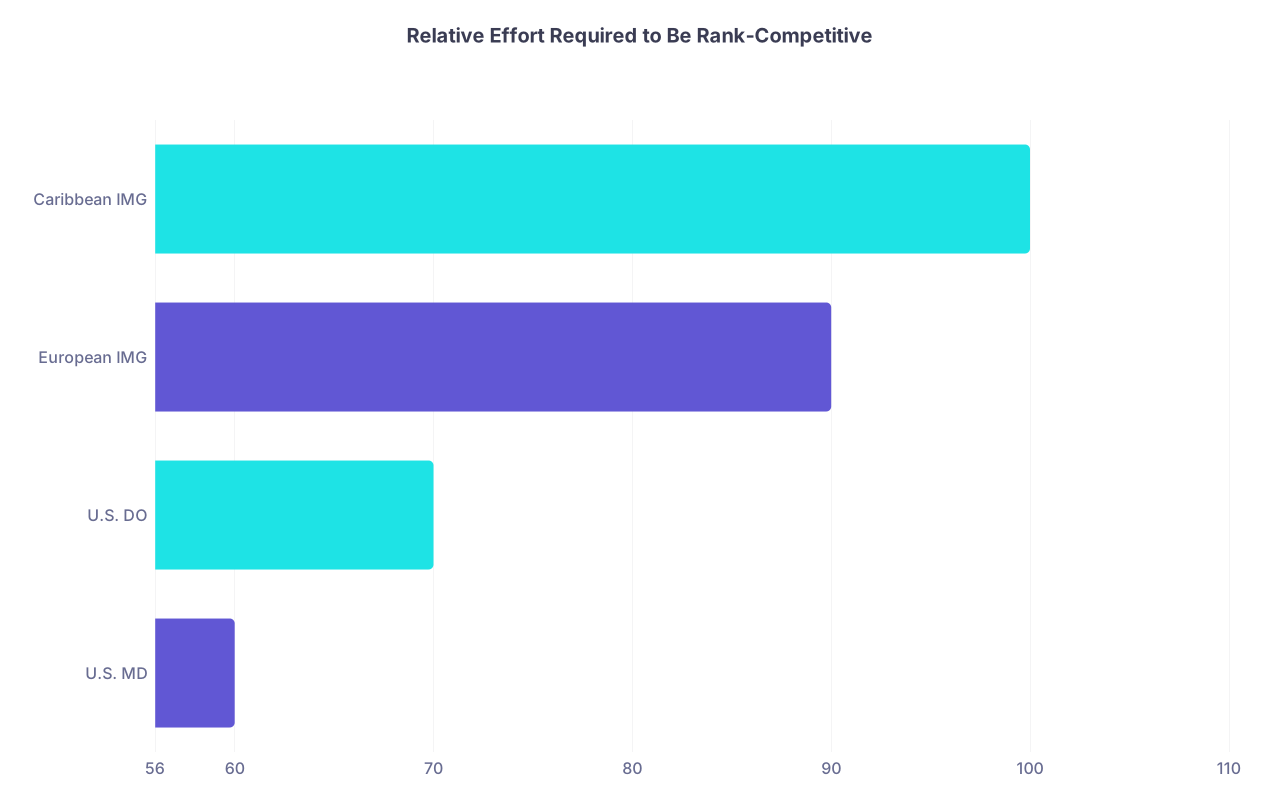
| Category | Value |
|---|---|
| U.S. MD | 60 |
| U.S. DO | 70 |
| European IMG | 90 |
| Caribbean IMG | 100 |
The chart is how PDs and faculty talk about this behind closed doors: Caribbean and European IMGs have to work harder to look equal on the list.
What You Don’t See on Match Lists (But PDs Talk About All Year)
You’ll see a program brag on Twitter:
“Proud of our diverse 2026 intern class: 8 U.S. MD, 4 U.S. DO, 3 IMGs from 5 countries!”
Here’s what you don’t see:
- The IMGs who were ranked as “reach” choices, slotted lower on the list because of school origin, not ability
- The internal emails where leadership asks the PD, “Are we comfortable with this many IMGs?”
- The Excel columns tracking visas, school types, and how that plays with institutional expectations
One PD I know in IM was blunt over coffee:
“I love my IMGs. They work harder on average. But institutionally, I cannot rank them in bulk above U.S. grads, or it becomes a fight with the chair. So I make sure the ones I do rank high are truly undeniable.”
That’s the game you’re stepping into as a Caribbean or European grad. You’re trying to be “undeniable” in a system that’s wired to prefer someone else before they even look at your file.
Know that before you write your first tuition check.

| Step | Description |
|---|---|
| Step 1 | Applicant Pool |
| Step 2 | Baseline trust\nLower risk assumed |
| Step 3 | Higher risk bucket\nNeeds standout scores & letters |
| Step 4 | Uncertain training\nNeeds proof of U.S.-fit |
| Step 5 | Interview performance\nLetters\nFit |
| Step 6 | Rank Position\nAdjusted by politics & risk tolerance |
| Step 7 | U.S. MD/DO? |
| Step 8 | Caribbean vs Other IMG |
FAQ – The Questions You’re Afraid to Ask PDs
1. Can a Caribbean or European grad ever outrank a U.S. MD/DO?
Yes. I’ve seen it many times. But it’s not a fair fight.
A strong Caribbean or European candidate can absolutely outrank a mediocre U.S. grad if:
- Your scores are clearly higher
- Your U.S. letters are stronger and from credible names
- You interviewed better and the team genuinely liked you more
But “slightly better” usually isn’t enough. You have to be obviously better across multiple domains to overcome the built-in bias. If you’re not prepared to aim for that, you’re underestimating how these rooms work.
2. Are there specialties where school type matters less?
It varies by program far more than by specialty, but yes, some areas are more flexible, especially at community or lower-volume programs. Certain IM, FM, psych, peds, and transitional year programs are more open to IMGs, including Caribbean and European grads.
But at competitive locations (big coastal cities, academic centers) and in higher-demand specialties (EM, anesthesia, rads, any surgical field), school type becomes much more of a gatekeeper. The tighter the competition, the less risk PDs are willing to take on non-U.S. paths.
3. If I’m premed and can’t get a U.S. MD, should I go DO, Caribbean, or Europe?
If your goal is U.S. residency, especially anything mildly competitive:
U.S. DO almost always beats Caribbean or random European school.
Why? Because on Rank Day, DO is now mostly integrated into the “U.S. grad” mental category. Caribbean and European grads are not. They’re still treated as separate risk groups.
If DO is truly off the table and you’re choosing between Caribbean and Europe, then it becomes very individual:
- Caribbean: more U.S.-oriented from day one, but you’re fighting school stigma and match stats.
- Europe: less stigma, but more work to integrate into the U.S. system and prove equivalence.
Either way, understand this: you’re not choosing just a medical school. You’re choosing how hard you’re going to have to swim later when some PD pulls up their spreadsheet and sorts by “School Type” before they look at anything else.
With that reality in mind, you’re in a much better position to make a deliberate choice now—and to build an application so strong that when your name comes up on Rank Day, nobody in that room dares to say, “Why take the risk?”
That’s the level you should be aiming for. The rest—how to actually build that kind of application—that’s a story for another day.


