

The idea that a low MCAT automatically kills your medical career is wrong. It just kills the lazy, one-path-only version of it.
If your MCAT is below where U.S. or Canadian schools want it, you have exactly two options: rebuild a stronger domestic application over years, or build a smart, disciplined plan that uses international medical schools as a viable route. Both can work. What fails is denial, impulsive decisions, or picking a random Caribbean school because a friend “got in with a 495.”
I am going to lay out a concrete, step‑by‑step plan so you can:
- Decide if international school is appropriate for you
- Choose realistic target regions and programs
- Build an application strategy that accounts for your low MCAT
- Protect your chances of actually practicing medicine at the end
No fluff. This is the playbook I wish more premeds saw before wiring deposits overseas.
Step 1: Get brutally clear on your starting point
You cannot design a smart plan until you stop sugarcoating your numbers.
A. Classify your MCAT realistically
Use this simple breakdown:
| MCAT Range | Tier Label | Typical U.S./Canada Options |
|---|---|---|
| 515+ | Excellent | Competitive for most schools |
| 508–514 | Solid | Competitive for many, not all |
| 502–507 | Borderline | Selective / DO-heavy / reinvention paths |
| 495–501 | Low | U.S. MD unlikely, DO tough, reinvention needed |
| <495 | Very Low | U.S./Canada nearly closed without major rebuild |
If you are reading this, I am assuming you are in the “Low” or “Very Low” categories and are either:
- Burned out on retakes
- Up against age/money constraints
- Or have plateaued despite good prep
Write your exact score down and stop rounding it “up” in your head.
B. Check your GPA and academic signal
Your GPA matters even more once your MCAT underwhelms.
Ask yourself:
- Is my cGPA ≥ 3.4 and sGPA ≥ 3.3?
- Or am I sitting at 3.0–3.3 with some ugly semesters?
If your GPA is strong but MCAT is low, programs may assume test anxiety or poor standardized testing, not low intelligence. That is easier to work with.
If both GPA and MCAT are low, you are asking a school to take on clear academic risk. Some international programs will. Many will not.
C. Identify your non‑negotiables
Before you fall in love with any “MD abroad” idea, define:
- Do I need the option to match back to U.S./Canada?
- Am I open to practicing permanently in another country?
- How much total debt (all years combined) can I tolerate?
- What language(s) am I actually willing to learn to clinical fluency?
People get burned because they skip this and discover 4 years in that their degree is poorly recognized at home, or they hate living where they trained.
Write your non‑negotiables on a page. Keep them visible. They will shape every choice from here.
Step 2: Understand the real viability of international paths
Not all international medical schools are equal. Some are pipelines to U.S. residency. Some are essentially terminal degrees.
Here is a simple, reality‑based breakdown.
| Region/Path | MCAT Requirement | Main Language | Realistic Goal |
|---|---|---|---|
| Caribbean (Big 4-ish) | Low / Flexible | English | U.S. residency possible but competitive |
| Non–U.S. Canada (e.g., Ireland) | High-ish, MCAT or GPA-based | English | Challenging with low MCAT |
| Eastern Europe | None/Low | Local + English tracks | EU or limited U.S. return |
| Mexico / Latin America | Usually none | Spanish | Practice locally or tough U.S. pathway |
| Asia (e.g., Philippines) | Varies | English + local | Mixed outcomes, often local practice |
The harsh truth about match rates
Most schools advertise “match lists” and individual success stories. That is marketing, not statistics. The only numbers that matter:
- What percentage of students who started as North American citizens actually matched into U.S./Canadian residency in a recent year?
- In which specialties?
You are not “the exceptional story” until you have actual evidence that you are. Plan as if you are average in your cohort, not the hero of the brochure.
Step 3: Decide: retake MCAT, domestic reinvention, or commit to international
Before we talk strategy abroad, you must decide if you are done with the MCAT and the domestic system or not.
Option 1: One last strategic MCAT retake
You should seriously consider one more MCAT attempt if:
- Your last score is 495–501,
- You never did a fully disciplined prep (3+ months, 2k+ practice questions, 5–8 full‑lengths),
- Your practice scores were 3–5 points higher than official.
If that is you, a 4–6 month, one‑shot retake aimed at 505+ could:
- Make U.S. DO or less competitive MDs realistic
- Open doors to stronger international programs (e.g., Ireland, Australia, Israel)
If you do this, treat it like a job:
- Build a weekly schedule with specific daily question targets
- Use AAMC materials exhaustively
- Do at least 6–8 full‑lengths under test conditions
- Fix one section at a time (do not just “take more FLs” and pray)
If after that you still sit under ~502, then yes, it is time to accept that standardized tests are a real limiter and build a plan that respects that.
Option 2: Domestic reinvention route
This path is slow but legitimate:
- 1–2 year special master’s program (SMP) or strong post‑bacc
- Ace the coursework (3.7+ in rigorous science)
- Pair with MCAT retake in 505+ territory
If you are under 24 and can afford 2–3 extra years, this route is often safer than diving into a random offshore school.
If you are older (late 20s/30s), have family duties, or limited funds, multi‑year reinvention may not make sense. That is where international planning becomes realistic.
Option 3: Commit to international – for the right reasons
You should consider committing to an international plan if:
- You are realistically done with MCAT retakes (money, energy, plateau)
- You accept that you are voluntarily adding risk and complexity
- You are willing to work harder than most of your U.S. peers to get back into the same residency pool
If you are just chasing the fastest “MD” with the least work, stop. That mindset will get you chewed up and spit out by attrition, licensing exams, or unmatched status.
If you are ready to grind and think strategically, let us build a real plan.
Step 4: Choose your region strategically, not emotionally
Do not start with “Which Caribbean school will take me?” Start with: “Where can I realistically train and then practice?”
Here is a clean way to think about region choice.
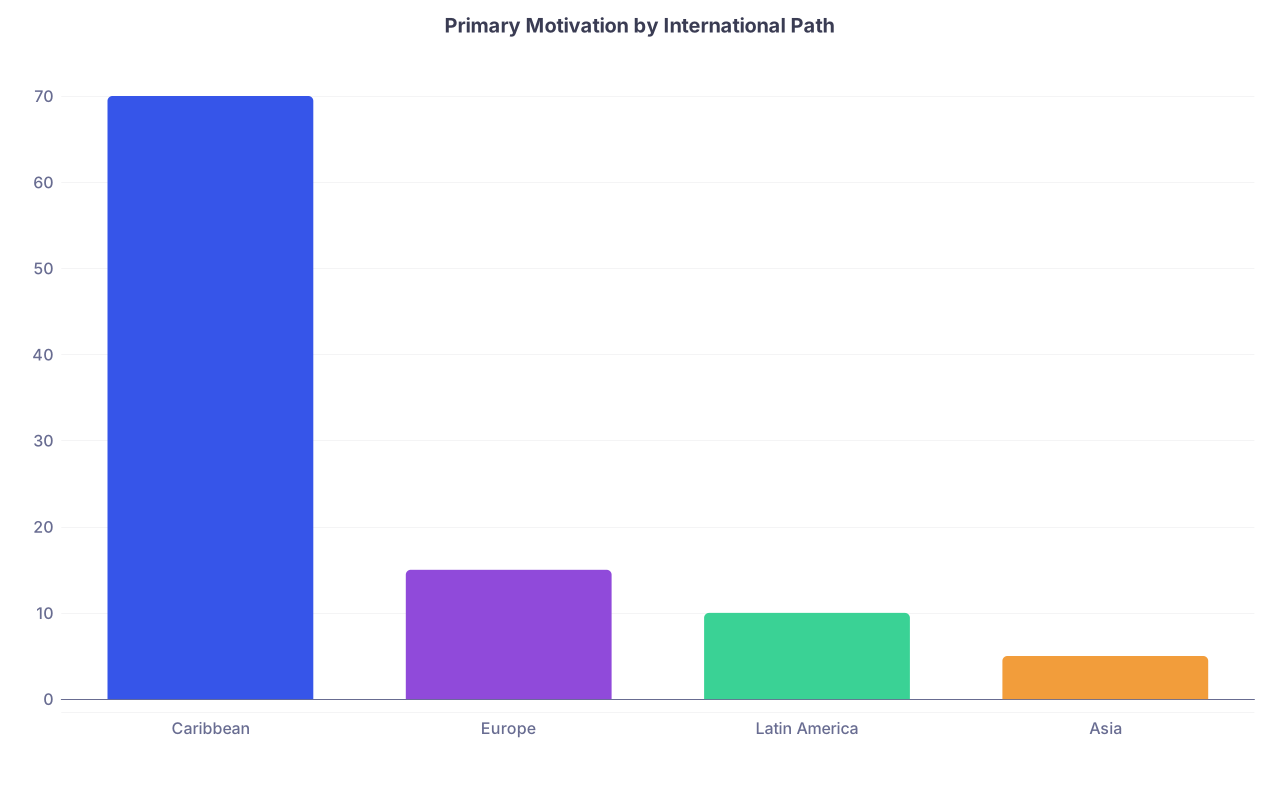
| Category | Value |
|---|---|
| Caribbean | 70 |
| Europe | 15 |
| Latin America | 10 |
| Asia | 5 |
(Approximate breakdown of why North American students choose each path: most head to the Caribbean explicitly aiming for U.S. return.)
A. Caribbean schools – the risky shortcut
Pros:
- English language programs
- U.S.-style curriculum and USMLE focus
- Established clinical rotations in the U.S. at certain schools
Cons:
- Huge variability in quality and match outcomes
- High attrition and step exam failure rates at weaker schools
- Debt can hit $300k+ easily
If you consider Caribbean, narrow to:
- Schools eligible for U.S. federal loans (this filters a lot of noise)
- Schools with consistent, published first‑time USMLE Step 1 pass rates and transparent U.S. match data
Anything less is gambling.
B. Europe (Eastern and some Western)
Pros:
- Often lower tuition than Caribbean
- Some programs with English tracks aimed at international students
- Potential for practicing in EU countries
Cons:
- Language barriers for clinical years if not fully bilingual
- Licensure and recognition issues when returning to North America
- Variable support for USMLE prep
This path is more realistic if:
- You honestly are open to living and practicing in that region long term
- You will invest time in the local language early
C. Latin America / Asia
Pros:
- Much lower tuition and cost of living
- Some programs taught in English (Philippines, some Indian schools)
- Strong clinical exposure and hands‑on training
Cons:
- Often require strong local language skills with minimal hand‑holding
- Harder path back to U.S./Canada; ECFMG and local regulation changes hit these grads hard
- Visa, culture, and distance from family add stress
If you are fluent in Spanish, Mandarin, Tagalog, etc., and open to regional practice, this can be viable. If you are monolingual and want a guaranteed U.S. match, it is a very steep climb.
Step 5: Build an application strategy that offsets the low MCAT
Once you know your region, you need to package your application so you are not just “another low MCAT North American desperate for a seat.”
A. Reframe your story
You are not hiding your MCAT. You are contextualizing it.
Core narrative should hit:
- Evidence you can handle academic rigor
- Strong upper‑level science grades
- Any post‑bacc/SMP or tough coursework with As
- Evidence you can handle standardized tests eventually
- Stepwise MCAT improvement across attempts (even if still low)
- Good performance on other exams (DAT, GRE, internal school tests) if relevant
- Maturity and realistic understanding of international training
- Show you have researched licensing, match issues, and costs
- Mention specific steps you plan to take (e.g., early USMLE prep, language study)
Do not write the “I always wanted to be a doctor since age 5” essay. Adcoms abroad also care about whether you will pass their exams and not drop out.
B. Lean on your strengths aggressively
If your MCAT is weak, something else must be strong. Typical levers:
- Clinical experience: real hours in ED, inpatient, scribing, EMS, not just shadowing
- Non‑clinical work: prior career, military service, serious leadership
- Research: publications or substantial lab work show you can handle complexity
- Life experience: first‑gen, immigrant, overcoming adversity with concrete outcomes
Spell these out in your CV and personal statement as evidence that you persist under difficulty. Schools taking on academic risk want grind, not entitlement.
C. Be selective with where you apply
Sending applications to every program that will email you back is how people end up in awful schools.
Criteria to use:
- Accreditation recognized by your home country’s medical council
- ECFMG eligibility and no looming regulatory deadlines that would affect your graduation year
- Documented match outcomes for graduates from your country
If they cannot or will not provide real data, cross them off.
Step 6: Plan your training years around one goal: being matchable
Getting an MD is not the finish line. Getting a residency position is.
Design your med school years backwards from that.
A. Know your exam landscape from day 1
If your target is U.S. residency:
- You will need USMLE Step 1 and Step 2 CK scores that offset your low MCAT
- That likely means aiming high: 230+ as a minimum target to be competitive in primary care; higher if you are ambitious
Plan like this:
- Start USMLE‑style question banks by end of first year
- Create an exam timeline with buffers for delays
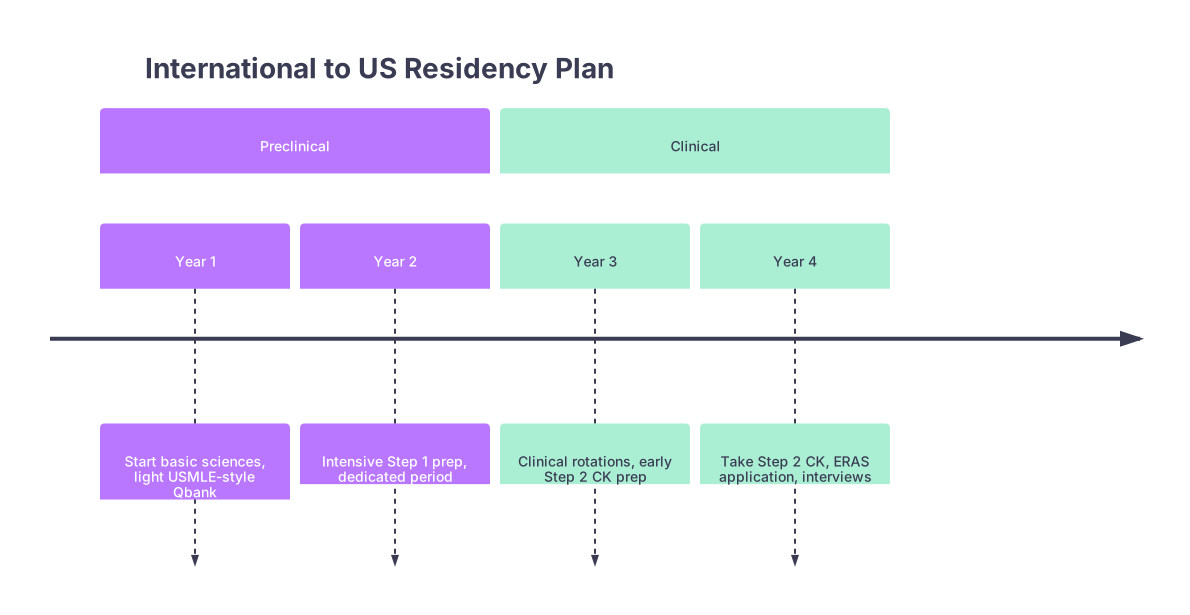
| Period | Event |
|---|---|
| Preclinical - Year 1 | Start basic sciences, light USMLE-style Qbank |
| Preclinical - Year 2 | Intensive Step 1 prep, dedicated period |
| Clinical - Year 3 | Clinical rotations, early Step 2 CK prep |
| Clinical - Year 4 | Take Step 2 CK, ERAS application, interviews |
If your target is local practice:
- Identify required national licensing exams early
- Clarify language proficiency standards for clinical training
B. Aim realistically on specialty choice
As an international grad with a low MCAT, you do not build a plan around dermatology or plastic surgery. You focus on:
- Internal medicine
- Family medicine
- Pediatrics
- Psychiatry
- Maybe OB/GYN or general surgery if you absolutely crush exams and clinical performance
You can still subspecialize later (cardiology, GI, etc.) through fellowships. The key is to get into the system first.
C. Stack your CV with targeted experiences
International schools often give fewer formal opportunities; you will have to hustle.
Non‑negotiables if you want U.S./Canada:
- Strong letters from U.S.‑based physicians during visiting electives
- At least one or two U.S. clinical experiences (4–8 weeks each)
- Documented research or scholarly work, even small projects
This is where planning early matters. Visa, scheduling, and travel cost coordination can blow up last‑minute “I’ll just do an elective in the U.S.” fantasies.
Step 7: Control cost and risk like a professional, not a dreamer
The fastest way to destroy your future is to borrow $300k for a degree that does not lead to practice.
Build a basic financial model before committing anywhere.
| Path | Tuition Range (USD) | Living Costs (USD) | Typical Total Debt |
|---|---|---|---|
| U.S. MD (in-state) | 180k–240k | 80k–120k | 250k–350k |
| Caribbean Big 4 | 220k–280k | 80k–120k | 280k–380k |
| Eastern Europe (Eng track) | 60k–120k | 40k–80k | 120k–220k |
| Latin America / Asia | 30k–80k | 30k–70k | 80k–160k |
A. Lock in realistic funding sources
Ask yourself:
- Will I have access to U.S. federal loans (only a few foreign schools qualify)?
- If not, what are the terms on private loans? Cosigner? Variable rates?
- How much can my family actually contribute without wishful thinking?
If the math shows you hitting >$300k in high‑interest private debt with uncertain match odds, you stop and reconsider. That is not being negative. That is being an adult.
B. Build a downside scenario
Assume the worst: you graduate but do not match into U.S./Canada.
What are your options?
- Practicing in the country where you trained? Are you eligible? Language ready?
- Non‑clinical careers where the MD is still marketable locally?
- Can you service the debt on non‑physician income?
If you hate all those answers, you either:
- Choose a different school / region with better outcomes
- Or return to the domestic reinvention / non‑physician path before enrolling
Step 8: Execute with discipline once you commit
Once you sign that deposit, you stop hand‑wringing and start performing.
A. Early habits that separate matchable grads from the rest
- Attend everything. Skipping basic science classes because “they give you the slides” is how you become a marginal test taker forever.
- Start board‑style questions early, even 10–20 per day.
- Form a small, serious study group. 3–4 max. No tourists.
- Keep a running spreadsheet of deadlines: exams, elective applications, visa paperwork, ERAS dates, etc.
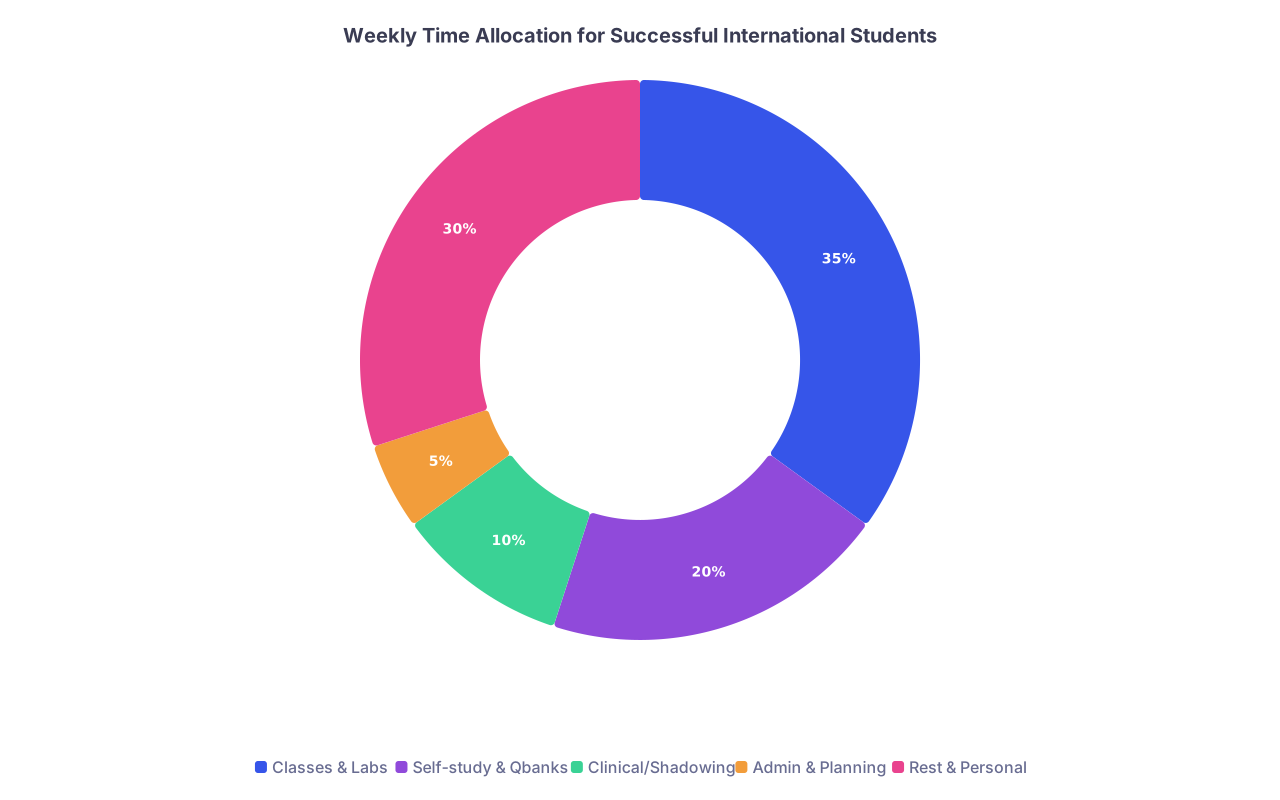
| Category | Value |
|---|---|
| Classes & Labs | 35 |
| Self-study & Qbanks | 20 |
| Clinical/Shadowing | 10 |
| Admin & Planning | 5 |
| Rest & Personal | 30 |
B. Stay brutally honest each year
At the end of every academic year, ask:
- Are my grades in the top half of my class?
- Are my practice test scores for Step 1/2 trending to competitive territory?
- Am I still aligned with my original goal (U.S. match vs local practice), or has reality shifted?
If at any point the data say, “You are not likely to pass boards,” you do not double down out of sunk cost. You reassess. Quietly. With advisors who will tell you the truth.
Frequently Asked Questions
1. My MCAT is 496 and GPA is 3.5. Should I go straight to a Caribbean school or retake?
If you have not done a serious MCAT prep cycle, you retake once with a structured, 4–6 month plan. A jump to even 505 completely changes your options: U.S. DO, some MD, stronger international programs. Going Caribbean with a 496 and untapped MCAT potential is rushing into one of the riskiest paths without using your best leverage.
2. Can I match into competitive specialties from an international school with a low MCAT if I crush USMLE?
Theoretically yes, practically very rare. International grads who match into competitive fields usually have exceptional Step scores, top‑tier clinical performance, research, and sometimes prior domestic credentials. With a low MCAT background, your best strategy is to target core specialties first, get into the system, then subspecialize via fellowship.
3. How do I tell if an international medical school is a scam or low quality?
Red flags: aggressive recruiters pushing you to “reserve your seat” quickly, no transparent data on USMLE pass rates and U.S./Canadian match outcomes, tiny or nonexistent presence in respected forums or alumni networks, and overpromising marketing (“We place our graduates everywhere!”) with no hard numbers. If you cannot verify licensing recognition and real outcomes, walk away.
4. Is it ever smarter to walk away from medicine entirely rather than attend an international school with a low MCAT?
Yes. If the only schools that will take you have shaky accreditation, terrible documented outcomes, and require you to borrow into six‑figure, high‑interest debt, you seriously consider alternative careers in health (PA, NP, nursing, clinical research, health administration). Preserving your financial and mental health is not quitting; it is choosing a winnable arena.
Key points: A low MCAT does not end your medical ambitions, but it does force you to be strategic and brutally honest. International medical schools can be part of a viable plan only when you choose the right region, vet programs by real outcomes, and design your training years around becoming matchable, not just getting an MD.


