

The brutal truth: a weak undergraduate GPA will close doors at many U.S. and Canadian medical schools. But it does not have to end your path to becoming a physician—if you stop wishful thinking and start using international medical schools strategically, not desperately.
Most students who get burned by international schools make the same mistake: they treat them as a shortcut instead of a bridge. A bridge has structure, planning, and a clear endpoint. A shortcut is wishful thinking with tuition.
Here is how you use international schools as a deliberate, strategic bridge when your undergraduate GPA is weak.
1. Get Honest About “Weak GPA” and What You Are Up Against
Stop using vague language. Weak GPA means something specific in admissions.
For North American MD programs, “borderline” and “weak” fall roughly like this:
| cGPA Range | How U.S./Canada MD Schools See It | Reality Check |
|---|---|---|
| 3.7–4.0 | Competitive | You have academic leverage |
| 3.4–3.69 | Borderline at top schools | Viable with strong MCAT and story |
| 3.1–3.39 | Weak | Many MDs out of reach without major repair |
| 2.7–3.09 | Very weak | Traditional MD path unlikely; special routes needed |
| <2.7 | Critically low | Need substantial academic rebuild before medicine is realistic |
You are here because:
- Your GPA is too low for your target country’s MD/DO schools right now.
- You are considering international schools as a way around that barrier.
Here is the bad news you need to hear first:
- An MD from outside the U.S./Canada/UK/Australia automatically puts you in a more competitive bucket for residency.
- Some international schools will take your tuition and leave you with:
- No residency
- Massive debt
- No real path back
But here is the good news:
- If you choose the right kind of international school.
- In the right country.
- With a realistic long‑term plan.
You can absolutely turn a weak undergraduate GPA into a successful medical career. I have watched students with 2.8–3.2 GPAs match into IM, FM, psych, even anesthesia, by treating international school as one move in a longer game, not the whole strategy.
2. Decide Your End Goal First: U.S./Canada vs Practicing Abroad
You cannot be strategic about a bridge if you do not know what shore you are trying to reach.
Ask yourself, and be bluntly honest:
Where do you want to do residency and practice long‑term?
- United States
- Canada
- Another country (UK, Australia, Ireland, your home country, etc.)
Those three answers lead to three different uses of international schools.
A. If Your Goal Is U.S. Residency
You need an international medical school that:
- Is recognized by ECFMG/WHO/FAIMER.
- Has a consistent track record of:
- USMLE pass rates above ~90%.
- U.S. residency match placement, especially in your target specialties.
- Provides U.S. clinical rotations, not just observerships.
You are not just looking for “accredited” or “listed.” You want proof that graduates from your exact school are getting internal medicine, family medicine, psych, peds, etc. in the U.S., not just one poster child in dermatology they parade on the website.
B. If Your Goal Is Canada
This is harder. Canada is notoriously unfriendly to international medical graduates (IMGs), even Canadians who go abroad.
You will need:
- Stellar academic performance abroad.
- Very high exam scores (USMLE if going through U.S., plus MCCQE if applicable).
- Often additional years of training, research, or a foothold in the U.S. first.
If your goal is Canadian residency, international school is possible but it is a high‑risk bridge. For many low‑GPA Canadian students, the more rational path is:
- High‑quality post‑bacc or SMP in Canada/US.
- Apply DO/US MD if you can salvage GPA + MCAT.
- Consider practicing in the U.S. long‑term.
C. If Your Goal Is To Practice Abroad (Not U.S./Canada)
Then sometimes the smartest move is:
- Forget coming back.
- Train and settle in a country where IMGs are routine (e.g., UK via PLAB, some EU countries, certain Caribbean nations if you aim to stay, etc.).
In that scenario, your international medical school is not a “bridge” to the U.S. It is the main road to a career elsewhere. Very different strategy. Very different risk profile.
For the rest of this article, I will assume your likely goal is U.S. (or maybe Canadian) residency, because that is where “bridge” strategies really matter.
3. Use International Schools as One Move in a Multi‑Step Plan
You cannot just “go Caribbean” and pray. That is how students end up broken and bitter.
Think in phases.

| Step | Description |
|---|---|
| Step 1 | Weak undergrad GPA |
| Step 2 | Fix what you can pre-matriculation |
| Step 3 | Choose right international school type |
| Step 4 | Crush basic sciences & board exams |
| Step 5 | Strategic clinical rotations & letters |
| Step 6 | Targeted residency application plan |
| Step 7 | Match into realistic specialty/location |
Let’s break each of those down into what you actually need to do.
4. Phase 1 – Before You Even Apply Abroad: Repair, Prove, Plan
If your GPA is weak and you jump straight to “I’ll just go to an international school,” you are doing this wrong. There are 3 things you should do first.
4.1 Repair Your Academic Story (As Much As Possible)
You cannot change your old GPA. But you can show:
- Upward trend
- Recent excellence
- Mastery of hard sciences
Concrete steps:
Targeted post‑bacc coursework (12–30 credits)
- Take upper‑level sciences: physiology, biochemistry, genetics, cell biology.
- Aim for 3.7+ in this new work. Nothing below an A‑ or B+.
- If you failed or withdrew from premed prereqs, retake and destroy them.
If your GPA is under ~3.0:
- You may need more time and credits than you want to hear.
- A year or two of 3.7+ work can signal that you are not the same student you were at 19.
Fix the “why” behind your low GPA
- Health issue? Family crisis? Immaturity? Too much work?
- You need a clean narrative: “Here is what went wrong. Here is what I changed. Here is the proof it worked.”
4.2 Prove Cognitive Ability with MCAT (If Applicable)
Some international schools do not require MCAT. That is not a feature. It is a warning sign.
- If you are aiming for U.S. residency, write the MCAT.
- Target at least:
- 505+ if your GPA is 3.0–3.3
- 510+ if your GPA is below 3.0
A strong MCAT tells residency programs: “my undergrad GPA is not my ceiling.”
If you already took the MCAT and bombed:
- Consider:
- 6–9 months of structured prep.
- Formal course or tutoring if you can afford it.
- One strong retake can completely change how programs read your file.
4.3 Build a Realistic 10‑Year Plan
You do not need a perfect script, but you do need a direction.
At minimum, write out:
- Years 0–2: Pre‑matriculation repair / MCAT / applications
- Years 2–6: Medical school (abroad)
- Years 5–7: Board exams (USMLE Step 1, Step 2 CK), electives in U.S.
- Years 7–10: Residency (likely in primary care or broad specialties at first)
This is not busywork. This is forcing yourself to see:
- Time cost
- Financial cost
- Realistic timelines for when you will actually be earning a physician salary
5. Phase 2 – Choosing the Right Type of International School
Not all international schools are the same. Some are legitimate, structured, and oriented toward U.S./UK residency. Others are tuition collection agencies with anatomy labs attached.
You want to think in three main categories:
- Established Caribbean schools targeting U.S. students
- European/Australasian programs with English tracks
- Other emerging/less‑regulated schools
5.1 Caribbean Schools: High‑Risk, Can Be Strategic if Done Right
Let me be blunt: many people should not go Caribbean. But if you are going to use it as a bridge, you must be selective.
There is an informal “tier” system:
| Tier | Characteristics | Strategic Use |
|---|---|---|
| Top-Tier Caribbean (e.g., SGU, AUC, Ross, Saba) | Long history, U.S. rotations, decent match rates, large classes | Possible bridge for low GPA with strong MCAT and discipline |
| Mid/Lower-Tier | Newer, weaker clinical networks, poor exam support, low match rates | Avoid if goal is U.S. residency |
Strategic Caribbean use requires:
- You choose one of the truly established schools, even if more expensive.
- You are willing to:
- Treat Step 1 and Step 2 CK like a full‑time job.
- Aim for 230+ on Step 2 CK to compete as an IMG.
- You accept you are likely headed for:
- Internal medicine
- Family medicine
- Psychiatry
- Pediatrics
At least initially. Do not go Caribbean to chase plastics. That is fantasy.
5.2 European / Australian / Irish / Other English‑Language Programs
These can be smart if:
- You are younger.
- You are open to practicing outside the U.S. as a Plan B.
- You want a 5–6 year program starting from high school level.
Upsides:
- Often better structure and regulation than some Caribbean schools.
- You may qualify for local internships / training there.
- Reasonable shot at UK/Australia/EU if you learn the system.
Downsides:
- Coming back to U.S. or Canada is still IMG territory.
- You must juggle:
- Different exams (e.g., PLAB, local boards)
- USMLE on top if you want U.S.
If your GPA is weak but you did well on A‑levels/IB or can present a strong recent academic record, these programs might take you more seriously than U.S. MD schools will.
5.3 Red Flags: Schools You Should Avoid
Basic rules:
- No consistent data on:
- USMLE pass rates
- Match outcomes
→ Walk away.
- No structured U.S. clinical rotations. Only observerships.
→ Walk away. - Admission feels like buying a product, not being selected for a profession.
→ Walk away.
6. Phase 3 – While in International School: Turn Weak GPA into Strong Performance
Getting in is the easy part. Repairing your reputation as a student happens during medical school.
Here is how you use your time abroad as a bridge, not a holding pattern.
6.1 Treat Basic Sciences as Your Second Chance Transcript
Residency directors will look at:
- Class rank.
- Honors / distinctions.
- Whether you repeated or failed any courses or clerkships.
You want your medical school performance to scream: “This person figured it out.”
Specific non‑negotiables:
- Be in at least the top 25–30% of your class.
Top 10–15% is better. - Never fail or repeat a course. Ever.
- If you struggled early, show a strong upward trend.
You cannot afford to “just pass.” You are already behind because of your undergrad GPA. This is your rebuild.
6.2 USMLE / Licensing Exams: Where You Overcompensate
If you want the bridge to hold, you have to crush the boards.
For U.S. residency:
- Step 1 is now pass/fail, but:
- Failing once as an IMG is extremely damaging.
- Many programs still care about first‑time pass.
- Step 2 CK matters a lot:
- Target 230+ as IMG minimum.
- 240+ starts to open more doors.
Practical protocol:
- Use UWorld as your main question bank. Complete it thoroughly, timed and mixed, at least once.
- Start NBME practice exams months before the real thing, not weeks.
- Do not sit for Step 1 or 2 until your NBMEs predict a safe margin above pass.
If your school is casual about Step timing, ignore that. Protect your record. You cannot afford a fail.
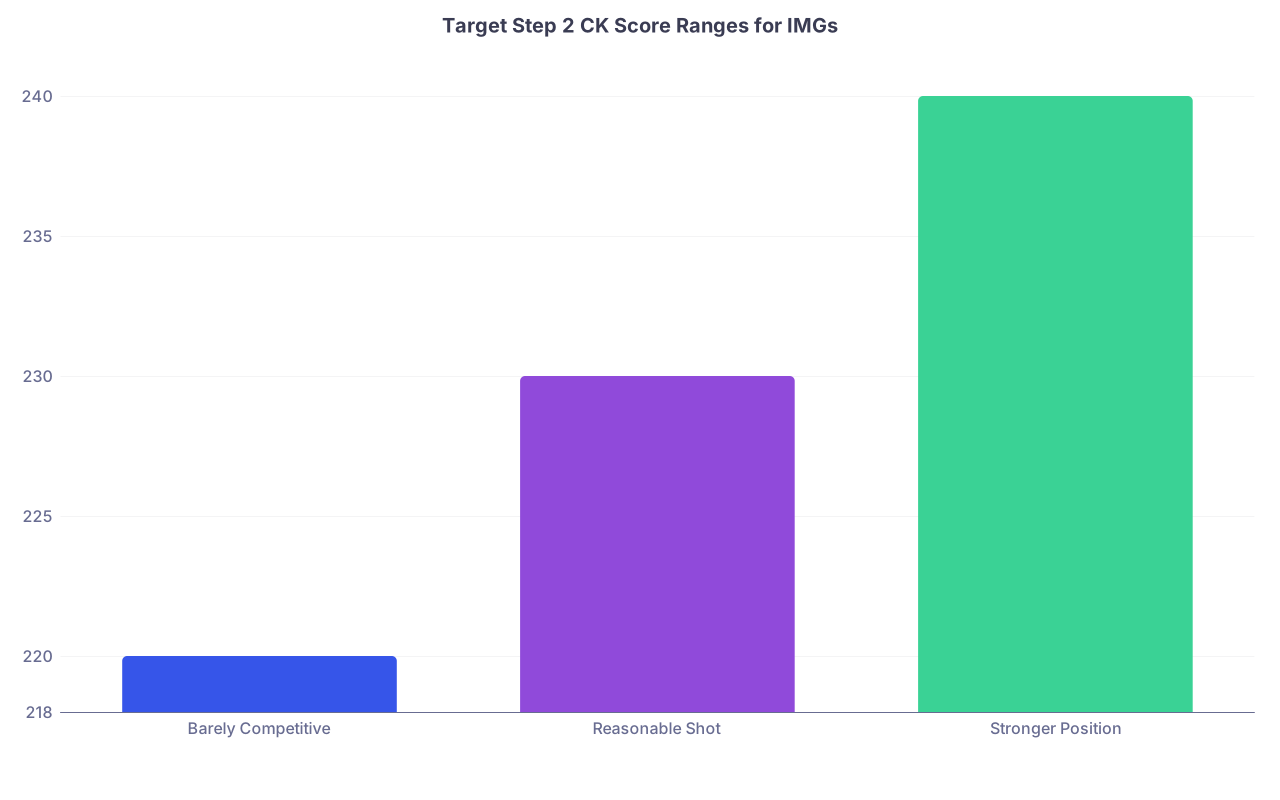
| Category | Value |
|---|---|
| Barely Competitive | 220 |
| Reasonable Shot | 230 |
| Stronger Position | 240 |
7. Phase 4 – Clinical Years: Build the U.S. (or Target Country) Profile
Clinical years are where you stop being “that kid with the low GPA” and become “the IMG this attending actually wants in their program.”
7.1 Secure U.S. Clinical Rotations Early and Strategically
You want:
- Core clerkships in solid U.S. teaching hospitals if your school offers them.
- Away electives at institutions that:
- Take IMGs.
- Have residency programs in your realistic target specialties.
Priority electives for IMGs aiming at U.S.:
- Internal Medicine (especially at community programs with residency)
- Family Medicine
- Psychiatry
- Pediatrics
You are not just trying to collect rotations. You are trying to collect:
- Strong letters of recommendation (LORs).
- Real advocates who will remember you when your application hits their desk.
7.2 Letters of Recommendation: You Need People, Not Paper
Your low undergrad GPA will not be in front of the attending writing your letter. Your performance with them will.
To get strong LORs:
- Show up early. Stay late.
Yes, cliché. It works because few students actually do it consistently. - Volunteer for work others skip:
- Call consultants
- Follow up on families
- Write the first draft of notes (within your school’s rules)
- Ask for feedback mid‑rotation:
- “Is there anything I can do better to work at intern level by the end of this month?”
Then, ask for letters from:
- U.S. attendings in your target specialty.
- People who really supervised you, not big names who barely know you.
8. Phase 5 – Applying to Residency: Use the “Bridge” Story Correctly
Here is where most IMGs with weak GPAs blow it. They hide their past instead of owning it strategically.
You need a clear narrative that connects:
- Weak undergraduate GPA → Wake‑up moment / change →
- Academic redemption in post‑bacc / MCAT / medical school →
- Strong boards, strong clinical performance →
- Fit for their program.
8.1 How You Talk About Your Weak GPA
You do not:
- Blame everyone.
- Write an essay about unfair professors.
- Pretend it does not exist.
You do:
- Briefly explain context:
- “During my early undergraduate years, I struggled with X (e.g., excessive work hours, unmanaged health issue, immaturity).”
- Immediately shift to corrective action:
- “Once I recognized this, I did Y (reduced work, sought treatment, changed study habits, took fewer credits but did them well).”
- Point to concrete evidence:
- “In my last 50 undergraduate credits, I achieved a GPA of 3.7.”
- “In medical school, I ranked in the top 15% and passed USMLE Step 2 CK with a score of 238.”
No self‑pity. No long apology tours. Just cause → correction → proof.
8.2 Apply Smart, Not Proud
If your profile is:
Weak undergrad GPA
Caribbean school
Step 2 CK 232
Good LORs
Then your targets should be:Community programs
Less competitive regions
Specialties that regularly take IMGs
Not:
- Big‑name academic centers in coastal cities.
- Highly competitive specialties on your first try.
Once you have U.S. residency and board certification, no one cares as much about your GPA.
9. When an International School Is a Terrible Bridge (And What to Do Instead)
You should not go international yet, or at all, if:
- Your undergrad GPA is below ~2.7 and:
- You have done nothing to prove you can handle heavy science.
- You have no money or plan for how to handle:
- Tuition
- Cost of living abroad
- Exam and application fees
In those cases, a better “bridge” is:
- Serious post‑bacc or community college rebuild
- Two years if needed. Yes, really.
- Explore DO / domestic options with an improved academic record.
- Shadow and work in health care to confirm you actually like clinical work.
- Keep international schools as a later move, once you have proved you can perform academically.
Sometimes the strongest move is delaying medicine 2–3 years to build a real foundation. That beats spending $200,000+ to drop out in second year because the same issues that wrecked your GPA wrecked your med school performance.
10. Financial Reality: Do Not Pretend This Part Is Optional
People like to talk dreams and ignore math. That is how they end up in trouble.
At a rough level, for many international routes:
- Tuition alone: $25,000–$60,000 per year
4–6 years = $100,000–$300,000+ - Living expenses: $15,000–$25,000 per year
- Exam / travel / applications: $10,000–$20,000+ over the journey
You must ask:
- Do I have or can I obtain loans/sponsorships realistically?
- Can I afford a delay in earning real income until my early to mid‑30s?
- What is my Plan B for debt repayment if I never match?
If you cannot answer those questions, you are not ready to pick an international school yet. Do the math now, not when you are already enrolled.
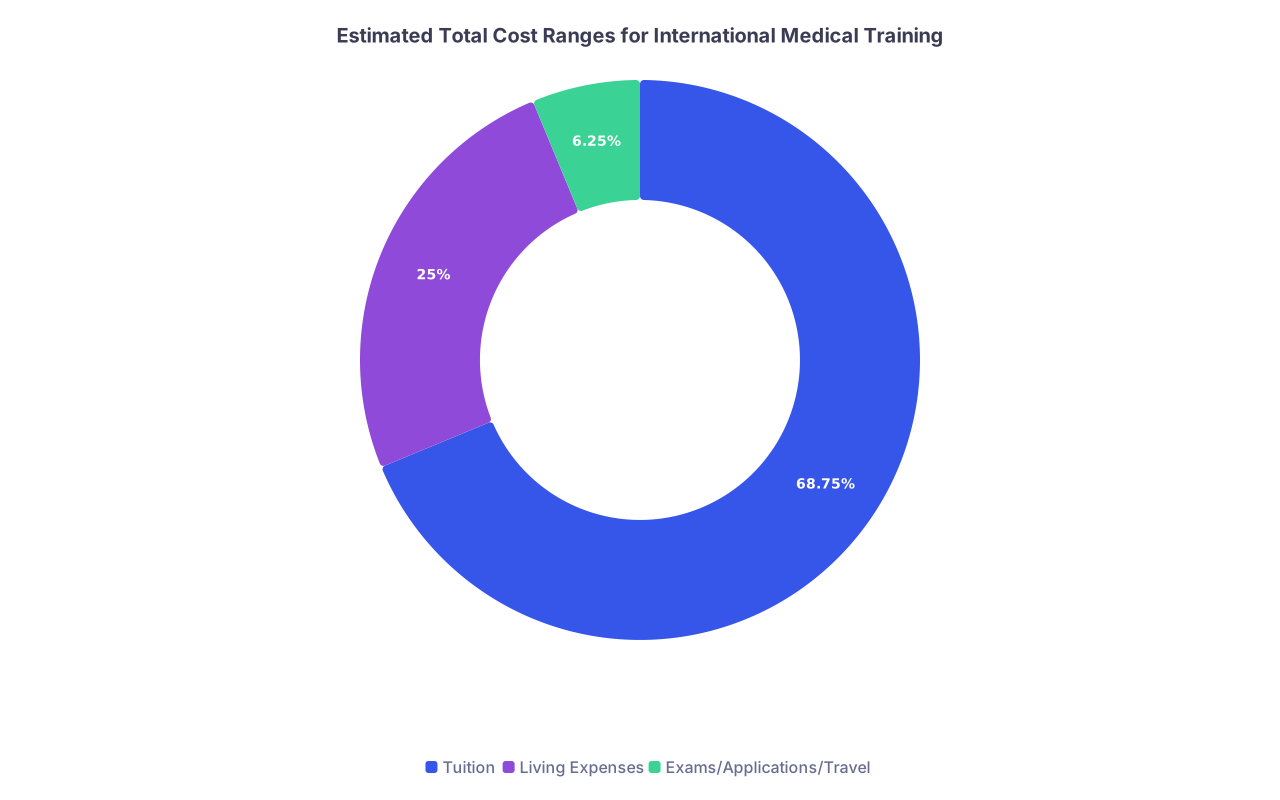
| Category | Value |
|---|---|
| Tuition | 220000 |
| Living Expenses | 80000 |
| Exams/Applications/Travel | 20000 |
11. Practical Checklists: How to Use International Schools as a Bridge, Not a Trap
You wanted solutions. So here is a compact protocol to run through.
11.1 Before Applying to Any International School
- Raise your recent GPA with 12–30+ credits of strong science.
- Take/re‑take MCAT and aim for a genuinely competitive score.
- Decide your primary practice destination (U.S., Canada, other).
- Roughly map your next ten years, including finances.
11.2 When Evaluating Schools
Ask each school (and verify via alumni, not just brochures):
- USMLE pass rates (Step 1 and 2 CK), first‑time.
- Match list for the last 3–5 years:
- How many matched to U.S.?
- Which specialties?
- Which programs (academic vs community)?
- Where are clinical rotations held?
- How many students start vs graduate? (Attrition rate.)
If they dodge or sugarcoat, walk away.
11.3 Once You Are In
Your minimum protocol:
- Treat every exam like it counts twice: once for med school, once for your reputation.
- Build a daily schedule that treats studying like a real job (8–10 focused hours).
- Start light board prep early (not just during dedicated):
- UWorld
- Anki
- NBMEs
- Fight for the best available clinical rotations and attendings.
- Collect strong LORs and mentors, not just grades.

12. Alternative Bridges if International School Feels Too Risky
If you are not comfortable with the risk profile of international schools, there are other “bridges” that still move you toward medicine or adjacent careers.
Realistic alternatives:
- Nursing → NP/CRNA routes
Heavy clinical work, good pay, shorter path. - Physician Assistant (U.S.)
Very competitive, but less brutal than MD for some. - Clinical research / public health master’s and later re‑evaluation of med school options.
- Reapply to domestic DO/MD after major GPA repair.
None of these are “consolation prizes.” They are legitimate career paths that still put you in patient care or health systems.

13. Reality Check vs Hope: A Simple Self‑Assessment
If you are trying to decide whether an international school is a smart bridge for you, sit with these questions and answer them brutally honestly:
- Am I willing to study harder and more consistently than I ever have in my life, for 4–6 straight years?
- Can I tolerate uncertainty about where I will match and where I will live?
- Do I have at least a rough financial plan, and am I comfortable with debt risk?
- Have I already shown recent academic excellence (post‑bacc, MCAT, etc.)?
- Am I willing to aim for less “prestigious” specialties at first to just get in the door?
If your answer is “no” to most of those, pause. Do not use international schools as an escape hatch from a bad transcript. Use them, if at all, as the final piece of a carefully rebuilt academic and professional story.

Key Takeaways
A weak undergraduate GPA does not disqualify you from medicine, but it does mean you need a structured, multi‑phase plan. International schools can be a bridge only if you repair your academic profile first and aim for the right countries and programs.
Not all international schools are equal. If your goal is U.S. or Canadian residency, you must be ruthlessly selective, crush your exams, and treat clinical years as your audition for residency, not a vacation abroad.
You are betting years of your life and six‑figure money. Make that bet only after running the numbers, building a ten‑year plan, and proving—to yourself first—that you can perform at a level that will make that bridge actually hold.


