

Last cycle, I sat in a rank meeting where an attending flipped through ERAS applications like he was sorting mail. He saw the name of an international school he didn’t recognize, smirked, and said, “Probably Tier 4, hard pass,” without reading a single line of the personal statement. The room moved on. That applicant never had a chance, and they had no idea why.
You’re told “programs review applicants holistically” and “strong applicants can come from any school.” That’s brochure language. Behind closed doors, almost every residency program in the U.S. and Canada uses an informal tier system for IMGs. They do not publish it. They rarely admit it. But they use it. Constantly.
Let me walk you through how it actually works.
The Reality: IMGs Are Not All Seen the Same
When a program director sees your med school name, they’re not starting at zero. They’re loading years of experience, bias, and institutional memory onto that one line.
Here’s the quiet truth: IMGs are mentally sorted into “tiers” before anyone looks at your Step scores, your research, or your letters.
Not officially. Not written on any website. But if you sit in enough selection meetings, you’ll recognize the categories. Everybody in those rooms knows them, even if they never say “Tier 1” out loud.
The tiers are based on three things:
- How many successful residents they’ve had from that school
- How painful or smooth those residents were to train
- What their colleagues say about graduates from that school
Forget what your dean’s office tells you. That’s marketing. What matters is what happens in the workrooms when they’re arguing over who gets an interview slot.
The Unspoken IMG Tier System
Here’s the rough framework most attendings are running in their heads. They might call them “trusted,” “known,” “neutral,” “risky,” but the idea is the same. I’ll call them Tier 1–4 because it’s simple.
| Tier | Internal Label Programs Use | Typical Reaction When They See It | Interview Odds (if US citizen, decent scores) |
|---|---|---|---|
| 1 | Trusted / Proven | “We know this place. Safe.” | High |
| 2 | Known / Neutral-Positive | “We’ve had a few. Let’s look.” | Moderate to good |
| 3 | Unknown / Question Mark | “Never heard of it. Hmm.” | Low |
| 4 | Red Flag / Diploma Mill-ish | “Hard pass unless insane CV.” | Almost zero |
These tiers have nothing to do with how hard your anatomy exam was, how good your professors are, or how proud you are of your white coat ceremony.
They’re based on: “When we took people from here in the past, did they make us look smart or foolish?”
Let me break each down with what people actually say in the room.
Tier 1: “We Know Them. We Like Them.”
This is the top of the IMG food chain.
These are schools where:
- Programs have a track record of solid residents
- Clinical communication is decent
- Step scores tend to be okay or better
- Their graduates don’t implode in PGY-1
Think: big Caribbean “big four” (but not all specialties, not all programs), a handful of long-established European schools, Israeli schools that have sent people to US programs for decades, some Irish and UK schools, and a very short list of others that a given program knows well.
What PDs actually say:
- “We’ve got a current PGY-3 from there. Excellent.”
- “We took two last year; they’re solid. I’d look at this one.”
- “I know that school. They usually test well.”
Tier 1 doesn’t mean “equal to US MD” in most programs’ eyes. It means “I’m not scared to interview this person because of the school name.”
A Tier 1 IMG with strong scores gets treated like a plausible, safe bet. Not flashy. Not exciting. But not risky.
The hidden advantage: if one graduate from your school crushes it at a program, they drag your school up a tier in that program’s mind. That’s why you keep hearing, “Where our graduates have matched” in marketing. They’re trying to climb tiers.
Tier 2: “We Know It. Not Amazing. But We’ll Look.”
Tier 2 is the middle lane. Recognized, but not loved. Not hated either.
These are schools where:
- The name rings a bell, but no one in the room is saying, “Oh yes, we love them”
- They’ve had maybe a couple residents from there, outcomes mixed
- No widespread horror stories, but no fan club
Maybe the last resident from that school had weak notes but a good work ethic. Or great knowledge and awkward communication. Mixed impressions end up here.
What people actually say:
- “We had one from there… he was fine.”
- “I don’t mind them, but they need good scores.”
- “If they’ve got 240+ and good letters, sure, invite.”
Tier 2 is where most non-Caribbean IMGs land in the U.S. PD psyche: Eastern European, some Latin American, many Asian schools. There are exceptions, but that’s the pattern.
You can absolutely match from Tier 2. But you’re not getting any automatic bonus. Everything else on your application has to do the lifting.
Tier 3: “Never Heard of It. Probably a Risk.”
This is where a lot of people get blindsided.
You might think your school is respected because locally it’s prestigious. In your country, it might be the “Harvard of X.” In the U.S. committee room? It’s a shrug.
Tier 3 is “unknown territory,” and committees are risk-averse. They’re not going to gamble on unknown when they’ve got a pile of applicants from proven pipelines.
What they say:
- “Where is this?” (followed by a quick Google)
- “Is this recognized? Do they have decent USMLE pass rates?”
- “I don’t know anyone we’ve taken from here.”
Here’s the brutal part: if your school is Tier 3 at a given program, you now carry the full burden of proving the school is not a bad bet.
That means:
- Step 2 in the top 10–15% of their applicant pool
- Strong US clinical experience with US letters
- Clear communication skills on paper and later in person
If you look average on paper, you’re not “average.” You’re “unproven plus average,” which, in selection meetings, just means: “No.”
Tier 4: “No. Just No.”
This is the category nobody talks about publicly, but everyone uses.
These are schools that have, rightly or wrongly, gained a bad reputation among program directors. Sometimes deserved. Sometimes guilt by association. Sometimes a couple of disastrous residents poisoned the well.
Common red flags that get you tossed into Tier 4 in people’s heads:
- Historic Step 1/2 pass rates are terrible
- The school is known as a “last-resort” school for US/Canadian applicants who couldn’t get in anywhere
- Prior residents from that school have been unsafe, unprofessional, or academically weak
- The curriculum is chaotic, records are messy, or no one answers verification requests
- There are public controversies around the school or its leadership
What gets said in the room:
- “We’re not taking from there again.”
- “Hard pass; remember that intern we had from there?”
- “Bunch of red flags from that place consistently.”
If your school is mentally in Tier 4 at a given program, you can be a perfect human with off-the-charts CV and they still may never open your file.
Yes, it’s unfair. No, you’re not going to fix that mid-application cycle.
How Programs Quietly Build These Tiers
These tiers aren’t created in a policy meeting. They accrete like plaque on a coronary artery. One case at a time.
Here’s the behind-the-scenes process.
1. Residents’ War Stories
Intern mess, call rooms, workroom gossip. That’s where reputations stick.
If a PGY-2 says, “All the grads from X can’t write a note to save their life,” that gets repeated. If an attending constantly needs to redo orders from someone and then sees their school name, that burns in.
Nobody is keeping formal notes like, “School X = bad.” It’s vibes, memory, and pattern recognition.
2. PD and APD Comparison Lists
Some PDs keep mental lists. Some keep spreadsheets. Yes, actual personal tier lists.
I’ve seen a PD with a color-coded Excel file of schools:
- Green: “Trusted pipeline”
- Yellow: “Fine with good scores”
- Red: “Do not touch”
They won’t put that in an email. But they’ll pull it up when the application flood hits.
3. GME Office Pain
Here’s a side most applicants never consider: the paperwork burden.
Schools that:
- Are slow or messy with verification
- Don’t provide proper documentation
- Have inconsistent graduation dates or transcripts
…get labeled administratively annoying. That feeds into a softer “we don’t like dealing with them” tier that absolutely affects future applicants.
4. Word-of-Mouth from Other Programs
PDs talk. Quietly. At conferences. On phone calls. Over beers.
“Hey, you ever taken anyone from [School X]? We got burned last year.”
Or the opposite: “We’ve had great luck with [School Y]. If you’re IMG-friendly, they’re usually solid.”
That’s how entire continents shift up or down a notch over a few years in different regions.
How This Affects You Before You Even Apply
You might be premed, browsing catalogs of international schools, thinking, “Location? Weather? Tuition?” Those matter. But they’re not what program directors are sorting on.
Here’s what your choice is actually doing long-term.
You’re Buying Into a Reputation You Don’t Control
By choosing a school, you’re inheriting every past graduate’s behavior, performance, and professionalism—good or bad.
If a string of grads from your school matched one particular internal medicine program and were phenomenal, you’re now surfing that wave. If they were lazy or unsafe, you’re surfing a sewage spill.
You don’t get to “opt out” of that reputation. You can only overpower it with an exceptional personal file—and sometimes not even then.
Your Ceiling Changes the Second You Enroll
Be honest with yourself.
Some U.S. specialties basically treat most IMGs as “not realistic” except from the very top tier of international schools paired with absurdly strong applications: neurosurgery, plastics, ENT, dermatology. There are exceptions, yes. They’re rare enough to be campus legends.
If you go to:
- A lesser-known Caribbean school
- A small, regional school with no US track record
- A brand-new international med school
You’re not just making it harder; you’re closing certain doors almost completely at many programs. Before Step 1. Before M1 orientation.
Does that mean you shouldn’t go? Not necessarily. It means you’d better understand the tier you’re walking into and choose your school accordingly.
How to Roughly Gauge Your School’s Tier
No ranked list exists, and any you see online are 90% speculation. But you can do something smarter: infer how your target specialty and region see your school.
Here’s how to read the tea leaves.
1. Look at Real Match Outcomes, Not Marketing Posters
Your school will plaster “We matched at Mayo!” on the wall if one graduate 10 years ago got a prelim spot there. Ignore the cherry-picked stuff.
You want patterns:
- How many people matched into categorical positions in the U.S./Canada from the last 3–5 classes?
- Which specialties show up over and over?
- Are those programs community-based, mid-tier academics, or top-tier?
If 90% of people end up in family medicine in small community programs and one unicorn matched neurology at a university, you know the real tier.
2. Talk to Residents, Not Just the School
Reach out to residents in the U.S. from your desired school. Ask very specific questions:
- “How were you perceived compared with Caribbean grads?”
- “Did anyone say anything about your school name in interviews?”
- “Were there programs that flat-out told you they don’t take people from your school?”
People in PGY-2 or PGY-3 will be honest in a way no dean’s office ever will.
3. Watch for Red-Flag Phrases
From programs or mentors:
- “We don’t usually take applicants from that school.”
- “Historically, we haven’t had good experiences with grads from there.”
- “You’ll need exceptional scores to get a look.”
That’s code for: your school is Tier 3 or 4 in their minds.
If You’re Already at a Lower-Tier School
You might already be mid-M1 at a school that’s not exactly famous in U.S. circles. So what now?
You cannot single-handedly drag your entire school up two tiers nationally. But you can outgrow your school’s ceiling at individual programs.
Here’s what I’ve seen actually move the needle:
Destroy Step 2
For IMGs now that Step 1 is pass/fail, Step 2 is your currency. PDs may say “we look holistically,” but the backroom talk is, “If an IMG doesn’t crack X on Step 2, don’t bother.”U.S. Clinical Rotations at Programs That Actually Take IMGs
Not random observerships. Actual hands-on electives at IMG-friendly programs. If you impress on service, you override some of the school bias. I’ve watched a skeptical PD go from “unknown school” to “we should rank her high” off one outstanding month.Letters From People With Name Recognition
A glowing letter from an unknown community doc does less than a specific, detail-rich letter from a faculty member at a residency program that matches IMGs regularly. And those letter writers sometimes explicitly say, “Despite coming from a less-known school, this student is better than many of our US grads.” That kind of line lands.Flawless Professionalism
IMG residents from weaker schools are scrutinized more. It’s unfair, but it’s real. If you’re late, disorganized, or difficult even once, people don’t think, “That resident is struggling.” They think, “We shouldn’t have taken grads from that school.” You’re representing the whole pipeline whether you like it or not.
Choosing an International School with Tiers in Mind
If you’re premed and still choosing, this is where you can use the tier system before it uses you.
Here’s how to think like a program director before you sign a contract and a loan agreement.
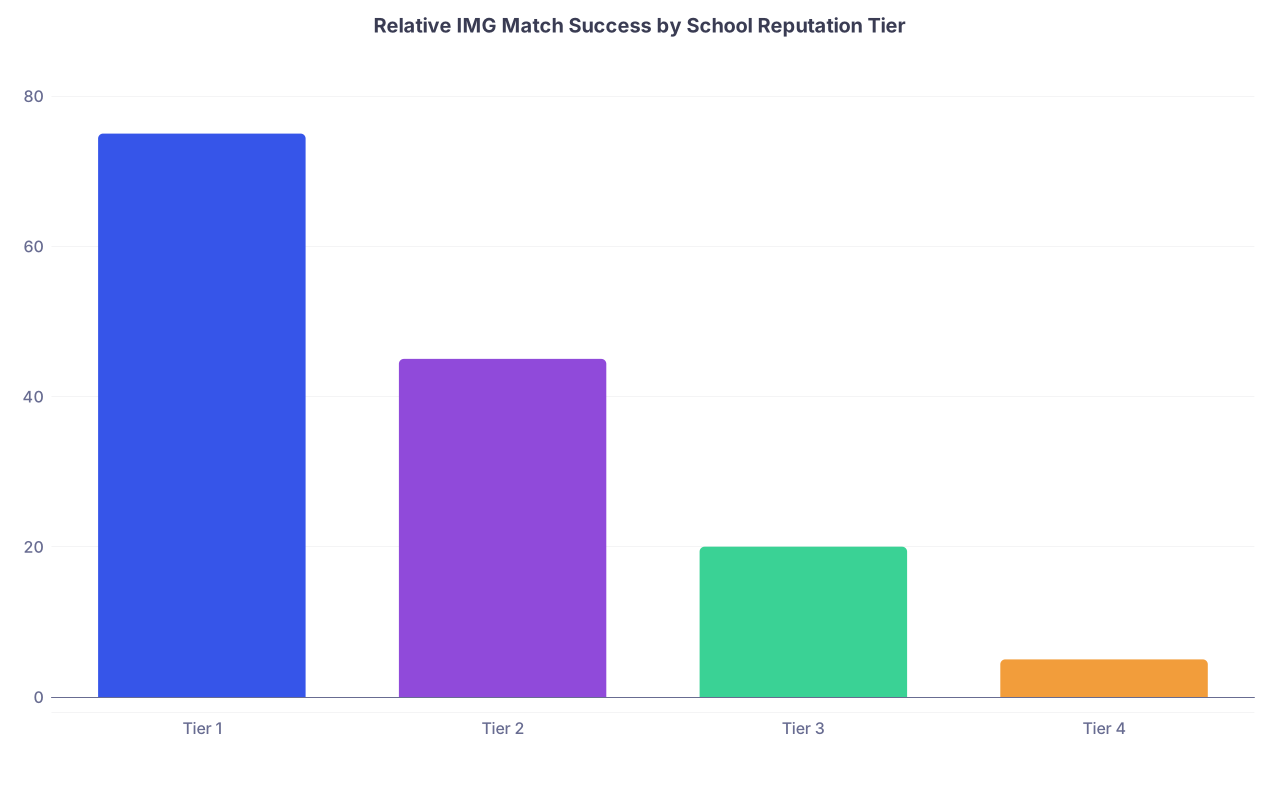
| Category | Value |
|---|---|
| Tier 1 | 75 |
| Tier 2 | 45 |
| Tier 3 | 20 |
| Tier 4 | 5 |
The numbers are illustrative, but the relationships are real. The drop-off from Tier 1 to Tier 3 is massive.
Prioritize:
- Schools with decades of US match history, not new experiments
- Transparent, detailed match lists you can independently verify
- Alumni in the specialties and countries you realistically want
Be very wary of:
- Schools that cannot clearly tell you their USMLE pass rates
- “Brand new” international programs promising US alignment without proof
- Places where the majority of US/Canadian grads end up unmatched or in prelim-only roles
Your school choice will not guarantee success. But choosing a Tier 1-ish or high Tier 2 school for your target region makes everything afterward less uphill.
How Committees Actually Talk When Your Name Comes Up
Let me give you a snapshot of what happens in that conference room when your application is on the screen.

| Step | Description |
|---|---|
| Step 1 | See Applicants Name & School |
| Step 2 | Unknown / Risk |
| Step 3 | Review Scores & CV Generously |
| Step 4 | Require Strong Scores to Consider |
| Step 5 | Quick Scan for Exceptional Metrics |
| Step 6 | Discuss for Interview |
| Step 7 | Decline Early |
| Step 8 | School Known? |
| Step 9 | Good Past Experience? |
That first branch—school known / school unknown—happens in about 2 seconds. Before anyone reads your heartfelt personal statement about why you love medicine.
That’s why understanding the unspoken tier of your school matters. Not to discourage you. To let you play the real game instead of the brochure fantasy.
Final Thought
Years from now, you won’t be thinking about “Tier 2 vs Tier 3” as much as you think. You’ll be thinking about the patients you see, the residents you train, the students you mentor. But the way you get to that future is shaped, quietly and powerfully, by how your school’s name lands in a room full of tired attendings flipping through hundreds of applications.
You cannot control the bias entirely. You can control where you train, how you perform, and how clear-eyed you are about the system. Walk into this with your eyes open, not with marketing slogans echoing in your ears.


