

The match rate numbers international medical schools advertise are not just misleading. Read wrong, they can wreck your career planning.
You are up against sophisticated marketing, survivorship bias, and statistics presented just clean enough to look “official” but not honest enough to guide high‑stakes decisions. I have watched smart premeds sink six figures into schools they would never have touched if they had understood what those shiny “92% match rate!” banners actually meant.
Let me walk you through the biggest mistakes applicants make when interpreting international school match rates—and how to avoid being the next cautionary story.
Mistake #1: Believing “Overall Match Rate” Means “Your Chances”
When a Caribbean or other international school advertises a “90%+ match rate,” most applicants subconsciously translate that into:
“If I go here, I have around a 90% chance of matching into residency in the U.S.”
That is wrong. Flat‑out.
An “overall match rate” is almost always calculated on a carefully filtered group of people who already made it through multiple selection steps you have not yet faced.
Common hidden filters:
- Only counting graduates (ignoring attrition)
- Only counting those who actually applied to the Match
- Excluding people who applied but did not take Step exams
- Excluding students who failed out, transferred, or just disappeared
So the real funnel looks more like this:
- Students who start at the school
- Students who make it through basic sciences
- Students who pass Step 1
- Students who complete clinicals
- Students who pass Step 2
- Students who actually apply to the Match
- Students who match
The “90%” is usually talking about step 7 divided by step 6. What you care about is step 7 divided by step 1. The school has every incentive not to show you that number.

| Step | Description |
|---|---|
| Step 1 | Students Matriculated |
| Step 2 | Completed Basic Sciences |
| Step 3 | Passed Step 1 |
| Step 4 | Completed Clinicals |
| Step 5 | Passed Step 2 |
| Step 6 | Entered Match |
| Step 7 | Matched |
See the problem? The further “upstream” you are, the more inflated those advertised percentages become compared with your true odds.
How to avoid this mistake
When you see a match rate:
- Ask: “Match rate among whom exactly?”
- Push for: “Of the students who matriculated in year X, what percentage matched into U.S. residency within 3 years?”
If they cannot answer cleanly, that silence is far more informative than the glossy percentage.
Mistake #2: Ignoring Attrition and Step Pass Rates
International schools know something you are not supposed to think about: your risk does not only live at the Match. A huge chunk of students never even get that far.
Common missing data:
- First‑time Step 1 pass rate among all students (not only “authorized” test‑takers)
- Attrition rate in the first two years (withdrawals, dismissals, non‑progression)
- Time‑to‑graduation (how many “take an extra year” unofficially)
Here is the usual quiet pattern I have seen:
- Starting class: 100 students
- Still enrolled at end of basic sciences: 70
- Take Step 1: 60
- Pass Step 1 on first attempt: 45
- Eventually match: 35
But the marketing brochure happily says: “Match rate: 83%!” (35/42 who actually applied that cycle), and leaves you to assume you will be in that denominator.
| Stage | Students Remaining | % of Original Class |
|---|---|---|
| Matriculated | 100 | 100% |
| Completed Basic Sciences | 70 | 70% |
| Took Step 1 | 60 | 60% |
| Passed Step 1 (first attempt) | 45 | 45% |
| Applied to the Match | 42 | 42% |
| [Matched into Residency](https://residencyadvisor.com/resources/international-med-schools/how-pds-really-compare-caribbean-european-and-us-grads-on-rank-day) | 35 | 35% |
If you only look at the 83%, you forget the 65 students who never became doctors in the first place.
Red flags to watch for
- School advertises match rates but not first‑time Step 1/2 pass rates
- Step pass rates are far below U.S. MD/DO averages and shrugged off as “students’ responsibility”
- No clear, published attrition or dismissal data by class year
Without this context, you underestimate the true risk and overestimate how “safe” an international route really is.
Mistake #3: Confusing “Matched” with “Matched into Competitive, Sustainable Careers”
Not all matches are equal, and schools rely very heavily on you not asking “matched into what exactly?”
Here is how this trap works:
- The school counts any NRMP or SOAP position as a “match”
- They treat preliminary/transitional year slots as wins without clarifying what happened after
- They lump together:
- Community internal medicine
- Transitional year with no follow‑on PGY‑2
- Unaccredited programs abroad
- And the occasional prestige match they parade endlessly
A brutal truth: many international grads end up clustered in a small set of less competitive, often less desirable programs—sometimes with limited fellowship options, heavy service loads, and weaker connections.
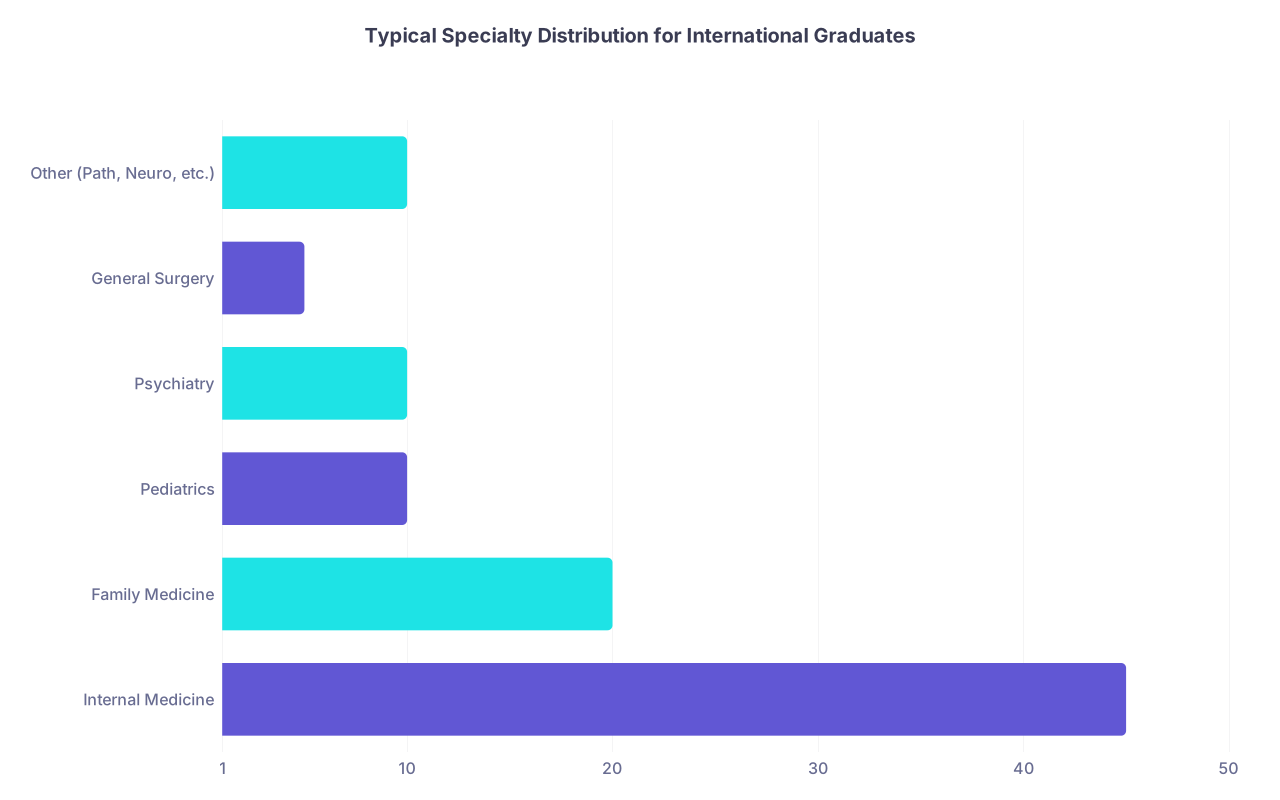
| Category | Value |
|---|---|
| Internal Medicine | 45 |
| Family Medicine | 20 |
| Pediatrics | 10 |
| Psychiatry | 10 |
| General Surgery | 5 |
| Other (Path, Neuro, etc.) | 10 |
Compare that to U.S. MD/DO graduates and you will see the difference in surgical, radiology, dermatology, and competitive subspecialty access. The gap is not small.
Questions you should demand answers to
- “Break down your matches by specialty and by program type (community vs university‑affiliated).”
- “How many categorical vs preliminary positions?”
- “How many students end up with SOAP‑only matches?”
If a school brags about “our grads matched into surgery!” and cannot tell you if that was one prelim year in an obscure program with no categorical follow‑up, they are counting on your ignorance.
Mistake #4: Not Checking Where Graduates Actually Matched
Location matters. Program reputation matters. Saying “we placed graduates across the U.S.” is not information. It is marketing fluff.
Here is what is often hiding under that sentence:
- Heavy clustering in a few lower‑tier community hospitals
- Many programs historically used to taking large numbers of IMGs because U.S. grads do not rank them highly
- Weak academic footprints: limited research, weak fellowship pipelines, minimal subspecialty exposure
You want to see specifics, not vague heat maps.
- Names of programs
- Number of residents placed per year at each
- How many graduates matched into university‑affiliated or university‑based programs
If all the examples in their brochures are “Community Hospital of X” or anonymous “Regional Medical Center,” you should recalibrate your expectations.
Watch for these patterns
- One or two big‑name match examples repeated constantly (“Our grad at Mayo!”) with no context on how rare that is
- No link between their graduate outcomes and your particular interests (e.g., you want neurology, they show you only primary care matches)
- No long‑term follow‑up data on fellowship placement rates from those residency programs
A match into a weak residency that leaves you boxed out of your desired subspecialty is technically a “success” for the school. That does not mean it is success for you.
Mistake #5: Forgetting How Much the Landscape Has Changed
People love telling stories that are 10–20 years out of date.
The classic narrative:
“My cousin went to St. George’s / Ross / AUC and matched into a solid internal medicine program. He is a cardiologist now. You’ll be fine.”
What they ignore:
- U.S. MD and DO schools have expanded significantly
- Step 1 going pass/fail has shifted how programs filter applicants
- Many programs are raising their IMGs thresholds or cutting them entirely
- More U.S. grads are backing up with “safety specialties” that used to be more IMG‑friendly
The same route that “worked” in 2005 may be much riskier in 2025.
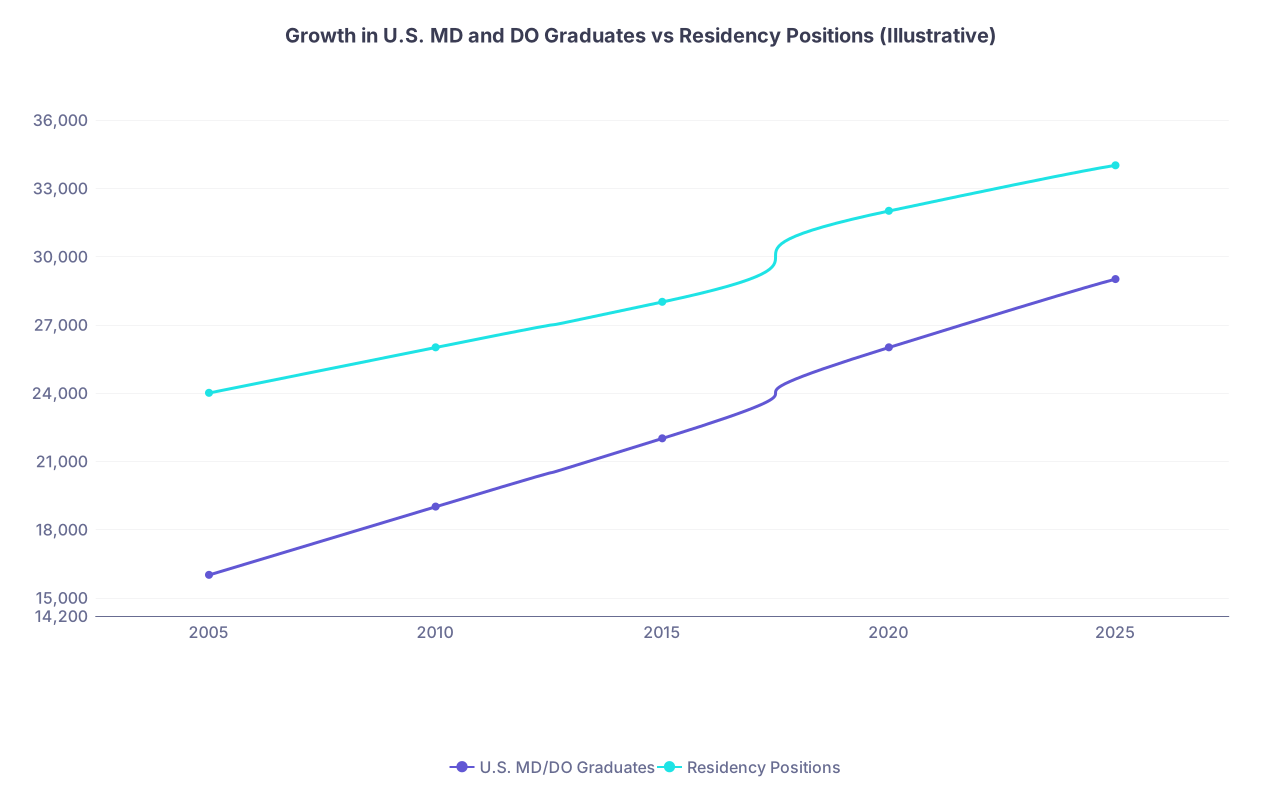
| Category | U.S. MD/DO Graduates | Residency Positions |
|---|---|---|
| 2005 | 16000 | 24000 |
| 2010 | 19000 | 26000 |
| 2015 | 22000 | 28000 |
| 2020 | 26000 | 32000 |
| 2025 | 29000 | 34000 |
Notice the lines getting closer. That squeeze hits IMGs first.
If you look at a school’s long‑term “historic match rates” without understanding how much harder the environment has become for international graduates, you overestimate your future safety.
How to reality‑check this
- Ignore global “since our founding” language. Focus on the last 3–5 match cycles only.
- Look for trends: are IMGs making up a smaller share of matched applicants overall? (They are.)
- Read NRMP’s “Charting Outcomes in the Match” and IMG‑specific reports, not just school marketing.
If a school is selling you a story based on the past while ignoring the present, that is not optimism. It is deception.
Mistake #6: Taking Self‑Reported Match Lists at Face Value
Many international schools publish “match lists” that look impressive at a glance:
- Long PDFs of program names
- Nicely formatted slides with hospital logos
- Occasional mention of top institutions
The problem: these lists are often self‑curated and not independently audited.
Common tricks:
- Listing programs without specifying the position type (prelim vs categorical)
- Mixing in non‑NRMP matches (e.g., home country placements) without labeling them clearly
- Including multiple years in one list, but presenting it like a single‑year achievement
- Omitting class size or the number of graduates who did not match that year
How to dissect a match list
When you get your hands on one of these documents, do not skim. Attack it:
- Count: How many unique positions are actually listed?
- Compare: How does that number line up with estimated graduating class size?
- Label: Identify which positions are:
- Categorical vs preliminary
- U.S. vs non‑U.S.
- NRMP vs other processes
If the school cannot supply these distinctions, assume they are inflating their success.
Mistake #7: Assuming All International Schools Are Equal
“Caribbean school” is not a category. It is a spectrum. Same for European, Latin American, or Asian programs that feed into U.S. residency.
There are schools with:
- Long track records of matching consistent numbers into U.S. residencies
- Reasonably transparent data
- Alumni networks that actually help
And there are schools that:
- Opened recently with tiny, cherry‑picked match data
- Have revolving‑door leadership and unstable affiliations
- Rely heavily on aggressive recruitment and large class sizes
If you look at one “good” school’s outcomes and project them onto every offshore program, you are setting yourself up for disaster.
| Factor | More Established School | Newer/High-Risk School |
|---|---|---|
| Years of Operation | 30+ | 5 |
| Published Match Data | 5+ years, detailed | 1–2 years, vague |
| Step Pass Rates | Near U.S. averages | Significantly lower |
| Class Size | Moderate, stable | Very large, expanding |
| Clinical Affiliations | Long-term contracts | Short-term or rotating |
If a recruiter says, “Just look at how [better-known school] places people, we are basically the same,” ask them to prove it with numbers. They usually cannot.
Mistake #8: Ignoring Your Own Competitiveness Profile
This one is touchy, but I am going to say it plainly: some students using international schools as a “shortcut” are already struggling with academic metrics. The combination of:
- Lower GPA
- Lower MCAT
- Weaker study habits
plus
- More challenging environment
- Less institutional support
- Higher stakes on Step exams
is exactly the wrong formula for a high‑risk pathway.
The match rate you see is typically driven by:
- The top portion of the class (who might have done fine at a lower‑tier U.S. MD/DO school)
- Students with exceptionally strong work ethic and support systems
- People who treat Step 1 and 2 like life‑or‑death full‑time jobs (because they are)
If you do not honestly assess where you stand, you might read a “75–85% match rate” and forget that your personal odds are lower if you enter with weaker preparation or life chaos.
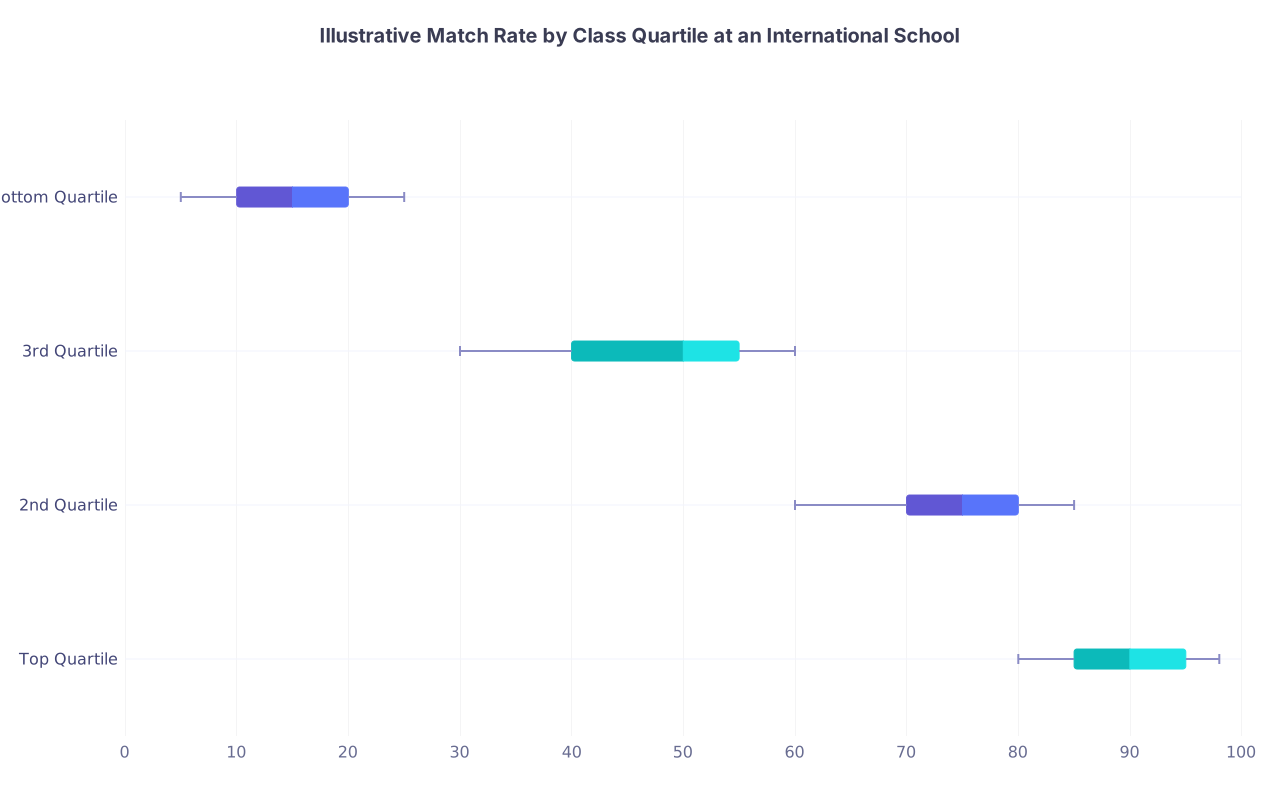
| Category | Min | Q1 | Median | Q3 | Max |
|---|---|---|---|---|---|
| Top Quartile | 80 | 85 | 90 | 95 | 98 |
| 2nd Quartile | 60 | 70 | 75 | 80 | 85 |
| 3rd Quartile | 30 | 40 | 50 | 55 | 60 |
| Bottom Quartile | 5 | 10 | 15 | 20 | 25 |
Numbers above are hypothetical, but the pattern is not. The school will advertise something that looks like “75% overall.” That figure hides brutal outcomes in the bottom half of the class.
If you are already scraping by academically, an international school does not magically erase that. It amplifies it.
Mistake #9: Underestimating Financial and Time Risk Tied to Those Percentages
Match rates are not abstract. They are directly attached to:
- Tuition and fees (often $200k+ total)
- Years of your life (4–6 years, sometimes more with delays)
- Opportunity costs (lost income, lost alternatives)
If you misread a 60–70% “real” chance as a safe bet, you are gambling with money and time you may never get back.

Imagine this scenario I have seen more than once:
- Student borrows heavily to attend an offshore school
- Struggles with Step 1, passes on second attempt
- Ends up unmatched after graduation, applies again, unmatched
- Now has six‑figure debt, no residency, and very limited options
That person technically once attended a school with a “75–85% match rate.” That does not help when creditors start calling.
You cannot treat those percentages like lottery odds. This is not a fun gamble. It is a life‑defining fork.
Mistake #10: Not Cross‑Checking with Independent Data
Most applicants do a deep dive on MCAT prep but barely skim the data that will actually determine their career viability.
You have independent sources. Use them.
Look at:
- NRMP’s “Results and Data” and IMG‑specific reports
- ECFMG annual reports
- State medical board rules for licensing (some have restrictions on certain schools)
- Residency program websites: many explicitly state their IMG policies

Before you emotionally commit to an international path, validate:
- How many IMGs in your desired specialty matched in the last cycle
- Step score distributions for those IMGs
- Typical number of programs IMGs must apply to and interview at to succeed
You are not just trying to parse one school’s numbers. You are mapping your odds within the entire system.
How to Read International Match Rates Without Getting Burned
Let me give you a simple, blunt checklist. Any international medical school you seriously consider should be able to answer these, clearly and in writing.
Of the students who started in the entering class of year X:
- What percentage:
- Are still enrolled?
- Graduated within 4–6 years?
- Matched into residency within 3 years of graduation?
- What percentage:
Step Exams
- First‑time Step 1 pass rate for each of the last 3 years
- First‑time Step 2 CK pass rate for each of the last 3 years
- Whether these rates include all students or only a filtered subset
Match Details (Last 3 Years Only)
- Number of graduates who applied to U.S. residency
- Number and percentage who matched
- Breakdown by:
- Specialty
- Program name
- Categorical vs preliminary
Context
- How their outcomes compare to U.S. MD and DO graduates
- Any known state licensing restrictions on their graduates
If any of this is “unavailable,” “confidential,” or “complicated,” do not invent excuses for them. Schools that take hundreds of thousands of dollars from you can track and share their own outcomes. When they do not, that is your signal.
The Non‑Negotiable Takeaways
Keep this tight and simple:
Advertised match rates are usually for a filtered subgroup, not for everyone who starts. You care about your odds from day one, not a cherry‑picked denominator.
“Matched” does not automatically mean “good fit, sustainable career, or desired specialty.” Demand details: program names, specialty, categorical vs prelim.
The international route is higher risk in a tightening market. If a school’s stats are vague, outdated, or selectively framed, assume the real numbers are worse—not better—than what you see.
Read the numbers like someone who will personally pay the price if they are wrong. Because you will.


