

You are staring at an acceptance email from a Caribbean medical school.
Your GPA is bruised, your MCAT is average, and U.S. MD/DO rejections are piling up. Your parents are saying, “A doctor is a doctor, right?” A classmate tells you, “My cousin went Caribbean and matched, you’ll be fine.” You are tired. You want this whole application nightmare to be over.
This is the exact moment people make the worst decision of their careers.
I am not telling you “never go Caribbean.” I am telling you this: if you ignore the red flags, you can destroy years of work and bury yourself in debt with no residency, no license, and no way out. I have seen it. More than once.
Let’s walk through the seven Caribbean medical school red flags pre-meds routinely ignore—and regret.
1. Vague or Hidden Match / Residency Data
If a school will not clearly show you where their graduates match, in what specialties, and at what rates, step back. Hard.
The biggest lie students tell themselves here is: “They said their grads practice in all 50 states, so it must be fine.” That phrase is marketing code. It is not data.
Here is what you need and what many schools avoid giving you:
- Total number of graduates in that year
- Number who actually matched into residency (not just “placed” or “postgraduate training”)
- The specialties and locations of those matches
- US citizen vs international citizenship breakdown
- USMLE pass rates alongside match results
Watch for these specific tricks (I have seen them on actual school pages):
- “97% residency attainment” — with an asterisk: only includes students who “actively participated” in the match and sometimes omits those who failed exams or dropped out.
- Listing only the names of hospitals where someone matched at some point, but no numbers (1 internal medicine at Mayo vs 40 prelim/TY spots at small community programs counts the same in their glossy brochure).
- Combining multiple years of match data in one list, making it look like a single year’s results.
If their “outcomes” page feels like a highlight reel rather than a transparent report, assume the worst. Good schools brag with numbers. Weak schools brag with anecdotes.
| Aspect | Healthy Pattern | Suspicious Pattern |
|---|---|---|
| Match % displayed | Clear, with denominator | Only a % with no total graduates |
| Year-by-year breakdown | Yes, last 3–5 years | No, only “recent matches” |
| Specialty distribution | Listed with counts | Just logos or hospital names |
| US citizen outcomes | Separate statistics | Blended or not mentioned |
| USMLE linked to match data | Yes | Kept separate or not published |
If you ask admissions for detailed data and they send you another brochure instead of a spreadsheet, that is not “confidentiality.” That is a red flag.
2. Aggressive, Sales-Like Admissions Behavior
Real medical schools are selective. Caribbean mills are sales organizations with classrooms attached.
Warning signs you are dealing with a sales shop, not a serious academic institution:
- You get called or emailed repeatedly, sometimes within hours of filling out an “info form.”
- They push application or seat deposits urgently: “We only have a few spots left this term.”
- You are offered acceptance before all your documents or letters are in.
- They are far more focused on financing options than academic support or outcomes.
- Your GPA/MCAT are significantly below U.S. DO averages, and they still tell you, “You’re a strong candidate.”
I once listened to a recorded call where an admissions “advisor” told a 2.6 GPA / 493 MCAT applicant, “The Caribbean route works for many students like you; U.S. schools just don’t see your potential.” That is not guidance. That is predatory flattery.
A few concrete red flags:
- Waiving application fees instantly “because you’re such a great fit.”
- Promising that your “dream specialty” is absolutely possible without any discussion of Step scores or match odds.
- Telling you U.S. schools “overvalue stats” while they “look at the whole person,” but then never ask you about your clinical exposure, research, or service in any serious way.
Good schools make you sweat. They scrutinize. They wait. If you feel like you are talking to a call center closer rather than an admission dean, trust that feeling.
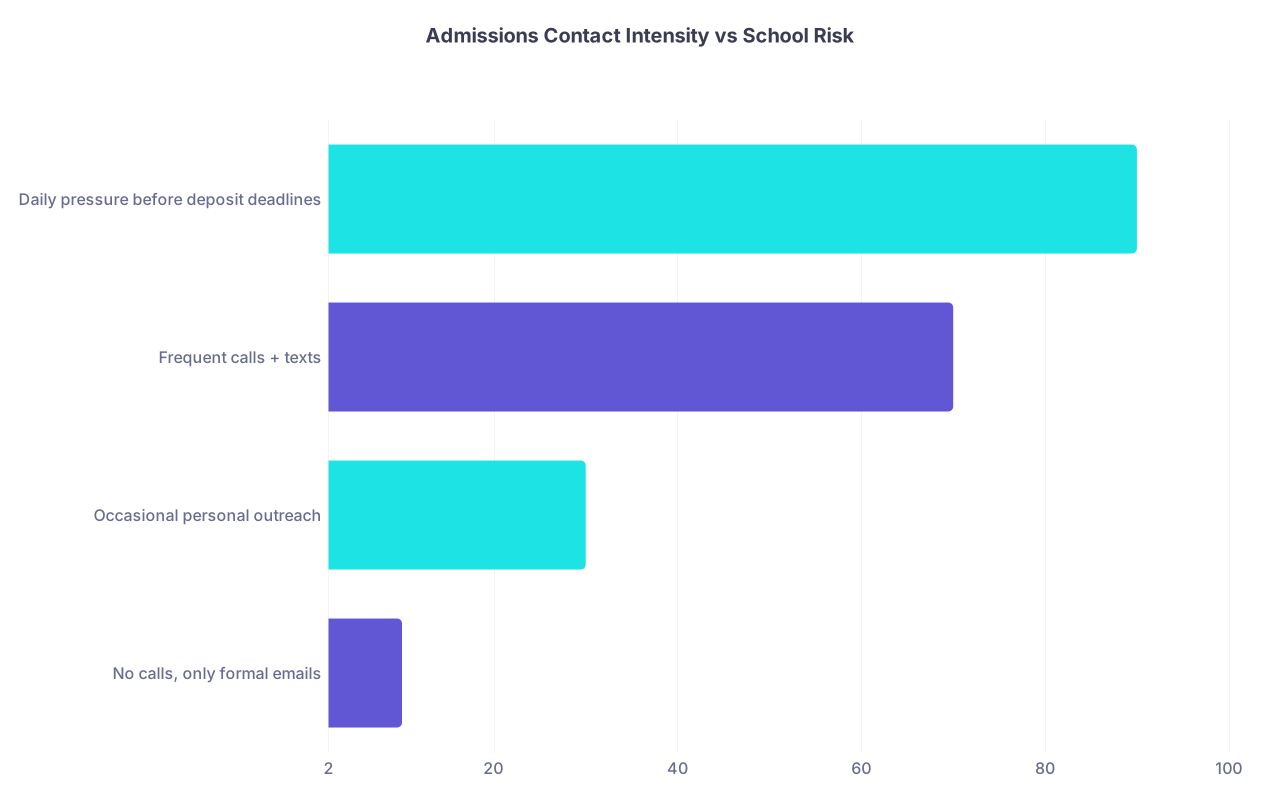
| Category | Value |
|---|---|
| No calls, only formal emails | 10 |
| Occasional personal outreach | 30 |
| Frequent calls + texts | 70 |
| Daily pressure before deposit deadlines | 90 |
3. USMLE and Attrition Numbers That Do Not Add Up
Caribbean schools love to splash “95% USMLE Step 1 pass rate!” on their websites. The reality behind those numbers is often ugly.
Here is the quiet part they do not say:
- Many schools prevent weaker students from even sitting for Step 1 until they pass multiple internal “NBME-style” exams.
- Students who cannot pass are “remediated,” “decoupled,” or quietly dismissed.
- Guess who is not in that 95% statistic?
You must ask two specific questions schools hate:
- How many students start with a given entering class?
- How many of those original students end up:
- Taking Step 1
- Passing Step 1 on the first attempt
- Graduating on time
- Matching into residency
If they cannot or will not give you this pipeline data, it probably looks bad.
Typical pattern I have seen:
- 100 students start.
- Only 70–75 are ever allowed to sit for Step 1.
- Of those, 95% pass → 66–71 students.
- Of those, maybe 60–65 finish on-time.
- Of those, a fraction match into U.S. residency.
That shiny “95%” hides a quiet 30–40% attrition rate before Step 1. Sometimes higher.
Strong schools show this pipeline clearly. Weak ones hope you cant do basic math.
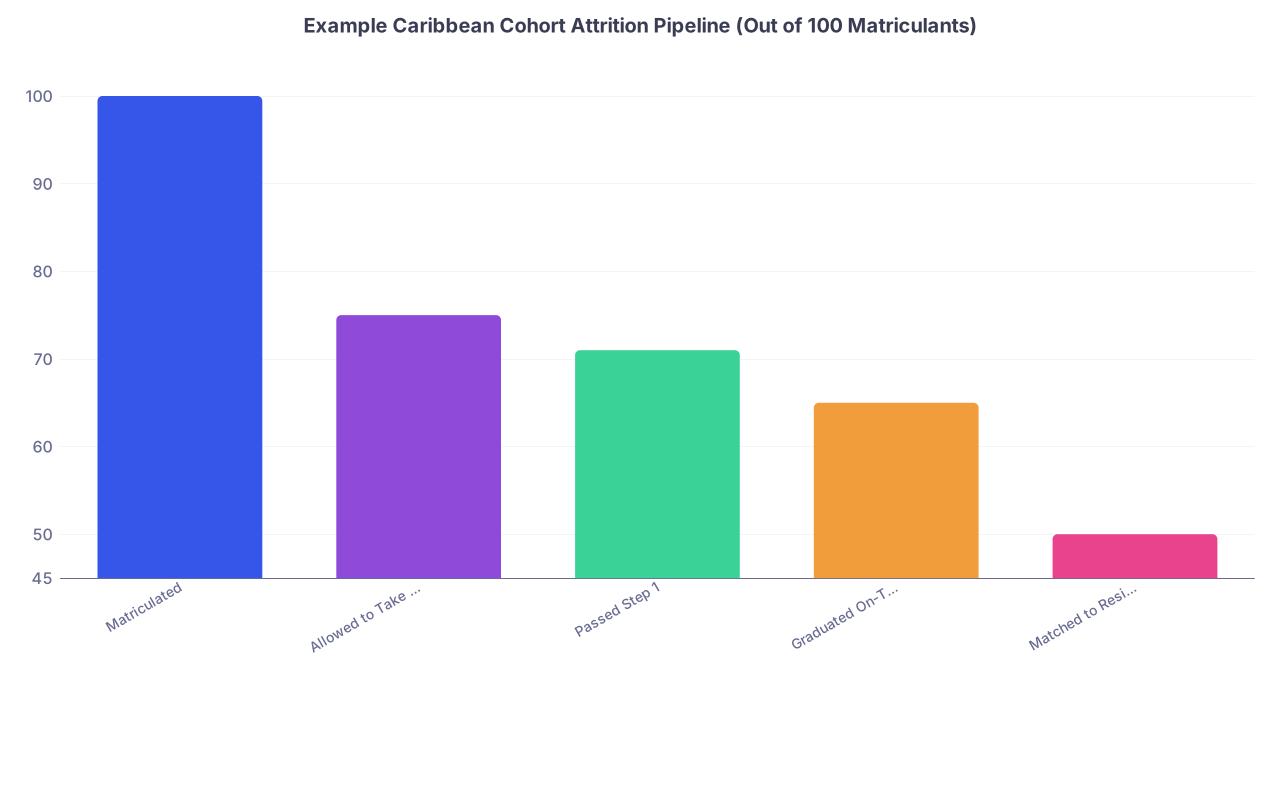
| Category | Value |
|---|---|
| Matriculated | 100 |
| Allowed to Take Step 1 | 75 |
| Passed Step 1 | 71 |
| Graduated On-Time | 65 |
| Matched to Residency | 50 |
If a school only shows Step 1 pass rate and nothing about how many students never get there, that is a massive red flag. You are not just betting on passing exams—you are betting they will not quietly block you from taking them.
4. Accreditation and State Approval Problems
You cannot fix accreditation problems as a student. You just suffer them.
Two separate but related domains:
- Accreditation by a recognized body
- State approvals / disapprovals inside the U.S.
You must verify both. Do not take the school’s website at face value.
Key checks:
- Is the school accredited by an agency recognized as comparable by the U.S. Department of Education’s NCFMEA (National Committee on Foreign Medical Education and Accreditation)?
- Does the school appear on the World Directory of Medical Schools (WDMS) with an ECFMG eligibility note?
- Is it approved or banned by big states like:
- California
- New York
- Texas
- Florida
Some states outright refuse licensure to graduates of specific foreign schools. Others only allow limited rotations. You do not want to find this out on PGY-2 when you try to move states.
| Item | Green Flag | Red Flag |
|---|---|---|
| WDMS listing | Yes, with ECFMG eligibility | No listing or unclear notes |
| NCFMEA-comparable accreditation | Clearly stated and verifiable | Vague “recognized internationally” claim |
| California / New York approval | Explicit approval | “Awaiting decision” or not mentioned |
| School website accreditation page | Up-to-date, linked to agencies | Broken links or generic banners |
One more harsh reality: accreditation status can change. Schools lose approval. If a program is “on probation,” “under review,” or constantly changing names or corporate ownership, you are playing with fire.
5. Overreliance on Federal Loans and High Tuition with Weak Outcomes
Run from any school that encourages you to borrow like outcomes are guaranteed.
Caribbean tuition often approaches or exceeds U.S. private medical schools. That might be tolerable if match rates and outcomes were comparable. They usually are not.
Specific financial red flags:
- Tuition plus fees approaching $60,000+ per year with:
- No transparent match data
- No clear USMLE performance breakdown
- Heavy emphasis on U.S. federal loans (Direct, Grad PLUS) without equal emphasis on:
- Attrition risk
- Match probability
- Alternative careers if you do not obtain a residency
You need to think in worst-case financial terms, not best-case dreams. That is how adults make decisions.
Basic thought experiment:
- Total debt after 4–5 years: $300,000–$400,000+ with interest.
- If you do not match:
- You cannot practice clinical medicine in the U.S.
- You will struggle to use an MD degree for non-clinical jobs that pay enough to service that debt.
- Loan servicers do not care about your match “bad luck.”
When a school frames your future like this—“With our financial aid options, money does not need to be a barrier”—without equally clear talk about outcome risk, they are not on your side.
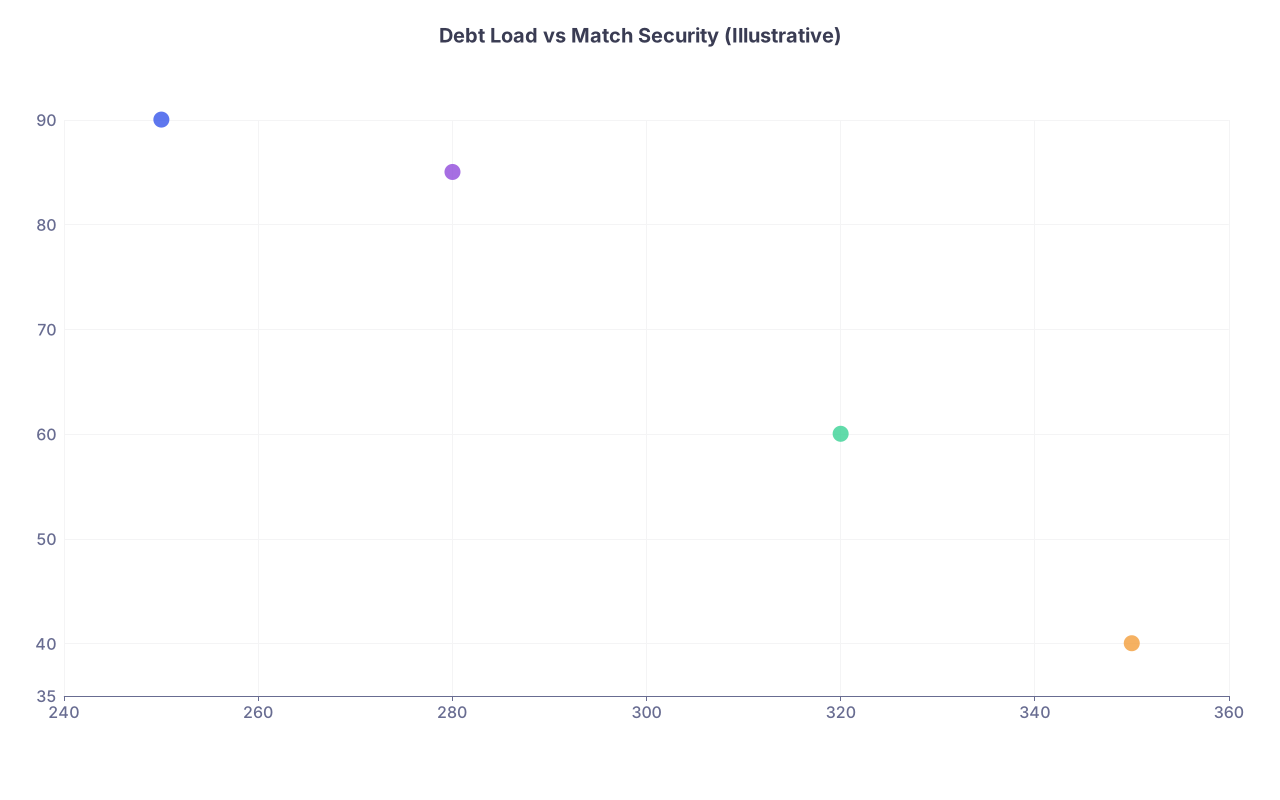
| Category | Value |
|---|---|
| US MD | 250,90 |
| US DO | 280,85 |
| Top Caribbean | 320,60 |
| Lower-tier Caribbean | 350,40 |
(X = approximate debt in thousands, Y = approximate % chance of matching to some residency for average students. The trend is obvious.)
If your loan counselor is more optimistic about your future than the actual data justifies, that is not “supportive.” That is negligence.
6. Clinical Rotations: Weak, Unstable, or Pay-to-Play
Your first two years might be in a nice island classroom. Your career is made or broken in years 3–4.
Too many pre-meds underestimate how critical clinical rotations are. Caribbean schools exploit that ignorance.
Red flags:
- No guaranteed core rotation slots in the U.S. for all students; everything sounds “subject to availability.”
- Heavy use of short-term contracts with small community hospitals rather than long-standing academic relationships.
- Students paying extra fees to secure “better” rotation sites.
- Rotations scattered across multiple states with poor coordination, leaving gaps between clerkships that delay graduation.
- Limited or no access to strong internal medicine and surgery programs that actually feed into residencies.
You want to know:
- Where are core rotations done (hospital names and locations)?
- How long has the school had contracts with those hospitals?
- Do these hospitals have their own ACGME residency programs?
- Are there caps or lotteries that leave students scrambling for spots?
Programs lose rotation contracts. It happens. The question is: Does the school absorb that hit or dump the chaos onto students?
If you hear stories from current students like, “I am waiting three months for my next rotation because they cannot find me a site,” believe them.
7. Culture of Overpromising and Student Blaming
Last, and maybe the most dangerous: the school culture.
You can usually sniff this out by listening to how the administration talks about students who struggle.
Two patterns:
Honest, student-centered culture
- Talks clearly about how hard it is to match from the Caribbean.
- Emphasizes discipline, realistic specialty choice, and backup plans.
- Owns part of the responsibility when students fail: poor advising, insufficient support, etc.
Defensive, blame-shifting culture
- “Students who do not match just did not work hard enough.”
- “We provide every opportunity; it is on them if they fail.”
- Heavy reliance on a few success stories rather than recognizing the many who never match.
If everything that goes well is “because of the school,” and everything that goes badly is “because of the student,” you are entering a toxic environment.
Concrete behavior to watch for:
- No independent student-run forums or the school tries to shut down negative discussions online.
- Current students you talk to are hesitant or guarded when asked about support, or they say, “I’d rather not put this in writing.”
- Advising that pushes unrealistic paths—plastic surgery, dermatology—from a Caribbean starting point for an average student.
Compare that to a rare honest dean who might say:
“You came here with a 2.8 GPA and 498 MCAT. If you do very well, you can likely match into internal medicine, family medicine, or pediatrics. More competitive specialties will be out of reach, and you must accept that now.”
If you do not hear that kind of blunt realism, you are not being treated as an adult. You are being handled as a revenue source.
Quick Decision Flow: Should You Even Consider Caribbean?
Use this as a sanity check.

| Step | Description |
|---|---|
| Step 1 | No US MD/DO Acceptances |
| Step 2 | Plan to Retake/Strengthen App |
| Step 3 | Reapply to US MD/DO |
| Step 4 | Explore Other Careers or Post-bacc |
| Step 5 | Evaluate Only Top Caribbean with Clean Data |
| Step 6 | Walk Away |
| Step 7 | Proceed with Extreme Caution |
| Step 8 | Fixed GPA/MCAT or Can Improve? |
| Step 9 | Ready to Accept Primary Care Only + High Risk? |
| Step 10 | Transparent Match & Accreditation? |
If you are not mentally ready to:
- Accept that competitive specialties are almost entirely off the table
- Live with a much higher chance of never matching at all
- Carry enormous debt with no guarantee of practicing
…then you are not ready to sign a seat deposit for any Caribbean program.
Final Thoughts: What Actually Matters
Strip away the marketing, the desperation, and the anecdotes.
Here is what actually matters when you evaluate a Caribbean medical school:
Hard outcomes, not hopeful stories.
- Match rates with denominators.
- USMLE pass rates tied to initial matriculant numbers.
- Residency type and location, not just “we have grads in all 50 states.”
Structural legitimacy and support.
- Real accreditation and state approvals.
- Stable, quality clinical rotations with clear guarantees.
- A culture that tells you the hard truth, not what you want to hear.
If you cannot verify those two, do not convince yourself you will be the exception. That mindset is how smart, determined pre-meds end up with six figures of debt, no residency, and a lifetime of what-ifs.
Better to pause, retool your application, or even change paths than to charge blindly into a bad situation because you were tired of waiting.
Do not let exhaustion make a permanent decision for you.


