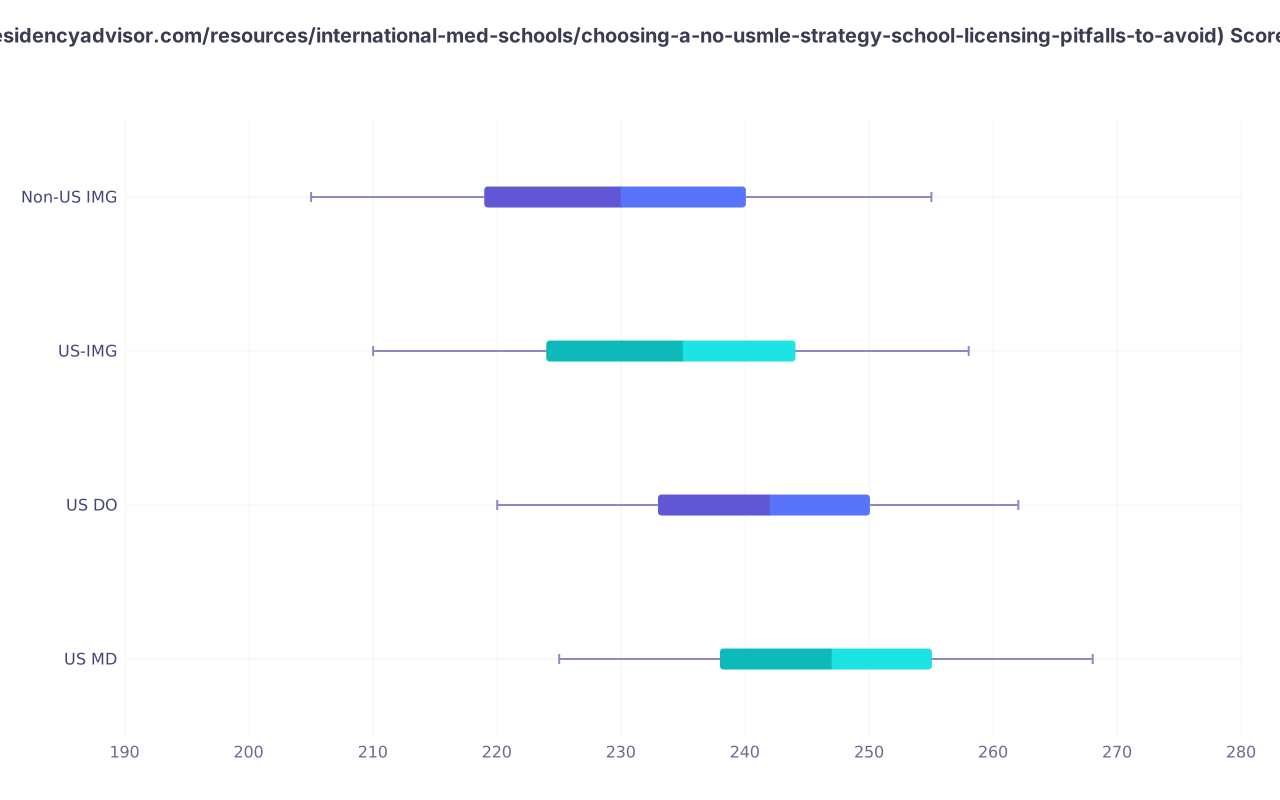
| Category | Min | Q1 | Median | Q3 | Max |
|---|---|---|---|---|---|
| US MD | 225 | 238 | 247 | 255 | 268 |
| US DO | 220 | 233 | 242 | 250 | 262 |
| US-IMG | 210 | 224 | 235 | 244 | 258 |
| Non-US IMG | 205 | 219 | 230 | 240 | 255 |
The score gap between IMGs and U.S. grads is real, measurable, and large enough to change careers. Pretending otherwise is how people end up unmatched with a 230+.
If you are an international medical graduate—or planning to become one—the single most rational thing you can do is understand the score distributions cold. Not averages. Distributions. Who clusters where. Who fights for the same interview slots. And what “competitive” actually means for you, not for the student at a U.S. MD school.
Let’s walk through what the data shows, specialty by specialty, and what it implies for your strategy.
1. The Core Reality: Step Scores Are Not Evaluated Equally
Step exams are supposed to be standardized. Same test, same scale. So in theory, a 240 should mean the same thing whether you trained in Karachi, Krakow, or Kansas City.
In practice, it does not.
Program directors know three stubborn facts:
- U.S. MD students, on average, score higher than IMGs.
- U.S. MD schools have heavy pre-screening to get in. Many international schools do not.
- Most IMGs apply to the same limited set of “IMG-friendly” programs, spiking competition there.
So a “good” score depends heavily on your training background.
Approximate step distributions by group
Using recent NRMP and USMLE data trends (Step 1 pre-pass/fail and Step 2 CK current distributions), the picture looks like this for Step 2 CK:
- Mean for U.S. MD seniors: roughly 245–247
- Mean for U.S. DO seniors: roughly 240–242
- Mean for U.S.-citizen IMGs: roughly 235–238
- Mean for non-U.S.-citizen IMGs: roughly 230–233
The exact numbers vary year to year, but the pattern is stable: U.S. MD > U.S. DO > US-IMG > non-US IMG.
That 10–15 point spread matters. A lot. Because it compounds when programs set cutoffs.
| Group | Mean | 25th %ile | Median | 75th %ile |
|---|---|---|---|---|
| U.S. MD Seniors | 246 | 238 | 247 | 255 |
| U.S. DO Seniors | 241 | 233 | 242 | 250 |
| U.S.-citizen IMG | 237 | 228 | 238 | 247 |
| Non-U.S. IMG | 232 | 223 | 233 | 242 |
For an IMG, this means a “median” performance within your own group often sits below the median U.S. MD performance. When residency programs say “we like to see scores above average,” they are rarely talking about the IMG average. They are looking at the U.S. MD benchmark.
2. How Distributions Translate into Match Odds
Scores by themselves do not matter. Scores plus behavior do.
What actually matters:
- How many people with certain scores apply to a given specialty
- How many positions that specialty offers
- How many programs are willing to consider IMGs at a given score
Now the uncomfortable piece: IMGs disproportionately aim for specialties that are already highly competitive, while starting from a lower mean score distribution.
The big-picture match data
If you look at NRMP Charting Outcomes patterns:
- U.S. MD seniors with a Step 2 CK around 240–245 match into internal medicine at very high rates (often >90%).
- IMGs with the same score are nowhere near those odds. They match well, but not automatically—and the effect is worse in competitive fields.
For something like orthopedic surgery, dermatology, or plastics, Step 2 minimums for IMGs jump into the high 250s for realistic interviews, not because every IMG must have that score, but because the few who match tend to sit in the long right tail of the distribution.
So the distributions are not just shifted; they are filtered. Programs do not sample evenly from the IMG pool. They cherry-pick the very top.
3. Specialty-Specific Distributions: Who Needs What
Let us be concrete. Below is a stylized view of Step 2 CK score ranges that tend to be associated with realistic match chances, split by background. These are not cutoffs; they are observed patterns when you look at who actually matched.
| Specialty | U.S. MD (often match) | IMG (often match) |
|---|---|---|
| Internal Medicine | ≥ 225–230 | ≥ 235–240 |
| Family Medicine | ≥ 215–220 | ≥ 225–230 |
| Pediatrics | ≥ 225–230 | ≥ 235–240 |
| Psychiatry | ≥ 220–225 | ≥ 230–235 |
| General Surgery | ≥ 240–245 | ≥ 250–255 |
| Anesthesiology | ≥ 235–240 | ≥ 245–250 |
| Radiology (DX) | ≥ 245–250 | ≥ 255–260 |
| Dermatology | ≥ 255–260+ | ≥ 260–265+ |
| C --> | No | D[8-10 Weeks Content + UWorld Pass 1] |
| C --> | Yes | E[6-8 Weeks Intensive UWorld + Review] |
| G --> | Yes | H[Schedule Step 2 CK] |
| G --> | No | I[Targeted Weak Area Review + Extra Qs] |
The flow above is what I see in the IMGs who break into competitive programs. There is nothing mystical. Just structured, data-driven prep.
9. U.S. Clinical Experience and Research: Secondary Distributions
When Step scores are close, tie-breakers matter. Again, distributions come into play.
Among matched IMGs:
- A high percentage have at least some U.S. clinical experience (observerships, externships, sub-internships).
- Many have at least 1–2 publications or abstracts, especially in academic or competitive specialties.
What programs are doing, in effect, is this: from the already filtered group of high-scoring IMGs, they further select those with U.S. experience and some research. You are moving from one filtered distribution to another.
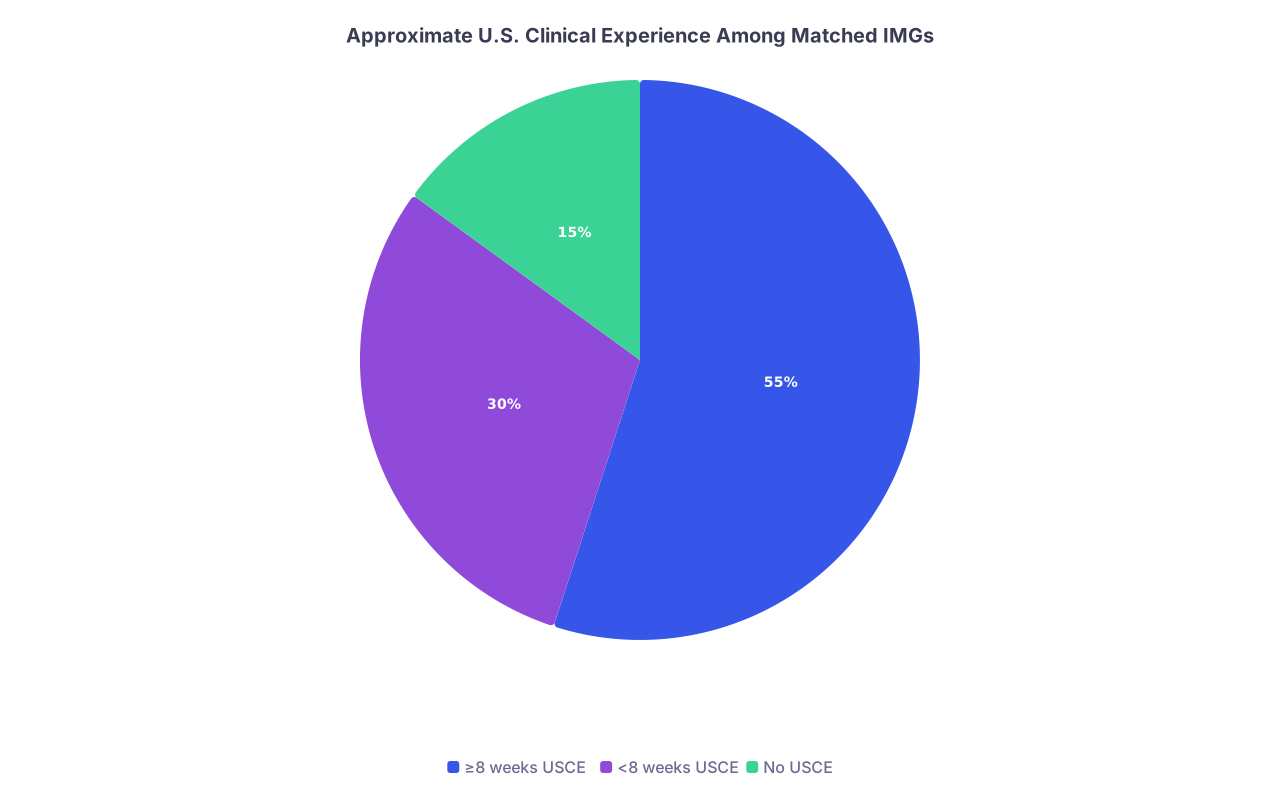
| Category | Value |
|---|---|
| ≥8 weeks USCE | 55 |
| <8 weeks USCE | 30 |
| No USCE | 15 |
So if you and another IMG both have a 245, but you have 12 weeks of U.S. IM rotations, a poster at a U.S. conference, and letters from U.S. attendings, you move to the more favorable part of the non-numeric distribution.
Scores open the door; these extras decide which IMG actually walks through it.
10. Premed and Early Planning: If You Have Not Started Med School Yet
Since this is under “Premed and Medical School Preparation,” let me address the upstream decision.
If you have not yet committed to an international school, the data compare U.S. MD, U.S. DO, and IMGs very clearly.
Read that again. A U.S. MD student has about a 9 in 10 chance of matching somewhere. For non-U.S. IMGs, it is closer to a coin toss.
And this is not “discrimination in the abstract.” It is a direct consequence of:
- Lower average scores
- Higher attempt rates
- Less U.S.-aligned training
- Oversupply of applicants to a limited number of IMG-friendly positions
So if you are a premed with the option to aim for U.S. schools—even DO—and you are casually considering an offshore school, you are ignoring very blunt numbers. An offshore MD is not “basically the same but cheaper.” It is a statistically higher-risk route that forces you to live in the right tail of every distribution just to have similar odds.
11. What the Numbers Reveal, Boiled Down
Strip away anecdotes and self-justification. The score distributions for IMGs vs U.S. grads tell you three things:
You start behind.
The mean Step 2 CK for IMGs is 8–15 points lower than for U.S. MDs. Programs know this and adjust expectations accordingly.To look equivalent, you must outperform.
For many specialties, an IMG needs a Step 2 score roughly 5–12 points higher than a U.S. MD peer to command similar interest, especially outside primary care.The system rewards the right tail.
Among IMGs, matching is heavily concentrated in those who push into the upper quartile of the score distribution and pair that with U.S. clinical experience and, for competitive fields, some research.
If you are already in an international school, the response is not to complain about the system. The rational response is to use the data as a target: plan your prep, your specialty choice, and your U.S. exposure around being in that right tail.
If you are premed and still choosing a path, the numbers are blunt: every step you take away from a U.S. MD seat increases the score burden and decreases your margin for error. You may accept that tradeoff. Just do it with your eyes open, not with wishful thinking.
Those are the distributions. That is what they reveal.