The idea that you can “just transfer back” to a U.S. medical school if an international program doesn’t work out is fantasy. Not optimism. Not a backup. Fantasy.
If you’re making a life‑altering decision based on this myth, you’re playing Russian roulette with your career.
Let me walk through what actually happens to students who go abroad thinking, “If it goes badly, I’ll just transfer home.” Because I’ve seen that movie. More than once. It rarely has a happy ending.
The Myth vs. Reality: How Transfer-Friendly Are U.S. Med Schools Really?
The myth version of the story goes like this:
- You cannot get into a U.S. MD or DO school.
- You enroll in a Caribbean or other international program.
- You prove yourself there with good grades.
- You transfer into a U.S. medical school after a year or two.
- You graduate as if you’d started in the U.S. all along.
Now here’s the reality.
Very few U.S. medical schools accept any transfer students. Among those that do, most accept 0–2 students per year, and only from accredited U.S. or Canadian schools. Many explicitly state they do not consider international transfers at all.
Let’s put that into something concrete.
| School | Accepts Transfers? | From International Schools? | Typical Slots/Year |
|---|---|---|---|
| Harvard Medical School | No | N/A | 0 |
| University of Michigan | Rare, case-by-case | Generally no | 0–1 |
| University of Florida | Yes, limited | No | 1–2 |
| Ohio State University | Yes, very limited | No | 0–2 |
| State school in many U.S. states | Often no | No | 0 |
These example policies are typical of MD schools nationwide: most take no transfers; a small minority consider them; almost none consider them from non–U.S./Canadian schools.
DO schools? Slightly more open, but still not “Sure, come on over from any Caribbean school.” Most want COCA-accredited DO programs or LCME-accredited MD programs, not offshore schools.
You’re not “likely” to transfer back. You’re barely eligible in most cases.
Why U.S. Schools Basically Don’t Want International Transfers
This isn’t personal. It’s structural.
There are several hard reasons U.S. schools almost never take transfers from international medical schools:
1. Accreditation and curriculum mismatch
LCME-accredited MD schools and COCA-accredited DO schools have tightly regulated curricula, competencies, and assessment standards. International schools, especially offshore Caribbean ones, vary wildly.
U.S. schools worry about:
- Different anatomy/physiology depth
- Different clinical exposure timelines
- Assessment rigor (or lack of it)
- Who actually supervised your training
They don’t want to spend time reverse‑engineering if your Year 2 in St. Somewhere is equivalent to their Year 2 in Ohio.
It’s easier and safer to just say: if you did not start in a U.S. or Canadian school, we’re not taking you.
2. Seat capacity and financial incentives
Medical school class sizes are fixed. Every “new” transfer student displaces someone else.
- They cannot exceed their approved class size.
- They already have a full cohort paying full tuition.
- Their own students who took leaves or are repeating years often get priority for any open spots.
So who gets that rare empty seat?
A U.S. citizen at a Caribbean school hoping for a fresh start? Or a strong U.S./Canadian student whose current school closed or had a major disruption?
In practice, transfer slots are safety valves for their own system, not catch‑all rescue spots for international students.
3. Risk, optics, and outcomes
Schools are obsessed with:
- USMLE pass rates
- Match rates
- Graduation within 4–6 years
Bringing in a transfer from a program with weaker average outcomes is a gamble with their stats. If you struggle, it reflects on them.
They don’t need that risk. They already have more applicants than seats.
The Harsh Data: What Actually Happens to International Grads
Let’s ground this in real-world outcomes.
International medical graduates (IMGs) — including U.S. citizens who went abroad — are at a clear disadvantage for U.S. residency.
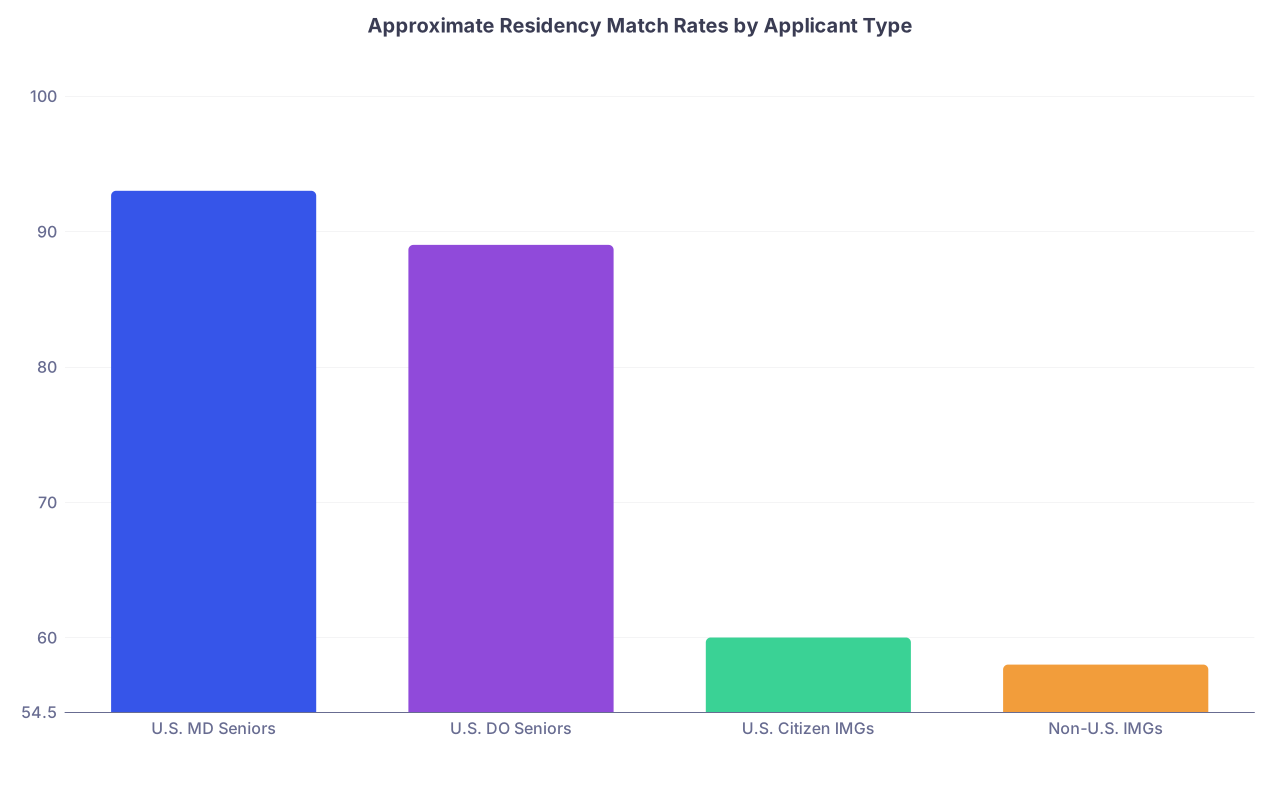
Use one example: the NRMP (Match) data for recent cycles. The pattern is stable:
- U.S. MD seniors: Match rate commonly in the >90% range.
- U.S. DO seniors: Often >85–90%.
- U.S. citizen IMGs: Typically around 55–65%.
- Non-U.S. citizen IMGs: Often lower still.
| Category | Value |
|---|---|
| U.S. MD Seniors | 93 |
| U.S. DO Seniors | 89 |
| U.S. Citizen IMGs | 60 |
| Non-U.S. IMGs | 58 |
You can argue about a few percentage points depending on the year, but the hierarchy doesn’t change: IMG status is a handicap.
Why mention residency when we’re talking about transferring? Because the whole reason most people want to “transfer back” is to avoid ending up in the IMG bucket. The transfer path is extremely narrow. If you go abroad, you should assume you’re going to be an IMG for Match purposes.
If that makes you uneasy, good. It should.
Common Sales Pitches vs. What They Actually Mean
I’ve heard the same lines from students who went offshore after talking with recruiters.
Let’s translate some of the greatest hits.
Pitch: “We have students who successfully transfer to U.S. schools every year.”
Reality:
This might mean:
- 1–2 people out of hundreds.
- Or they’re counting people who moved from one Caribbean school to another.
- Or it happened 7 years ago and they’re still milking the anecdote.
Unless they show hard numbers and specific U.S. schools, assume “rare exception,” not “reliable path.”
Pitch: “Our curriculum is modeled after U.S. medical schools.”
Reality:
That’s a marketing phrase. It does not mean:
- LCME accreditation
- U.S. schools will automatically view your coursework as equivalent
- You’re considered like a U.S. MD student
“Modeled after” is not “treated as.”
Pitch: “Our graduates match into U.S. residency programs every year.”
Reality:
Sure. Some do. The real questions are:
- What percentage of your entering class eventually matches?
- How many dropped out, failed exams, or disappeared along the way?
- What specialties and locations are typical? (Neurology in the Midwest is different from derm in Boston.)
You’ll see shiny slides with “Match success!” and logos of big hospitals. You won’t always see the pipeline of students who never made it to that slide.
Realistic Transfer Scenarios (Where It Might Happen)
There are rare scenarios where a “transfer” story isn’t total fantasy. But even these are exceptions, not plans.
Scenario 1: U.S. school closures or disruptions
If a U.S. school loses accreditation, closes, or undergoes serious problems, other U.S. schools sometimes accept their students as transfers to protect them.
Key detail: those students are still from U.S. or Canadian LCME-/COCA-accredited programs. Not from offshore schools.
Scenario 2: You start at a U.S. DO and move to U.S. MD (or vice versa)
Very rare, but occasionally a U.S. student in one accredited program moves to another for strong personal reasons (family illness, spouse relocation, military). Even here:
- Stellar performance is required.
- Space has to exist.
- Schools often have state or internal policy restrictions.
This doesn’t help someone already abroad.
Scenario 3: Edge-case high performer at a top-tier international school
Maybe you’re at a well-regarded international university with solid research, good U.S. affiliation, and you are crushing everything: top 1–2% of your class, high scores, existing U.S. faculty relationships.
Could a U.S. school make an exception? Possibly. In the same way that you can possibly win the lottery.
If your entire medical education plan assumes “I’ll be the tiny exception,” you’re not planning. You’re gambling.
The Hard Question: Why Are You Banking on Transferring?
If you’re seriously considering an international school with the idea of “I’ll go there now and transfer back later,” you owe yourself an uncomfortable self-audit.
What’s actually going on?
Some common patterns I’ve seen:
- You’re in a rush. You don’t want to sit out a year, improve your GPA or MCAT, and reapply.
- You’re terrified of another denial from U.S. schools.
- A recruiter made it sound like this is a standard, honorable alternative path. “Plenty of successful doctors did this.”
- Your family is pressuring you to “just get started” with med school anywhere that will take you.
I’m going to be blunt:
Starting medical school in the wrong place, at the wrong time, under false assumptions, can be worse than waiting a year or two and fixing your application.
Students massively underestimate:
- The debt they’ll incur
- The psychological toll of failing out or not matching
- The difficulty of climbing back once you’re labeled “IMG with gaps and issues”
Everyone thinks they’ll be the one who outworks the statistics. Most are not.
What You Should Plan Around Instead
Let’s switch from myth‑busting to strategy.
If you’re premed or early in the process and considering international schools, anchor your thinking around this:
Assume you will not transfer.
Design your plan under the assumption you’ll complete your entire MD/MBBS abroad and apply as an IMG.Research real outcomes from that specific school.
And not just the shiny ones:- What percentage of matriculants graduate?
- How many match into U.S. residencies, and in what specialties?
- How many needed 5–7+ years to finish?
- Where do students who struggle end up?
Ask to speak with recent grads, not just handpicked superstars from a decade ago.
Compare that path to delaying and reapplying in the U.S.
If you spend 1–2 years:- Doing a post-bacc or SMP
- Retaking the MCAT
- Building strong clinical and research experience
What’s your realistic shot at a U.S. MD or DO seat vs. going abroad now and becoming an IMG?
Be honest about specialty goals.
If you want highly competitive fields (derm, plastic surgery, ortho, ENT, neurosurgery), going offshore is almost always a massive disadvantage.
Some IMGs match in these areas, yes. The numbers are tiny, and usually with extreme board scores + research + luck.
A Quick Reality Flow: From “Can’t Get In” to “Going Abroad”
Let’s diagram what actually happens to a lot of students who take the “I’ll just transfer” bait.

| Step | Description |
|---|---|
| Step 1 | Rejected from U.S. schools |
| Step 2 | Gap years, post-bacc, stronger app |
| Step 3 | Higher chance at U.S. MD/DO |
| Step 4 | Enroll in international school |
| Step 5 | Complete abroad as IMG |
| Step 6 | IMG in residency |
| Step 7 | Debt + limited options |
| Step 8 | Improve & Reapply? |
| Step 9 | Transfer back to U.S.? |
| Step 10 | Match in U.S.? |
Notice the branch that says “Transfer back to U.S.?” It almost always closes. The real decision point is before you go abroad.
What About “Big Name” Caribbean Schools?
Someone’s going to object: “But what about [insert well-known Caribbean school]? Don’t they have great match numbers?”
Here’s the nuance.
Yes, some of the more established offshore schools:
- Have long histories
- Have more structured U.S. clinical rotations
- Publish detailed match lists
But you need to think like a statistician, not a brochure reader:
- Their match rates are often calculated off those who reach graduation and enter the Match, not off the original entering class.
- There can be heavy attrition in the preclinical years.
- A portion of students may never take USMLE or stop along the way.
And crucially: none of that magically opens transfer doors into U.S. schools. Their strength is “better odds as an IMG,” not “secret tunnel back to LCME schools.”
So if you’re looking at them, fine. But judge them on their real role: as a full alternative path, not as a stepping stone.
Bottom Line: Build a Plan That Works Without a Transfer
Here’s the uncomfortable truth you probably sensed before you even asked:
- Transfers back to U.S. medical schools from international programs are extraordinarily rare.
- The schools that even consider them almost always prioritize students from other U.S./Canadian programs.
- Treating “I’ll transfer later” as a safety net is like treating a lightning strike as a financial plan.
If you are premed or pre-enrollment and you’re on the fence, the smart play usually looks like this:
- Assume no transfer.
- Decide if you’re genuinely willing to be an IMG in the Match.
- If not, pause, retool your application, and re‑attack U.S. MD/DO.
Two or three extra years now is nothing compared with 40 years of career trajectory and the risk of six figures of debt with limited options.
Key takeaways
- “I’ll just transfer back if needed” is not a plan; it’s a myth. U.S. schools almost never accept transfers from international programs.
- If you go abroad, assume you’ll finish there and apply to U.S. residency as an IMG — with all the competitive disadvantages that entails.
- Before committing overseas, seriously compare that path against spending extra time to become competitive for U.S. MD or DO schools.