
It is March. You are in your third year at an international medical school. Your friends are talking about Step 1 and Step 2 CK, and you are staring at your syllabus thinking: “Where, exactly, did we ever learn any of this biostatistics?” Or you open a UWorld cardiology question and realize your school taught you heart failure purely as “NYHA I–IV” and drug names, with almost zero physiology.
You are not confused. The curriculum is.
Let me break down how that happens and how to fix it.
We are going to go system by system, but more importantly, curriculum by curriculum. Because an Indian MBBS, a Caribbean integrated program, and a German Staatsexamen structure do not miss the same things. Yet the USMLE blueprint is blind to where you trained; it just expects a specific integration of basic science + clinical reasoning across defined content domains.
1. The USMLE Content Blueprint: What You’re Actually Being Tested On
Forget “Step 1 is basic science, Step 2 is clinical.” That line is outdated and dangerously simplified.
Both Step 1 and Step 2 CK are organized around:
- Organ systems
- Physician tasks / competencies
- Disciplines (biochem, pharm, path, etc.)
The exam writers think in matrices. You need to, too.
| Dimension | Examples |
|---|---|
| Organ Systems | CV, Pulm, GI, Neuro, MSK, Repro |
| Disciplines | Path, Pharm, Physio, Micro, Stats |
| Physician Tasks | Diagnosis, Management, Ethics |
Now, compare that to how most international schools teach:
- Phase-based: preclinical → clinical
- Discipline-based: separate courses (anatomy, then physiology, then pathology)
- Or block-based: integrated “modules” by system, but often missing exam-level integration of epidemiology, ethics, communication, and decision-making.
The USMLE does not care which model you had. It cares whether, for a 24-year-old with subacute cough and night sweats, you can:
recognize TB risk factors, interpret CXR, choose the right test, know the drug regimen, monitor side effects, and understand public health implications. That is multiple content domains in one question.
You should be constantly mapping: “Where in my curriculum did I actually get this?”
Let us go through the major curriculum types.
2. Indian MBBS Curriculum → USMLE Domains
Imagine you are at an MCI/NMC-recognized college in India. Standard MBBS: 4.5 years + internship.
How MBBS Is Structured
- 1st year: Anatomy, Physiology, Biochemistry
- 2nd year: Pathology, Pharmacology, Microbiology, Forensic, maybe some early clinical exposure
- 3rd–4th year: Medicine, Surgery, OBGYN, Pediatrics, and allied subjects
- Internship: Rotations in major and minor specialties
Good on paper. But here is how it maps—and where it fails—against USMLE.
Strong Overlaps with USMLE
Pathology
Usually taught thoroughly. Indian pathology teaching (especially in exam-focused colleges) can exceed US standards in detail:- Cellular adaptations, inflammation, neoplasia
- Systemic path with solid morphological grounding
Good foundation for Step 1 path questions. What is missing is often the correlation to radiology and decision-making.
Pharmacology
Heavy on drug classes and mechanisms.
You learn prototypical drugs in depth:- Anti-TB, anti-leprosy, antihypertensives, chemo regimens, anesthetics
For Step 1 mech questions, this is helpful. But…
- Anti-TB, anti-leprosy, antihypertensives, chemo regimens, anesthetics
Microbiology
Strong memorization of organisms, lab diagnosis, staining, culture, and major clinical features.
Helps with Step 1 ID questions, especially basics of bacteria, viruses, parasites (like malaria, helminths) which US students sometimes see less of.
Systematic Gaps vs USMLE
Biostatistics & Epidemiology (Major Deficit)
Many Indian schools either:- Treat community medicine as low-yield for college exams
- Teach stats formulas without clinical integration
But USMLE Step 1 and especially Step 2 CK are loaded with:
- Study design (cohort, case-control, RCT, cross-sectional)
- Bias, confounding, effect modification
- Sensitivity, specificity, PPV/NPV, likelihood ratios
- NNT/NNH, hazard ratios, interpreting Kaplan–Meier curves
If you are MBBS-trained, expect to be badly underprepared here unless you explicitly work on it.
Behavioral Health, Ethics, and Communication
USMLE loves:- Breaking bad news, consent, capacity, surrogates
- Physician impairment, boundaries, gifts, conflicts of interest
- Depression, anxiety, personality disorders, substance use in a US cultural context
Typical MBBS psychiatry gets you: classification, drugs, some psychopathology. But not the nuanced patient–physician interaction or US legal framework.
Clinical Reasoning Integration
MBBS training is often OSCE + theory-exam oriented, not vignettes that span ED → ward → outpatient with labs, imaging, and guideline-driven management.
You might know that “rheumatic fever follows strep throat,” but USMLE will force you to pick secondary prophylaxis duration, echo follow-up, or valve intervention timing. Those are guidelines, not just facts.Public Health in US Context
India’s community medicine ≠ US public health practices:- Vaccination schedules differ
- Screening guidelines differ
- Legal frameworks around reporting, confidentiality, insurance differ
How to Map MBBS Subjects to USMLE Domains
Let me be concrete.
- Anatomy + Physiology + Biochem → Step 1 basic science, but you must re-frame in systems terms: “Cardio” = structure, pressure–volume loops, autonomics, pharm interactions.
- Path + Micro + Pharm → Step 1 high-yield pathophys and mechs; later Step 2 CK path + treatment rationales.
- Medicine + Surgery + OBGYN + Peds (final years) → Step 2 CK. But you need to overlay US guidelines on top.
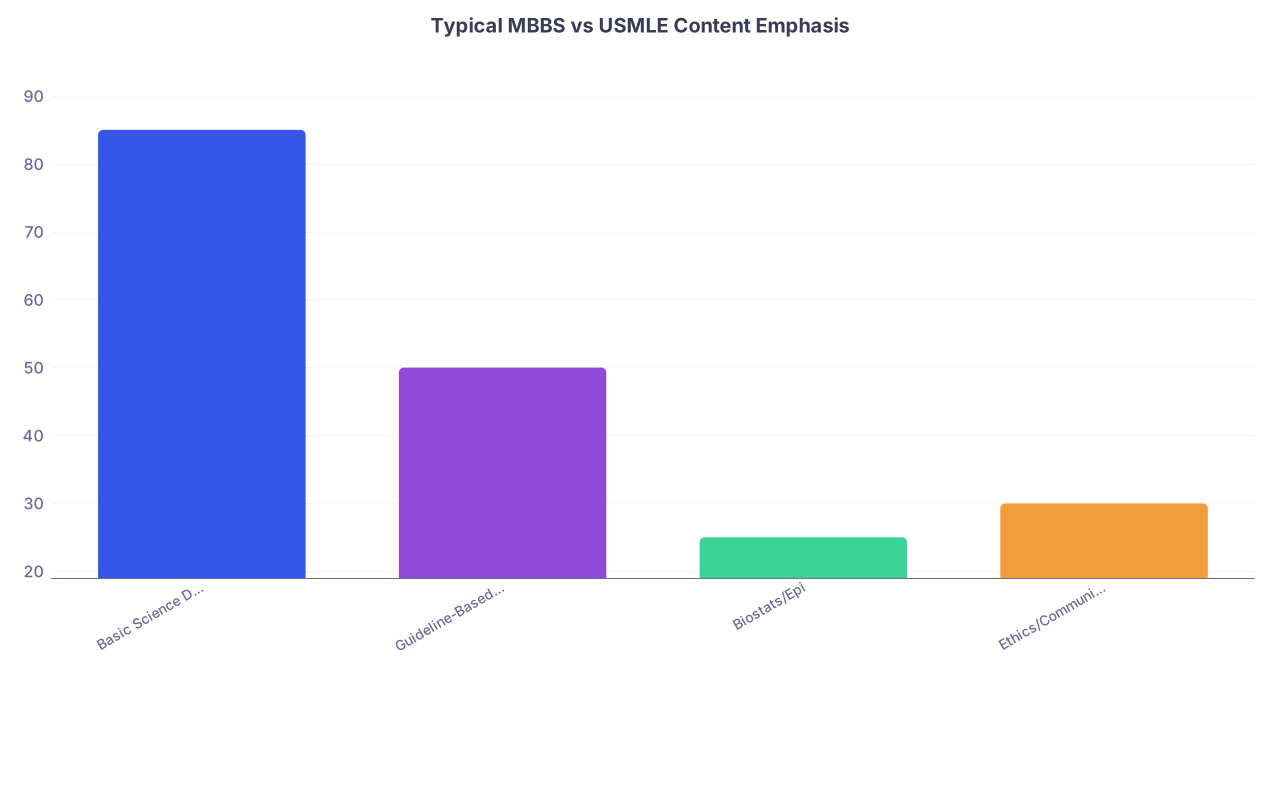
| Category | Value |
|---|---|
| Basic Science Detail | 85 |
| Guideline-Based Management | 50 |
| Biostats/Epi | 25 |
| Ethics/Communication | 30 |
(Think of 100 as “well covered for USMLE”. Those numbers are where most MBBS programs actually sit.)
Practical Fix if You Are MBBS-Trained
You compensate, intentionally, in these domains:
- Biostatistics & Epi: Dedicated USMLE-centric text + Qbank section (UWorld biostats, Boards & Beyond/OnlineMedEd stats lectures, NBME-style questions).
- Ethics & Communication: Do not skip these in UWorld; read explanations like they are a textbook.
- US Guidelines: Use a Step 2–oriented resource (UWorld, OnlineMedEd, AMBOSS) to re-learn management per US standards, not how your local attending does it.
3. Caribbean / US-Modeled Integrated Programs → USMLE
Different animal. If you are at a Caribbean school with a strong USMLE focus (SGU, AUC, Ross, Saba, etc.), or a non-Caribbean school explicitly modeled on US integrated curricula, your mapping problem is different.
How These Curricula Are Structured
Usually:
- 2 years “basic sciences” organized by systems or integrated modules
- 2 years clinical rotations, often in US-affiliated hospitals
- Internal exams sometimes modeled on NBME items
- Official Step 1 prep built into curriculum
On paper, almost 1:1 with US schools. In reality, quality and consistency can vary massively.
Overlaps with USMLE
Systems-Based Teaching
You learn cardiovascular as a package: anatomy + physio + pharm + path + radiology.
This mirrors Step 1’s organ-system emphasis. Good news for you.Explicit USMLE Terminology and Frameworks
Faculty usually talk about:- US screening guidelines
- US epidemiology
- US social determinants of health framing
So Step 2 CK’s “US primary care” flavor fits more naturally.
Integrated Biostat/Epi and Behavioral Science
Most US-modeled schools know this is high-yield, so they at least attempt to include:- Study types, interpreting graphs
- Informed consent, confidentiality, malpractice
- Cultural competence
Where These Curricula Still Miss
Depth of Basic Science Mechanisms
Some programs over-focus early on “high-yield” summary style and under-teach genuine physiology and biochemistry. That hurts on more detailed Step 1 pathophys questions.Clinical Rotation Quality and Consistency
Rotations are often spread across multiple sites, sometimes with limited teaching:- You may see hospital medicine but very little structured outpatient primary care.
- Yet USMLE Step 2 CK is heavy on ambulatory internal medicine, preventative care, chronic disease follow-up.
Procedural and Emergency Exposure
If your surgery or EM rotations are weak, your procedural and acute management questions can suffer (e.g., trauma, shock, airway, acute coronary syndromes, stroke timelines).
Mapping to USMLE Domains
Caribbean/integrated programs tend to cover:
- Organ system content reasonably well for Step 1, but foundational understanding might be thin.
- Biostats/ethics closer to US expectations.
- US-style clinical management better than most non-US schools, but still variable based on rotation quality.
For you, the mapping problem is less “Where do I get this?” and more “Did my school go deep enough, or did we skim everything?” You usually need to rebuild core physiology and pathophysiology independent of the school’s PowerPoints.
4. European / 6-Year Programs (Germany, Eastern Europe, etc.) → USMLE
If you started medicine right after high school in a 5–6 year program, your structure is different again.
Example: German Staatsexamen-type structure; or Eastern European programs (Poland, Romania, Czech Republic) with English tracks.
Typical Structure
- Early years: basic sciences (often more classic, discipline-based)
- Middle years: more clinical subjects, some integration
- Final years: major clinical rotations, state exam preparation
You are often trained for your national licensing exam, not USMLE. Different exam culture, different expectations.
Strengths vs USMLE
Solid Classical Basic Sciences
Anatomy (especially gross), histology, and classical physiology often taught in more depth than in American schools. That can help with:- Neuroanatomy on Step 1
- Complex physiology questions (renal, respiratory, endocrine)
Pathology and Internal Medicine
Depending on the country, path and medicine can be strong, especially for hospital-based diseases. Hematology, oncology, rheumatology, and nephrology are often well covered.Clinical Examination Skills
Many 6-year programs emphasize physical exam and bedside teaching more heavily than some US schools. That can help you reason through certain Step 2 CK cases if you mentally “translate” into USMCQ-style.
Gaps vs USMLE
US-Specific Preventive Care & Screening
Almost always missing or incomplete:- USPSTF-style recommendations
- Age-based screening schedules (mammography, colonoscopy, Pap/HPV, DEXA, lipid screening)
- Vaccination schedules and catch-up immunizations
Biostatistics / EBM in USMLE Format
You might get epidemiology and statistics, but not always framed in the way NBME cares about:- Identifying bias sources in studies
- Non-inferiority margins, interpreting P-values and confidence intervals in clinical trials
- Reading forest plots, survival curves in US context
Behavioral Science & Ethics, US Legal Framework
Consent laws, malpractice, end-of-life laws are country-specific. USMLE expects knowledge anchored in US practice:- Emancipated minor rules
- Confidentiality vs duty to warn
- Reporting requirements (child abuse, STIs, gunshot wounds)
Emergency / Ambulatory / Algorithmic Management
Many European programs are more descriptive and less algorithmic. USMLE Step 2 is obsessed with:- First step in management
- Next best diagnostic test
- ED algorithms for shock, sepsis, ACS, stroke, trauma (ATLS style)
- Outpatient management of hypertension, diabetes, depression, etc.
Mapping Strategy in a 6-Year Program
You likely have:
- Strong structural knowledge → Good base for Step 1
- Variable micro/pharm integration → Must be standardized with USMLE resources
- Weak US public health / preventive care → Must be built almost entirely from scratch for Step 2 CK
Your plan should be:
- Early: Start using USMLE-style videos/Qbanks along with your school’s curriculum (not after the fact).
- Mid/late: Anchor your clinical learning to US guidelines by parallel reading UWorld/AMBOSS for each topic you see on the ward.
5. Problem-Based / PBL-Heavy Curricula → USMLE
Some international schools, especially in Europe, the Middle East, or Asia, have adopted PBL or hybrid curricula inspired by McMaster/UK models.
Small group cases. Self-directed learning. Less didactic lecturing.
Where PBL Helps
Clinical Reasoning and Integration
You are forced to pull anatomy, physiology, and pathology into each case. That is exactly how USMLE vignettes are constructed.Communication and Professionalism
PBL discussions train you to think about patient perspectives, ethics, shared decision-making. Good for Step 2 CK communication/ethics questions.Lifelong Learning Skill Set
You get used to looking things up, synthesizing, and presenting. That skill becomes crucial when you tackle Qbanks and need to fill knowledge gaps independently.
Where PBL Falls Short for USMLE
Coverage Gaps
PBL often assumes you will fill in the blanks. Many students never systematically cover:- Full microbiology catalog
- Detailed pharmacology (MOA, ADRs, contraindications)
- “Boring” but test-heavy subjects like biochemistry pathways, immunology, and reproductive endocrinology
Lack of Exam-Style Training
You might excel in oral case discussions, then crater on long MCQ exams with nitpicky pathophysiology questions if your school does not run NBME-style assessments.
Mapping PBL to USMLE Domains
If you are in a PBL-heavy curriculum:
- Your integration and reasoning skills are better than average, but your factual coverage is often spotty.
- You must impose a USMLE-oriented structure yourself:
“This week we did a COPD case → I will now systematically review: pulmonary function tests, obstructive vs restrictive physiology, COPD staging, pharm management, exacerbation treatment, lung cancer as a comorbidity, and screening guidelines.”
Without that, you will have islands of deep understanding and big oceans of nothing.
6. Organ Systems: How Different Curricula Line Up with USMLE
Let me walk through a few organ systems and show you how training backgrounds differ in practical mapping.
Cardiovascular
MBBS / Classical European:
Great at valvular disease murmurs, rheumatic heart disease, classic CHF. Often weaker on:- US ACS management details (door-to-balloon times, DAPT duration)
- Heart failure guideline-based med titration (ARNI, SGLT2 inhibitors)
Caribbean / US-Modeled:
Good coverage of ACS, CHF, hypertension per US guidelines. But sometimes superficial on vascular pathophysiology, congenital heart disease details, and in-depth EKG interpretation.PBL:
Decent at tying symptoms to underlying disease, but may miss:- Rare congenital lesions
- Specific drug side effect patterns
- Risk stratification scores (e.g., CHADS-VASc for AF)
USMLE Step 1/2 both expect:
Integration of anatomy, physio, pharm (e.g., why non-dihydropyridine CCBs precipitate heart block in preexisting conduction disease) plus management algorithms.
Neurology
- Many international schools do neuro as a self-contained discipline, often with heavy emphasis on localization.
- USMLE goes further into:
- Autoimmune neuro (MS, GBS, myasthenia, paraneoplastic)
- Stroke workup + acute management specifics
- Neuropharmacology (antiepileptics, migraine meds, Parkinson’s drugs, psychiatric drug side effects)
European programs often teach localization brilliantly but underemphasize acute stroke timelines and thrombolysis/thrombectomy criteria in US guideline language.
Obstetrics & Gynecology
MBBS and many European schools:
- Strong in labor mechanics, high-risk pregnancy, and classic complications.
- But not always aligned with ACOG/USPSTF-style screening recommendations, Pap/HPV protocols, and contraception choices as expected on Step 2 CK.
Caribbean/US-modeled:
- More likely to teach US norms for prenatal care schedules, GDM screening, Rh immunoglobulin use, and postpartum contraception brands.
USMLE Step 2 CK is intensely US-guideline-centered in OBGYN. You must re-learn these if your home country uses different thresholds or protocols.
7. Where Every International Graduate Must Self-Correct
Regardless of your curriculum, there are four domains almost every international student underestimates:
US-based Preventive Care and Screening
You need an almost reflex-level familiarity with:- Age-based cancer screening (breast, cervical, colon, lung, prostate nuance)
- Vaccines (adult, pediatric, pregnant, immunocompromised, special cases like asplenia)
- Metabolic and infectious disease screening (HIV, hepatitis, TB, lipids, diabetes)
Biostatistics and Study Interpretation
Not formulas memorized. Application to data:- “What does this confidence interval imply about statistical vs clinical significance?”
- “Which bias is most likely in this trial description?”
- “Given this 2×2 table, what is the NNT?”
Ethics, Communication, and Legal Constructs
You need a US mental model:- Autonomy vs beneficence vs nonmaleficence vs justice in actual scenarios
- Minor consent laws and emancipated minors
- Handling demanding families, nonadherent patients, errors disclosure
Algorithmic, First-Step, Next-Best-Action Thinking
International exams often reward: “List the causes/treatment of X.”
USMLE asks:- What is the most appropriate next step in management?
- What is the best initial test?
- What should you do before giving drug Y?
That requires living inside clinical algorithms, not just memorizing them.

| Step | Description |
|---|---|
| Step 1 | Local Curriculum Topic |
| Step 2 | Identify Organ System & Discipline |
| Step 3 | Map to USMLE Content Outline |
| Step 4 | Targeted USMLE Resource Review |
| Step 5 | System-Specific Qbank Practice |
| Step 6 | Analyze Missed Questions by Domain |
| Step 7 | Fill Gaps in Biostats/Ethics/Guidelines |
| Step 8 | Reinforce with Mixed-Block Questions |
8. Concrete Mapping Examples by Curriculum
Let me give you a couple of direct “if your school does X, you must do Y” patterns.
Example 1: Indian MBBS + Internship
You see a 60-year-old man with chest pain.
Local training gives you:
- Clinical recognition of MI
- Knowledge of thrombolytics vs PCI
- Basic post-MI care
USMLE wants you to:
- Choose aspirin + P2Y12 inhibitor + anticoagulation + beta-blocker + statin regimen
- Know door-to-balloon targets
- Select between PCI vs thrombolysis based on time and contraindications
- Arrange specific follow-up and cardiac rehab considerations
- Recognize when to start ACEI, aldosterone antagonists, etc.
Your “map” is:
Use UWorld cardiology sections as your real teacher for Step 2 CK; treat MBBS as background flavor.
Example 2: European 6-Year Program, Strong Physiology
You know renal physiology thoroughly. Starling forces, RAAS, free water clearance.
Then you see a USMLE Step 2 CK question about diabetic nephropathy management with ACEI, ARBs, SGLT2 inhibitors, BP and A1c targets, and indications for nephrology referral.
Your physio is perfect, but your practical outpatient nephrology is incomplete. That piece will not come from your original curriculum. It must come from a USMLE-focused clinical resource.
Example 3: Caribbean / US-Modeled School
You did an “Endocrine block” and covered diabetes, thyroid, adrenal. But your school’s exam focused on “Which diagnostic test?” and “What is the underlying mechanism?”
Step 2 CK will drill you on:
- Adjusting insulin regimens
- Managing DKA vs HHS protocols
- Screening for complications (nephropathy, retinopathy, neuropathy)
- Special populations (pregnancy, elderly, comorbidities)
Your map:
Take that same block and systematically run through all UWorld endocrine questions, then circle back to fill guideline gaps with dedicated review.
9. Building Your Own Curriculum Map
You are not going to get a perfect alignment from your school. You will have to build it.
Do this once, well:
- Print or open the official USMLE content outline (Step 1 and Step 2 CK).
- For each major system: cardio, pulm, GI, renal, neuro, endocrine, repro, heme/onc, MSK, psych, derm:
- Label: “Where did my school actually teach this?” (course, year, exam)
- Mark: Strong / Medium / Weak coverage
- Overlay cross-cutting domains:
- Biostats/epi
- Ethics/communication
- Public health/preventive medicine
- Build a targeted plan:
- Strong → maintain with Qbanks
- Weak / Not covered → assign specific resources (Boards & Beyond, Pathoma, OnlineMedEd, UWorld blocks, AMBOSS articles)
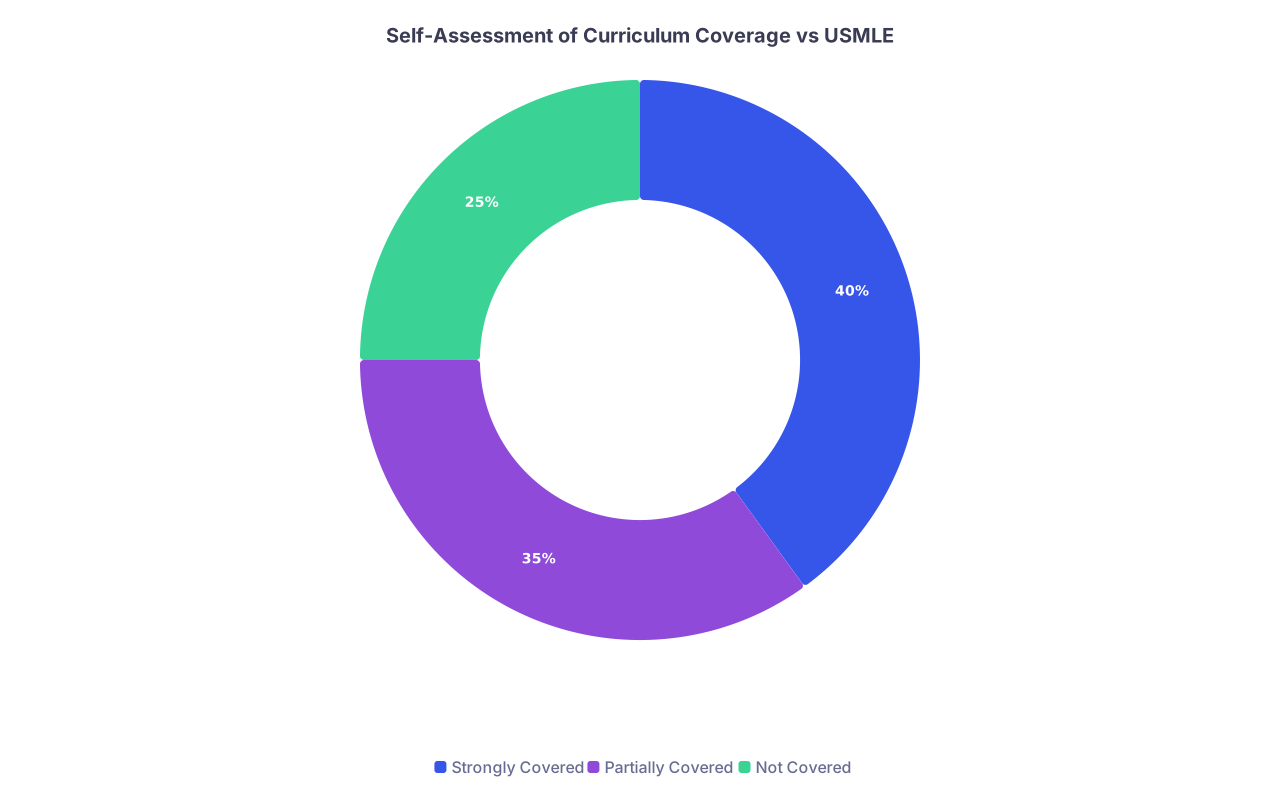
| Category | Value |
|---|---|
| Strongly Covered | 40 |
| Partially Covered | 35 |
| Not Covered | 25 |
Most international students, once honest, realize that about a quarter of USMLE content domains were barely touched, or touched in a totally different context.
FAQ (Exactly 4 Questions)
1. I am still in preclinical years at an international school. When should I start USMLE-focused studying?
Start now, but in parallel, not in competition with your school. When you do cardiovascular physiology in class, review a USMLE resource on cardiovascular physiology the same week. You do not need to start full Qbank blocks yet, but you should align your understanding with USMLE-style structure from day one. By the end of preclinicals, your knowledge should already resemble a Step 1 framework, not your local exam syllabus.
2. My program barely covered biostatistics. Can I fix that in a few weeks before the exam?
Not properly. You can memorize formulas in a few weeks, but USMLE biostats questions are about pattern recognition and comfort with data, which comes from repeated exposure over months. Treat biostats as its own subject: do a focused resource (e.g., UWorld biostats review or a concise biostatistics book) and then hammer questions steadily across your entire prep, not just at the end.
3. How do I adjust from my country’s guidelines to US-specific recommendations for Step 2 CK?
Pick one or two high-yield clinical resources that explicitly use US guidelines (UWorld, AMBOSS, OnlineMedEd). For each major topic—hypertension, diabetes, ACS, stroke, asthma/COPD, prenatal care, cancer screening—annotate your notes with US targets, first-line medications, and screening schedules. When your local practice conflicts with USMLE expectations, default to the US resource every time. Do not mix them.
4. I am coming from a PBL curriculum and feel weak on memorized facts. What is the fastest way to patch that for Step 1?
Leverage your strength: you already think in cases. Use an integrated basic science resource (e.g., Boards & Beyond or similar) and immediately follow each video/topic with 10–15 related Qbank questions. Do not passively watch. Your PBL background means you are good at “why,” but Step 1 will still punish you if you do not know specific enzyme names, bugs, drug side effects, and classic lab patterns. Combining concise high-yield content with aggressive question practice is the most efficient correction.
Key takeaways:
- Your local curriculum was never designed for USMLE; stop assuming “good in school” automatically maps to “ready for Step.”
- Every international pathway has predictable blind spots—almost always biostats, US preventive care, ethicolegal nuance, and guideline-based algorithms.
- The students who match from international schools are the ones who build a deliberate USMLE curriculum on top of their degree, not the ones who trust their school to do it for them.


