
Understanding Foundation and Premed Years in 5–6 Year European Med Tracks
European “premed” years are not what American advisors think they are. If you treat them like a shortcut around US prerequisites, you will get burned.
Let me break this down specifically.
When you look at 5–6 year European medical tracks (especially the English-taught ones in Central and Eastern Europe), the first 1–2 years function as a built‑in premed plus early preclinical hybrid. But schools market this very vaguely. “Integrated curriculum.” “From high school to doctor.” Sounds smooth. It is not smooth if you do not understand how these foundation years actually work.
We are going to dissect:
- What “foundation,” “premed,” and “first cycle” actually mean in Europe
- How the first 1–2 years differ at 5‑year vs 6‑year programs
- What background you really need in math, chemistry, biology, and physics to survive
- How these years are graded and how badly they can hurt (or help) you later
- The trap international students fall into: assuming foundation year = easy gap year
By the end, you will know exactly what you are signing up for when you enroll in a 5–6 year European track straight out of high school.
1. What “Foundation” and “Premed” Mean in European Tracks
Forget the US usage for a second. In Europe, these terms sit inside a completely different educational structure.
5–6 Year Integrated Med Programs: The Baseline
Most “high school to MD” style tracks in Europe are 5 or 6 years, directly after secondary school. Common examples (English-taught):
Central/Eastern Europe:
– Charles University (Czech Republic) – 6 year General Medicine
– Semmelweis, Debrecen (Hungary) – 6 year
– Comenius (Slovakia), Medical University of Warsaw (Poland), etc.Western Europe with specific tracks:
– Some Italian, Spanish, and Portuguese universities running 6‑year integrated tracks
– A few private / hybrid institutions in Cyprus, Malta, etc.
Within these programs, schools carve out early “basic science” years that look like premed. But the labels they use vary:
- “Foundation Year”
- “Premedical Year”
- “Year 1 – Basic Sciences”
- “Preparatory Year”
And then there are standalone foundation programs that sit before the official 5–6 year track. Different beast.
Two Different Animals: Internal vs Standalone Foundation
You need to separate:
Internal foundation/premed years
These are the first year (or two) inside the medical curriculum. You are already admitted to medicine. You take physics, chemistry, biology, anatomy, histology, etc. You pass → you move to Year 2 (or 3). Fail too much → you repeat or get dismissed.Standalone foundation courses/programs
These are usually 1‑year programs run by university or partner colleges. Target: students lacking the right science background, language proficiency, or grades. Completion may give you:- A guaranteed place in medicine if you meet certain exam thresholds
- Or just eligibility to apply again, with no guarantee
The marketing copy blurs this line. But academically and strategically, they are not the same.
Let me be blunt:
- Internal “premed” = you are in medical school, just at the baby stage. Grades count.
- Standalone foundation = you’re paying to try to qualify properly for medical school.
If you skip this distinction and just see “premed,” you will misjudge risk, difficulty, and cost.
2. Structure of the Early Years: 5‑Year vs 6‑Year Tracks
The length of the program changes how intense the early “premedish” years are.
6‑Year Tracks: More Classic High‑School‑to‑Doctor
In many 6‑year programs, the first two years look like this:
Year 1: Heavy basic sciences, light clinical flavor
Typical subjects:
- General Chemistry (sometimes two semesters: inorganic + organic basics)
- Physics for Medical Students
- Biology / Cell Biology
- Medical Terminology / Latin / Intro to Anatomy
- Biostatistics or basic math
- Ethics or intro to medicine
Year 2: Transition to preclinical core
- Anatomy (often full‑body, detailed, with dissection or prosection)
- Histology + Embryology
- Physiology (starts in Year 2, extends into Year 3 in some schools)
- Biochemistry (simple metabolism in 2, advanced in 3)
- Maybe some humanities / public health
Do not be fooled by the word “basic.” The pacing is fast. Think: compressing large chunks of US college Gen Chem, Intro Physics, and Bio into 2–3 exam blocks, while simultaneously adjusting to a new country, new languages, and often new grading culture.
5‑Year Tracks: Denser, Less Forgiving Front End
Some Scandinavian, Dutch, or special accelerated English programs claim 5‑year medical courses. When they accept high school graduates, they tend to:
- Assume stronger high‑school science
- Compress or integrate basic sciences more aggressively
- Push you into clinically oriented content earlier
So you might see:
Year 1: Strong integration
- Anatomy + Histology from day one
- Physiology already appearing late in Year 1
- Biochemistry early
- Some problem‑based learning (PBL) with clinical cases
There may still be “chemistry” and “physics” but it is less standalone and more integrated into “medical science” blocks. Translation: you do not get a gentle revisit of high school topics. They expect you to arrive with them largely in place.
Where “Foundation” Usually Sits
Let me map typical patterns I see with international applicants:
- Student with weaker science background or non‑science high school:
– May be funneled into standalone foundation first → then, if they hit required grades, progress to the 5–6 year program (and start at “Year 1”). - Student with good science A‑levels / IB / AP:
– Direct entry to Year 1 of 6‑year program (which many schools casually call “foundation” or “premed”).
So: that “premed” label can either mean “you are in medicine” or “you are not in medicine yet, pay us for a year and we will see.”
You have to read the fine print.
3. What Academic Background You Really Need
I have watched students show up to European 6‑year tracks thinking, “No US premed? Great, they will teach me everything from scratch.” That fantasy lasts about three weeks.
Here is the unvarnished version of what you should already be comfortable with.
Core Sciences: The Real Minimum
From a practical survival perspective, before starting the first year of a 5–6 year track you want:
Chemistry
- At least up through:
– Stoichiometry, molarity, gas laws
– Acid‑base, buffers, pH
– Redox basics
– Organic: major functional groups, isomerism, basic reactions - If you never pushed beyond “light” high‑school chem, your first‑year exams will feel like a foreign language.
- At least up through:
Biology
- Solid understanding of:
– Cell structure and function
– DNA/RNA, transcription/translation
– Mitosis, meiosis
– Basics of genetics (Punnett squares, dominance, linkage, etc.)
– Enzymes, metabolism basics, homeostasis concepts
- Solid understanding of:
Physics
- You will not need deep calculus, but you do need:
– Kinematics, Newtonian mechanics (forces, work, energy)
– Fluids (pressure, Bernoulli basics)
– Electricity and magnetism fundamentals (voltage, current, resistance)
– Optics basics - Most “Physics for Med” courses heavily target cardiovascular (fluids), respiratory, and imaging physics later. If algebra‑based physics scared you in high school, fix that before you get on the plane.
- You will not need deep calculus, but you do need:
Math
- Typically:
– Good algebra
– Basic logarithms and exponentials
– Elementary probability and statistics - Calculus is rarely central in assessments but does make some physiology and pharmacokinetics smoother.
- Typically:
Language and Learning Style
English‑taught programs still exist in non‑English environments. You will need:
- Strong enough English to handle dense textbooks and rapid‑fire lectures.
- Willingness to learn the local language early, because clinical years demand it. The foundation years are your only runway for this. Use them.
If you are coming from a system where learning was spoon‑fed, wake up early. European systems often expect more independent reading, fewer structured assignments, and punishing end‑of‑term exams.
4. How Assessments Work in Foundation / Premed Years
The “premed” years are not a courtesy. They are a filter. Sometimes a brutal one.
Entrance Exams vs Foundation Exams
First, many 6‑year tracks use entrance exams that look like a small MCAT:
- Biology + Chemistry (sometimes Physics, sometimes math)
- Multiple‑choice, maybe some short answer
- Focused on high‑school‑level content, but fast and specific
Standalone foundation programs sometimes replace direct entrance exams:
- You pay for a year
- They “teach and test” you internally
- At the end, you need specific grades to progress
If you do a foundation program just to sneak past a tough entrance exam, you may find that the exams inside the foundation are actually harsher. You cannot cram everything the night before and hope.
Inside the Program: The Early Filter
Once you are in Year 1 or Year 2:
Common structure:
Lectures + seminars/practicals
Attendance often mandatory for labs/seminars. Miss too much → you lose exam eligibility.“Credit tests” / colloquia during the semester
These are mid‑term oral or written assessments. Fail too many → you cannot sit for the final or you need remedial tests.Final exams
Often a mix of:
– Written MCQ or SAQ
– Oral component (yes, old‑school, one‑on‑one with a professor or examiner panel)
– Practical (e.g., identify structures on histology slides, answer anatomy questions at cadaver tables)
The oral exam culture surprises North American students. I have watched otherwise bright students crumble when they face a stone‑faced professor asking, “Describe the course of the ulnar nerve, and list its major branches,” with zero hints, in front of a pile of skulls and bones.
These early exams are absolutely used to reduce cohort size. Programs may admit more students than they expect to graduate and use Years 1–2 to cut.
Repeating Years and Failing Out
Typical realities:
- You can usually repeat a failed course once, sometimes twice.
- If you fail a major subject (like anatomy) multiple times, you repeat the year or are dismissed.
- Some schools limit how many times you can repeat any year entirely.
The foundation years often are where this happens. Because content is new, pace is fast, and many international students are simultaneously adjusting to living abroad.
This is why treating them like “easy premed” is naïve. They are the opposite. They are a sorting mechanism.
5. How Different European Models Compare
Let me concretely compare three common patterns international students run into.
| Pathway Type | Duration Before Clinical Exposure | Entry Stage |
|---|---|---|
| 6-year direct from HS | 2–3 years basic/preclinical | Year 1 medicine |
| 5-year integrated (strong HS science) | ~2 years preclinical | Year 1 medicine |
| 1-year standalone foundation + 6-year | 1-year foundation + 2–3 preclinical | Foundation then Year 1 |
Now let’s anchor this with a stylized but realistic example.
Example: Central/Eastern European 6‑Year Track
Scenario:
- You finish IB with HL Biology, SL Chemistry, decent math.
- You apply to an English‑taught 6‑year program in, say, Czech Republic, Hungary, or Poland.
- You pass the university entrance exam in Biology and Chemistry.
Your first two years might look roughly like this:
Year 1:
- Chemistry (with lab)
- Biophysics or Physics for Medicine
- Biology / Cell Biology
- Anatomy I (intro, skeletal, basic)
- Latin / Medical Terminology
- Public Health / Ethics / History of Medicine
Year 2:
- Anatomy II (head and neck, organs, neuroanatomy)
- Histology + Embryology
- Physiology I
- Biochemistry I
- Maybe Psychology, Sociology, or “Introduction to Clinical Medicine”
These two years collectively function as your premed + early preclinical. You are not doing US‑style gen eds. It is all medicine‑adjacent.
Example: Standalone Foundation then Medicine
Another student:
- Barely any high school science.
- Decent grades otherwise.
- Enrolls in a 1‑year foundation at the same university (or a partner college in the UK / Cyprus / Eastern Europe).
The 1‑year foundation might include:
- General Biology
- General & Organic Chemistry
- Physics / Math
- Academic English / Study Skills
- Local language introduction
At the end:
- You take final foundation exams.
- Achieve set thresholds → you are allowed to enter Year 1 of the 6‑year medicine program.
- Fall short → you leave with a certificate and no guaranteed place.
So that “7 years to MD” path actually becomes: 1 year of expensive preparation, then the full 6 years, if you survive.
6. The Real Role of These Years: More Than Just Science Content
People focus obsessively on content. “Will they teach me physics?” The truth: these years are doing four other, less advertised jobs.
1. Social and Cultural Screening
International cohorts in these programs are messy mixtures:
- Students straight from British A‑levels
- Scandinavian students looking for cheaper or more accessible options
- US/Canadian students who did not want (or could not get) US/Canadian med acceptance
- Students from the Middle East, Asia, or Africa using Europe as a springboard
The foundation years sort out:
- Who can function semi‑independently in a foreign system
- Who actually shows up to labs on time
- Who deals with stress without exploding or disappearing
Professors notice attendance and attitude. It is not just rumor; I have seen examiners recognize names and ask more aggressively in orals when they know a student has been sloppy all year.
2. Language Transition
You will do your clinical work in the local language, not English, in most European programs. Patients are not switching to English for your convenience.
The early years are when you are supposed to:
- Finish at least B1–B2 in the local language
- Start using medical vocabulary in that language
- Practice basic patient encounters
If you spend the foundation period in an English‑only bubble with other internationals, you are going to pay later when mandatory language exams appear before clinical clerkships.
3. Study Habits Upgrade
The exam style in many European schools is “few high‑stakes assessments, wide content coverage, unforgiving markers.”
If your default is:
- Memorize slides week before
- Hope for partial credit
- Expect grade inflation
You are misaligned. Foundation / premed years should be where you:
- Learn to make your own condensed notes or Anki decks
- Get comfortable with oral exams and being cold‑called
- Manage blocks with multiple parallel subjects (not one subject at a time, like some US colleges)
4. Signaling for Future Moves (Residency Abroad)
Your performance in the first two years is not invisible outside Europe.
If you eventually want:
- US/Canada residency
- UK Foundation Programme
- Or even competitive specialties in your home country
You will be asked for transcripts. Failing anatomy twice and repeating Year 1 does not disappear just because you crushed your final clinical exams later. It is a permanent part of your academic story.
7. Common Myths and Traps International Students Fall Into
Let me be uncomfortably honest. These are the recurring patterns I see.
Myth 1: “It’s easier than US premed, so I will cruise”
Reality: It is different, not necessarily easier.
- You skip the 4‑year US undergrad maze and MCAT. True.
- You replace it with:
– Entrance exams
– Two years of dense basic and preclinical science
– A high‑failure environment in a foreign country
– Oral exams that can sink you even if you memorized First Aid
If you are academically capable and disciplined, it can feel more direct and less bureaucratic than US premed. If you are looking for “easy,” this is the wrong continent.
Myth 2: “Foundation year is just a backup; I can always transfer back home”
Transfer fantasies are persistent and mostly wrong.
- US medical schools almost never accept transfers from foreign schools.
- Canadian schools are even stricter.
- UK and Ireland might accept a tiny trickle of transfers from EU schools under specific circumstances, but this is not a realistic baseline plan.
Your foundation / early premed years in Europe should be treated as the start of a full European medical education, not a cute side quest before somehow slipping into second year at a domestic medical school.
Myth 3: “If I bomb early, I’ll just reapply elsewhere with better preparation”
Maybe. But:
- A failed or repeated year on transcript is a red flag for many programs.
- If you want to shift countries or schools, you will often have to disclose it.
- Visa complications layer on top if you switch jurisdictions.
Better move: treat the first year like it actually matters. Because it absolutely does.
8. How to Prepare Before You Ever Start a European Foundation/Premed Year
If you are serious about these programs, preparation does not start on Day 1 of Year 1. It starts 6–12 months earlier, wherever you are now.
Academically
I would do this, concretely:
- Take or retake solid high‑school level Chemistry and Physics, even at community college or online, if your base is weak. Do problem sets, not just videos.
- Use a focused textbook or resource such as:
– For Chemistry: something at the level of “Zumdahl: Introductory Chemistry” or equivalent
– For Physics: an algebra‑based text like “Giancoli: Physics” - Work through a structured Biology review, focusing on cell biology, genetics, molecular basics. IB Bio HL or AP Bio prep books work well here.
The goal is not to be a master. It is to make the first‑year European lectures feel like a review, not your very first exposure.
Skills and Logistics
I would also:
- Start the local language early (B1 level target by arrival if possible). Use apps, tutors, online courses. The earlier, the better.
- Get used to oral presentation and being questioned. Join debate, tutorials, anything that makes being questioned in front of others feel less terrifying.
- Learn basic time blocking and parallel studying. You will have multiple heavy subjects simultaneously; practicing that now pays off.
Mindset
Understand this clearly:
- A 5–6 year European track is not “cheaper, easier US med.” It is its own ecosystem.
- The foundation/premed years are your calibration period. But they are not optional or low‑stakes.
Treat them with the same seriousness as a US student treats their entire premed plus MCAT process. Because in your path, these are the years that make or break your trajectory.
9. Strategic Use of an Official Foundation Year (Standalone)
One last angle: when does a standalone 1‑year foundation make strategic sense?
It can be reasonable if:
- Your high‑school science is very weak or non‑existent.
- You are switching fields (e.g., humanities background) and realistically cannot pass direct entrance exams.
- The foundation guarantees a seat in medicine if you hit clearly defined grade thresholds, and you trust yourself to hit them.
But it is a bad idea if:
- You already have strong A‑level/IB/AP sciences and just want an “easier” route. You are wasting a year and money.
- The foundation gives no guaranteed progression, only “improved chances.” Translation: you may pay for a year of school with nothing concrete at the end.
- You are using foundation as an excuse to avoid self‑studying high‑school science now.
If you are already near competitive level for direct entry, I usually advise: prepare hard for the entrance exams, skip the extra year, and go straight in.
10. Putting It Together: What Your First 2–3 Years Will Really Look Like
Let me sketch a realistic three‑year arc for an international student entering a 6‑year European program straight from high school.
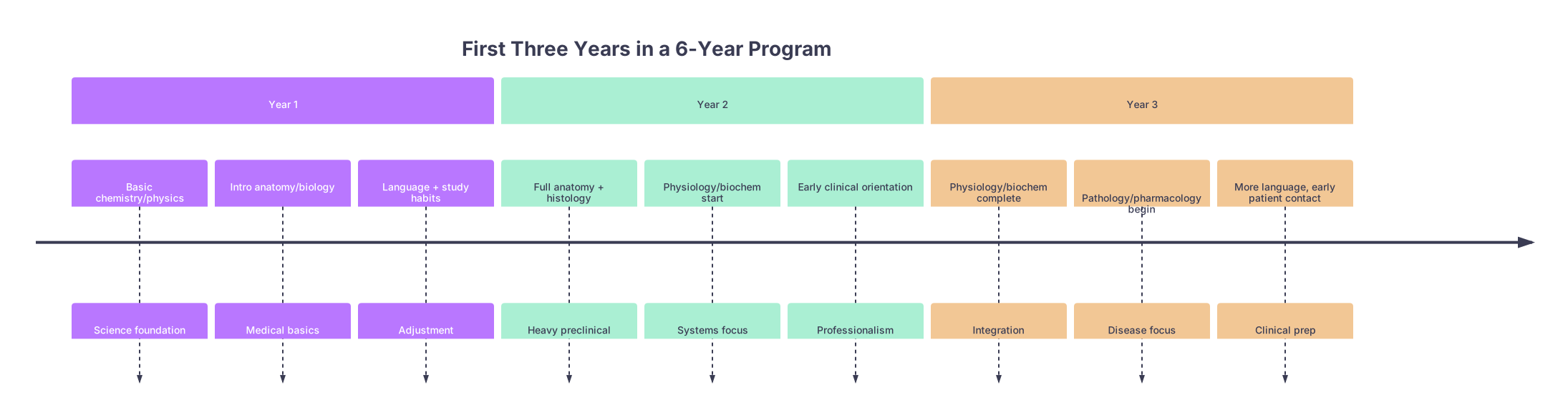
| Period | Event |
|---|---|
| Year 1 - Basic chemistry/physics | Science foundation |
| Year 1 - Intro anatomy/biology | Medical basics |
| Year 1 - Language + study habits | Adjustment |
| Year 2 - Full anatomy + histology | Heavy preclinical |
| Year 2 - Physiology/biochem start | Systems focus |
| Year 2 - Early clinical orientation | Professionalism |
| Year 3 - Physiology/biochem complete | Integration |
| Year 3 - Pathology/pharmacology begin | Disease focus |
| Year 3 - More language, early patient contact | Clinical prep |
You will not be “just doing premed.” You will be:
- Building the scientific base you should have brought from high school
- Simultaneously being thrown into anatomy labs and histology slides
- Learning a new national language
- Adjusting to oral exams and often cramped, underfunded facilities
- Watching classmates quietly disappear after failed exams or repeated years
If you accept that upfront and prepare accordingly, these foundation and premed years can be incredibly efficient. You go from high school to real medicine without a multi‑year detour through an unrelated bachelor’s degree.
If you walk in thinking “I escaped US premed, now I can relax,” you will be the one packing your bags after the second anatomy retake.
11. Where This Leaves You
Understanding the structure and purpose of foundation and premed years in 5–6 year European medical tracks is not optional. It defines whether this path is right for you.
Summarize the key realities:
- “Foundation/premed” inside a 6‑year program = you are in medicine, under evaluation from day one.
- Standalone foundation = expensive, conditional runway to maybe earn a place.
- Early years double as academic filter, language training, and culture shock therapy.
- Prior science preparation still matters. A lot.
If this sounds harsh, good. Medicine is harsh. Better to see it now than halfway through Year 1 in a foreign city, trying to memorize the branches of the celiac trunk in a language you barely speak.
Once you internalize how these early European years really function, you can make sane decisions:
- Do you sharpen your sciences and aim for direct entry?
- Do you use a foundation year strategically because you truly need it?
- Or do you realize this path is incompatible with your tolerance for risk and go another way?
Get that decision right, and the rest of your planning—exams, visas, long‑term career strategy—finally starts to line up. With that groundwork in place, the next step is figuring out how these European degrees translate into residency options in the US, UK, or elsewhere. But that is a whole different fight, and a topic for another day.