
Most international medical graduates underestimate how aggressively U.S. programs judge them on grades and class rank. That mistake costs interviews every single cycle.
Let me break this down specifically.
You are not evaluated in a vacuum. You are compared against thousands of U.S. MD/DO students whose transcripts and class ranks are standardized and familiar. Your 8.6/10, 72%, “First Class,” “Very Good,” or “Distinction” means nothing to a U.S. program director until it is translated into a context they trust.
This article is about that translation. How your grading system, your class rank, and what ends up on paper can either make you competitive or make you invisible.
1. How U.S. Programs Actually Read International Transcripts
Forget the fantasy that every PD has time to deeply analyze your country’s grading culture. They do not. Most will glance at three things:
- Are there clear grades in a recognizable numeric or letter format?
- Is there a class rank or decile/quartile?
- Are there any red flags: failed courses, repeats, huge variability?
If they cannot quickly figure out where you stand relative to your peers, they default to Step scores, school reputation, and letters. If those are not outstanding, your application slides down the pile.
The hierarchy in their head
Roughly, the mental priority stack is:
- Clear class rank (top 5%, 10%, quartile, decile)
- Distribution-based grades (e.g., honors / high pass / pass with defined cutoffs)
- Raw numeric scores with an obvious maximum (e.g., 0–100, 0–10)
- Vague narrative grading (“Very Good”, “Satisfactory”) without rank
If your transcript is in the last category and you do nothing about it, you are handicapping yourself.
2. Common International Grading Systems – And How They’re Interpreted
I will go through the major types I keep seeing from IMGs and how they typically land with U.S. reviewers.
A. Percentage systems (0–100)
Common in: India, Pakistan, Middle East, parts of Africa, some Eastern European schools.
A 65% in some Indian universities can be “excellent,” while for a U.S. reader 65% screams borderline C/D. That disconnect is lethal if left unexplained.
Most PDs:
- Understand “percentage” as:
- 90–100: A
- 80–89: B
- 70–79: C
- 60–69: D
- Have no clue that in many MBBS programs, class averages cluster in the 50s–60s and 75+ might put you near the top of the class.
If your school (or university) provides a grading key that states what counts as distinction / first class / etc., that needs to be visible in your transcript or attached document. If not, you must use any official document you can obtain that contextualizes marks (university handbook, grading policy on official letterhead).
B. 10-point scales (0–10 or 0–5)
Common in: Latin America, some European and Asian schools.
Variants:
- 0–10 with passing at 6 or 7
- 0–5 with passing at 3
- Some use only integers, others use decimals (e.g., 7.5, 8.3)
How U.S. reviewers usually try to see it:
- They often mentally map 0–10 to 0–4.0 GPA even when that is not accurate.
- They like to see:
- The minimum passing grade
- The maximum possible grade
- The average grade for the cohort if available
An 8.7/10 might be outstanding, average, or mediocre depending on the school’s distribution. If your dean’s letter includes a line like “The class average for preclinical years is 7.2; a score above 8.5 is considered excellent,” that suddenly gives your numbers weight.
C. “First class / Second class / Distinction” systems
Common in: Commonwealth countries, Caribbean, several private schools.
Typical pattern:
- Distinction or First Class with Distinction
- First Class
- Second Class (Upper / Lower)
- Pass
U.S. PDs are more familiar with this pattern than you think, but they still want rank or percentiles.
If your university can provide something like:
- “First Class with Distinction: awarded to top 10%”
- “First Class: next 25%”
you are in much better shape.
D. Pass/fail or descriptive systems only
Some European, Latin American, and problem-based curricula use almost pure narrative assessment:
- “Pass / Fail”
- “Satisfactory / Good / Very Good / Excellent”
- Portfolio and competency-based grading
These are the hardest to sell without rank.
Here is what I have seen work:
- A separate official letter from the dean’s office explaining:
- That the curriculum is pass/fail
- That failures are rare/rarely remediated
- That relative standing is provided in another document (decile/quartile list)
- Or a class rank list or statement (“Student X ranks in the top decile of the cohort”)
If your school refuses to quantify anything, you lean heavily on:
- Exceptional Step scores
- Strong, comparative letters (“one of the top 5% of students I have supervised in 20 years”)
- Evidence of academic awards or distinctions
3. Class Rank: The Single Most Valuable Number You Can Get
If you remember one thing: an honest, official class rank or decile is more interpretable than your raw grades and far more comparable across systems.
Programs love:
- “Top 5% of class”
- “Top 10% of class”
- “Top quartile”
- “Ranked 8 of 240 students”
Let’s be blunt: U.S. MD schools commit heavily to ranking or at least quartiles/deciles. PDs expect something similar or an explanation why it does not exist.
How rank is usually generated (behind the scenes)
Different schools use different formulae:
- Weighted average of all courses
- Greater weight for clinical years
- Exclusion of failed/remediated courses or, in some schools, heavy penalty for them
- Conversion of grades to points, then averaged
You need to know – and if possible, get in writing – how your class rank is determined.
Practical move: when you are still in school, ask the academic office something very specific like:
“For students applying to U.S. residency programs, can the school provide an official statement of class rank, quartile, or decile position, and how is that calculated?”
Do not wait until after graduation when everyone is slower and less motivated to help you.
What if your school “does not rank”?
Often “we do not rank” really means:
- They do not routinely publish rank to students.
- But they absolutely keep internal performance lists to decide awards.
You can push, respectfully:
- Ask if they can provide relative standing language:
- “Among the top 10 students in a class of 150”
- “Upper decile in academic performance”
If they flatly refuse, then your dean’s letter (MSPE equivalent) must at least:
- Describe the grading system
- Provide aggregate data:
- “Only 12% of students graduate with honors”
- “The average GPA is 7.1/10; this student’s GPA is 8.5”
Not perfect, but better than nothing.
4. How ECFMG and ERAS Present Your Grades and Rank
Most IMGs underestimate how much gets lost in translation between your university and the ERAS file a PD actually clicks.
ECFMG and your transcript
ECFMG does not convert your GPA to a U.S. 4.0 scale. They:
- Receive your official transcript
- Verify its authenticity with your medical school
- Upload the scanned transcript into ERAS
Some schools now send transcripts with:
- An English version
- A grading key or legend
- A short description of grading practices
If your school does not automatically include this, request that any transcript sent for ECFMG purposes:
- Be in English or accompanied by certified translation
- Include the grading scale (pass marks, distinctions, maximum/minimum, etc.)
ERAS and what PDs see
Program directors viewing your ERAS file typically see:
- Your USMLE scores
- The Medical Student Performance Evaluation (MSPE) / dean’s letter
- Your transcript as a PDF
- Any extra letters that mention rank or performance
They are not recalculating GPA. They are scanning for:
- Trends: early poor performance vs later improvement
- Failures or remediations
- Honors/distinctions/awards
- Rank or percentile language
If your transcript is a wall of numbers with no key, do not count on the PD taking time to decode them.
5. Specialty Competitiveness and How Much Grades/Rank Matter
The brutal reality: the more competitive the specialty, the more your academic performance matters, especially as an IMG.
Here is how this typically scales.
| Specialty Type | Typical Weight of Grades/Rank |
|---|---|
| Highly competitive (Derm, Plastics, Ortho, ENT) | Extremely High |
| Moderately competitive (Radiology, Anesthesia, EM) | High |
| Core fields (IM, Pediatrics, FM, Psych) | Moderate |
| Preliminary/Transitional Year | Variable |
Highly competitive specialties
For derm, plastics, ortho, ENT, neurosurgery:
- If you are an IMG, programs already assume you must be exceptional to be in the conversation.
- Vague or average-looking transcripts kill you.
- Top decile or better, honors, and strong narrative comparisons are almost mandatory.
Honestly: if your class rank is average and your Step scores are just decent, these fields are effectively closed in most U.S. programs.
Moderately competitive specialties
Radiology, anesthesia, EM, some OB/GYN:
- Good grades and a clearly high class standing help a lot.
- A weak or ambiguous transcript can sometimes be offset by stellar Step scores, strong U.S. letters, and research.
Core fields
Internal medicine, pediatrics, family medicine, psychiatry:
- PDs still care about failures and consistency, but they are more forgiving.
- Class rank is still a plus and can move you from “generic IMG” to “strong IMG.”
6. Strategic Moves While You Are Still in Medical School
If you are still a student or early in your training abroad, you have leverage. Use it.
Aim for top quartile, preferably top decile
This is not just bragging rights. It shapes how any future evaluator reads the rest of your file.
- Top 10%: strong signal you can handle U.S. training.
- Top 25%: still solid.
- Anything below median: now you are relying heavily on USMLE and everything else.
No magic here: work steadily, prioritize high-yield subjects, and do not tank early foundation courses thinking you will “fix it later.” Some schools weigh preclinical marks forever in rank calculations.
Protect your clinical year grades
Many schools weigh clinical years more heavily when calculating rank. PDs also care more about:
- Internal medicine
- Surgery
- Pediatrics
- OB/GYN
- Psychiatry
If your preclinical performance was mediocre, your best chance to climb rankings is outstanding clinical grades, especially on core rotations.
Understand which courses are “weighty”
Ask directly:
“For class rank, are all courses weighted equally or are certain years or subjects weighted more?”
Then adjust your effort accordingly. I have seen students throw away high-weight courses because the content felt dry, not realizing those grades would define their rank.
7. What to Do if Your Grading System is Unclear or Weird
This is extremely common with some newer private schools, offshore Caribbean programs, or experimental curricula.
Here is the blunt playbook.
Step 1: Get the official story in writing
Ask your registrar or academic office for:
- A written description of the grading scale
- Definitions for “Honors / High Honors / Distinction / Merit” or similar labels
- Whether the school tracks relative performance (top X%, quartiles, etc.)
If they email you, try to get it later on letterhead, signed, if you intend to upload or use quotes in your dean’s letter.
Step 2: Nudge for rank-like language
If they insist “we do not rank,” you ask:
“For students applying abroad, can you provide a phrase like ‘upper quartile’ or ‘top decile’ based on internal performance data, even if we do not publish official numerical rank?”
Many offices will say yes if you phrase it like that. Academic bureaucracy often responds better to specific wording.
Step 3: Get this into your MSPE / dean’s letter
The most important document that should carry this context is your dean’s letter (for IMGs, often an MSPE-style letter generated by your school or sometimes by you in draft form).
You want language along the lines of:
- “Student X has performed consistently in the top 10% of their class based on cumulative grades across preclinical and clinical years.”
- “Among this year’s graduating cohort, Student X’s GPA of 8.8/10 places them in the upper quartile.”
U.S. PDs are used to seeing exactly this type of phrasing.
8. Translating Your Performance Yourself (Without Lying or Over-selling)
You should never fabricate rank or invent conversions. That is career-ending if discovered. But you can, and should, present your record in the clearest honest light.
Places where you can do this:
- Personal statement
- CV (under medical school entry)
- Emails to potential research mentors or program contacts
Examples of how to phrase it:
- “Graduated with First Class with Distinction (top ~10% of class) from a class of 220 students.”
- “Cumulative average 8.7/10 (institutional high honors; approximate top decile).”
- “Consistently ranked in the upper quartile of my class, as reflected in my dean’s letter.”
Key principle: whenever possible, tie your self-description to something documented elsewhere (certificate, dean’s letter, transcript legend).
9. How PDs Realistically Weigh International Performance vs USMLE
You already know Step 1 is pass/fail now, which changed the calculus. For IMGs, Step 2 CK has become the numeric filter.
But Step scores never fully replace your academic history.
Think of it this way:
- Stellar grades + top decile + strong Step 2:
- “This person has been consistently strong for years.”
- Mediocre transcript + no rank + excellent Step 2:
- “Smart and good at tests, but not sure about their discipline or consistency.”
- Good transcript + high class rank + average Step 2:
- “Hardworking, consistent, possibly worth a shot in core fields.”
Programs that interview large numbers of IMGs (community IM, FM, some university-affiliated community programs) will often triage using Step 2 and then “upgrade” applicants with clearly strong class ranks or honors.
Programs that rarely interview IMGs (academic derm, ortho, ENT) will expect both: top academic record and very high Step scores.
10. Timing: When to Gather What
Here is where students shoot themselves in the foot: they graduate, move home, and only then realize they need official letters and explanations. The school admin has changed, people do not remember them, and half the policies are “we don’t do that anymore.”
Collect these while you are still there:
- Multiple sealed copies of your official transcript
- At least one transcript that includes a grading legend
- A copy (or at minimum, screenshot/print) of any official grading policy pages from your school’s calendar/handbook
- Early draft or sample of an MSPE / dean’s letter format your school uses
If you are already done and struggling, then you pivot to:
- Getting the dean’s office to generate one good letter with rank or relative standing language
- Making sure your ECFMG file has the cleanest possible transcript with grading key
- Having your letter writers include comparative statements (“among the strongest 10–15% of students I have worked with”)
11. Country-Specific Pitfalls I Keep Seeing
A few patterns that show up again and again.
India and Pakistan (percentage systems)
- Students with 65–75% who are actually in the top 10–20% of their classes, but nothing in their documents says that. To a U.S. program, 68% looks mediocre.
- Solution: push hard for any rank list, honors certificate, or official statement about relative standing. Include distinctions from university-level exams if those exist.
Caribbean schools
- Heavy use of pass/fail or “Honors / High Pass / Pass” with unclear cutoffs.
- PDs are suspicious if they cannot see distribution.
- Some schools publish class rank but do not proactively send it. You must request it and make sure it makes it into the dean’s letter or transcript addendum.
Eastern Europe / Russia / some ex-Soviet systems
- 3/5 is pass, 4/5 is good, 5/5 is excellent – but PDs often read 3/5 as “C-level” when locally it might just be a routine passing grade.
- This needs a grading key:
- “5 – Excellent”
- “4 – Good”
- “3 – Satisfactory (Pass)”
Western Europe with narrative assessments
- Some programs consider almost everyone “Good” or “Very Good” with little separation.
- You must rely heavily on:
- Comparative phrases in letters (“top few students of my career”)
- Any distinctions, prizes, or competitive scholarships.
12. A Quick Visual: How Different Systems “Feel” to U.S. PDs
To crystallize how programs might subconsciously “rank” typical international grading outputs:
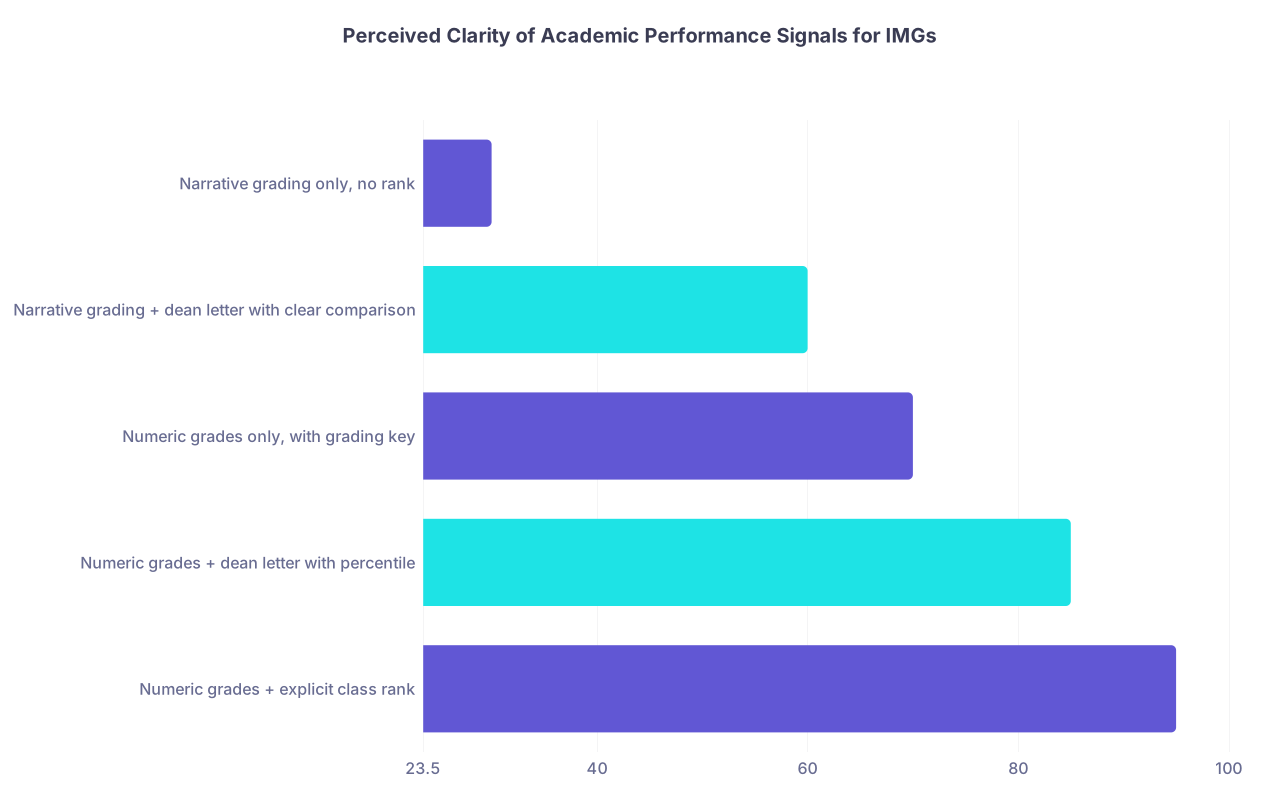
| Category | Value |
|---|---|
| Numeric grades + explicit class rank | 95 |
| Numeric grades + dean letter with percentile | 85 |
| Numeric grades only, with grading key | 70 |
| Narrative grading + dean letter with clear comparison | 60 |
| Narrative grading only, no rank | 30 |
The exact numbers are illustrative, but the hierarchy is very real.
13. Putting It All Together: A Stepwise Plan
Let me strip this down into an action plan you can actually use.

| Step | Description |
|---|---|
| Step 1 | Understand Your Grading System |
| Step 2 | Confirm How Rank Is Calculated |
| Step 3 | Request Official Rank or Relative Standing |
| Step 4 | Ensure Transcript Has Grading Key |
| Step 5 | Coordinate With Deans Office for Strong MSPE |
| Step 6 | Align Narrative Statements With Documented Data |
| Step 7 | Prepare to Explain System in Personal Statement or CV |
Briefly:
- Learn exactly how your grades are assigned and how rank (if any) is produced.
- Get rank or at least decile/quartile, in writing, on official letterhead if possible.
- Make sure your transcript includes a grading legend. If your school does not normally provide it, ask them to add one.
- Work with your dean’s office so that your MSPE / dean’s letter explicitly states relative standing.
- Echo that same language (accurately) in your CV and personal statement so PDs see a consistent story.
14. Final Thoughts
You cannot change the country where you trained or the grading system you were given. But you can absolutely change how clearly and convincingly that system is presented to U.S. residency programs.
Three key points:
- Class rank or clear relative standing is gold. If your school can quantify it, you must get it and make sure it appears in your official documents.
- Raw grades without context are weak. Always push for grading keys, legends, and written explanations of what counts as honors / distinction / passing.
- Consistency of narrative matters. Your transcript, dean’s letter, and personal materials should all tell the same clear story about where you stood in your class.
If you handle those three, you move from “mysterious foreign transcript” to “strong, understandable applicant.” And that shift alone can be the difference between a full interview season and another year of waiting.