
The way most premeds talk about “elective vs core rotations” for IMGs is dangerously oversimplified.
If you are looking at a foreign medical school, the single biggest mistake you can make is assuming “clinical years are clinical years.” They are not. How the school structures core versus elective rotations, where they happen, who supervises you, and how they are documented will determine how residency program directors read your application. And whether they trust it.
Let me break this down specifically.
Core vs Elective Rotations: What They Actually Mean
Forget the marketing language from school brochures for a moment. In practice, especially for IMGs aiming at the US, Canada, or the UK, “core” and “elective” have very specific functional meanings.
Core rotations are:
- Required by your degree program.
- In the major disciplines that every graduate is expected to know.
- Usually full-time, block-based, with defined minimum weeks.
- Used to judge whether your training is “equivalent” to local standards.
Elective rotations are:
- Optional or semi-optional (sometimes chosen from a list).
- In subspecialty areas or more niche disciplines.
- Often used for career exploration or to strengthen a specific residency application.
- Highly variable in quality and structure.
If you are thinking about matching into the US, the ECFMG/NRMP world informally assumes something like this for core clerkships:
| Core Rotation | Common Minimum Duration |
|---|---|
| Internal Medicine | 8–12 weeks |
| General Surgery | 8–12 weeks |
| Pediatrics | 6–8 weeks |
| Obstetrics & Gynecology | 6–8 weeks |
| Psychiatry | 4–6 weeks |
Schools that consistently fall short of these norms (or play games with “integrated” blocks instead of clearly labeled cores) send weaker applications into the match. Program directors notice.
Electives, on the other hand, can look impressive or meaningless depending on:
- Where they were done (US ACGME hospital vs unknown private clinic abroad).
- Whether they were hands-on or just observerships.
- Whether they appear as official school-approved credits on your transcript.
You are not just picking “cool rotations.” You are building the backbone of your clinical credibility.
How Foreign Schools Typically Structure Clinical Training
There is no single “international” structure. But there are recognisable patterns. I will break them by region and type of school, because that is how residency folks subconsciously sort you.
1. Caribbean Schools (US-Focused IMGs)
Most premeds know these names: St. George’s, Ross, AUC, Saba, etc. They are built around one premise: deliver a curriculum that can plausibly be sold as “US-style.”
The usual structure:
- Preclinical years on the island (sometimes accelerated or 16-month / 20-month systems).
- Clinical years almost entirely in the US (and sometimes UK/Canada) through affiliated hospitals.
Core rotations:
- Often all arranged in US teaching hospitals or community sites.
- Clearly broken out on transcripts as IM, Surgery, Peds, OB/GYN, Psych, Family/Primary Care.
- Scheduled in 6–12 week blocks, sometimes with a “transition to clinicals” course.
- Sometimes done in a single state or multiple states depending on capacity.
Electives:
- A mix of affiliated sites and student-arranged rotations.
- Broad offerings: cardiology, EM, radiology, ICU, nephrology, etc.
- Often 2–4 week blocks.
- Typically limited by affiliation agreements; students fight for high-yield sites (NY, NJ, FL, CA, IL).
The catch:
- Not every “clinical site” is equal. Some are large teaching hospitals with residents; some are tiny community sites where you are basically shadowing.
- Core rotations in hospitals with residents and ACGME programs carry more weight (program directors know these names).
- Some states (like California, Texas) scrutinise school and site approval very aggressively.
If you are considering a Caribbean school and they cannot give you:
- A written list of core rotation sites.
- Confirmation that your cores will be in the US and hands-on.
- Historic data on how many students complete on-time vs delayed due to lack of spots.
Walk away.
2. Eastern European and Central European Schools
Think Poland, Czech Republic, Hungary, Romania, Bulgaria, Slovakia. Many of these run “English programs” targeting international students.
Structure tends to be:
- 3 preclinical years (heavy on basic sciences).
- 3 clinical years in affiliated teaching hospitals.
Core rotations:
- Built into the last 3 years as multiple smaller blocks each semester.
- Internal medicine and surgery are usually spread out: e.g., IM I, IM II, IM III.
- Pediatrics, OB/GYN, Psychiatry, Neurology, Family Medicine, sometimes Infectious Diseases, each as required courses.
- A lot of dual-labeling like “Internal Medicine and Propaedeutics” or “Surgery with Orthopedics.”
Electives:
- Sometimes minimal or poorly structured.
- Often appear as “optional courses” with modest clinical exposure.
- Occasionally you can arrange a “free mover” clerkship abroad (e.g., UK, Germany, Scandinavia) with approval.
Here is the key problem for residency programs: the transcript is often cluttered, fragmented, and opaque. It might show 8 different internal medicine courses across years with hours instead of weeks.
Programs in the US or Canada do not want to decode that.
If you know you want the US match later, you must:
- Keep a personal log converting hours to weeks for each discipline.
- Make sure your Dean’s letter / MSPE equivalent explicitly summarises your core rotation durations.
- Use electives in your final years to get US or UK clinical experience with documentation.
3. Indian, Pakistani, and South Asian Schools
MBBS programs in India, Pakistan, Bangladesh, Sri Lanka have a different logic. They are training for their own systems first. The US or UK is an afterthought.
Typical structure:
- 4.5 to 5.5 years of study plus 1 year of compulsory rotatory internship (CRRI / house job).
- Preclinical and paraclinical years, then clinical postings, then internship.
Core rotations: During final years:
- “Postings” in medicine, surgery, pediatrics, OBG, orthopedics, ENT, ophthalmology, psychiatry, community medicine.
- Often 2–6 weeks each, repeated over time. During internship:
- Mandatory rotations: medicine, surgery, pediatrics, OBG, emergency, etc.
- These are the real “hands-on” full responsibility periods.
Electives:
- Historically limited. Some colleges now bolt on “elective postings,” but these are variable.
- For students aiming abroad, electives are often external (student-arranged US/UK observerships, away rotations) rather than formal in-house electives.
Residency directors abroad will ask:
- Were your real cores during final year or internship?
- Were they supervised? Was there evaluation?
- Can someone summarise the months you spent in each major discipline?
Strong South Asian graduates do very well when:
- They complete a 1-year rotating internship with clear documentation of weeks per specialty.
- They add 8–12 weeks of US clinical electives/externships in their final year or just after graduation.
- Their school provides a consolidated internship certificate with rotation breakdown.
Weak files usually show a messy paper trail, vague letters (“worked satisfactorily in all departments”), and no structured electives in the target system (e.g., no US clinical).
4. Latin American Schools
Latin American programs (Mexico, Brazil, Colombia, etc.) are highly variable. Some are excellent, some are nearly impossible to interpret for a US PD.
Structure:
- Longer programs (6–7 years) with early clinical exposure.
- Final year often functions as an “internado” with hospital-based rotations.
- Plus social service year (e.g., servicio social) which is not equivalent to formal core rotations elsewhere.
Core rotations:
- Internal medicine, surgery, pediatrics, OB/GYN, primary care/family medicine, psychiatry, and sometimes emergency.
- Rotations may be integrated or repeated.
- Documentation can be good or terrible depending on the school.
Electives:
- Some schools allow senior electives; others are rigid.
- International electives exist but are less standardised than in Caribbean or European schools focused on export.
For IMGs from Latin America planning US or Canadian residency, the same principle applies: get your final year and internado clearly documented in weeks per specialty, and do targeted electives in the destination country if at all possible.
5. “New” English-Language Schools in Asia and the Middle East
Think Gulf-region schools, China’s English-language MBBS programs, newer schools in Malaysia or Turkey.
Structure:
- Advertised as “US-style” or “UK-style” but often hybrid.
- 2–3 preclinical years, then 3+ clinical years at parent hospital.
- Sometimes partner agreements with Western hospitals for electives.
Core rotations:
- Usually present on paper: medicine, surgery, pediatrics, OB/GYN, psychiatry, family medicine, etc.
- Reality on the ground can range from robust ward-based teaching to glorified shadowing.
Electives:
- Marketed heavily: “opportunities to do electives in the US/UK/Europe.”
- Actual slots can be extremely limited, competitive, or unfunded.
- Many students end up doing observersips labeled as “electives,” which US programs do not value the same as hands-on clerkships.
If you are contemplating one of these newish schools, your first task is to separate marketing from reality:
- How many students last year actually completed US or UK electives?
- Were they hands-on? Did they count as school credit?
- What is the school’s graduate match track record, by country and specialty?
If the answer is vague, believe that. Vague usually means poor.
How Schools Allocate Cores vs Electives: The Three Common Models
Across all these regions, I keep seeing the same three structural patterns for clinical years.
Model 1: Classic Block Cores + Senior Electives
This is closest to US/Canadian structure.
3rd/4th year (or final two years) look like:
- 8–12 weeks Internal Medicine
- 8–12 weeks Surgery
- 6–8 weeks Pediatrics
- 6–8 weeks OB/GYN
- 4–6 weeks Psychiatry
- 4–6 weeks Family Medicine / Primary Care
- Remaining time: electives, sub-internships, research blocks.
Electives may be:
- Single specialty subrotations (Cardiology, GI, Endocrinology, EM).
- Away rotations in other hospitals or countries.
- Research blocks in clinical or lab settings.
This model is ideal for IMGs wanting US/Canada/UK, because program directors understand it instantly. No translation needed.
Model 2: Distributed Cores + “Postings” + Internship
Common in South Asia, some European and Latin American systems.
You start seeing:
- Medicine I, Medicine II, Medicine III spread across semesters.
- Surgery I, Surgery II.
- “Short postings” in ENT, Ophthalmology, Dermatology, etc.
- Then a full-time rotating internship year.
Your “core training” is effectively the sum of:
- Final year postings.
- Plus your internship breakdown.
It is acceptable to Western boards if, and only if:
- The internship rotations are clearly structured with supervision.
- The school or hospital can furnish a breakdown with weeks/months in each major branch.
Electives in this model are often squeezed in unofficially:
- You finish final exams early and go abroad for a US externship.
- You take leave during or after internship for observerships or electives.
- You add “clinical experience” that is not strictly part of your degree but is critical for your application.
Model 3: Hybrid / Fragmented with Heavy Integration
Some newer programs, especially in Europe and Asia, love integrated curricula:
- “Clinical Medicine 1” (combining IM, surgery, psych, etc.).
- “Man in Disease” type modules.
- Horizontal/vertical integration all over the transcript.
Educationally, that might be fine. For residency applications, it is a nightmare.
A US residency coordinator does not care that your “Integrated Clinical Module C” had 3 weeks of cardiology, 2 of GI, and 1 of nephrology. They want to know:
Did you do a defined internal medicine clerkship, on a ward, for at least several weeks, with real patient care?
Students from these schools often have to:
- Request supplementary letters from the Dean explicitly listing core clerkships and weeks.
- Create explanations in their CV/personal statement clarifying structure.
- Lean heavily on well-known electives abroad to reassure programs about their clinical training.
Why This Matters: How Program Directors Actually Read It
Let me be blunt: many US program directors do not have the time or interest to parse complicated international transcripts. They look for a few quick signals.
What they want to see:
- A recognisable core rotation structure.
- At least one or two US or comparable clinical experiences where you were evaluated in their system.
- Letters from clinicians who can compare you to their local students.
They do not care if your school had 20 different micro-rotations, all proudly listed on your website. They want anchor points.
Here is how this difference plays out:
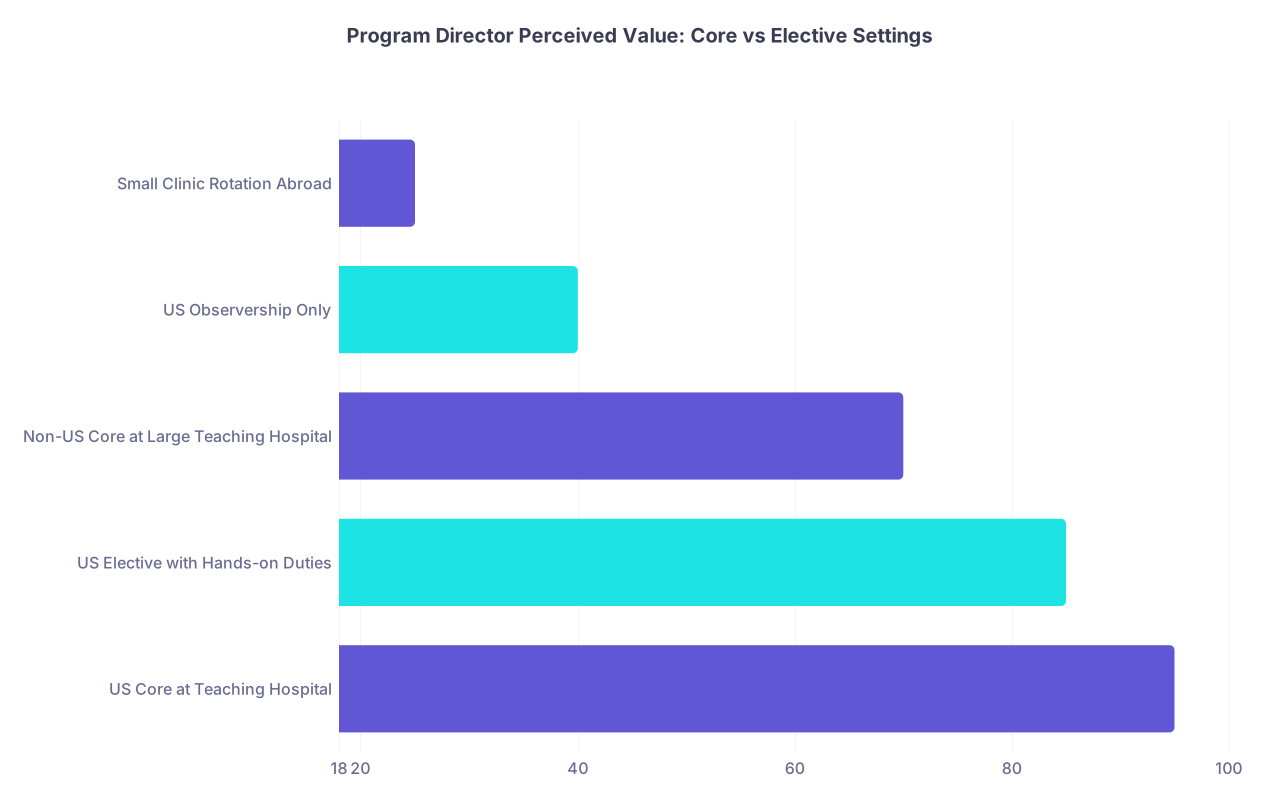
| Category | Value |
|---|---|
| US Core at Teaching Hospital | 95 |
| US Elective with Hands-on Duties | 85 |
| Non-US Core at Large Teaching Hospital | 70 |
| US Observership Only | 40 |
| Small Clinic Rotation Abroad | 25 |
Those numbers are not from a specific study; they are a realistic reflection of how people talk in selection meetings. I have sat in those rooms. The pattern is always the same.
If your foreign school:
- Gives you solid, documented cores.
- Then lets you stack strong electives in your target country.
You are in the game.
If your school:
- Has weak or poorly supervised cores.
- Offers no real pathway to external electives.
- Or treats US/UK clinicals as “student-arranged, at your own risk.”
You will be fighting uphill, no matter how smart you are.
Red Flags in How a Foreign School Structures Rotations
Let me give you practical filters you should absolutely use before you ever wire a deposit.
Red flag phrases in brochures or emails:
- “Observational exposure during clinical years.”
- “Students may observe procedures and patient care.”
- “Opportunities to visit hospital wards.”
- “Lecture-based clinical curriculum with limited bedside practice.”
Translation: you will mostly shadow. Residency programs know this.
Structural red flags:
- No clear list of core rotation durations by weeks.
- Heavy reliance on private clinics instead of recognised hospitals.
- No named affiliate hospitals on the website (“affiliated hospitals in Europe/North America” with no specifics).
- Students from the same school giving wildly different stories about their clinical experience.
Documentation red flags:
- The school cannot (or will not) give a sample transcript and Dean’s letter template.
- Graduates report difficulty getting official breakdowns of their internship or cores.
- Letters are all generic (“X was a good student”) with no specific rotation assessment.
If you see two or more of these, assume the clinical structure will hurt you as an IMG.
How to Use Electives Strategically as an IMG
Electives are not decorations. Used properly, they are your most powerful weapon to compensate for being trained abroad.
Think of them as doing three jobs simultaneously:
- Proving that you can function in the target health system.
- Generating credible letters of recommendation.
- Signaling interest in a specialty and sometimes a specific program.
The highest-yield setup for a US-aiming IMG looks like this:
- Solid home country cores (or Caribbean/US-based cores) in the big five: IM, Surgery, Peds, OB/GYN, Psych.
- 8–12 weeks of US hands-on electives or sub-internships in:
- Internal Medicine (ward-based, not just outpatient).
- The specialty you want (e.g., Cardiology elective if aiming IM; EM elective if aiming EM, etc.).
- Ideally at hospitals that either:
- Have residency programs in that specialty, or
- Are attached to a university or large teaching system.
You want your elective attending to be able to say things like:
- “Performed histories and physicals independently.”
- “Managed 4–6 patients per day under supervision.”
- “Presented concisely on rounds and developed assessment and plans comparable to our own students.”
That kind of evaluative language lands very differently than “attended clinics and observed patient care.”
For Canada, UK, and some European programs, the logic is similar, but the terminology differs:
- “Clinical attachments” or “taster weeks” in the NHS.
- “Stage” or “externat” in Francophone systems.
- “Famulatur” and “PJ” in German-speaking systems.
You want the highest level of responsibility that is legally allowed for a student, in a recognised training hospital, documented as an official part of your record.
Planning Backwards: Choosing a School Based on Rotation Structure
Most premeds choose foreign schools based on:
- Language of instruction.
- Tuition.
- Country aesthetics.
- A couple of online reviews.
That is how you end up surprised in year 4 that your school has no real US or UK pathway.
A smarter approach: plan backwards from the residency system you care about.
Use a simple mental flow:

| Step | Description |
|---|---|
| Step 1 | Where do you want residency? |
| Step 2 | Need US-style cores + US electives |
| Step 3 | Need EU-recognised cores + NHS/EU electives |
| Step 4 | Home country focus |
| Step 5 | Check school core rotation weeks & US sites |
| Step 6 | Check GMC/EU recognition & attachment options |
| Step 7 | Check internship structure & local training pipeline |
| Step 8 | US/Canada? |
| Step 9 | UK/Europe? |
For US/Canada:
- Favour schools with US-based cores or at least long-standing export track records plus documented successful US electives.
- Run away from programs where the first time you hear “we cannot guarantee US rotations” is after you have paid fees.
For UK/Europe:
- Confirm GMC or local recognition of the degree.
- Confirm access to clinical attachments in the NHS or EU teaching hospitals, even if limited.
For those staying home:
- Focus on internship quality and pathway into your local residency/PG training.
- Electives abroad then become a bonus, not the foundation.
Questions You Should Be Asking Admissions (But Most Don’t)
If you remember nothing else, remember these. Ask them before you commit.
- “Can you send me a sample transcript and list of required clinical rotations with weeks in each specialty?”
- “Where, specifically, do students complete their core rotations? Please name the hospitals.”
- “Are core rotations hands-on, with students writing notes and participating in care, or primarily observational?”
- “How many students in the last graduating class completed clinical electives in the US/UK/Canada, and at which institutions?”
- “Is there any guarantee of access to those elective slots, or is it first-come, first-served or student-arranged only?”
- “Can I see a sample Dean’s letter / MSPE or equivalent that you provide for residency applications abroad?”
If they dodge or send vague promotional material instead of clear answers, assume the truth is worse than they are willing to say.
One Last Point: Core vs Elective Is Not Just About Checkboxes
A lot of IMGs treat cores as a hurdle and electives as garnish. That is backwards.
- Cores establish your floor. If they are weak, poorly supervised, or half-observerships, no amount of flashy electives will fully erase that.
- Electives raise your ceiling. They are where you show you can operate at the level of a local final-year student, in the system where you want to train.
Foreign schools vary wildly in how they build that foundation and how they let you extend it.
If you choose a school with:
- Clearly structured core rotations aligned with your target system,
- Real teaching hospitals as sites,
- Documented pathways to high-quality electives abroad,
you give yourself room to grow, specialise, and compete.
If you choose a school where:
- Cores are vague,
- Electives are mostly marketing,
- And documentation is chaotic,
you will spend your application season explaining and compensating instead of competing.
Key Takeaways
- Core rotations are your currency of credibility. Electives are your leverage. You need both, structured and documented, in a way residency programs recognise instantly.
- Foreign schools differ far more in clinical structure than in basic science teaching. Choose based on rotation sites, weeks per core, and real elective opportunities—not brochure slogans.
- Plan backwards from where you want to match. If the school cannot show you a clear, proven path of cores + electives that feed into that system, you are betting your future on marketing, not structure.