European 6‑year medical programs are not a shortcut to U.S. practice. They are a different problem set with different landmines, and most premeds underestimate how many ways this can go sideways.
Let me be blunt: a lot of students end up in these programs not because they strategically chose them, but because they didn’t get into U.S. schools and wanted to avoid the Caribbean. Then someone on Reddit said, “Bro, just go to Poland/Italy/Czech — it’s 6 years, straight from high school, way easier, and you can still come back to the U.S.”
That narrative is dangerously incomplete.
You can absolutely reach U.S. residency from a European 6‑year program. People do it every year. But “possible” and “easier” are not the same thing. The data, the timelines, and the policy changes all say the same thing: this route is high-friction, unforgiving, and only “easier” if the comparison is repeating a post‑bacc for the third time while reapplying to U.S. MD/DO with a 2.7 GPA and a 498 MCAT.
Let’s separate myth from reality.
The Big Promise: “6 Years, No MCAT, Straight to MD”
Here’s the sales pitch you keep hearing:
- Skip the MCAT
- No bachelor’s degree needed
- Start med school right after high school or early college
- Six years later you’re a doctor, then come back to the U.S.
On the surface, it sounds efficient. But this only looks efficient if you ignore the actual bottlenecks: licensing exams, ECFMG rules, and U.S. residency competitiveness.
Most European 6‑year English-taught programs enroll large numbers of international students. Some of those students are EU citizens planning to stay in Europe. Others are non‑EU students targeting their home countries. The fraction actually aiming for the U.S. is smaller than you think.
And unlike U.S. MD/DO schools, these programs are not built around the U.S. system. They don’t care about Step 2 score distributions or how your clerkship evaluations read in an ACGME program director’s eyes. Their job is to train a physician for their own system. You’re the outlier.
So yes, you can save time up front by skipping a 4‑year undergrad + MCAT circus. But you’re trading that for a much steeper ramp on the back end.
Reality Check: Data on IMGs, Europe, and U.S. Residency
You should not make a decision of this magnitude without looking at actual match numbers.
Each year, the NRMP publishes results for IMGs (international medical graduates), which includes Caribbean, Europe, Asia, everywhere outside the U.S. A few hard truths:
- U.S. MD seniors match into their preferred specialties at very high rates.
- U.S. DO seniors lag slightly but still do well across a broad range of specialties.
- IMGs, as a group, match at substantially lower rates, especially for competitive specialties and top programs.
Now, European grads are a subset of IMGs. They’re not broken out separately, but we have program director surveys and anecdotal patterns from internal medicine, family med, psych, etc.
You’ll occasionally hear: “But European schools are more respected than Caribbean.” Sometimes true, sometimes fiction. What matters more:
- Your exam scores (Step 2, now that Step 1 is pass/fail)
- Your clinical performance and U.S. letters of recommendation
- Whether your school has a track record with U.S. programs
- Your ability to get U.S. clinical experience in 4th–6th year
Here’s a rough comparison of training paths, purely on time and some major friction points:
| Pathway | Total Years Pre-Residency | Major Bottleneck | Match Odds (General) |
|---|---|---|---|
| U.S. MD | 8 (4+4) | Getting into med school | Highest |
| U.S. DO | 8 (4+4) | Getting into med school | High |
| European 6-year (IMG) | 6 (post-HS) or 8+ (post-BA) | USMLE + U.S. clinical experience | Moderate–Low |
| Caribbean MD (IMG) | 8+ | USMLE + match stigma | Low–Moderate |
The “6 years” only applies if you enter straight from high school or after 1–2 years of undergrad. If you already did a full bachelor’s in the U.S., then go to a 6‑year European program, you’re not saving time at all. You’re just moving locations and adding immigration complexity.
To understand why this is not automatically easier, you have to look at the real choke point: licensing and match.
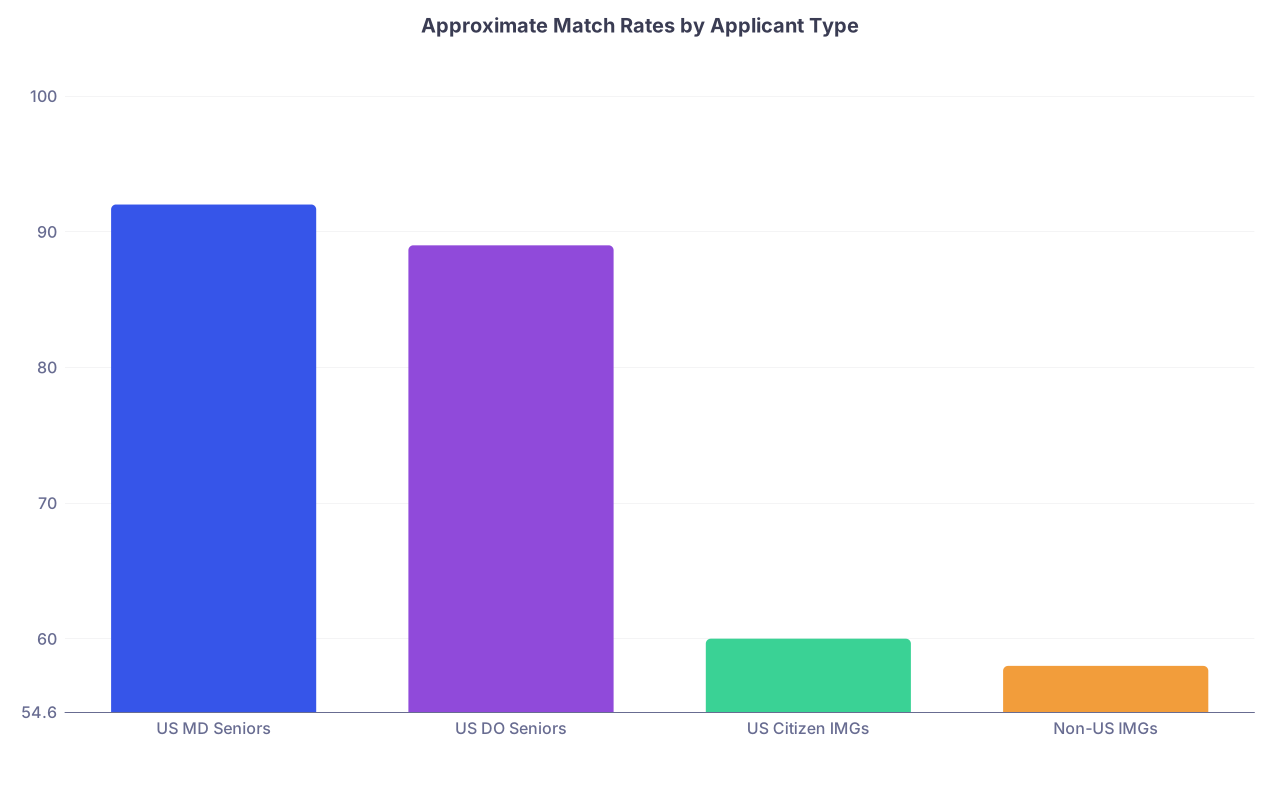
| Category | Value |
|---|---|
| US MD Seniors | 92 |
| US DO Seniors | 89 |
| US Citizen IMGs | 60 |
| Non-US IMGs | 58 |
These are ballpark values from recent cycles, not school-specific. European grads sit inside that “US Citizen IMGs” and “Non‑US IMGs” bar. You are not playing the same game as a U.S. MD.
Curriculum Reality: Your School Is Not Built Around the USMLE
Another deeply rooted myth: “European training is stronger academically, so you’ll crush USMLE.”
Sometimes I hear this from students who’ve never opened a UWorld block.
European med schools (especially in Central/Eastern Europe) often have:
- Very heavy early basic science, often lecture-based, exam-heavy
- Limited integration with U.S.-style clinical reasoning frameworks
- Minimal multiple-choice exam culture; a lot of oral exams or written essays
- Spotty or completely absent in-house USMLE advising or prep integration
You will absolutely learn anatomy, physiology, pathology. But high-level conceptual clinical integration the way UWorld and NBME expect? That’s usually on you.
The few schools that cater heavily to North Americans (e.g., some Czech, Polish, or Hungarian programs) may have some USMLE workshops or student‑run prep groups. But this is not the same as going to a U.S. MD school where every block, clerkship, and shelf exam is aligned with the NBME system.
I’ve seen more than one European 6‑year student with excellent local exam performance score terribly on their first USMLE practice test because they never trained in US‑style multiple choice reasoning.
You’re not doomed. You just have to be honest: you’re self‑directing a parallel curriculum.
You’ll be attending mandatory lectures in pharmacology, then going home and doing Anki + UWorld for a completely different exam system that no one around you is taking. Your classmates might be planning to work in Germany or the UK and could not care less about the USMLE schedule. You’re on an island.
Logistics and Timelines: The “Hidden” Difficulty
A European 6‑year program isn’t just a different country. It’s a different clock.
Look at this clearly:
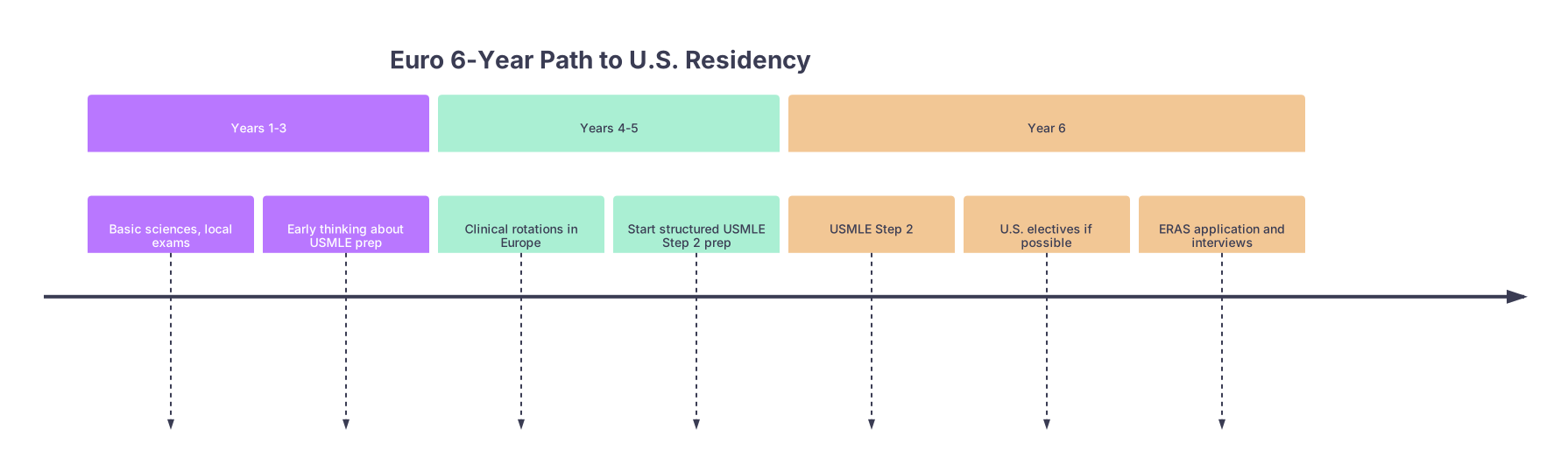
This all sounds neat until you overlay reality:
- Visa limitations on travel for U.S. rotations
- School calendars that don’t line up with U.S. elective blocks
- Faculty who have never heard of an MSPE or ERAS letter formatting
- No built-in U.S. clinical network
Getting U.S. clinical experience (real, hands‑on electives, not just observerships) from a European 6‑year program can be harder than from some Caribbean schools, simply because those Caribbean schools live off their U.S. affiliations.
You may end up:
- Cold-emailing dozens of U.S. hospitals
- Paying out-of-pocket for visiting student fees
- Negotiating with your dean to get time off for those electives
- Doing USMLE prep in the cracks between a European exam-heavy schedule
“Easier” is not the word I’d use.
The ECFMG 2024 Rule: Accreditation Gotcha
Another myth: “All European med schools are automatically recognized and safe for U.S. practice.”
Not anymore. ECFMG has tightened the gate.
As of 2024, ECFMG requires that your medical school be accredited by an agency recognized by the World Federation for Medical Education (WFME). Many European schools are fine. But not all. Some are in accreditation transition, some in limbo, some in countries with fragmented oversight.
If your school or country fails to meet WFME standards, you may not be eligible for ECFMG certification → no USMLE → no U.S. residency. That’s not a small footnote.
Before you sign anything:
- Look up your school in the World Directory of Medical Schools (WDOMS) and verify the ECFMG “Recognized” note
- Check if your country’s accreditor is WFME-recognized
- Confirm with ECFMG directly if there’s any ambiguity
Do not just trust the school’s marketing slides.
Comparing Routes: Is Europe Actually “Better Than Caribbean”?
The internet loves binaries: “Caribbean bad, Europe good.” Reality is more nuanced and less comforting.
Here’s the unromantic comparison:
| Factor | European 6-Year Program | Caribbean MD |
|---|---|---|
| Entry Point | High school / early college | After bachelor’s + MCAT (usually) |
| USMLE Integration | Usually low | Variable, sometimes heavily integrated |
| [U.S. Clinical Rotations](https://residencyadvisor.com/resources/international-med-schools/the-idea-that-us-clinical-rotations-guarantee-img-matches-debunked) | Harder to arrange, fewer built-ins | Central to the business model |
| Stigma With PDs | Lower than lower-tier Caribbean | Higher, especially for weaker schools |
| Total Cost | Moderate to high, varies by country | High, often very high |
Neither path is “easy.” Both are IMG routes that require high performance to overcome structural disadvantages.
If you can get into a solid European 6‑year program early (right out of high school) and you know from day one that you want the U.S., you have time to plan, integrate USMLE prep, and strategically arrange U.S. electives. That can absolutely work.
But if you already finished college in the U.S., bombed the MCAT twice, then go fishing for a random 6‑year English-language program in Eastern Europe as a reset button, you’re not resetting. You’re just adding distance between your training and the system you ultimately want to work in.
Who Actually Benefits From European 6‑Year Programs?
Let’s be fair. These programs are not scams. They’re just mis-sold to American students.
They make more sense if:
- You’re an EU citizen who can work in that country or elsewhere in the EU without massive bureaucracy.
- You’d be genuinely okay building a career in Europe if the U.S. door never opens.
- You’re entering right after high school and can’t or don’t want to do a U.S. bachelor’s first.
- You’re academically strong, self-directed, and prepared to design your own USMLE path on top of a heavy local curriculum.
They make far less sense if:
- You insist your only acceptable outcome is U.S. residency, preferably in a competitive specialty, at a decent program.
- You already have a U.S. bachelor’s and are trying to “save time” or “avoid the MCAT.”
- You’re hoping the “EU” brand alone will impress U.S. program directors. It won’t. They care far more about your numbers, letters, and clinical performance than whether your diploma says Poland, Italy, or Grenada.
The Mental Health and Isolation Factor
One angle people conveniently ignore: the psychological burden.
I’ve watched this play out:
A 19‑year‑old American lands in a city where they don’t speak the language. They’re doing anatomy in English, but their patients on wards speak only the local language. Clinical learning is filtered through interpreters or minimal broken conversation.
Their classmates? Many are planning to work in Germany or Scandinavia. No one is worried about ERAS deadlines or U.S. letter writers. The “U.S. track” student is effectively doing a double workload and a double identity:
- One identity: pass local exams, learn the local system, survive
- Second identity: grind UWorld, master NBME-style questions, research how to get into U.S. hospitals that have never heard of their school
That is isolating. It’s doable, but let’s not pretend it’s some smooth, low-stress path.
How to Assess a Specific European Program (Without the Fairy Dust)
If you’re still considering it, ignore the glossy brochures and ask hard questions:
- How many graduates in the last 5–10 years matched into U.S. residency? Which specialties? Which programs?
- Do you have a dean’s office that understands ECFMG, USMLE, ERAS, MSPE, and U.S. letters? Or will I be the first?
- Are there formal exchange agreements or visiting student slots with any U.S. hospitals? Names, not vibes.
- What’s the teaching language in clinical years, and how much real patient interaction will I have if I don’t speak the local language fluently?
- What percentage of students actually pass all their years on time? High attrition is a massive red flag.
If those answers are hand‑wavy or vague, you’re not choosing a structured U.S.-feeder route. You’re choosing to be a pioneer. Some people like that. Most premeds don’t realize that’s what they’re signing up for.
Quick Reality Summary
Strip away the myths and you’re left with this:
- European 6‑year programs are not an “easier” path to U.S. practice. They’re a different IMG route with their own serious obstacles: USMLE misalignment, logistics, and lack of built‑in U.S. clinical pathways.
- These programs can work if you enter young, are willing to self‑manage a U.S. track from day one, and would actually accept staying in Europe if the U.S. plan fails. If U.S. residency is the only acceptable outcome, this is a high‑risk strategy.
- Branding (“Europe”) doesn’t override the realities of IMG status, exam performance, and clinical experience. The match cares about your scores, letters, and performance — not your romantic idea of studying medicine in a historic European city.