
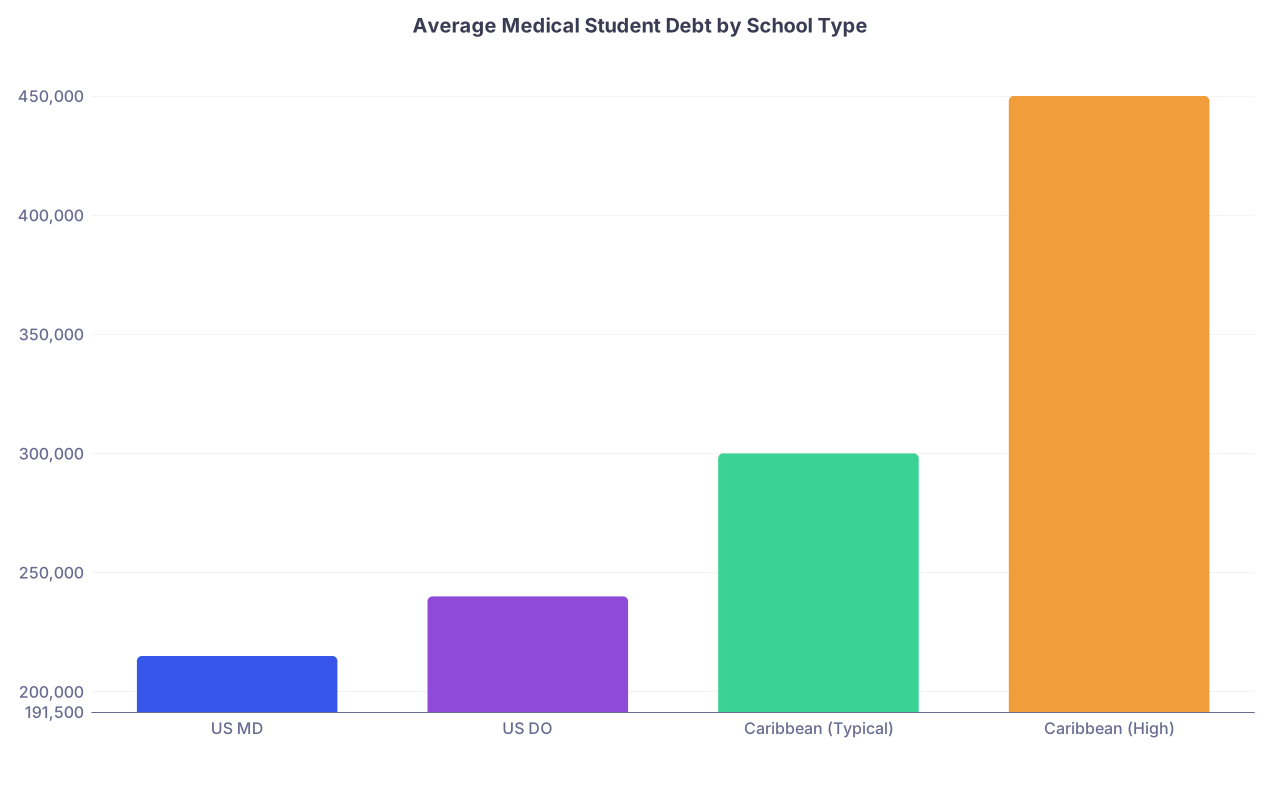
| Category | Value |
|---|---|
| US MD | 215000 |
| US DO | 240000 |
| Caribbean (Typical) | 300000 |
| Caribbean (High) | 450000 |
It is April. You are staring at two emails:
- One from a U.S. MD school waitlist that has been quiet for months.
- One from a Caribbean medical school offering you a seat starting in September—if you put down a non‑refundable deposit in 10 days.
Your heart says, “This is my shot at being a doctor.”
Your brain whispers something about “cost” and “loans,” but you push it away. You think: Four years, I will figure it out. Doctors make money. It will work.
This is where people ruin their financial future. Not in residency. Not when repayment starts. Right here—by underestimating what Caribbean medical school debt actually looks like, and how unforgiving it is if things do not go perfectly.
I am going to walk you through the biggest financial planning mistakes I see over and over in Caribbean applicants and students. If you are even considering this path, you cannot afford to make these errors.
1. Pretending Caribbean Tuition Is “Like U.S. Med School, Just Somewhere Else”
The first bad assumption: “It costs about the same as U.S. med school.”
Often wrong. And sometimes catastrophically wrong.
The sticker price trap
Caribbean schools love publishing neat, clean tuition tables. What students actually pay looks very different.
Common misses:
- Ignoring fees (technology, lab, exam, malpractice, “administrative,” clinical placement)
- Forgetting about housing and travel on an island
- Not factoring in currency fluctuations (yes, your costs can change mid‑degree)
- Underestimating clinical-year costs in the U.S. (moving every few months, high rents, car, etc.)
Here is how the math often really plays out:
| Expense Category | U.S. Public MD | U.S. DO | Caribbean Mid-Tier | Caribbean Expensive |
|---|---|---|---|---|
| Tuition & Fees | $180k–$220k | $190k–$230k | $220k–$260k | $260k–$320k |
| Living (4 years) | $80k–$110k | $80k–$110k | $100k–$140k | $110k–$150k |
| Travel/Relocation | $10k–$20k | $10k–$20k | $20k–$40k | $30k–$50k |
| **Total Borrowed** | **$270k–$330k** | **$280k–$360k** | **$340k–$420k** | **$400k–$500k+** |
You see the problem. Many Caribbean students are walking into a situation where $350k–$450k of debt is not rare. I have seen it higher.
If you are planning your life around “average med student debt” numbers you saw on some U.S. AAMC slide deck (~$200k–$250k), you are undercounting by six figures.
2. Ignoring the Residency Match Risk When You Borrow
Here is the biggest error:
Taking on U.S. med school‑level (or worse) debt with a much lower probability of matching into residency.
Debt only makes sense if you finish the path:
MD → Residency → Attending income.
Caribbean schools often publish impressive “match rates.” But if you read the fine print (most people do not), you will see things like:
- Only including students who actually applied to the Match (not the ones who failed exams or dropped)
- Excluding people who never passed USMLE
- Counting pre‑match positions heavily in a few specialties or locations
What matters to you is not the brochure percentage. It is:
- What percent of matriculants eventually match into a U.S. residency?
- What happens financially to the ones who do not?
Here is the piece no one wants to think about:
- You can borrow hundreds of thousands.
- You can fail Step 1 or 2 more than once.
- You can graduate but never match.
- The loans still exist. With interest. For decades.
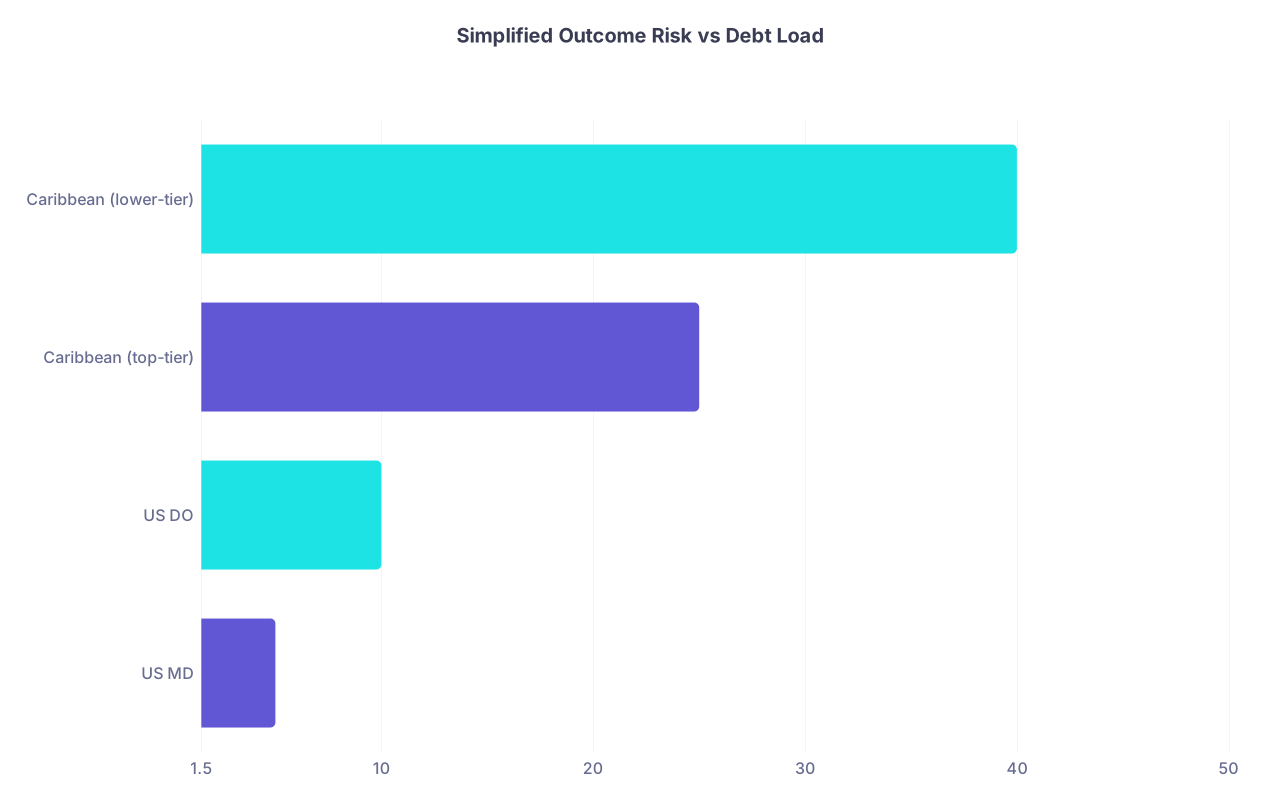
| Category | Value |
|---|---|
| US MD | 5 |
| US DO | 10 |
| Caribbean (top-tier) | 25 |
| Caribbean (lower-tier) | 40 |
(Values above: rough % of grads who may struggle to match or fail to match on time—illustrative, not official numbers. The relative risk is the point.)
If you treat Caribbean school as a guaranteed path to practicing medicine, you are planning like the risk is 0%. That is fantasy.
You need to plan like:
- There is a real chance you may not match.
- There is a real chance you may need extra years (remediation, failed exams, repeat rotations).
- There is a real chance you may match only in lower-paying, high-burnout fields or programs in expensive cities.
If your debt plan only works in the “perfect scenario,” it is not a plan. It is denial.
3. Misunderstanding the Type of Loans You Will Actually Use
Another mistake: assuming you will get the same loan protections as U.S. med students.
U.S. MD/DO students:
- Federal Direct Unsubsidized and Grad PLUS loans
- Access to income‑driven repayment (IDR)
- Public Service Loan Forgiveness (PSLF) eligibility
- Very clear protections and standardized terms
Caribbean students:
- Depends on the school and your citizenship
- Some schools are U.S. federal loan eligible; many are not
- Many students end up with:
- Private loans with variable rates
- Co-signers (parents) on the hook
- No IDR, no PSLF
This is where people mess up. They see “You may be eligible for federal loans” on the website and stop asking questions.
You need to know:
- Is the school on the U.S. Department of Education’s approved list for federal aid?
- Will all years and clinical sites be eligible?
- What happens if:
- You need an extra semester?
- You take a leave?
- You fail a course and repeat?
If you end up relying heavily on private loans:
- Interest rates can be higher.
- Interest can capitalize frequently.
- No forgiveness.
- No income-based safety net if salary is low or delayed.
I have seen graduates with $350k at 8–10% interest and a PGY-1 salary. That is not “challenging.” That is a trap.
4. Forgetting the “Island Cost Multiplier”
You budget for rent like you are in a U.S. college town. That is a mistake.
Island life has a cost multiplier that a lot of premeds do not see until they are stuck there.
Common surprises:
- Housing priced for desperate medical students, not locals
- Electricity and AC bills that are painful
- Groceries that cost 1.5–2x U.S. prices
- Imported everything: textbooks, supplies, toiletries, electronics
- Mandatory health insurance and “student services” that are not optional
And then there is travel:
- Round-trip flights multiple times per year
- Extra luggage fees
- Emergency trips home for family issues
- Housing deposits that are non‑refundable
If you borrow “just enough” for listed tuition and generic living expenses, you will use credit cards to fill the gap. This is how you end up with:
- $350k in student loans plus
- $10k–$30k in credit card debt at 20% APR
You need a realistic cost-of-living budget, not the fantasy number in your head where you “live frugally” like a monk. Med students on a remote island burn out. They order food. They pay for convenience.
5. No Contingency Plan for Delays and Failures
U.S. med schools are not gentle, but Caribbean programs can be brutal. High attrition. High exam pressure. Limited remediation.
Common ways timelines (and costs) stretch:
- Failing a basic science block → repeat semester
- Failing Step 1 → delay clinicals, extra study time, more living expenses
- Gaps between basic sciences and clinical rotations while waiting for placements
- Visa or logistical issues causing downtime
Every extra semester is not just:
- Extra tuition
It is also: - Extra rent
- Extra food
- Extra interest accruing on all prior loans
People plan financially for “4 years.” A lot of Caribbean grads end up at 4.5–5+ years before even starting residency.
You need to ask yourself:
- What if this takes me an extra year?
- Can I survive an unexpected $40k–$70k cost increase?
- What is my plan if I fail Step 1 or Step 2 once? Twice?
If your financial plan collapses the moment something goes wrong academically, it is not a plan. It is wishful thinking.
6. Believing Future Attending Income Will Fix Everything Automatically
The fantasy goes like this:
“Yes, the debt will be big. But I will be a doctor. Attending salaries are $250k–$400k. I will pay it off.”
I have heard this from people matching into:
- Primary care in high cost-of-living cities
- Community hospitals with lower pay
- Specialties they never originally wanted, taken out of desperation
You cannot plan on:
- Matching into derm, ortho, plastics, or radiology from a mid‑tier Caribbean school. Possible? Occasionally. Reliable? No.
- Living in a cheap rural town. You may end up in NYC, Miami, LA.
- Perfect financial discipline as a burned-out resident finally earning money.
And remember:
- Interest compounds while you train.
- Income-driven plans reduce payments but stretch out the timeline, and with private loans you may not even have that option.
Here is what a lot of people actually face:
- $350k–$450k at 6–9%
- Residency for 3–5 years, making IDR payments that barely touch principal (if you have federal)
- Attending income that looks high on paper but vanishes once taxes, malpractice, cost of living, and lifestyle creep hit
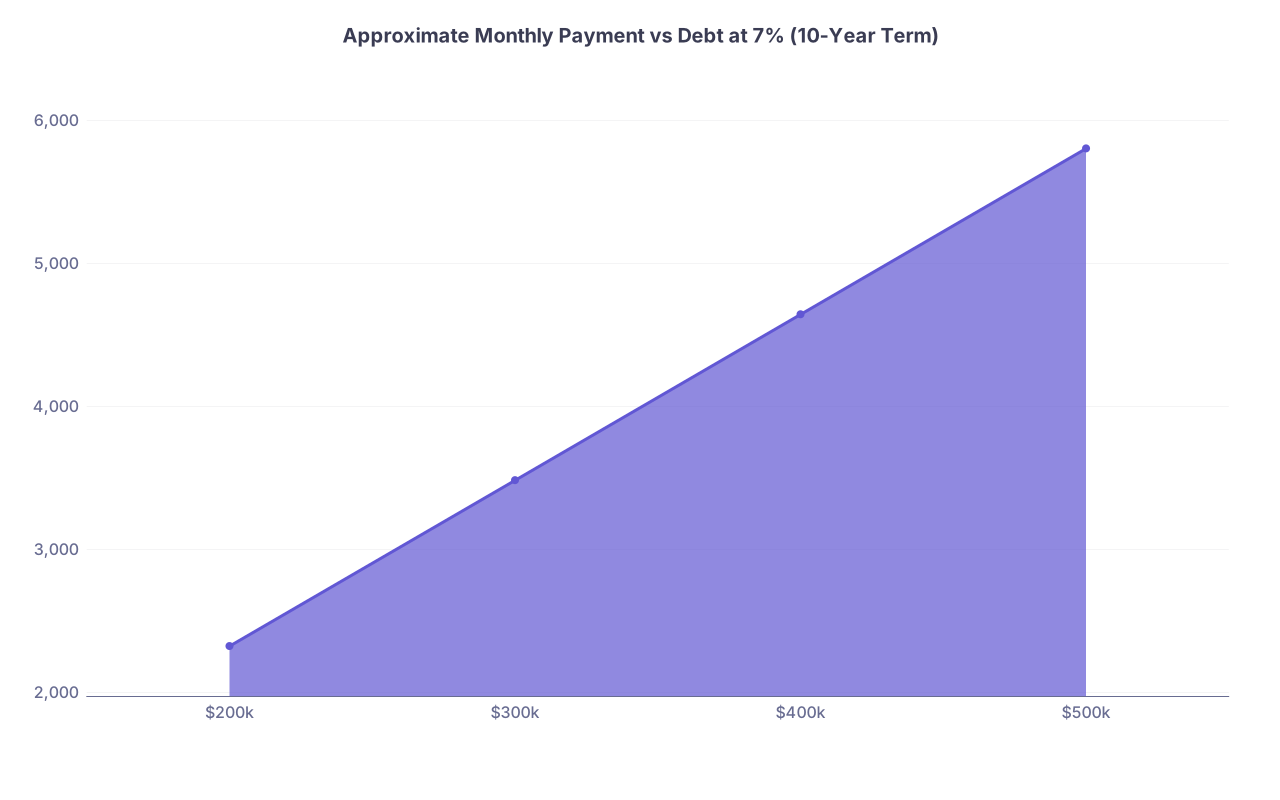
| Category | Value |
|---|---|
| $200k | 2320 |
| $300k | 3480 |
| $400k | 4640 |
| $500k | 5800 |
Those monthly payment numbers are not made up. That is the ballpark for a standard 10-year repayment with no forgiveness. Many Caribbean grads simply cannot handle that and are forced into extended or interest-only structures that keep them in debt for 20–30 years.
7. Not Running a Worst-Case Scenario Before Committing
Almost nobody does this. They only run the dream scenario.
Here is what you need to model on paper before you put down a deposit:
Scenario A – Everything goes right
- Graduate on time (4 years)
- Pass Step 1 and Step 2 on first attempt with solid scores
- Match into IM/FM/Peds in a reasonable cost-of-living area
- Debt at graduation: e.g., $360k @ 7%
Can you:
- Live on a resident salary while making IDR payments?
- Tolerate attending payments of $3k–$4k/month if you want to be done in 10–15 years?
Scenario B – Delayed and average
- One extra semester or year
- One exam failure with delay
- Match into lower-paying or expensive-city program
Now your:
- Debt = $400k–$450k
- Interest accumulates longer
- Cost of living is higher
Does the math still work? Or are you stuck in 25-year repayment?
Scenario C – No match or repeated no-match cycles
- Graduate but do not match, or need to SOAP into prelim-only spots repeatedly
- Working non-physician jobs
- Private loans, no IDR safety net
What does your life look like then?
Can your family co-signer handle that?
Are you okay owning that risk?
If you are not running Scenario B and C, you are lying to yourself.
8. Failing to Compare Alternatives Honestly
A lot of students treat Caribbean school as “last chance or nothing.” That mindset pushes them into terrible financial decisions.
Alternatives people blow off too quickly:
- Reapplying to U.S. MD/DO with:
- Improved MCAT
- Stronger clinical exposure
- Formal post‑bacc or SMP
- PA school, NP, anesthesia assistant, etc.
- International schools with better match and cost structures (some UK, Ireland, Australia, though they have their own issues)
- Waiting 1–2 years to fix academic weaknesses instead of jumping immediately
I have seen people:
- Go Caribbean with a 498 MCAT, 3.1 GPA, and zero upward trend
- Borrow $400k+
- Never pass Step 1 despite multiple attempts
For many of them, taking 1–2 years for a structured post‑bacc and retaking the MCAT, then applying to DO schools, would have been vastly smarter. They chose speed over sustainability.
Do not think, “If I do not go now, I will never be a doctor.”
Think, “If I go into this the wrong way, I might end up neither a doctor nor financially stable.”
9. Red Flags in Caribbean School Financial Promises
Some specific warning signs when you look at school websites or talk to reps:
Vague total cost estimates
“Estimated tuition per semester” with no clear 4-year breakdown.Aggressive “Scholarship” language
Scholarships that only cover the first semester or have GPA requirements many students lose.Pushy deposit timelines
“You must commit in 7–10 days or lose your seat.” Classic sales pressure.Overly rosy match statistics
Without:- Numerator/denominator details
- Specialty breakdown
- US vs non-US positions
No serious talk about loans
Reps gloss over whether most students rely on:- Federal loans
- Private loans
- Co-signers
If their financial office cannot walk you through realistic, all-in cost projections and loan structures line by line, that is not a good sign.
10. How to Approach Caribbean School If You Still Decide to Go
I am not saying, “Never go Caribbean.” I am saying, “Do not walk in blind.”
If you decide this is still your path, you must be ruthlessly intentional.
Minimum steps:
Get exact numbers in writing
- Tuition by semester for all 10–12 semesters
- All mandatory fees
- Health insurance requirements
- Estimated housing for both island and U.S. clinical years
Map your borrowing plan
- Federal vs private loans
- Expected interest rates
- Capitalization points
- Co-signer risk to family
Build a worst-case budget with a buffer
- Add 20–30% to your living cost estimate
- Include 1 extra semester as a contingency in your calculations
Understand match realities for that school
- Specialty distribution
- Number of unmatched grads each year (not just a percentage)
- Step score averages (if they will share them)
Plan your exit ramps
- Under what academic conditions would you withdraw rather than double down on more debt?
- How much sunk cost are you willing to walk away from if it is clearly not working?
This is medicine, not a casino. You are allowed to fold a losing hand. But it is extremely hard to walk away when you already owe $200k.

| Step | Description |
|---|---|
| Step 1 | Considering Caribbean Offer |
| Step 2 | Calculate 4-5 Year Total Cost |
| Step 3 | Reconsider / Improve Application |
| Step 4 | Assess Match Odds and Outcomes |
| Step 5 | Clarify Loan Types & Protections |
| Step 6 | Extreme Caution / Smaller Borrowing |
| Step 7 | Proceed with Tight Budget & Exit Points |
| Step 8 | Debt <= $350k and Realistic Plan? |
| Step 9 | Comfortable with Worst-Case? |
| Step 10 | Federal + IDR Safety Net? |
FAQs
1. Is going to a Caribbean medical school ever financially reasonable?
Yes, in some situations:
- You have a reasonably competitive academic profile but extenuating circumstances.
- You attend a more established Caribbean school with stronger match outcomes.
- You keep total debt under ~$350k and have access to federal loans and IDR.
- You are mentally prepared to fight hard for a primary care or core specialty match and to live modestly for a long time.
What is not reasonable: going in with weak academics, no backup plan, and an assumption that any specialty, any city, and any income level will magically appear.
2. How much total debt is “too much” for Caribbean school?
My opinion: once you project over $400k in total debt, you are entering dangerous territory, especially with private loans.
Why:
- Standard repayment becomes brutal.
- Even with IDR (if you have federal loans), you may be carrying this for decades.
- Any disruption—illness, family issues, job loss—hits harder.
I start to get seriously uncomfortable when someone says:
- “I will need $450k–$500k to finish,”
and they have no rock-solid academic record.
3. I am already at a Caribbean school and my debt is climbing. What should I do?
Stop and reassess now, not in two years.
- Get your exact current balance and projected future borrowing.
- Talk to:
- Financial aid
- A real student loan advisor (not the school’s salesperson)
- Be brutally honest about:
- Your grades
- Any failed exams or marginal passes
- How you are scoring on NBME/CBSE/USMLE practice tests
If your performance suggests you may not pass Step 1/2 or might struggle heavily to match, you have to consider whether cutting losses now is smarter than doubling down on sheer hope. That conversation is painful. It is still better than waiting until you owe $350k with no path forward.
4. Would it be smarter to wait and reapply to U.S. schools instead?
Often, yes.
If:
- Your GPA has room for repair through a post‑bacc or SMP
- Your MCAT can realistically be raised by 5–10 points with structured prep
- You have not exhausted multiple U.S. application cycles with a truly optimized application
then an extra 1–2 years of preparation may drastically improve your shot at:
- U.S. DO schools
- Possibly lower‑tier U.S. MD programs
Waiting feels awful in the short term. But trading a year or two of delay for a safer, more financially sane path is often the difference between “doctor with manageable debt” and “non‑practicing graduate with $400k of loans.”
Key points to carry with you:
- Caribbean medical school debt is frequently far higher and far riskier than applicants assume.
- You must plan based on realistic match odds and worst-case scenarios, not brochure statistics and optimism.
- If you choose this route, you need a hard, detailed financial plan with clear exit points—because hoping it will “work itself out” is the biggest, most expensive mistake you can make.


