

It’s 8:00 p.m. The clinic day is over, the residents are barely holding it together, and up on the fourth floor, a group of attendings and program leadership is still sitting around a long table. Coffee cups, ERAS printouts, a shared screen with an Excel spreadsheet of applicants.
They’re on the “borderline” pile.
Three US grads, two DOs, and your application—an IMG with a one-year gap after graduation, a failed Step attempt, and 4 months of US observerships.
Now they’re talking about you. Out loud. By name. And what they say is not what you think they say.
Let me walk you into that room.
How Committees Actually Sort and Label IMGs
The first reality: most US programs don’t start with a “holistic review.” They start with filters. Especially for IMGs.
A typical internal breakdown looks something like this:
| Bucket | Description | Typical Fate |
|---|---|---|
| Auto-Invite | Stellar scores, recent grad, [strong US letters](https://residencyadvisor.com/resources/international-med-schools/letters-from-abroad-how-residency-faculty-read-lors-from-img-programs) | Reviewed carefully, many invited |
| Discuss | Some concern (gap, low score, older grad) but redeeming strengths | Committee debate |
| Long Shot | Multiple red flags but some positives | Rare interview if connections/needs align |
| No-Go | Deal-breakers for that program (e.g., too old grad year, multiple failures) | Never discussed in depth |
For IMGs, the conversation usually starts with: “Why would we take them over a US grad?”
That’s the quiet baseline. They won’t say it on a podcast or at a conference, but I’ve heard it in those rooms. Over and over.
So your “red flags” and “gaps” are not abstract. They’re specific answers to this question:
Are you worth the extra perceived risk?
And when your file comes up, the committee is looking at four things before they even really read your personal statement:
- Year of graduation
- USMLE history
- Gaps in training or work
- Type and quality of US clinical experience and letters
The red flags are not all equal. Some are survivable. Some quietly kill your shot before anyone even debates you.
The Red Flags That Trigger Real Pushback
Let’s talk about the ones that actually get discussed behind closed doors. Not the theoretical “maybe this is a concern” stuff. The ones that make faculty lean back and go, “Hmm… I don’t like this.”
Failed Step Attempts: What They Actually Say
You see “Step 1: Fail, then 230” and think: “Look, I proved I can do it. I improved.”
Inside the room, the first read is different.
You’ll hear phrases like:
- “This is a reliability issue.”
- “Do we want someone who needed two attempts to get through the basic hurdle?”
- “How did they fail? Were they not prepared, or was something going on?”
The nuance you never see:
Single Step 1 failure with a strong Step 2 (say 240+)
This is survivable in many mid-tier IM or FM programs, maybe even some community categorical spots in other fields. But you need a story. A clean, believable, contained story.Single Step 2 failure
This is significantly worse than a Step 1 failure. Step 2 is seen as more clinically relevant. Faculty say things like, “If they struggle with Step 2, how are they going to handle boards in residency?”Multiple failures (Step 1 or Step 2)
This moves you into “Long Shot” or “No-Go” at most programs. In meetings, the discussion usually ends fast:
“Multiple fails?”
“Yeah.”
“Next.”
They are not just judging knowledge. They are judging risk to board pass rates, accreditation, and call coverage.
What helps in the room:
- A clear progression: fail → pass with a strong jump in score
- Recent, higher-level exam success (e.g., strong Step 3)
- A consistent story that’s corroborated in your MSPE or letters, not just your own narrative
What hurts:
- Vague explanations: “personal reasons,” “stress,” “adjustment to a new system” without specifics
- No evidence of changed behavior (no extra coursework, no later exam success, no remediation history)
Long Gaps After Graduation: The Silent Cutoff
You already know some programs have “within 3–5 years of graduation” on their websites. What you don’t know is that some programs have stricter internal rules they don’t publish.
I’ve seen internal spreadsheets with columns like:
“YOG <= 5” = Green
“YOG 6–8” = Yellow
“YOG > 8” = Red (auto-screened out)
Nobody advertises that.
Here’s how the internal conversation goes for IMGs with gaps or older graduation years:
- “What have they been doing since graduation?”
- “Have they been clinically active?”
- “Are they basically re-starting medicine after a hiatus?”
The worst thing you can be in that room is:
- Old grad year
- Plus unexplained gap(s)
- Plus no current clinical activity
That combination screams: “De-skilling, risk, and unclear motivation.”
But a “gap” is not one thing. They distinguish between types of gaps, even if it’s never written down.
| Type of Gap | How It’s Usually Viewed | Salvageable? |
|---|---|---|
| 6–12 months for exams | Normal if explained and productive | Yes |
| 1–2 years for visa, moves, family illness with clinical/research alongside | Neutral to mildly negative | Often |
| 3–5+ years with non-clinical work (unrelated) | Concerning, “rusty” clinically | Rarely at competitive sites |
| Working as a physician abroad continuously | Much better than being non-clinical | Sometimes |
“What Were They Doing?” – The Question That Kills Applications
If your timeline makes people squint, you’re in trouble. I’ve sat through these exact lines:
- “So they graduated 2017… what were they doing in 2019?”
- “It says ‘preparing for Step’ for two years. That’s… a long time.”
- “They say they were doing observerships, but I only see 4 weeks listed.”
Vague or empty time gaps get filled in by the committee with the worst possible assumptions: inability to find work, lack of drive, burnout, family pressure, even mental health issues they’re scared to inherit without support.
Not fair? Correct. But that’s what happens.
Your job, long before you apply, is to make sure your eventual ERAS timeline won’t trigger that question: “So what were they doing?”
How They Weigh IMG Red Flags Against Each Other
Here’s the thing candidates don’t grasp: committees rarely reject you for just one red flag. They reject you for the stacking of red flags without offsetting strengths.
Inside the meeting, they’re mentally doing this kind of math:
Let’s take a hypothetical internal medicine IMG applicant:
- Grad year: 2020
- Step 1: pass (old scoring, 222)
- Step 2: 238
- Step 3: 225
- One 1-year gap: 2021–2022, “family reasons,” plus some research and part-time work
- 3 months US observerships, 2 strong US letters
How do they actually talk?
It sounds like:
“Grad 2020, still reasonably recent. Scores okay, not stellar but safe. There’s a one-year gap but they did some research and have decent US letters. No fails. This is someone we can work with.”
Now compare to:
- Grad year: 2016
- Step 1: fail then 214
- Step 2: 222
- Step 3: none
- 3-year gap after graduation: “preparing for exams”
- 2 months observership, one weak generic US letter, one foreign letter
The discussion usually goes like:
“Old grad year. Multiple years essentially idle. Exam history shaky and no Step 3. Low chance they’ll be competitive with our current pool. I don’t see a reason to take this over other IMGs.”
Notice what they’re not saying: “This person is bad.” They’re saying: “Risk/benefit doesn’t justify an interview.”
That’s the bar.
What Really Redeems an IMG With Red Flags
Some of you will have red flags you can’t erase: a fail, a gap, an older grad year. So what actually moves the needle in the room?
Here’s where the behind-the-scenes reality helps you.
1. Recent, Real, Clinically Relevant Activity
I don’t mean “shadowing” or another random observership you squeezed in for a couple weeks.
Committees lean forward when they see:
- Longitudinal US clinical exposure (3–6 months+), especially in the same specialty you’re applying to
- Consistency: “They’ve been in a hospital setting recently, not just sitting at home studying for years”
- Roles with responsibility, even if unofficial: acting as a research fellow embedded on the team, functioning like a sub-I in a structured program, working as a physician abroad right up until application
Behind closed doors, someone will say:
“Yes, they’re an older grad, but they’ve been working as an internist abroad and just did 4 months here in the US with good letters. They’re not rusty.”
That phrase—“not rusty”—is gold.
2. Strong US Letters That Address the Unspoken
You think letters are all fluff. Most are. Committees know that.
So they look for specific language. The kind only shows up if a US physician actually believes in you.
Things that make people sit up:
- “I’d take this applicant over many US grads I’ve worked with.”
- “They functioned at the level of a sub-intern.”
- “Given their nontraditional path, I was impressed by how quickly they adapted to our system.”
When you’ve got a red flag, committee members subconsciously ask: “Is this person going to be a problem?”
A strong letter from a known US attending saying, essentially, “No, they’re solid,” can override a lot of doubt.
On the flip side, a generic US letter full of “pleasant,” “punctual,” “eager to learn” might as well say: “I barely remember this person.”
3. A Clean, Tight Story for the Gap or Failure
I’ve watched applicants get quietly saved because their explanation was:
- Plausible
- Contained (not ongoing chaos)
- Tied to growth and behavior change
For example, how this lands in the room:
“They failed Step 1 while dealing with a parent’s cancer treatment, then took a structured prep course, moved away from home for a quiet place to study, passed with a big jump, and then scored well on Step 2. They’ve had no issues since.”
Faculty react to that differently than:
“I struggled with test anxiety and time management but eventually was able to pass.”
The second one says: chronic, unsolved problem. The first says: acute crisis, now resolved, with evidence.
Your explanation has to be brutally honest but controlled. Not a trauma dump. Not a vague cloud. Concrete cause → action → result.
And you want that story to quietly reappear in your letters and MSPE, not just your personal statement. Consistency is credibility.
How Early You Need to Think About This (Way Earlier Than You Think)
You’re premed or early in med school reading about “gaps” and thinking, “That’s a problem for Future Me.” It’s not.
The red flag discussions happen 5–10 years after decisions you are making now.
If you’re aiming to match as an IMG, here’s what you need to internalize:
Your graduation year is a clock that starts counting the day you finish med school.
Every year after that has to be accounted for with something defensible.Your exam timeline is part of your narrative.
A rushed Step attempt that ends in failure doesn’t just “delay you.” It labels you.“I’ll just take time off to study” is dangerous if it stretches.
Six months? Fine. Eighteen months? That will haunt your application conversations.
Here’s the mental framework committees use:
Is this applicant moving forward consistently, or are they bouncing around, pausing, resetting, starting over?
Forward motion buys forgiveness.
To make this more concrete, map it visually.
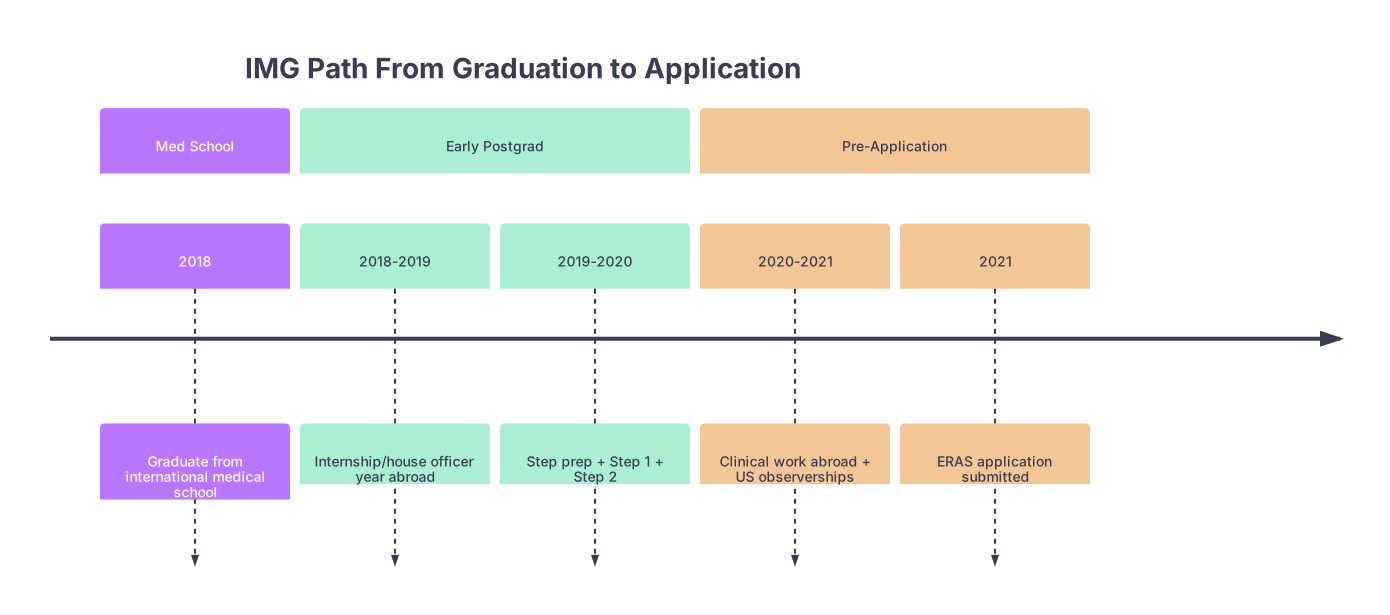
| Period | Event |
|---|---|
| Med School - 2018 | Graduate from international medical school |
| Early Postgrad - 2018-2019 | Internship/house officer year abroad |
| Early Postgrad - 2019-2020 | Step prep + Step 1 + Step 2 |
| Pre-Application - 2020-2021 | Clinical work abroad + US observerships |
| Pre-Application - 2021 | ERAS application submitted |
That path tells a story: no dead years, constant involvement in medicine, exams completed in a reasonable window. Committees like this.
Now compare it to:
- 2016 grad
- 2016–2018: “preparing for Step”
- 2018: Step 1 fail → later pass
- 2019–2021: “family reasons,” some non-medical work
- 2022: Step 2 pass, one observership
- 2023: ERAS
On paper? Chaotic. In discussion? High risk.
How Score Distributions and Gaps Compete in Reality
To give you perspective, here’s a simplified internal view many IM-heavy programs have when sorting IMGs with various red flags.
, Multiple fails + long gaps](https://cdn.residencyadvisor.com/images/articles_svg/chart-relative-competitiveness-of-img-profiles-with-diff-8220.svg "Relative Competitiveness of IMG Profiles With Different Red Flags")
| Category | Value |
|---|---|
| Recent grad, no gaps, no fails | 90 |
| Recent grad, 1 gap year well explained | 70 |
| Older grad (6+ years), fully clinical abroad | 55 |
| [Step 1 fail then strong Step 2](https://residencyadvisor.com/resources/international-med-schools/the-real-reason-some-imgs-get-fast-tracked-while-others-get-ignored) | 50 |
| Multiple fails + long gaps | 10 |
That’s the kind of subconscious scaling happening in those rooms. The closer you are to the left, the more time they spend discussing you. The closer to the right, the faster your file closes.
Tactical Moves If You Already Have Red Flags
If you’re already past the ideal stage and you’re carrying real baggage, here’s what actually helps your case when your name comes up in that committee room.
Maximize Recency and Relevance
If you have:
- Old graduation year
- Or gaps
- Or a fail
You cannot afford to be sitting idle before applying.
The strongest rehabilitation I see for IMGs with red flags is:
- Working clinically abroad up to the year of application
- Doing a structured, preferably longer-term (3–6 months) US clinical experience with hands-on exposure where possible (research fellowships integrated with clinical teams are powerful)
- Completing Step 3 before application to prove current exam competence
When your file is presented and someone can say:
“Yes, older grad, yes a Step 1 fail, but they just finished a year as a hospitalist abroad and did 4 months with us here with very strong performance. They also passed Step 3.”
People listen.
Choose Specialty and Program Level Realistically
This is uncomfortable, but I’ll say it plainly:
If you’re an IMG with big red flags and you’re applying to university programs in surgical subspecialties or super-competitive fields, you’re not being “ambitious.” You’re being ignored.
Behind closed doors, faculty open those files, see the profile, and say:
“Why are they applying here? They’re not even in the ballpark.”
If you’re carrying:
- A fail
- Multiple years post-graduation
- Weak or limited USCE
You need to be targeting:
- Community programs
- Less competitive specialties
- Places with a history of taking IMGs with similar profiles
That’s not “settling.” That’s making it to the table where they actually talk about you.
Craft One Coherent Story and Stick To It
Everything has to line up:
- Your ERAS timeline
- Your personal statement
- Your CV
- Your letters
- Any interview explanation
If your gap year explanation shifts between:
- “I was caring for my sick parent”
- “I needed time for exam prep”
- “There were visa delays”
people on the committee smell it instantly. They’ll say:
“This feels… off. Next file.”
You want one core explanation, framed as:
- Specific
- Time-limited
- With evidence of what you did to stay engaged in medicine or improve your situation
And if you’re still premed or early in school reading this: your future explanation starts now, with the choices you make about how you spend time between major steps.
The Two or Three People Who Actually Decide Your Fate
Final thing you should understand about “behind closed doors”:
It’s rarely a giant democratic vote about you. Often, it’s 1–2 people fighting (or not fighting) for your file.
Here’s how it goes:
The coordinator or PD scrolls.
“Next is an IMG, grad 2018, one Step 1 fail, Step 2 236, 3-month observership at [Hospital X], worked as a physician abroad.”
Half the room is half-listening. If no one knows you, and nothing jumps out as exceptional, sometimes that’s it. You’re moved down the list.
But if just one faculty member says:
“Oh, I worked with this person on service. They were actually very good. The fail was earlier on, but they’ve clearly grown. I’d interview them.”
Now things change. People defer to someone who’s worked with you. The fail becomes a footnote, not the headline.
That’s why meaningful USCE with real responsibility and involvement matters more than another generic observership. It gives you a chance to have an advocate in that room.
Because behind those closed doors, you’re not a PDF. You are:
“Do we have a reason to take a chance on this person?”
Give them very clear reasons.
Key points:
- Red flags and gaps are judged in context and in combination; one issue rarely kills you, but stacking multiple without current clinical activity or strong US support absolutely does.
- Committees care about recent, continuous engagement in medicine, coherent timelines, and believable explanations more than your carefully worded self-justifications.
- If you’re an IMG with any red flags, your best leverage is early planning, realistic targeting, and building real relationships and performance in US clinical environments so someone in that room is willing to say, “I’d take this one.”


