

The fastest way to get ignored by U.S. programs is to send them a European-style, 6-page narrative CV full of high school awards and random conferences. U.S. residency coordinators toss that mentally in three seconds.
You need a U.S.-focused CV that speaks ERAS and American expectations. You are in a foreign medical school. The default documents around you are not built for that world. So you have to build your own system.
Here is exactly how to do it.
Step 1: Understand What a “U.S.-Focused” CV Actually Means
A “U.S.-focused CV” is not just English language and a few USMLE scores.
It means:
- Format and sections mirror what U.S. programs see in ERAS
- Content emphasizes what American PDs use to filter applicants
- Details are translated from your local system into U.S.-friendly language
Think of it as your “master document” that will later feed:
- ERAS experiences
- Personal statements
- Visiting student applications (VSLO/VSAS or institutional portals)
- Email introductions to U.S. attendings and researchers
If you copy your university’s CV template, you will almost certainly:
- Put information in the wrong order
- Overemphasize irrelevant details
- Under-explain your best strengths
Let me be blunt: you are competing with U.S. MD/DO students whose schools have been grooming them for this system since day one. Your CV has to close that gap.
So first, you need the structure.
Step 2: Build the Correct U.S.-Style CV Skeleton
Open a blank document. Forget your school’s template. Use this structure.
Mandatory Sections (In This Order)
- Name and Contact Information
- Education
- Examinations and Certifications (USMLE and others)
- Clinical Experience
- Research Experience
- Publications and Presentations
- Teaching and Leadership
- Honors and Awards
- Volunteer and Extracurricular Activities
- Skills and Languages
That is your standard, U.S.-friendly skeleton. Do not invent clever new section titles. Coordinators skim for familiar headings.
| Order | Section | Primary Audience Use |
|---|---|---|
| 1 | Name and Contact | Identification, quick reference |
| 2 | Education | School reputation, graduation year |
| 3 | Examinations and Certifications | Filters for interviews |
| 4 | Clinical Experience | Clinical readiness, [U.S. exposure](https://residencyadvisor.com/resources/international-med-schools/stuck-with-limited-clinical-rotations-abroad-how-to-build-us-exposure) |
| 5 | Research Experience | Academic orientation, specialty fit |
| 6 | Publications and Presentations | Scholarly productivity |
| 7 | Teaching and Leadership | Initiative, team roles |
| 8 | Honors and Awards | Distinction signals |
| 9 | Volunteer and Extracurricular | Human fit, community engagement |
| 10 | Skills and Languages | Practical value, communication ability |
Do not put hobbies in their own giant section. One line in Volunteer/Extracurricular is enough.
Step 3: Translate Your Education into U.S. Terms
U.S. readers are often confused by foreign degrees and grading systems. Your job is to reduce that friction.
Education Section: How It Should Look
Format:
- Reverse chronological (most recent first)
- No high school
- Include month/year for start and expected graduation
Example:
Education
Doctor of Medicine (MD) – University of Zagreb School of Medicine, Zagreb, Croatia
Aug 2021 – Expected Jun 2027
Integrated 6-year medical program. GPA: 4.6/5.0 (top 10% of class).Bachelor of Science in Biology – University of Delhi, New Delhi, India
Jul 2018 – May 2021
Graduated First Division with Honors.
Key points:
- Use “Doctor of Medicine (MD)” even if your official diploma will say something like “Dr. med.” or “MBBS equivalent.” Then you can add parentheses if needed:
“Doctor of Medicine (MD equivalent, 6-year program)” - Spell out the country. Do not assume they know your city.
- Briefly contextualize grades if you are strong: “top 15%,” “First Class Honors,” “Distinction.”
Do not:
- Convert your GPA into a 4.0 U.S. scale yourself. You will almost always misrepresent it.
- List every premed class. Degrees only.
Step 4: Put Exams and Certifications Front and Center
For U.S. programs, your CV lives or dies on this section. It deserves its own heading.
Examinations and Certifications
List in this order:
- USMLE exams
- Other relevant exams (PLAB, IFOM, etc., if they genuinely matter for your path)
- English language certifications if needed (IELTS/TOEFL)
- Any specialty-relevant certifications (e.g., BLS/ACLS, ATLS)
Format for USMLE:
- USMLE Step 1 – Passed, Jan 2025
- USMLE Step 2 CK – 249, Scheduled: Aug 2026 (if completed, add date and score; if scheduled, say “Scheduled”)
Do not hide a fail. But do not highlight it with bold, underlines, and drama either. Just state:
“USMLE Step 1 – Pass, first attempt, Jan 2025”
If you had a fail:“USMLE Step 1 – Pass (one prior attempt), Jan 2025”
Short, factual. Let your mentor strategize how to explain it in a personal statement, not your CV.
Step 5: Reframe Your Clinical Experience the U.S. Way
This is where foreign students usually mess up. They list all their standard clerkships like this:
“Internal Medicine rotation, Year 4, 3 months.”
That tells an American PD almost nothing. Every med student has core rotations. What matters:
- What you actually did
- Where you did it
- Any U.S. exposure
- Responsibility level
Break Clinical Experience into Two Subsections
If you have or will have U.S. time, split it:
- Clinical Experience – United States
- Clinical Experience – Home Country
Put U.S. first, always.
Format each entry:
- Position type (Clinical Elective Student, Subintern, Observer, etc.)
- Department and institution
- City, State, Country
- Dates (Month Year – Month Year)
- 2–4 bullet points with action verbs and concrete tasks
Example:
Clinical Experience – United States
Visiting Medical Student, Internal Medicine – Mount Sinai Hospital, New York, NY, USA
Sep 2025 – Oct 2025
- Participated in daily ward rounds on general medicine service, following 6–8 patients under resident supervision.
- Wrote daily progress notes and admission histories in the EMR, discussed plans with the supervising resident and attending.
- Presented new admissions at morning rounds and contributed to differential diagnoses and management planning.
Clinical Experience – Home Country
Clinical Clerk, General Surgery – University Clinical Center, Zagreb, Croatia
Feb 2025 – Apr 2025
- Assisted in 15+ minor surgical procedures as second assistant; performed simple wound closures under direct supervision.
- Conducted initial pre-operative evaluations and presented cases during team rounds.
- Participated in postoperative care, including drain management and wound checks.
Avoid vague fluff like “gained exposure to various conditions” or “improved communication skills.” That language is invisible to program directors.
Important Distinction: Observership vs. Hands-On
Be honest. U.S. programs know the difference.
- Hands-on (elective, sub-I): you examine patients, write notes, present on rounds.
- Observership: you watch, maybe attend conferences, but do not touch EMR or patients.
Never call an observership a clerkship. You will get caught when they check with the institution or see your letter.
Format observership like this:
Observer, Cardiology – Cleveland Clinic, Cleveland, OH, USA
Jan 2025 – Feb 2025
- Observed inpatient cardiology consult service, including daily rounds and case discussions.
- Attended departmental conferences and catheterization lab case reviews.
Shorter. Clearer. No pretending.
Step 6: Turn Your Research into U.S.-Readable Output
U.S. programs care less about what you intended to research and more about what you actually produced: abstracts, posters, papers, QI projects.
Split this into two pieces:
- Research Experience – what you did
- Publications and Presentations – what came out of it
Research Experience
For each position:
- Role title (Research Assistant, Student Researcher, etc.)
- Lab/department and institution
- Location and dates
- 2–4 bullet points: methods, responsibilities, outcomes
Example:
Research Experience
Student Researcher, Endocrinology – University Hospital Center, Zagreb, Croatia
Mar 2023 – Present
- Collected and analyzed clinical data on 180 patients with type 2 diabetes to evaluate predictors of poor glycemic control.
- Performed statistical analysis using SPSS, including logistic regression, under faculty supervision.
- Co-authored an abstract accepted for poster presentation at the European Society of Endocrinology Congress 2024.
Publications and Presentations
Use a modified AMA style. Separate into subsections if you have more than a handful:
- Peer-reviewed publications
- Abstracts / posters
- Oral presentations
Example:
Publications and Presentations
Peer-Reviewed Publications
- Novak I, Smith J, Petrovic A. Predictors of poor glycemic control in adults with type 2 diabetes. J Endocrinol Invest. 2024;47(3):210–218.
Posters and Abstracts
- Petrovic A, Novak I. Factors associated with HbA1c >9% in a tertiary care cohort. Poster presented at: European Society of Endocrinology Congress; May 2024; Stockholm, Sweden.
Underline or bold your name in multi-author works so they can find you quickly.
Do not list “manuscript in preparation” more than once or twice unless it is actually near submission and supervised. “In preparation” is code for “may never happen” in a PD’s mind.
Step 7: Make Your Leadership and Teaching Count
American programs like applicants who do more than just show up.
Create one combined section:
Teaching and Leadership
Then list roles like:
- Small-group tutor
- Anatomy demonstrator
- Class representative
- Committee work
- Student organization roles
Format:
Peer Tutor, Physiology – University of Belgrade Faculty of Medicine, Belgrade, Serbia
Oct 2023 – Jun 2024
- Led weekly small-group review sessions for 10–15 second-year medical students.
- Developed problem-based learning cases aligned with course objectives.
President, Internal Medicine Interest Group – University of Belgrade Faculty of Medicine
Sep 2022 – Present
- Organized 6 lecture events per year with invited faculty, averaging 80+ attendees.
- Coordinated a student-run case discussion series to improve clinical reasoning skills.
Specifics matter. Numbers help. “Organized events” is weak. “Organized 4 events with 60+ attendees” is much better.
Step 8: Clean Up Honors, Awards, and Extracurriculars
You are not writing a scholarship essay. Keep it sharp.
Honors and Awards
Only include:
- University-level academic awards
- National or major competition results
- Important scholarships
Example:
Honors and Awards
- Dean’s List (top 10% of class), University of Tartu Faculty of Medicine – 2022, 2023
- First Prize, National Medical Student Research Competition (cardiology category) – 2023
Skip:
- High school debate medals
- “Certificate of attendance”
- Random online course completion
Volunteer and Extracurricular Activities
This section is where your humanity shows up without turning into fluff.
Good entries:
- Long-term volunteer work
- Organized community health fairs
- Sustained activities that show discipline (sports, music, etc.)
Format:
Volunteer, Student-Run Free Clinic – City Name, Country
Jan 2023 – Present
- Assisted with patient intake and basic vitals for uninsured patients one evening per week.
- Provided health education on hypertension and diabetes management.
One line for hobbies is enough:
Other Interests: Long-distance running (3 half-marathons completed), classical guitar (10+ years), photography.
Do not write a paragraph about how soccer taught you teamwork and resilience. That belongs in a mediocre high school essay, not a residency CV.
Step 9: Present Skills and Languages the Right Way
Skills that matter:
- Languages with actual proficiency
- EMR systems, if you have U.S. experience
- Basic statistics or coding skills relevant to research
- BLS/ACLS certifications
Example:
Skills and Languages
- Languages: English (fluent), Spanish (conversational), Serbian (native).
- Software: SPSS, R (basic), Microsoft Excel (advanced).
- Certifications: BLS (AHA, valid through 2026), ACLS (AHA, valid through 2026).
Be honest. They will figure it out when they talk to you.
Step 10: Format Like Someone Who Respects the Reader’s Time
U.S. program coordinators skim hundreds of applications. Your goal: instant clarity.
Basic Formatting Rules
Length:
- Preclinical / early clinical: 1–2 pages.
- End of medical school with real experience: 2–3 pages.
Anything beyond 3 pages and you are probably padding.
Font: 10–11 pt, professional (Calibri, Garamond, Times New Roman).
Margins: around 1 inch, but you can go slightly smaller (0.7–0.8) if needed.
Use bold for headings and your name in author lists only.
Use consistent bullet style throughout.
Do not:
- Use colors, fancy borders, or icons. This is not a startup resume.
- Center everything. Left alignment is easier to read.
- Include a photo. That is standard in some countries; it is not standard here.
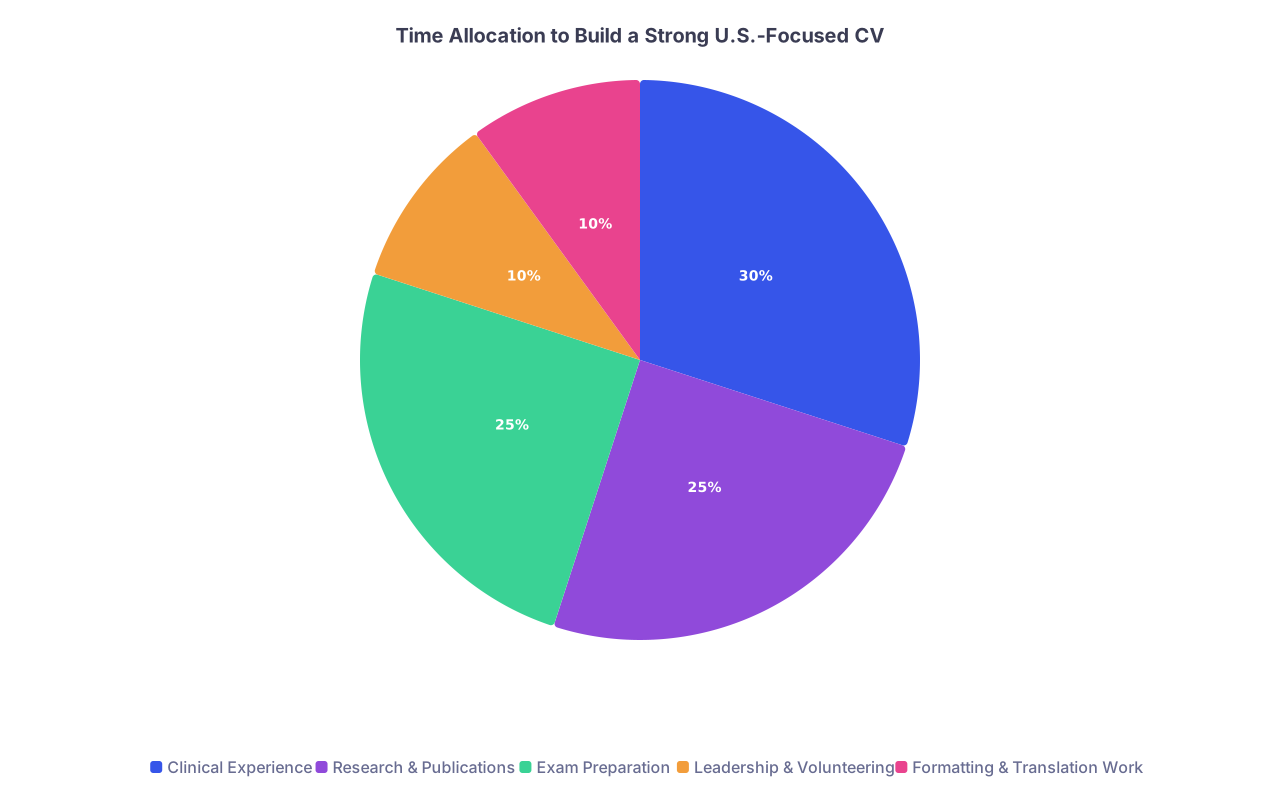
| Category | Value |
|---|---|
| Clinical Experience | 30 |
| Research & Publications | 25 |
| Exam Preparation | 25 |
| Leadership & Volunteering | 10 |
| Formatting & Translation Work | 10 |
Step 11: Start Early and Build It as a Living Document
You are in a foreign medical school. If you wait until final year to construct this CV, you will discover you are missing massive pieces.
The solution is simple: treat your CV like a running logbook.
Year-by-Year Focus
Use this as a rough plan, adjust for your curriculum.
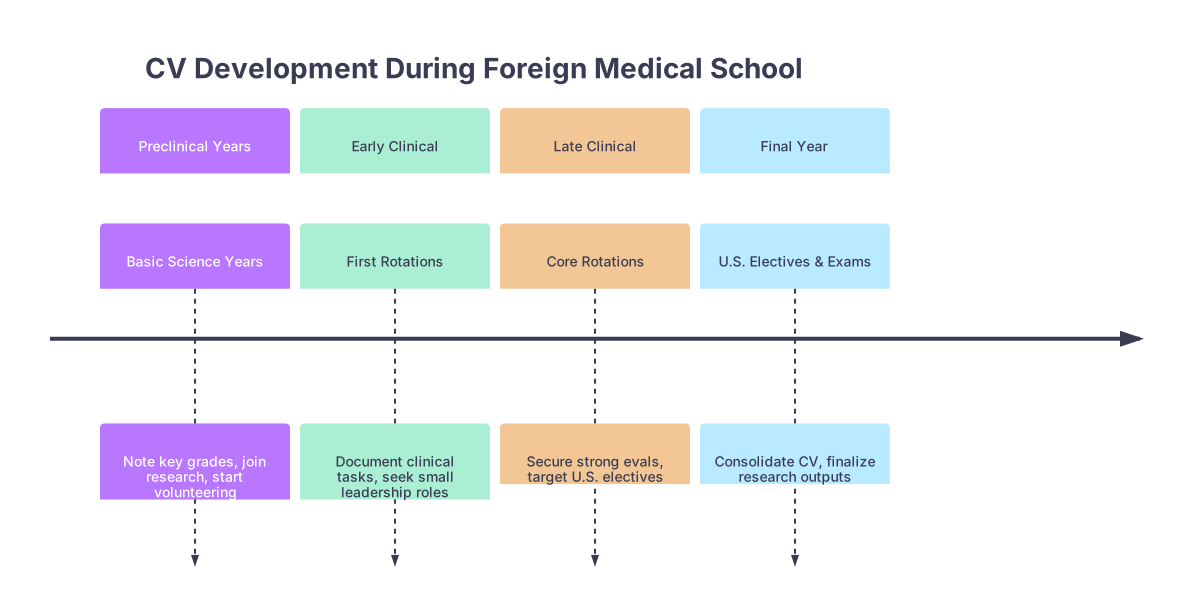
| Period | Event |
|---|---|
| Preclinical Years - Basic Science Years | Note key grades, join research, start volunteering |
| Early Clinical - First Rotations | Document clinical tasks, seek small leadership roles |
| Late Clinical - Core Rotations | Secure strong evals, target U.S. electives |
| Final Year - U.S. Electives & Exams | Consolidate CV, finalize research outputs |
Preclinical (Years 1–2 in 6-year; Years 1–3 in 4-year):
- Join one research project you can stick with.
- Find one consistent volunteer role.
- Keep a simple spreadsheet: date, role, hours, supervisor contact, key activities.
Early clinical:
- Start documenting concrete clinical responsibilities.
- Ask attendings if they would support you for a future U.S. elective letter if you perform well.
Late clinical / final year:
- Prioritize U.S. electives and quality letters.
- Focus research on getting at least 1–2 tangible outputs.
If you maintain a simple log as you go, building the CV later becomes data entry, not archaeology.
Step 12: Convert Local Systems into U.S.-Friendly Language
This is where being in a foreign school hurts you if you are lazy. You must translate:
- Grading systems
- Rotation structures
- Titles and roles
- Program names
Examples:
- “Student Index 4.7/5.0” → “GPA: 4.7/5.0 (top 5% of class).”
- “Propaedeutic practice” → “Introduction to Clinical Medicine rotation.”
- “Demonstrator in Anatomy” → “Anatomy teaching assistant (prosected cadaver demonstrations).”
When describing institutions unknown to Americans, sometimes one line helps:
- “University Hospital Center Zagreb – 1,700-bed tertiary referral center and main teaching hospital for the University of Zagreb School of Medicine.”
Do not overdo it, but one well-placed phrase like that can upgrade how they perceive your experience.
Step 13: Align Your CV With ERAS From the Start
Even years before applying, it helps to think in ERAS categories:
- “Work Experience”
- “Volunteer Experience”
- “Research Experience”
ERAS wants:
- One “Experience” entry per role.
- A concise description of duties and any “most meaningful” notes.
So when you write bullets on your CV, think: could I paste this into ERAS with minimal changes?
Example conversion:
CV bullet:
- “Assisted with outpatient follow-up for 15–20 pediatric patients per clinic, including growth charting and vaccine review.”
ERAS description field:
- “In this role I assisted with outpatient follow-up for 15–20 pediatric patients per clinic, including growth charting, vaccine review, and anticipatory guidance discussions under direct supervision.”
You are essentially building your ERAS experiences database early.

Step 14: Common Mistakes You Must Avoid
I have seen these derail strong applicants more times than I like.
Overstuffed CVs
- Listing every 2-hour workshop as “experience.”
- Ten different “certificates” that mean very little.
- Fix: Ask yourself, “Would an American PD care about this?” If not, cut it.
Local jargon everywhere
- “TPH,” “Index,” “Summer practice in dispensary,” etc.
- Fix: Write as if you are explaining your role to a smart American physician who has never been to your country.
Chronological chaos
- Random date order, missing years, no start/end months.
- Fix: Reverse chronological within each section with Month Year – Month Year for everything.
Exams buried on page two
- Coordinators want to know: did you pass Step 1 / Step 2?
- Fix: “Examinations and Certifications” on page one.
Photographs and personal data
- Photos, marital status, religion, date of birth.
- Fix: Name, email, phone, address, citizenship (optional). Nothing else.
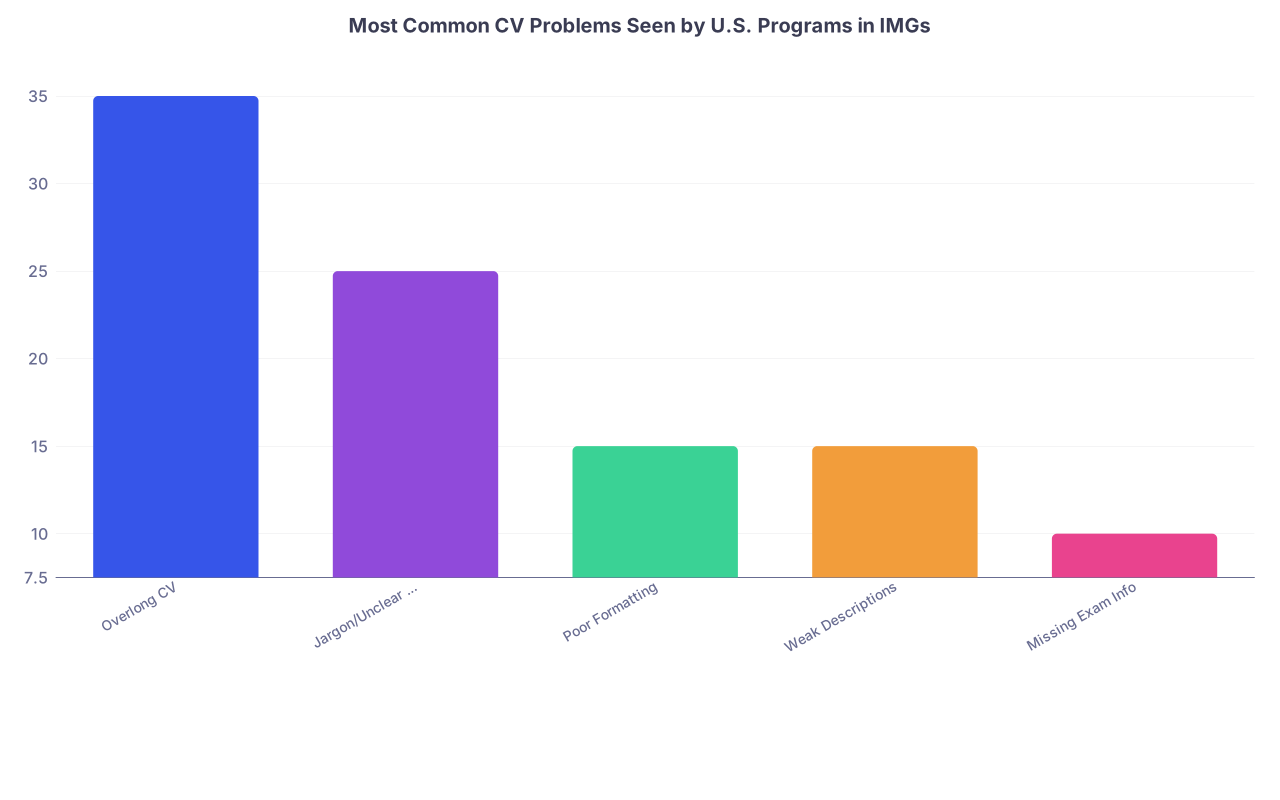
| Category | Value |
|---|---|
| Overlong CV | 35 |
| Jargon/Unclear Roles | 25 |
| Poor Formatting | 15 |
| Weak Descriptions | 15 |
| Missing Exam Info | 10 |
Step 15: Get a Ruthless External Review
You are too close to your own document to spot all the problems.
Who should review it:
- One person familiar with U.S. residency (attending, fellow, senior resident).
- Ideally someone who has served on a selection committee or interviews applicants.
Ask them very targeted questions:
- “If you saw this on ERAS, what would you assume about me?”
- “Which sections are weak or irrelevant?”
- “Where does this look like I am exaggerating or being vague?”
Then fix it. Without arguing. This is not a philosophical debate; it is job application surgery.

Step 16: Use the CV to Drive Your Next Moves
Here is the real power move: do not just build the CV. Use it as a planning tool.
Look at your current CV and ask:
- Do I have any U.S. clinical experience yet?
- Do I have at least one strong, long-term research or leadership commitment?
- Do I have concrete exam plans and realistic score targets for my specialty?
If there are blank or weak sections:
- Design your next 6–12 months around filling one or two gaps strategically.
- You do not need 20 activities. You need a handful of serious, sustained ones.

Final Tight Summary
Three key points.
- Build a U.S.-style structure from day one: clear sections, exams early, clinical and research described with specific, concrete duties.
- Translate your foreign school reality into American-readable terms: clarify degrees, grades, rotations, and titles, and avoid local jargon.
- Treat your CV as a living strategy document: keep it updated, use it to expose gaps, and plan your electives, research, and leadership to strengthen the weak spots before you ever hit “submit” on ERAS.


