
You’re midway through medical school abroad. Maybe M2 or early clinical years. You just discovered what nobody mentioned clearly in the glossy brochure: your international medical school has little or no access to U.S. clinical rotations. No formal U.S. teaching hospitals, no solid elective ties, sometimes not even a real affiliation letter template that programs respect.
You want a U.S. residency. Suddenly you’re realizing how big a problem this is.
This is the situation:
You’re already in. Money is sunk. Leaving feels impossible. Staying feels risky. Friends are shrugging and saying “people match from here every year” but when you actually dig into which ones and how, the stories get very vague.
So now the question is not “is this ideal?” It’s “given that I’m already here, what can I realistically do to salvage a U.S. residency shot?”
Let’s walk through that—stepwise, brutally honest, and practical.
Step 1: Get Clear on How Bad (or Salvageable) Your Situation Really Is
Before you start spinning, you need facts. Not rumors, not the dean’s speech.
Ask yourself and your school these very specific questions and write down the answers:
Do any graduates from my school match into U.S. residency in the last 3–5 years?
- Names. Programs. Specialties. Contact info if possible.
- Not “someone matched to New York.” I mean: “Dr. X matched IM at Nassau UH 2023.”
Does my school have signed affiliation agreements with U.S. hospitals?
- Not “we sometimes send students to…”
- Ask for: list of sites, type of rotation (core vs elective), and whether you’ll be guaranteed a slot or you’re competing.
Will I be allowed to do U.S. rotations during core years, or only as electives?
- Some schools lock you into local cores and only allow short U.S. electives late M4. That’s very limiting.
How many U.S. letters of recommendation (LoRs) do grads typically get?
- You want a number. “3–4 U.S. LoRs in specialty X” vs “1 generic LoR from an outpatient clinic doctor”.
What percentage of graduates pass Step 1 and Step 2 on the first attempt?
- If they do not know, or refuse to share, that is a red flag.
You’re trying to roughly place yourself in one of three buckets:
| Category | Description | U.S. Residency Chances (if you hustle) |
|---|---|---|
| [Tier A](https://residencyadvisor.com/resources/international-med-schools/the-unspoken-img-tiers-how-your-international-school-is-really-labeled) | Has structured U.S. core + electives, regular match history | Reasonable to good |
| Tier B | Only a few U.S. electives, some alumni matched | Possible but uphill |
| Tier C | No real U.S. access, almost no match history | Very difficult |
If you’re reading this, you’re probably Tier B or C. Tier A students are usually not panicking about lack of U.S. rotations.
Know your tier first. Then we talk salvage.
Step 2: Understand How Much U.S. Clinical Experience Actually Matters
Let me be blunt: for an IMG/FMG, U.S. clinical experience (USCE) is not “nice to have.” It’s core currency.
For residency programs, USCE does three big things:
- Shows you’ve seen U.S. patients, U.S. documentation, U.S. culture.
- Generates meaningful U.S. letters from people program directors know and trust.
- Makes your application feel less “unknown risky foreigner” and more “someone already functioning in this system.”
Programs don’t care much about shadowing. They care about:
- Hands-on clerkships (ideally in teaching hospitals)
- Sub-internships / acting internships
- Solid outpatient electives with strong documentation and supervision
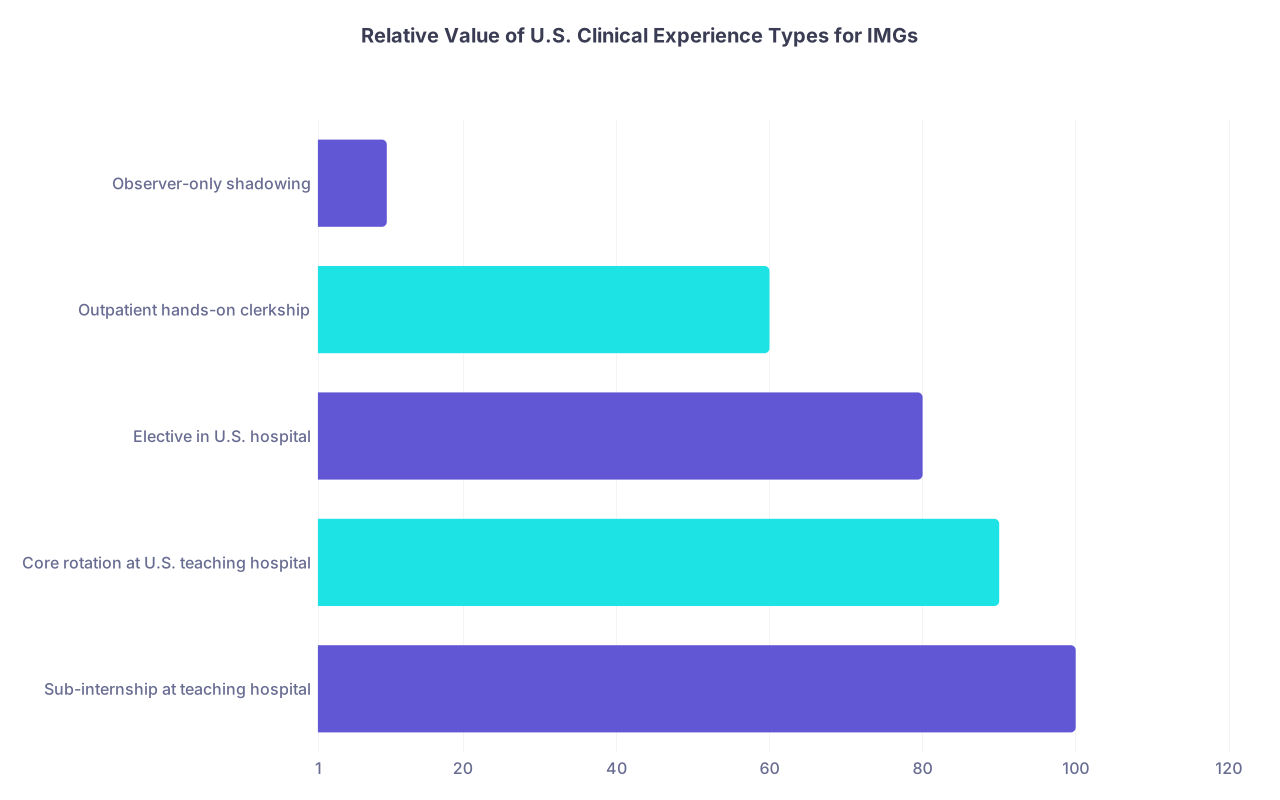
Here’s roughly how programs “rank” types of USCE:
| Category | Value |
|---|---|
| Sub-internship at teaching hospital | 100 |
| Core rotation at U.S. teaching hospital | 90 |
| Elective in U.S. hospital | 80 |
| Outpatient hands-on clerkship | 60 |
| Observer-only shadowing | 10 |
If your school offers none of that automatically, your job is to create enough of it on your own to not look completely outclassed.
Step 3: Know When You Might Need to Cut Losses and Transfer or Restart
This part nobody wants to say out loud.
There is a threshold where the smart move is to leave, transfer, or even restart rather than sink more years and money into a dead-end pathway.
I’ve seen this go wrong:
Student from an unrecognized Caribbean school, no hospital affiliations, Step 1 pass on second attempt, zero U.S. rotations until after graduation. They spend 3 years doing observerships and research, applying to 200+ programs annually. Never match. Now they’re locked out by recency-of-graduation filters and exam-attempt caps.
Contrast with the student who, in M2, realizes the school is a black hole and transfers to a better-known Caribbean program or even goes back to do a new degree at a more reputable institution. That hurts in the short term. But they eventually get integrated clinicals and match into FM or IM.
So here’s a quick reality filter. If all of these are true:
- No grads have matched to the U.S. in the last 3–5 years or it’s <1–2 per year
- School is not recognized by major state boards you care about (CA, NY, etc.)
- There are no structured U.S. hospital affiliations, just “we’ll help you find something”
- You’re still early (preclinical or early clinical)
Then I’d seriously consider:
- Transferring to a more established international school with U.S. rotations
- Pausing, taking stock, and possibly switching path altogether, if U.S. residency is non-negotiable for you
If you’re M4 or done with cores, the calculus changes. You’re probably too deep to restart, so you go into full salvage mode instead of escape mode.
Step 4: Build Your Own U.S. Clinical Rotations (The Uncomfortable Way)
Let’s assume you’re staying. No built-in U.S. rotations. You’ll need to build your own USCE portfolio. That usually means some mix of:
- Paid clinical electives / visiting student rotations
- Hospital-based externships
- Well-structured clinics with real hands-on work
- University-affiliated observerships (lower yield but still something)
Do not wait until final year. Start planning 12–18 months ahead, minimum.
4.1. Target hospitals and programs that actually accept IMGs
Stop Googling “best hospitals in U.S.” That’s how you end up on the Mass General site realizing they don’t take your school’s students.
You want places that:
- Already have IMGs in their residency
- Are in IMG-friendlier states (NY, NJ, FL, MI, TX, some community programs in the Midwest)
- Explicitly offer electives/observerships to international students
Look at program websites’ resident lists. If you see Caribbean, India, Pakistan, Eastern Europe, you know they’re not allergic to IMGs.
Then check if their associated med school/hospital offers:
- Visiting student electives (VSLO/VSAS is often U.S.-school-only, but some have separate IMG paths)
- Sponsored observer or extern programs
- Independent elective programs for a fee
4.2. Contact smaller hospitals and community programs directly
This is the grind that most people are too lazy to do. Which is why it sometimes works.
Template of what tends to work better:
- Find IM residency or FM residency program
- Look up core faculty, especially APD or clerkship director
- Send a short, extremely clear email: who you are, what you want, how long, and that you’ll handle your own malpractice insurance and documentation
You’re more likely to get yes from:
- Community hospitals with smaller med student presence
- Institutions in less “sexy” locations – think rural, smaller cities, Rust Belt, Deep South (for IM/FM)
- FM and IM vs Derm/Rad Onc/Neurosurgery (obvious, but people still try)
4.3. Use structured fee-based externship programs carefully
There are a bunch of companies that offer “U.S. clinical experience for IMGs” for a fee. Some are reasonable. Some are a joke.
Questions to ask before paying:
- Where exactly will I rotate (clinic vs hospital, teaching vs private)?
- Will I have direct patient contact and documentation responsibilities?
- Who writes my letter, and in what format?
- Have graduates gotten interviews or matches from this experience? Which specialties?
If the answer is mostly: “Outpatient clinic, no EMR, you’ll shadow and occasionally take vitals,” understand that this will not carry the same weight as an in-hospital teaching clerkship. Might still be better than nothing—but don’t fool yourself.
Step 5: Fix the Other Two Pillars: Exams and Research/Networking
Lack of U.S. rotations is one major handicap. That just means the other parts of your application cannot be mediocre. They need to carry more weight.
5.1. Overperform on exams
You do not have the luxury of being average here. For less competitive specialties, a strong exam record can partially offset weaker clinicals.
For IM, FM, peds, psych, etc., things that help:
- Step 2 CK: aim solidly above the mean for IMGs aiming for those fields
- Zero exam failures. A fail from an obscure school, plus no U.S. clinicals? That combination gets filtered out fast.
If you’re still early in school, structure your life around crushing Step 2. If Step 1 is pass/fail for you, then Step 2 is your de facto numeric flag.
5.2. Research and academic “legitimacy”
No, research will not magically erase the lack of USCE. But it does a few things:
- Gets you U.S.-based academic contacts
- Shows you can function in a U.S. team
- Adds something “anchored” to the U.S. system: PubMed-indexed papers, conference posters
Options that are realistic for IMGs abroad:
- Remote data projects with U.S. faculty (chart reviews, database work)
- Short in-person research stints during summers
- Volunteering for ongoing studies that don’t need you physically present full-time
Again, you’re looking for letters and relationships as much as lines on your CV.
Step 6: Time Your Moves Around Your Training Stage
What you do in M1 is different from what you do in your last year. Let’s break it down.
If you’re premed or not yet enrolled
Harsh truth: if you haven’t started at this school yet and it has no U.S. rotations? Just do not go there if U.S. residency is a serious goal.
You’re not “locked in.” You still have options:
- Reapply to U.S. DO or MD
- Consider more established international programs with real U.S. hospitals
- Strengthen your profile (MCAT, GPA, experiences) rather than signing up for a school that offers no clear path back
People get desperate and sign with any school that says “MD.” That’s how you end up in this situation 3 years later.
If you’re early preclinical (M1–M2 equivalent)
You’re in the gray zone where leaving or transferring is painful but still possible.
Your options:
- Try to transfer to a better-known international school that has real U.S. affiliations
- If you stay: set up a long-term plan now
- Build Step prep in a serious, consistent way
- Start networking for future rotations 12–24 months ahead
- Look up research options that you can begin even from abroad
This is when you’re deciding: “I’m committing to making this work” vs “I’m cutting my losses early.” Do not drift indecisively for two more years.
If you’re early clinical (starting cores)
At this stage, full restart is usually too expensive and disruptive. So you plan a hybrid strategy:
- Do local cores as required, but:
- Formalize a plan for 2–4 months of U.S. rotations in your final year
- Ask your school explicitly: can I take a leave or special elective time to do these?
- Build a timeline: exam dates, research, rotation months, ERAS application year
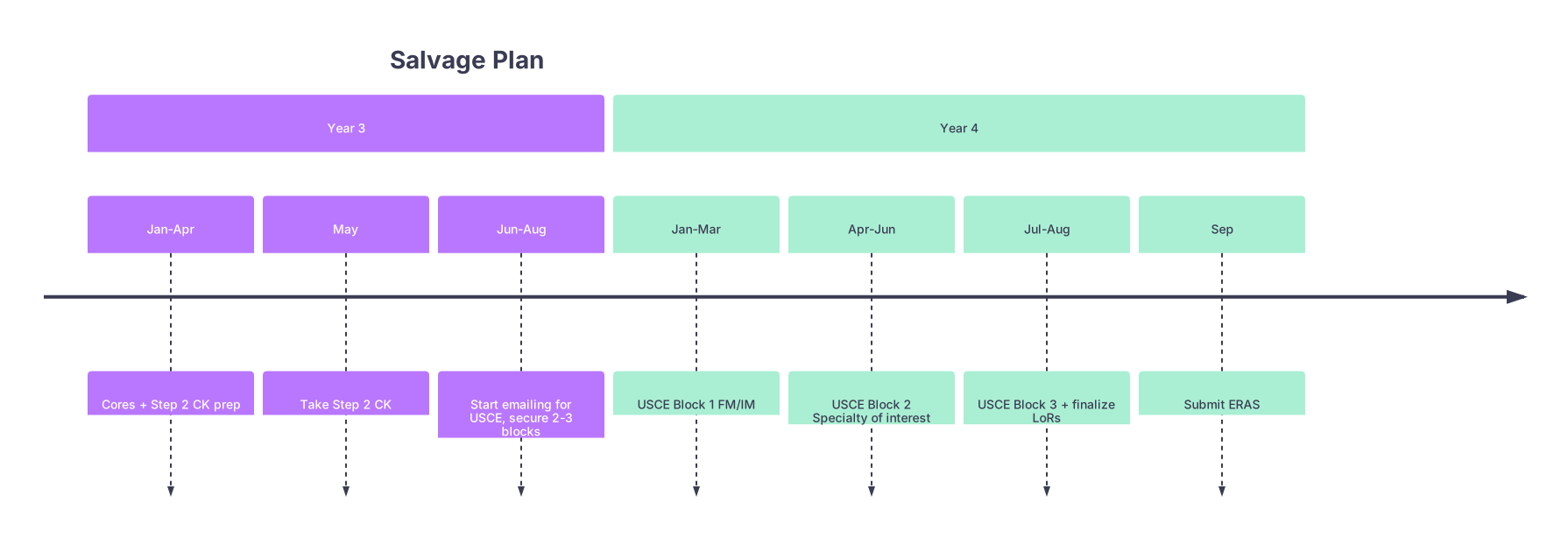
A rough, aggressive timeline might look like:
| Period | Event |
|---|---|
| Year 3 - Jan-Apr | Cores + Step 2 CK prep |
| Year 3 - May | Take Step 2 CK |
| Year 3 - Jun-Aug | Start emailing for USCE, secure 2-3 blocks |
| Year 4 - Jan-Mar | USCE Block 1 FM/IM |
| Year 4 - Apr-Jun | USCE Block 2 Specialty of interest |
| Year 4 - Jul-Aug | USCE Block 3 + finalize LoRs |
| Year 4 - Sep | Submit ERAS |
You won’t get that exact setup, but at least you’re thinking in terms of blocks and deadlines, not vague “I’ll figure it out.”
If you’re in your final year or already graduated
This is the hardest scenario. But not hopeless.
Your priorities:
- Secure at least 2–3 months of meaningful USCE (even if you’re paying for externship-type experiences).
- Collect 2–3 strong U.S. letters that specifically comment on your clinical work.
- Tight exam story: no new failures, Step 2 score solid, OET/English requirements handled.
- Apply strategically (more on that below).
You may need 1–2 application cycles. That’s not failure. That’s normal for a lot of IMGs in your position.
Step 7: Be Brutally Strategic About Specialty and Programs
You don’t have the application profile to “see what happens” with a scattershot of competitive specialties. Stick to lanes where you’re actually in the game.
In general (yes, there are exceptions), with no baked-in U.S. rotations, you should be looking strongest at:
- Family Medicine
- Internal Medicine (especially community programs)
- Pediatrics (selectively)
- Psychiatry (variable, but can be realistic)
These are relatively more IMG-friendly and more tolerant of uneven clinical backgrounds if other parts of the application are strong.
Less realistic without heavy extra support, connections, or insane exam/academic profile:
- Dermatology
- Neurosurgery
- Plastic surgery
- Ortho, ENT, Ophthalmology
- Radiation Oncology, Urology, etc.
You can want whatever you want; I’m telling you what actually happens.
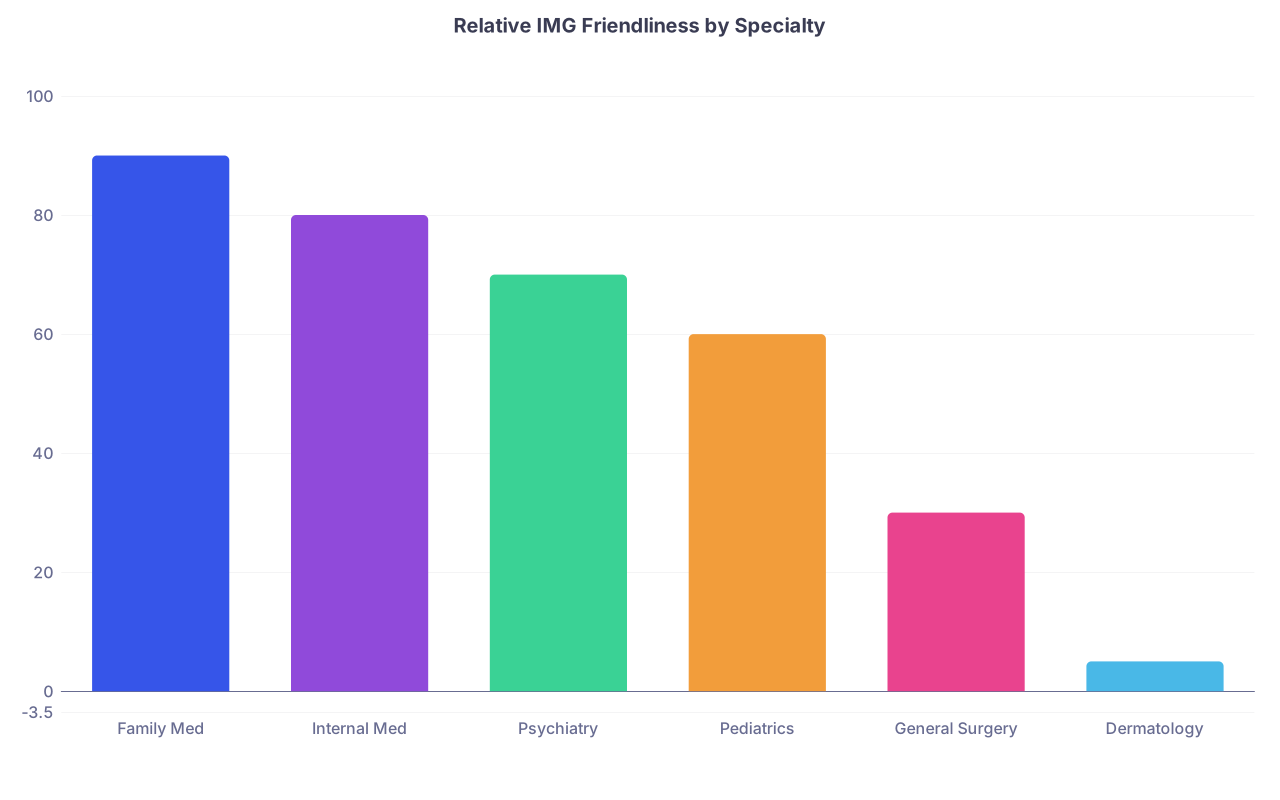
To get a sense of realistic target zones:
| Category | Value |
|---|---|
| Family Med | 90 |
| Internal Med | 80 |
| Psychiatry | 70 |
| Pediatrics | 60 |
| General Surgery | 30 |
| Dermatology | 5 |
Your program list should reflect your reality:
- Heavy on community hospitals
- Heavy on IMG-friendly states/regions
- Avoiding places with strict “no IMGs” or “must have U.S. med school” filters
You don’t need prestige. You need a training spot.
Step 8: Use Alumni and Personal Networking Aggressively (Not Politely)
If your school is weak on structure but has a few grads in the U.S., they’re gold.
Find them through:
- LinkedIn searches: “[School name] MD Internal Medicine”
- ECFMG or alumni groups
- Asking older students who matched: “Who helped you? Can I reach out?”
When you talk to them, do not ask, “Do you have any advice?” That’s vague and useless. Ask specific things:
- “Where did you rotate in the U.S. and how did you get those spots?”
- “Would your program consider me for an observership or elective?”
- “Would you mind introducing me to one attending who might host a rotation?”
Most will say no or be too busy. That’s fine. You do not need everyone. You need 1–2 solid connects.
Step 9: Prepare for a Longer Road and Have a Back-Up Plan
Here’s the part nobody wants to hear when they’re in med school abroad:
Sometimes, even when you do almost everything right, timing and luck don’t break your way.
You should still plan as if you will match. But you should have a backup channel running:
Potential contingencies:
- Another country’s residency: UK, Canada (tough), some European countries, your home country if acceptable
- Creating a profile strong enough for research-focused positions in the U.S. if you don’t match right away
- Non-training roles in healthcare while you reapply (clinical research coordinator, etc.)
Planning a backup isn’t “giving up.” It’s refusing to be cornered.
Step 10: What Not to Waste Time or Money On
Let me save you from common traps:
- Paying thousands for pure-shadowing experiences advertised as “USCE”
- Collecting generic “to whom it may concern” letters that say nothing about your clinical skill
- Applying to hyper-competitive specialties from a low-recognition school with no U.S. rotations
- Betting everything on one magic research project replacing real clinical work
- Believing school marketing about “many alumni in the U.S.” without verifying
You don’t have infinite time or cash. Every decision needs to move you towards:
Better USCE, stronger exams, or deeper U.S.-based relationships.
If it’s not clearly doing one of those, question it.
Key Takeaways
- If your international school lacks U.S. clinical rotations, you’re at a disadvantage—but not necessarily doomed. You either cut losses early (transfer/restart) or commit to a structured salvage plan: high exam scores, self-built USCE, and targeted networking.
- Your focus from now on is ruthlessly simple: secure real U.S. clinical experience with meaningful letters, overperform on exams, and apply to realistic specialties and programs that actually take IMGs.
- Don’t drift. Decide if you’re staying or getting out, build a concrete timeline, and accept that your road may be longer and less pretty—but still absolutely can end with a residency spot if you play it intelligently.


