

The biggest threat to international medical students isn’t the USMLE. It’s your school losing, changing, or “restructuring” its accreditation while you’re stuck in the middle of your degree.
If your international medical school suddenly changes accreditation status midway, you are not “a bit inconvenienced.” You are in a potentially career‑altering situation. And you need to treat it that way.
I’m going to walk you through what to do, step by step, like we’re sitting in a study room and you just showed me the email from your school. This is not about feelings. This is about salvaging your future options.
Step 1: Get brutally clear on what exactly changed
Do not trust the school’s mass email subject line. “Accreditation update” can mean anything from minor paperwork reshuffling to “you may never practice in the US.”
You need specifics. Quickly.
There are three main buckets of “change” you might be dealing with:
- Loss of accreditation
- Change of accrediting body
- Time‑limited / conditional / probationary status
You’re going to collect hard facts from three places:
- The school
- The accrediting agency (old and new)
- The country or region where you want to practice (e.g., ECFMG/US, GMC/UK, CPSO/Canada province, etc.)
Here’s the minimum info you must nail down this week:
- Old accrediting body name and status (e.g., CAAM‑HP, WFME‑recognized agency, national ministry only, etc.)
- New status:
- Fully lost?
- “Transitioning” to a new body?
- Placed on probation or conditional status?
- Effective date: When did the change actually take effect?
- Is there a “teach out” plan for current students?
- Has the school been listed in the World Directory of Medical Schools (WDMS) before and is it still listed?
Do not rely on verbal reassurance from a dean who “expects things to be fine.” Expect nothing. Verify everything.
Step 2: Cross‑check with where you actually want to practice
Accreditation is not abstract. It matters because licensing bodies and exam boards care.
You need to match your school’s new situation against the rules of your target country.
For US‑bound students, the big player is ECFMG. For UK it’s GMC, for Canada it’s provincial colleges + MCC.
Here’s how to sanity check, using the US as the main example.
For the US (ECFMG / USMLE / 2024+ rules)
Pull up three things:
- ECFMG / FAIMER website
- WDMS listing of your school
- The list of WFME‑recognized accreditation agencies
What you’re checking:
- Is your school still listed in WDMS as “Accredited”?
- Is the accrediting agency listed as WFME‑recognized?
- Are there cut‑off dates that might screw students who graduate after a certain year?
| Item to Check | Where to Look |
|---|---|
| WDMS status | World Directory of Medical Schools site |
| WFME recognition of agency | WFME official list |
| ECFMG eligibility year rules | ECFMG/FAIMER website |
| School's last accreditation date | School + accreditor websites |
If your school lost accreditation or swapped to some new local body that is not WFME‑recognized, this is a five‑alarm fire if you plan US residency after 2024. You may still be allowed to sit USMLE if you graduate before certain cutoffs, but the window can be narrow and unforgiving.
For the UK (GMC), you need to check:
- Is your school still recognized for provisional registration?
- Are there warnings or “transitional” clauses for students who enrolled before the change?
For Canada, you’re looking at:
- Whether your school remains on the acceptable list for that province’s college of physicians
- Whether MCC exams are still open to grads from your school
Bottom line: Within 72 hours, you should know:
- “If I graduate from this school in Year X, will I still be eligible for licensing/exams in Country Y?”
If you cannot answer that in a single sentence, you don’t understand your situation yet.
Step 3: Pin down your personal timeline and risk
Now we combine your facts:
- Current year in school
- Expected graduation year
- Policy timelines from ECFMG/GMC/etc.
- Accreditation timeline (loss, probation end, new body approval dates)
You’re answering one question: Is it safer to stay or safer to get out?
Let’s walk a few common scenarios.
Scenario A: School lost accreditation outright, no clear plan
Example: Second‑year student at a Caribbean school. Email says accreditation “was not renewed” and they’re “exploring options.”
This is bad. Especially if:
- You want US residency
- The school is not tied to a WFME‑recognized agency
- There’s no specific date or name for a new accrediting body
Here, your default assumption should be:
“If nothing changes, I may not be eligible for US residency or certain licensing.”
Unless:
- You can graduate before critical cutoff dates and
- ECFMG or your licensing body explicitly states you’re protected due to your enrollment date
If both are not 100% clear, you seriously consider transferring or restarting elsewhere.
Scenario B: Accreditation body changed, but both old and new are WFME‑recognized
Example: European school moves from national ministry accreditation to a regional WFME‑recognized agency. There’s a formal announcement with dates, and WDMS is updated.
This is much less concerning.
In that case, your main tasks:
- Confirm your cohort is covered in any transitional language
- Get written proof from the school that your degree will be considered accredited at graduation under the new system
You may not need to transfer, but you still document everything in case credentialing questions arise later.
Scenario C: Probation / conditional status
Probation is not the same as loss, but it’s a yellow flag.
What you want to know:
- What triggered probation? (faculty? facilities? governance? exam results?)
- Timeline for review and potential restoration or loss
- Whether students graduating during probation are still considered graduates of an accredited school in your target countries
If your graduation is 1–2 years away and the review is in 6–12 months, this is a watch‑closely situation, not immediate evacuation. But you should be researching transfer options in parallel, just in case the review goes badly.
Step 4: Talk to the right people (not just the loud ones)
There are always three groups who speak first and loudest:
- The school’s leadership trying to keep everyone calm
- Angry students in WhatsApp/Telegram groups saying “we’re all screwed”
- Random Reddit/FB “experts” who half‑understand accreditation
You need signal, not noise.
The people who matter:
- Registrar / academic affairs: for official status for each cohort
- Graduate affairs / ECFMG liaison (if your school has one): for US‑related specifics
- Actual licensing bodies: email ECFMG/GMC/etc. with your exact situation
- Upper‑year students / recent grads: to see what they’re hearing at the level of Match, registration, visas
Send specific questions. Not “Am I OK?”
Try something like:
I am a third‑year student at [School], matriculated in [Month Year], expected graduation [Month Year].
Our school was previously accredited by [Old Agency] and is now [status with new agency].
Can you confirm whether graduates in my cohort will be considered from an accredited medical school for purposes of [ECFMG certification / GMC registration / MCCQE eligibility], assuming we graduate on time?
Get answers in writing. Save the PDFs. You may need them 8 years from now.
Step 5: Decide between three main paths
Once you understand your risk, you’ve basically got three options:
- Stay and ride it out
- Transfer to another school
- Cut losses and restart elsewhere
None of them are fun. You’re picking the least bad option.
Path 1: Stay and ride it out
You stay if:
- Your ability to get licensed where you want is still intact with high confidence
- Accreditation is shifting between recognized agencies, not disappearing
- There is a clear, public plan with real dates and you’re in the protected cohort
If you stay:
- Push to finish on time. Delays can push you past important policy cutoffs.
- Avoid LOAs or repeat years unless absolutely necessary.
- Keep all documentation about accreditation status during your enrollment.
Think of this as “proceed with caution and record everything.”
Path 2: Transfer to another school
Transferring sounds easy in theory. In practice, it’s ugly.
Realities:
- Most reputable schools don’t love accepting mid‑program transfers from troubled schools.
- You may lose a year or more of credit.
- You will have to explain the move in future applications.
Good reasons to transfer:
- Your target country’s rules are clear: your school’s new status will block licensing.
- There’s no credible path to restoring recognized accreditation.
- You find a school with stable, recognized accreditation that will take most of your credits.
Transfer targets:
- Other international schools with strong, stable accreditation (e.g. CAAM‑HP‑accredited Caribbean schools, well‑established Eastern European universities with WFME‑recognized national agencies, etc.)
- Occasionally, domestic schools in your home country if they accept returnees
If you go this route, be ruthless. Do not move from one shaky, low‑status school to another just because the transfer is “easier.” That’s how you lose another two years and end up in the same hole.
Path 3: Cut losses and restart
This is the nuclear option, and it’s the right call more often than people admit.
You seriously consider a full restart when:
- Your current program is almost certainly going to be worthless for your target country
- Transfer options are either shady, unaccredited, or want you to repeat 2+ years anyway
- You’re early enough (pre‑clinical or early clinical) that burning 1–2 years now might still be better than graduating with a dead‑end degree
If you’re a second‑year at a no‑name offshore school that just lost the only accreditation that made you ECFMG‑eligible, and there’s no real plan? Restarting at a better‑vetted school (international or domestic) may be the smartest painful choice you ever make.
Step 6: Protect your exam and Match strategy
Accreditation changes don’t just affect your degree. They hit exams, visas, and Match competitiveness.
You need to adjust your tactical plan.
USMLE/ECFMG‑related
If your eligibility window might narrow:
- Push to take Step exams as early as allowed.
- Avoid unnecessary delays in clinical progression.
- Confirm that sitting the exam is still allowed for your cohort even if future grads may be blocked.
If there’s a risk that ECFMG certification becomes impossible after your graduation year, you might even aim to graduate slightly earlier (clearing electives, taking summer blocks, etc.), if your school allows it.
Residency / Match positioning
Programs pay attention—directly or indirectly—to accreditation chaos. Even if you’re technically eligible, you may be coming from a school now seen as unstable.
Your response:
- Overbuild the rest of your application: strong USMLE scores, US clinical experience, solid letters.
- Be prepared to explain the accreditation situation briefly and calmly in interviews: “When I was in year X, our school shifted accreditation from A to B; our cohort remained accredited and ECFMG‑eligible, and I verified that with ECFMG directly.”
- Consider slightly less competitive specialties or locations if your school’s reputation took a hit along with its accreditation.
Step 7: Manage the emotional and logistical fallout without going under
Let me be blunt: this sucks. You’re allowed to be angry, scared, resentful.
What you cannot do is freeze for six months and hope it works itself out. That’s how students miss transfer windows, exam cutoffs, and application cycles.
Concrete things to do:
- Give yourself a 72‑hour window for initial freak‑out. Vent. Talk. Complain. Then move to action.
- Set a short checklist for the first 2 weeks:
- Confirm status with school and accreditor
- Email licensing/ECFMG/GMC with your details
- Research at least 3 transfer/restart options
- Talk to at least 2 older students who are closer to graduation
- Revisit your plan monthly. Accreditation issues drag on, and things can improve or deteriorate.
Do not underestimate how much this might affect your long‑term trust in institutions. That’s normal. Just don’t let that anger push you into worse decisions (“I’ll just finish and see what happens” is not a plan).
Visual: Decision flow when accreditation changes

| Step | Description |
|---|---|
| Step 1 | Accreditation Change Announced |
| Step 2 | Confirm exact new status |
| Step 3 | Check WDMS & accreditor |
| Step 4 | Check ECFMG/GMC/MCC rules |
| Step 5 | Stay and document everything |
| Step 6 | Contact licensing bodies with cohort details |
| Step 7 | Evaluate transfer/restart |
| Step 8 | Still eligible at graduation year? |
| Step 9 | Get written confirmation? |
Common traps to avoid
I’ve watched students walk into these mistakes over and over:
Believing “we expect everything to be fine” from admin. Expect nothing until you see formal recognition from a WFME‑recognized or nationally accepted body.
Assuming your situation is the same as that one person on Reddit. Policy details—matriculation year, graduation year, old vs new accreditor—change everything.
Sinking more years into a degree that’s already dead in your target country. “But I’ve already done 3 years” is not a reason to do 2 more if the final paper doesn’t get you licensed.
Transferring laterally to another questionable school just because it’s easy. Better to pause, research properly, and join a more stable program even if it means some repetition.
Delaying decisions until options disappear. Transfer windows close. Accreditation decisions get finalized. You want a plan before you’re backed into a corner.
Simple example timelines
To make this less abstract, look at a quick timing comparison:
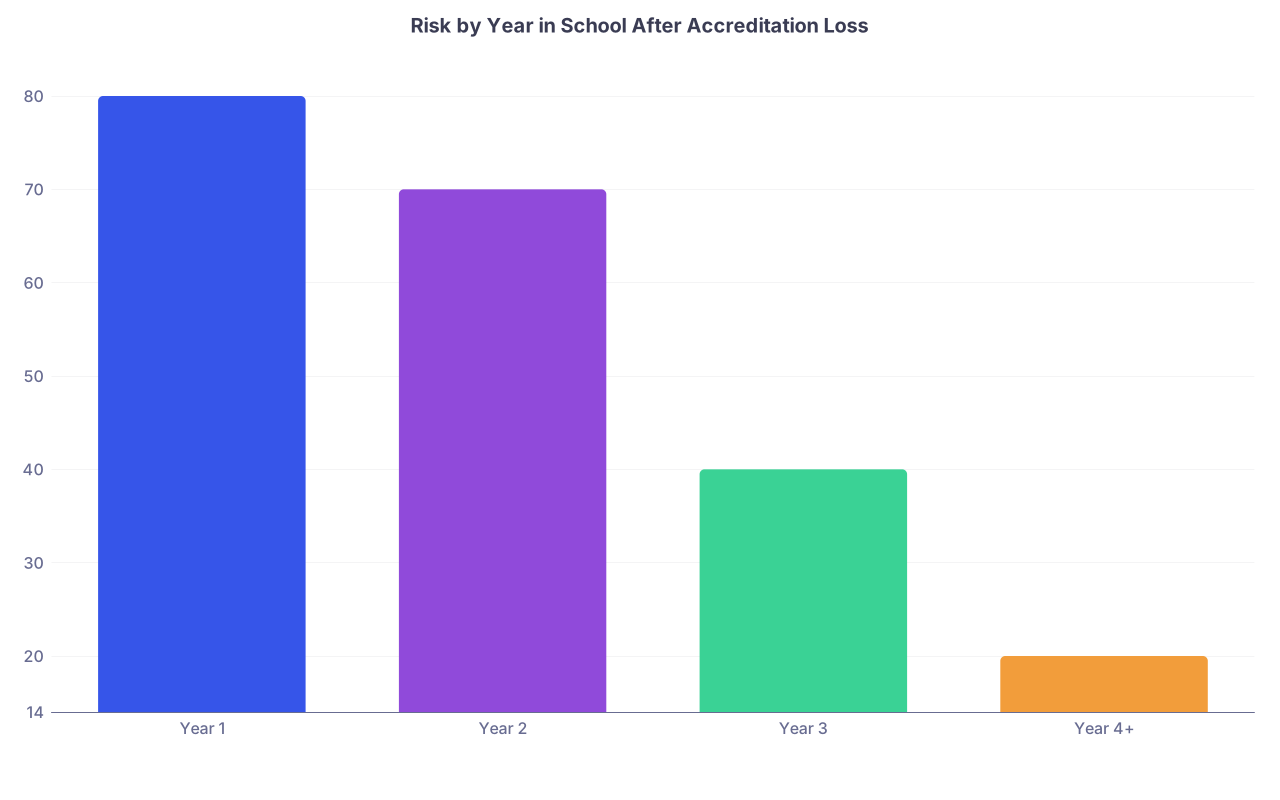
| Category | Value |
|---|---|
| Year 1 | 80 |
| Year 2 | 70 |
| Year 3 | 40 |
| Year 4+ | 20 |
Interpretation (rough, not mathematical):
- Year 1–2: high flexibility to transfer or restart; high risk of wasting time if you stay at a doomed program.
- Year 3: mixed; need precise policy info and realistic assessment of recovery chances.
- Year 4+: often better to ride it out if your cohort still qualifies under old rules.
FAQ (exactly 3 questions)
1. If my school is still listed in the World Directory, am I automatically safe?
No. WDMS listing by itself is not enough. What matters is:
- Whether your school is listed as “Accredited” by an agency that’s recognized (WFME or accepted by your target country), and
- Whether ECFMG/GMC/etc. have any time‑based rules tied to when you graduate.
A school can be in WDMS yet have accreditation that doesn’t meet new ECFMG 2024+ standards, or be in a transitional state. Always cross‑check WDMS with the accrediting agency’s recognition status and ECFMG/GMC rules.
2. Will transferring from a school with accreditation problems hurt me later in residency applications?
Programs mostly care about:
- The final school printed on your diploma,
- Your exam scores, clinical performance, and letters.
You may occasionally be asked why you transferred; a straightforward explanation (“My original school lost recognized accreditation; I transferred to ensure my eligibility for licensing”) is completely reasonable. That’s very different from hiding it. A well‑documented, rational transfer usually hurts you less than staying at a collapsing institution.
3. My school is saying that students who ‘matriculated before date X are protected.’ Can I trust that?
You can’t just “trust” it—you need to verify it. Sometimes this is true; accreditors or licensing bodies will grandfather in existing students. But you want:
- Written confirmation from the accreditor or licensing body (not just the school) that your cohort is considered from an accredited program for licensing/exams,
- Clear language tying protection to your matriculation or graduation date, not vague promises.
Until you have that, you should behave as if your eligibility is uncertain and keep transfer/restart options on the table.
Key points, no fluff:
- Do not rely on your school’s reassurance—get hard, written confirmation from accrediting bodies and licensing authorities about your cohort and your graduation year.
- Decide quickly but rationally between staying, transferring, or restarting based on one thing: future licensing eligibility where you actually want to practice.
- Document everything and adjust your exam/Match strategy to overcompensate for any reputational or bureaucratic damage your school’s accreditation chaos might cause.


