

The fantasy that you can easily “upgrade” your international medical school halfway through is wrong. Transfers between international medical schools are possible, but they’re rare, messy, and often more painful than just fixing your situation where you are.
If you’re thinking about transferring, you’re probably in one of a few situations:
- You hate your current school (teaching, culture, location, or all of the above).
- You realized the school’s accreditation or US/UK/Canada match outcomes are weak.
- Your life circumstances changed: family, finances, visas, wars, health.
- You want to move from one country’s system to another (say, Caribbean → Europe, Eastern Europe → UK, etc.).
I’ll walk you through when transferring can realistically work, when it’s a trap, and the exact steps to take if you decide it’s worth trying.
1. Get Clear on What You Actually Want
Before you Google “medical school transfer form” one more time, you need to answer a blunt question:
Are you trying to:
- Escape a bad situation quickly, or
- Strategically reposition yourself for long-term training and licensure?
Those are not the same move.
Common goals I see:
- “I want better chances to match in the US/UK/Canada.”
- “I want to be in a safer/more stable country.”
- “I need to be closer to family / partner.”
- “I think I picked a low-quality school and I want better training.”
- “I realized my school’s recognition/accreditation is shaky.”
Write down your top two reasons. If “I’m miserable” isn’t in the top two, but “my friends are transferring” is, pause. Transferring is too expensive and disruptive to do because of FOMO.
Then, clarify your target:
- Same country, different school?
- Different country, same language of instruction?
- Different system entirely (e.g., 6-year EU program → 4-year North American-style)?
The more system-jumping you do, the harder it gets. A Polish 4th-year trying to jump into a 3rd-year Canadian or US-style program? Massive headache. Multiple exams, curriculum mismatches, and often impossible.
2. Understand When Transfers Are Even Realistic
Most people overestimate how “transfer-friendly” medical schools are. They’re not like undergraduate programs. Seats are tightly regulated, tied to accreditation limits, and politically sensitive.
There are a few broad scenarios where transferring between international schools is at least plausible:
| Transfer Path | Difficulty | Typical Success Rate* |
|---|---|---|
| Within same country, same language | Medium | 20–40% |
| Within EU, English-taught → English-taught | Medium-High | 10–25% |
| Caribbean lower-tier → higher-tier Caribbean | High | <10% |
| Non-EU → EU/UK | Very High | Rare |
| International → US MD/DO | Extremely High | Exception-only |
*These are rough directional estimates from observed patterns, not official statistics.
General rules of thumb
You have your best shot at transferring if:
You’re early in the program
Year 1–2 (preclinical) is the realistic window. Once clinical rotations start, schools hate trying to align requirements.The curricula are similar
Same language, similar preclinical content, comparable exam structure. Example: Hungary → Czech Republic → Poland (English programs) is hard but not insane.You have strong grades and clean conduct
Many schools want you in the top 25–30% of your cohort. Academic probation? Failed multiple courses? Your chances drop sharply.You have a compelling reason the new school actually accepts
“I like your city more” is not a good reason. Documented safety concerns, war, political instability, closure/loss of accreditation, or major family issues carry more weight.
If you’re late in school (clinical years) and just want a better brand name: it almost never works. Most schools will say no outright.
3. Fix the Non-Negotiables First: Accreditation, Recognition, Licensure
If you’re in an international medical school and thinking about transferring, you’re probably worried about eventual licensure in the US, UK, Canada, or another high-regulation country.
Here’s the brutal truth: if your current school’s accreditation and outcomes are poor, transferring is sometimes the only smart option—if you can pull it off.
Start by checking these basics:
- Is your school listed in the World Directory of Medical Schools (WDOMS)?
- Does it have recognized accreditation (WFME-recognized agency, national regulator)?
- Does your eventual target country recognize graduates from this school?
- Are there recent or upcoming changes to status (on probation, at risk of closure, political issues)?
If the answer is:
- “No WDOMS” or
- “Losing accreditation” or
- “Country X has started rejecting this school”
…then you’re not overreacting. You’re in a structurally bad situation.
In that case, your priorities shift:
- Move to a recognized, stable program, even if it’s not glamorous.
- Minimize credit loss, even if you have to repeat a year.
- Document every course and exam you’ve taken for future regulators.
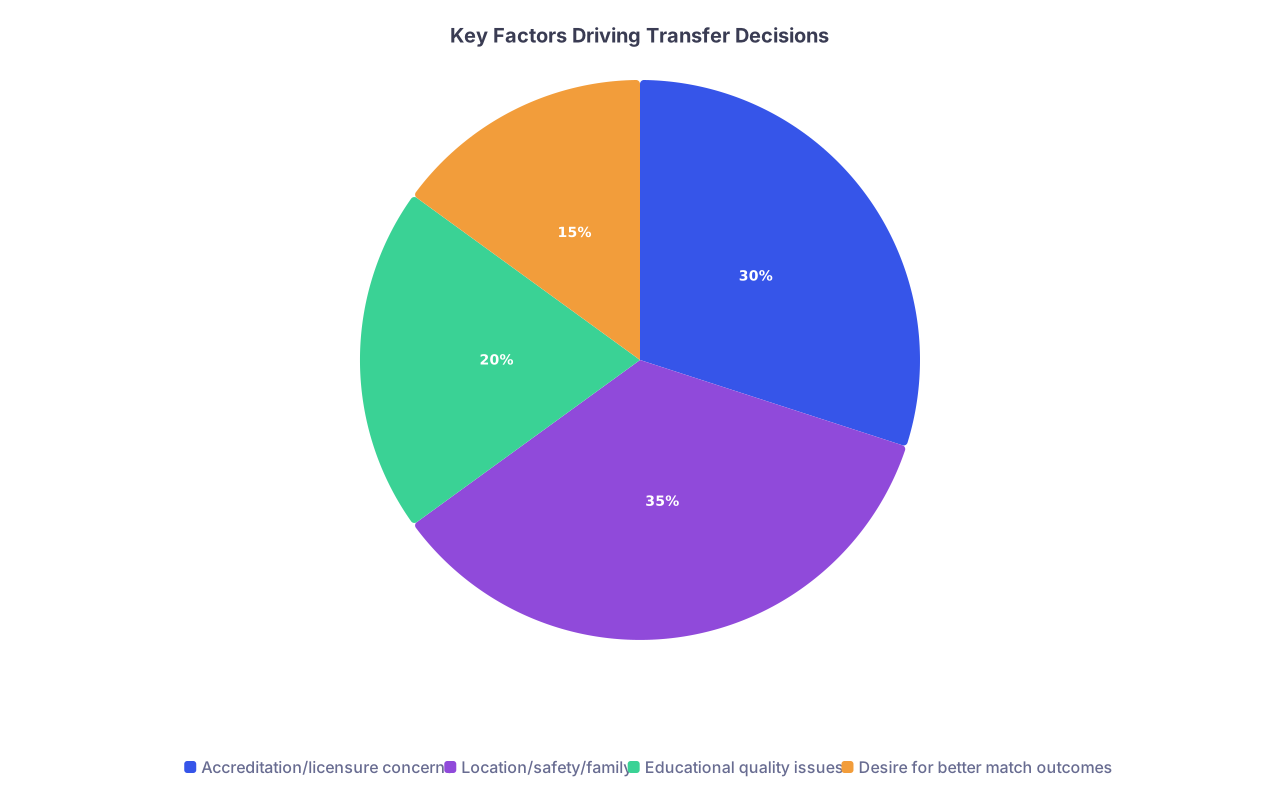
| Category | Value |
|---|---|
| Accreditation/licensure concerns | 30 |
| Location/safety/family | 35 |
| Educational quality issues | 20 |
| Desire for better match outcomes | 15 |
If your school is fine on accreditation but you’re just unhappy? Different story. In that case, staying and improving your profile (research, scores, electives) is often a better bet than a risky transfer.
4. The Step‑by‑Step Process: How Transfers Actually Work
If you’re serious about attempting a transfer, here’s the sequence I’ve watched actually produce results.
Step 1: Go quiet and collect intel
Do not start by complaining to your dean that you want to leave. You need information first.
Quietly gather:
- Your full transcript (with ECTS credits if in Europe or equivalent)
- Course syllabi/outlines (content, hours, assessment types)
- Proof of language of instruction
- Class rank or GPA if available
- Any official notes about curriculum structure (6-year, 4-year, integrated, etc.)
You’re building a “transfer packet” that lets another school map you into their system.
Step 2: Shortlist realistic target schools
Design a shortlist of 3–8 schools that:
- Accept transfer students at all (many don’t; check the website or email).
- Have programs that match yours reasonably (English vs local language, 6-year vs graduate-entry, etc.).
- Are in countries where you can feasibly get a visa and afford living costs.
Look for:
- “Admission to higher years” or “transfer admission” pages.
- Limits like “only up to year 3” or “no transfer into clinical years.”
- Required exams (some will make you sit their year-end exam or entrance test).
Use this filter: if the school’s website explicitly says “We do not accept transfers under any circumstances,” believe them. Do not try to charm your way around it. You’re wasting time.
Step 3: Quietly contact admissions the right way
Your email should be short and precise. Something like:
Dear Admissions,
I am currently a [2nd-year] medical student at [University, Country], enrolled in the [English-taught 6-year MD program], and I am exploring the possibility of transfer into [2nd/3rd] year at your institution due to [brief, neutral reason: family relocation / instability in region / school closure risk].
I have completed [X] ECTS credits, passed all compulsory subjects to date, and can provide detailed syllabi and transcripts. Could you confirm:
- Whether your school currently accepts transfer students into [year] of the program.
- The required documents and timelines.
Thank you for your time.
[Name, current year, contact]
Do not open with a rant about your current school. That’s a red flag. Focus on facts.
Collect their replies. Some will give you:
- Hard no → move on.
- Conditional yes → “We consider transfers, but you’ll likely need to repeat a year.”
- “Send us your documents and we’ll evaluate” → potential opportunity.
Step 4: Decide what you’re willing to sacrifice
Transferring almost always costs you:
- Time (repeating semesters or a full year)
- Money (new tuition structure, moving, visa fees)
- Stability (new system, new rules, new support network)
You need to know your lines:
- Are you willing to repeat a year?
- Can you afford 1–2 extra years of tuition + living costs?
- Can you handle temporary delays to licensing exams (USMLE, PLAB, etc.)?
If you are in year 3 and a school says, “We can take you into year 2,” that’s not an insult. That’s them trying to align their curriculum. Many students reject offers like this out of pride—and end up stuck in worse programs.
5. Special Scenarios: What If You’re In…
Let’s go through some of the common real-world situations I see and what usually works.
A. Caribbean medical school, worried about outcomes
You’re in a lower-tier Caribbean school. Match rates look sketchy. Clinical sites are unstable. You’re thinking of jumping to a higher-tier Caribbean school, US DO, or European English-taught program.
Reality:
- Transfer to US MD? Essentially no.
- Transfer to US DO? Rare, extremely competitive, usually only from well-known Caribbean programs and early in preclinicals.
- Transfer Caribbean → Caribbean? Possible but uncommon, and the “better” schools do not love taking students from weaker programs.
- Caribbean → Europe (6-year)? Sometimes possible but often means stepping back by 1–2 years.
If you’re preclinical and your school’s outcomes are demonstrably poor, I’d still explore:
- US DO transfer policies
- Higher-tier Caribbean programs with established US match pipelines
- European English-taught programs willing to place you in early years
But you must accept likely lost time.
B. Eastern Europe / Central Europe, thinking of switching countries
Example: 2nd-year in Ukraine/Georgia/Belarus forced out by instability; or student in one EU country wanting to move to another.
Here, you have more realistic hope.
Often possible:
- Ukraine/Georgia → Poland/Hungary/Czech/Slovakia → possible with documented coursework and entrance tests
- Within EU English-taught programs → some mobility, especially if your reason is war, closure, or political instability
You’ll likely face:
- Entrance exams (basic sciences)
- Extra language requirements if clinical years require local language
- Repeating part of a year because of curriculum gaps
In these situations, the documented reason (war, sanctions, expelled foreign students) can work in your favor. Schools don’t want to look heartless.
C. International program → UK/Irish medical schools
If you’re already in a non-UK medical program and think you can transfer into year 2 or 3 of a UK or Irish school: almost always no.
They might:
- Make you start from year 1 again as a new entrant (very rare).
- Refuse completely and ask you to apply for graduate entry later instead.
If the UK/Ireland is your end goal and you’re early in your international program, sometimes it’s smarter to:
- Withdraw early before you accumulate too many random credits,
- Apply fresh to 5–6-year UK/Irish programs or graduate-entry later.
Not saying it’s easy. Just more predictable than chasing transfer unicorns.
6. Protect Your Future Licensing Options While You Decide
Whatever you do, do not sabotage future licensing because you panicked and made a messy exit.
While you’re exploring a transfer:
Keep passing your current courses
A failed year on your transcript is a long-term scar. Even if you hate everything, protect your record.Collect documents as you go
Every semester, save:- Official transcripts
- Course descriptions, credit loads
- Any proof of language of instruction
Know how multiple schools on your CV will look
Some licensing bodies and residency programs will ask why you attended two or more medical schools. Have a clean, factual explanation ready:- “University X suspended foreign student teaching after war; transferred to University Y.”
- “Family relocation and visa loss required me to continue training in another country.”
Not: “I didn’t like it there.”
Do not burn bridges
You will need a “good standing” or “no objection” letter from your current school for some transfers. If you trash the place on your way out, you might not get it.
7. The Emotional Side: When to Stop Trying to Transfer
At some point, you need to commit. Either to leaving or staying.
Here’s when I tell people to stop chasing transfers and focus on maximizing their current school:
- You’re already in clinical years and no school will take you without losing 2+ years.
- Your current school is accredited, stable, and recognized where you want to practice.
- Your grades are mediocre and you’re not competitive for selective transfers.
- You’ve applied to several realistic schools and received only “no” or “start from year 1” offers you can’t accept.
In that situation, your energy is better spent on:
- Top-tier exam performance (USMLE, PLAB, national licensing)
- Strong clinical evaluations and letters
- Electives abroad in your target system
- Research, language skills, and networking
I’ve watched students waste 18–24 months emotionally “half transferred”—mentally checked out, constantly preparing applications, never fully investing where they are. They then graduate with mediocre records from decent schools and blame the school instead of the indecision.
Pick a lane.
8. Concrete Action Plans by Situation
Let me give you tight, scenario-based playbooks.
Scenario 1: You’re a 1st-year in an international school you already distrust
What to do in the next 3 months:
- Pass every course this year. Aim high grades.
- Build your full course documentation folder.
- Shortlist 5–8 more reputable or stable schools in countries you can live in.
- Email their admissions about transfer/higher-year entry for next academic year.
- Decide before the end of the year: stay and commit, or prepare to move and possibly repeat a year.
Scenario 2: You’re a 3rd-year starting clinicals and just realized match outcomes are poor
Reality check:
- Transfer options now are limited and expensive (repeat years, different systems).
- You’re better off exploiting every possible way to stand out from your current base.
Next 6–12 months:
- Clarify your target country and licensing path.
- Max exam scores (USMLE/PLAB/others) if allowed.
- Secure the best clinical experiences and mentors available.
- Explore visiting electives in more reputable systems during final years.
- Stop obsessing over transferring unless a truly exceptional opportunity appears (e.g., your school merges with another, or you’re offered a structured pathway).
Scenario 3: Your school is in a politically unstable region (or at risk of closure)
In this case, you move fast.
Within 4–8 weeks:
- Download and save every academic record possible.
- Contact multiple schools that have publicly accepted displaced students before (this happened with several Ukrainian cohorts).
- Accept that repeating a semester or year is likely.
- Consider both similar-region schools and more stable EU/English-taught options if language allows.
Do not wait until your school physically closes or expels foreign students. Once things are chaotic, getting documents becomes a nightmare.
9. A Quick Reality Filter: Is Transferring Worth It For You?
Ask yourself three blunt questions and answer honestly:
- If I stay where I am, can I still become licensed and employable in at least one country I’m okay living in?
- If I transfer, am I realistically improving my long-term chances, or just changing scenery?
- Can I handle an extra 1–2 years, financially and emotionally, without falling apart?
If:
- Q1 = no (school not recognized, losing accreditation),
- And Q2 = yes (target school clearly stronger in recognition),
Then yes, fight for a transfer or restart. Painful now, better later.
If:
- Q1 = yes,
- Q2 = murky,
You probably stay. And you make the most of your current situation instead of gambling on a move that may not happen.

| Step | Description |
|---|---|
| Step 1 | Unhappy or concerned in current school |
| Step 2 | Prioritize transfer or restart |
| Step 3 | Collect docs, email realistic schools |
| Step 4 | Focus on exams, electives, CV, stop chasing transfers |
| Step 5 | Weigh time/money vs long-term benefit and decide |
| Step 6 | Accreditation/licensure at risk? |
| Step 7 | Year <= 2? |
| Step 8 | Offers received? |

10. Final Moves: How to Exit or Stay Without Regret
If you decide to transfer:
- Get acceptance in writing with details on placement year and recognized credits.
- Secure needed letters from your current school before announcing departure widely.
- Plan visas, housing, and finances conservatively (assume delays).
- Accept the identity shift: you’re basically starting over socially and academically.
If you decide to stay:
- Stop browsing transfer forums daily. That mental drain is real.
- Map out a concrete route from your current school to your desired country: exams, electives, language, research.
- Fix what you can locally—seek better mentors, study groups, clinical exposure.

Key Takeaways
- Transfers between international medical schools are possible but rare, messy, and usually only worth it when accreditation, safety, or licensure are genuinely at risk—not just because you dislike the vibe.
- Your realistic window is early (years 1–2), within somewhat similar systems, and with strong academic performance; expect to lose time and possibly repeat a year.
- Whether you stay or move, commit: protect your transcript, document everything, and build a clear path to licensing in at least one country you’re actually willing to live in.


