

Last month a second‑year student from a Caribbean school messaged me at 3 a.m. Her city had gone into lockdown after protests turned violent. Lectures canceled. Curfew at 6 p.m. Rumors flying in every WhatsApp group: “School might close,” “They’re moving everyone to another island,” “Just wait it out.” She had no idea whether to stay, leave, or start over.
If you’re reading this, you might be in your own version of that mess. Political unrest. Street closures. Internet cutoffs. Embassies warning people to leave. You’re in a foreign country, in the middle of your medical education, and it suddenly feels like you’re holding a Jenga tower that’s about to collapse.
Let’s not sugarcoat it. This is brutal. But it’s survivable if you act deliberately instead of reactively. I’ll walk you through what to do right now, what to secure academically, how to protect your long‑term prospects (especially if you want to practice in the U.S., Canada, or the U.K.), and how to decide whether to stay, transfer, or walk away.
Step 1: Stabilize your own safety first
You do not negotiate with violence using “but I have a pharmacology exam.” If streets are unsafe, that exam is irrelevant.
Start with three questions:
- Am I physically safe in my current housing?
- Can I realistically leave the country if I need to within 48–72 hours?
- Is my embassy telling me to depart?
If any of those are shaky, you move safety to the top of the list.
Concrete actions in the first 24–72 hours
Check official sources, not rumors.
- Your country’s embassy website and email alerts
- Local government notices
- Your school’s official email and website (not just student WhatsApp)
Map your exit options.
- Nearest functioning airport(s) and border crossings
- Airlines still operating routes
- Friends or classmates with confirmed tickets leaving soon
If you can afford it, hold a fully refundable or flexible ticket out of the country. Treat it like an insurance policy.
Secure your documents.
Put all of this in a single physical folder and digital folder (Google Drive / OneDrive / iCloud):- Passport, visa, residency permit
- Student ID
- Copies of your lease
- Credit/debit cards and emergency cash in local and major currency (USD/EUR)
- Health insurance info
- Any police registration documents
Establish a communication plan.
Assume internet/phone might go down.- Download offline maps for your city and the route to the airport
- Share your location and rough plan with a trusted contact back home
- Agree on “check-in” times and a backup method (SMS vs WhatsApp vs email)
If your embassy is explicitly urging citizens to depart and commercial flights are open, I’m blunt: heavily lean toward leaving. You can’t redo your life if things escalate. You can redo school.
Step 2: Freeze your academic status in place
Once you’re not in immediate danger (or you’re at least working on it), the next job is to preserve evidence of everything you’ve already accomplished. Schools can close. Servers can go offline. Administrations can change. Your transcript doesn’t matter if no one can prove it.
Create a “Medical Education Backup Pack”
Do this even if things “calm down.” I’ve watched schools promise “We’ll handle it later” and then never deliver.
You want proof of:
- Courses taken and credits earned
- Grades received
- Clinical rotations completed and evaluations
- Tuition payments and enrollment letters
Collect:
- Unofficial transcript screenshot/PDF from your student portal
- Course syllabi (download from LMS, save as PDFs)
- Email confirmations of passed courses, exam scores, promotion to next semester
- Rotation schedules and completed evaluation forms, if you’re in clinical years
- Letters or emails from administration confirming your status (e.g., “You have successfully completed Semester 3 with a GPA of…”)
Store three copies:
- On your laptop
- In a cloud folder you control
- On an encrypted USB drive you can carry if you have to leave fast
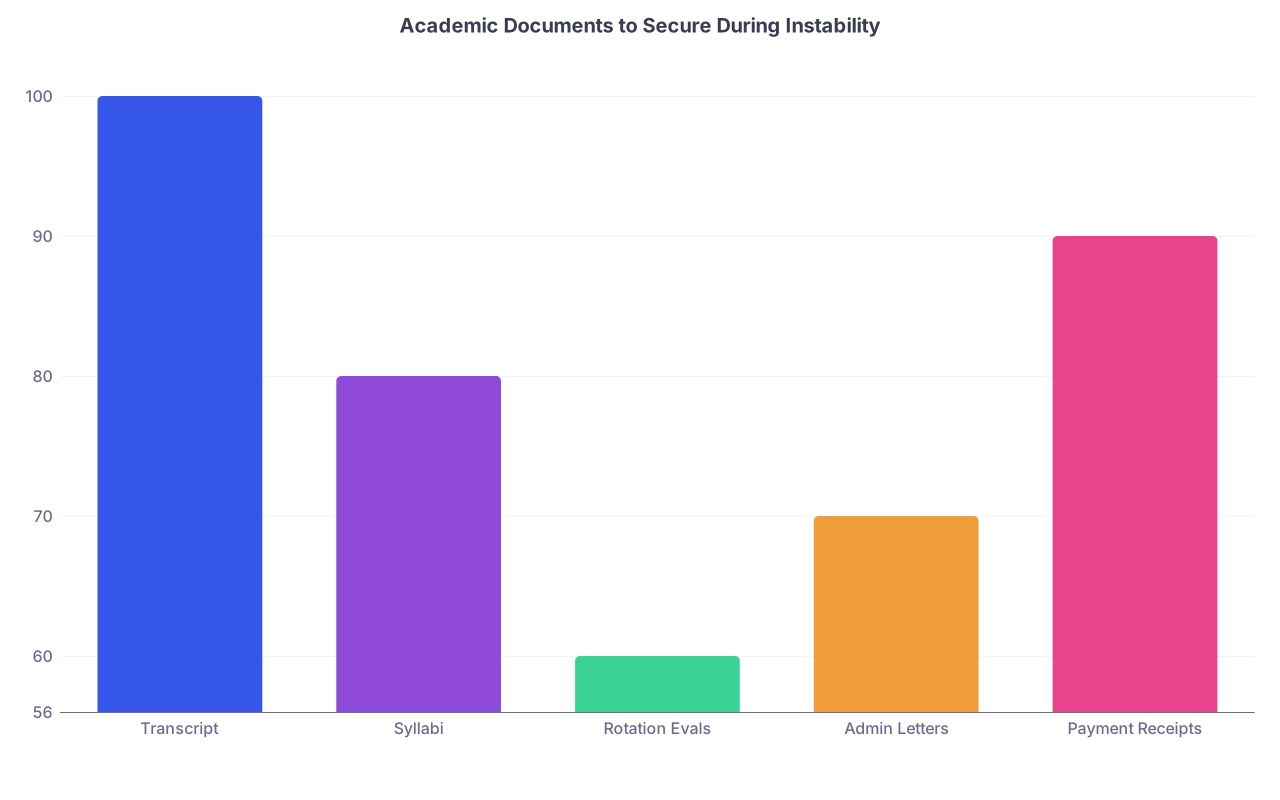
| Category | Value |
|---|---|
| Transcript | 100 |
| Syllabi | 80 |
| Rotation Evals | 60 |
| Admin Letters | 70 |
| Payment Receipts | 90 |
Those numbers don’t represent importance; they represent how often I see students actually have these when things go bad. Notice how rotation evaluations are usually missing. Do not be that person.
If the school has any kind of registrar’s office functioning, request:
- An official transcript (even if mailed to your home country address)
- A letter of good standing explicitly stating:
- Your enrollment dates
- Years/semesters completed
- Any academic concerns (or that there are none)
If they hesitate, push. Politely but firmly. Tell them you’re applying for “contingency documentation” because of instability. Say the quiet part out loud.
Step 3: Understand what disruption really means for you
Political instability hits different depending on where you are in training.
| Phase | Biggest Risk |
|---|---|
| Premed (planning to go) | Going to a school that may implode |
| Basic sciences (MS1-2) | Lost semesters, gaps in transcript |
| Early clinicals (MS3) | Cancelled rotations, visa issues |
| Late clinicals (MS4) | Delayed graduation, Match timeline |
| Post-grad planning (US/UK) | Accreditation/eligibility problems |
If you haven’t started yet (premed, accepted but not enrolled)
Blunt answer: if the country is unstable before you show up, think three times. Then think again.
Ask:
- Has the U.S./Canadian/UK government issued travel warnings for that country?
- Does your prospective school have a history of:
- Moving campuses suddenly?
- Losing accreditation temporarily?
- Students struggling to get ECFMG certification?
If you haven’t put down a non‑refundable deposit yet, press pause. Look at alternatives: other countries, delayed start, postbac at home, or working a year while you reassess strategy.
If you already accepted but haven’t flown out, seriously consider deferring. Ask the school directly: “If I defer for one year due to political unrest, will you guarantee my seat and current tuition rate?” Get that in writing.
Step 4: Decide: stay, temporarily leave, or exit permanently
This is the decision people obsess over while doing nothing. You can’t optimize a moving train. So you break it down.
Questions you must answer honestly
Is the instability short‑term chaos or systemic collapse?
Examples of short‑term: weeklong protests, brief curfews, elections with tension that usually resolves.
Systemic: government overthrow, long‑term civil conflict, repeated shutdowns over months.Is the school giving you:
- Clear, dated, written plans (e.g., “Semester 5 will move online, exams rescheduled to X”)?
- Or vague promises and “We’re monitoring the situation”?
How dependent is your education on being physically there?
- Basic sciences are more portable (can be delivered online).
- Clinical rotations depend heavily on local hospitals staying functional and safe.
What’s your visa situation?
If your legal status in that country depends entirely on that school staying open and functional, your risk is higher.
Rough decision framework
This is not perfect, but it keeps you from paralysis:
You strongly lean toward leaving (at least temporarily) if:
- Embassies are urging departure
- School is suspended “until further notice”
- There are repeated internet blackouts
- Hospitals are overwhelmed with conflict‑related injuries
You can consider staying if:
- Violence is localized and you’re not near it
- School has already moved classes online smoothly
- Curfews are temporary and predictable
- You’re close to finishing and need only a few months

| Step | Description |
|---|---|
| Step 1 | Situation unstable? |
| Step 2 | Plan exit within 72 hours |
| Step 3 | Request documentation & backup plan |
| Step 4 | Consider staying short term |
| Step 5 | Embassy advises departure? |
| Step 6 | School operations disrupted >2 weeks? |
| Step 7 | Clear written plan from school? |
If you leave, it does not automatically mean your medical career is over. But your chances drop if you leave with no documentation, no plan, and no idea how your previous credits will be recognized.
Step 5: Protect your future eligibility (especially for the U.S.)
You’re not just fighting today’s crisis. You’re also fighting the bureaucracies of ECFMG, NRMP, and residency program directors who do not care about your political context. They care about paperwork.
Minimum you should secure for U.S. pathway
If your goal is USMLE and U.S. residency, you need:
- A school recognized by ECFMG at the time you graduate
- A verifiable, continuous (or at least explainable) education timeline
- Enough clinical training in systems recognized as legitimate by programs (often U.S., Canada, UK, etc.)
If your current school looks like it might lose recognition, or collapse, you need back‑up.
This usually means one of three paths:
- Stick it out and graduate if the school retains recognition and operations resume.
- Transfer to another recognized international school that takes your credits.
- Restart at a new school (ugly, but sometimes the only real option).
Let me be blunt: transferring between international schools is often a nightmare. Many will gladly take your tuition but refuse to accept large chunks of your previous credits, effectively pushing you back a semester or a year. Some will “evaluate” your transcript and then ghost you.
So if you’re thinking about transfer:
- Target schools with known histories of taking transfers (e.g., certain Caribbean schools, some Eastern European programs).
- Ask current students there directly: “Did anyone transfer in from [your school]? How many credits did they keep?”
- Get a written evaluation of which credits they’ll accept before you commit.
Step 6: Manage gaps and explain them later
Let’s talk about optics. Assume you end up with a six‑month or even one‑year gap because of this chaos. Program directors don’t love unexplained gaps, but they’re not stupid. They read the news.
What they hate:
- Gaps with no documentation
- Vague descriptions like “personal reasons”
- No constructive use of that time
What they’re okay with (if handled right):
- “From June 2025 to February 2026, political unrest in [Country] halted all academic operations at my medical school. During this time, I relocated back to [Home Country], completed [online research, remote volunteering, USMLE prep], and secured a transfer to [New School].”
So while you’re in limbo, do not just sit and doom‑scroll.
If you’ve left the country or are stuck in your housing:
- Study for Step 1/2 CK or your home country’s licensing exam
- Take structured online courses (Coursera, edX) in relevant fields (public health, stats, ethics)
- Join remote research or QI projects if you have prior mentors
- Keep a simple timeline log: dates, events, how instability affected you, what you did anyway
Later, that becomes a coherent narrative rather than “I disappeared for a year.”
Step 7: Money, logistics, and not getting financially wrecked
I’ve seen students keep paying full tuition for semesters that barely function because they were afraid to rock the boat. Don’t do that blindly.
Ask the hard financial questions
In writing, ask your administration:
- Will tuition be prorated or refunded if the semester is canceled or significantly modified?
- What is the official policy if political unrest prevents in‑person attendance?
- Are there contingency agreements with partner schools in other countries?
If they dodge, that tells you something about how much they value you versus your money.
Also:
- Tell your bank and credit card company what’s happening. If cards are lost or ATMs are shut, you need backup.
- If you have loans, contact the lender. Ask if instability and forced relocation can qualify you for deferment or temporary hardship measures. Some will say no. Some won’t. You don’t know until you ask.
Step 8: Mental health while everything is on fire
You’re not weak because your hands shake during online exams with gunshots outside. I’ve had students describe studying pharmacology by candlelight because power cuts were scheduled during “non‑essential hours.”
Three concrete things that help:
Shrink your time horizon.
Stop trying to solve “Will I match in the U.S. in 7 years?” when you don’t know if you can get to the grocery store tomorrow. Solve: “What can I control in the next 48 hours?” Eat. Sleep. Back up documents. Secure exit options.Get clinical about your stress.
Write down symptoms: insomnia, palpitations, constant fear, inability to focus more than 10 minutes. This is not just “being stressed.” If you have access to telehealth or a counselor, use that language. Demand actual help, not “try yoga.”Stay out of the emotional rumor mill.
I know every WhatsApp group is lit up with “news” and conspiracy theories. Limit your exposure. Check twice a day, not twenty. Mute the loudest catastrophizers.

Step 9: If you’re still premed and watching this from afar
Maybe you weren’t caught in it. Maybe you’re researching foreign schools and just realized how fragile this can be. Good. You’re ahead.
You need to start judging schools not just on “Do they accept my GPA?” but on resilience.
Look at:
- Country stability track record
- School’s historical behavior during COVID (did they support students or abandon them?)
- Availability of multiple campuses/teaching hospitals in different locations
- Alumni outcomes in your target country—over multiple cohorts, not one lucky year
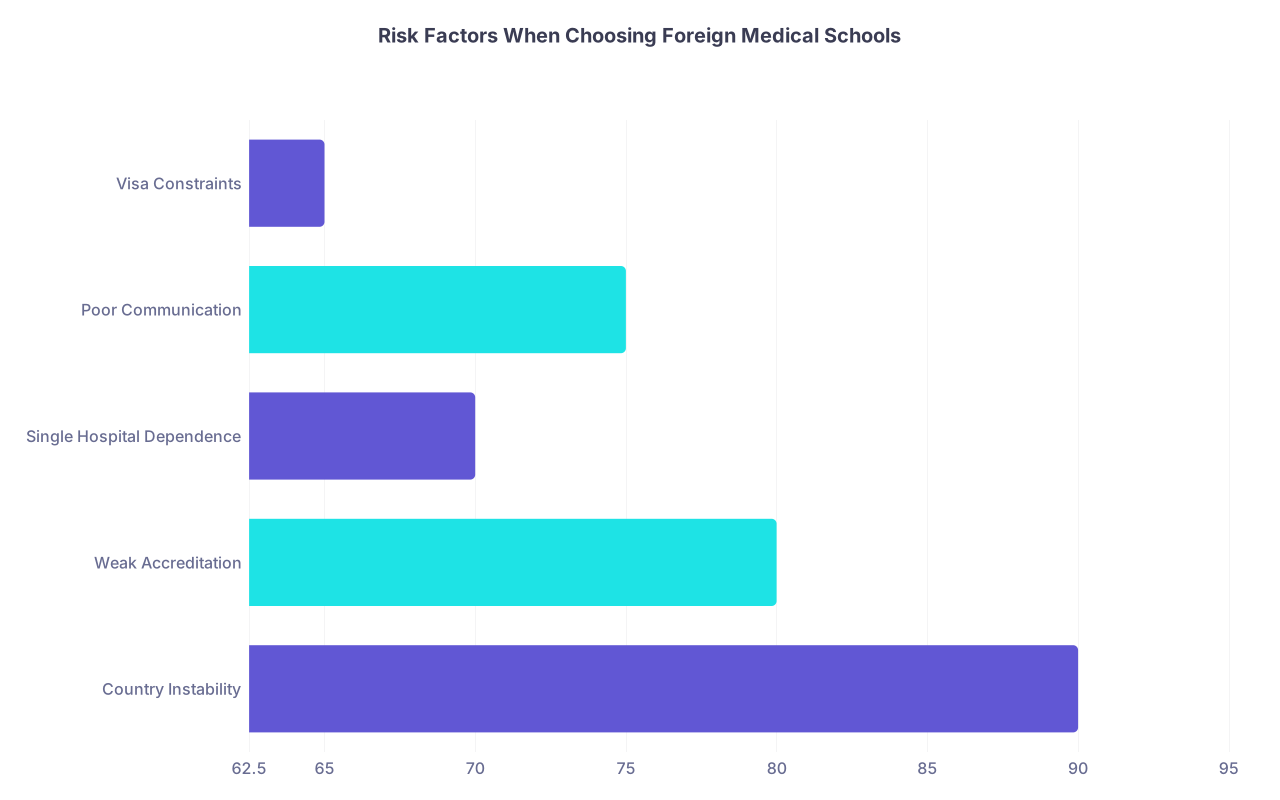
| Category | Value |
|---|---|
| Country Instability | 90 |
| Weak Accreditation | 80 |
| Single Hospital Dependence | 70 |
| Poor Communication | 75 |
| Visa Constraints | 65 |
If a school looks cheap and easy on the front end but is sitting in a country with a high probability of serious unrest, factor that risk into your decision. You’re not just choosing a campus. You’re choosing a political environment.
A practical checklist for today
If you’re in the middle of this right now, here’s what you do in the next 24–72 hours:
- Confirm safety via embassy and local news.
- Map exits and, if feasible, hold a flexible ticket out.
- Back up every academic document you can get your hands on.
- Email your dean/registrar requesting:
- Current transcript
- Letter of good standing
- Policy on academic continuity during unrest
- Start a “disruption log” – short dated notes on what’s happening academically and personally.
- If likely to leave, begin a list of potential transfer schools and their requirements.
- Tell one trusted person at home exactly what your situation is and what you’re considering.
Don’t try to decide your entire career in one night. Nail the basics. Then build from there.

FAQ (exactly 5 questions)
1. Will U.S. residency programs hold political instability against me?
Not if you handle it intelligently. What hurts you isn’t the unrest itself; it’s missing documentation, unexplained gaps, and poor narrative. If you:
- Preserve your transcript and letters
- Use downtime for constructive work (exam prep, research, volunteering)
- Explain the gap clearly in applications and interviews
Most reasonable program directors will understand. They’ve seen war, natural disasters, and political crises derail training before. They care about how you responded, not that it happened.
2. Should I leave the country even if my school is telling us to “stay calm and wait”?
If your embassy is advising departure and there’s real risk in daily life, yes, you should strongly consider leaving even if the school says otherwise. Schools have a financial incentive to keep you in place. Your embassy doesn’t. Trust the entity whose job is your safety, not your tuition. You can continue remote coursework from a safer place if the school offers it; you can’t continue anything if you’re injured or trapped.
3. Can I transfer to a medical school in the U.S. or Canada with foreign credits?
Almost never at the MD/DO level. A few U.S. schools technically allow very limited advanced standing, but in practice it’s rare and often restricted to students from a small number of well‑known foreign schools. Canada is even tougher. Realistically, your transfer options are other international schools, not North American ones. That’s why getting your credits and documentation in order now is crucial: you’ll need them for any potential transfer abroad.
4. What if my school loses accreditation or recognition after I’ve already studied there?
If your school loses recognition (for example, with ECFMG) before you graduate, you may be blocked from certain licensing pathways like U.S. residency. In that case:
- Graduating from that school may no longer be viable if your goal is the U.S. or another strict system.
- A transfer or restart at a recognized institution may be the only logical move, even if it costs you time and money.
This is brutal, but I’ve seen people try to “ride it out” in a dying school and end up with a diploma they cannot use in their target country.
5. I’m just starting to apply to foreign schools. How do I avoid ending up in this situation?
You can’t control geopolitics, but you can reduce risk. Do three things:
- Choose countries with relatively strong, stable institutions and low recent history of severe unrest.
- Prioritize schools with multiple clinical sites in different regions or countries, and with established international partnerships.
- Talk to current students and recent grads, not just agents or glossy brochures. Ask them directly: “How did the school handle COVID and any local instability? Did they protect students or leave you hanging?”
Your next step: open a document and list the top 3 schools or scenarios you’re considering (or dealing with). Under each, write: safety, documentation, long‑term eligibility. Then, tonight, take one concrete action for each—email a dean, back up your transcript, or price out an exit ticket. Don’t wait for perfect clarity. Move on what you can control today.


