

It’s late at night. Your Caribbean school portal is still open on your laptop. You’ve reread the email three times: “You have been placed on a mandatory leave of absence…” Your stomach’s in your throat. You’re thinking:
Am I done? Will any school take me? Do I tell future programs? Do I just give up?
You’re not done. But you are in a high‑risk situation where a couple of bad moves can close doors permanently.
Let’s walk through what to do, step by step, if you’ve been forced onto a leave of absence (LOA) from a Caribbean medical school.
Step 1: Get Crystal Clear on Why and What’s on Paper
Most students in your situation underestimate this part. They skim the email, feel the shame, and move straight to “What else can I do with my life?” That’s premature.
You need facts. Not vibes.
Start here:
Pull the official documents.
- The email/letter announcing your LOA
- Any academic/disciplinary committee notes you’ve received
- Your current transcript
- Student handbook sections on LOA, dismissal, remediation
Identify the category of LOA you’re dealing with:
- Academic (failed courses, repeated failures, not meeting progression standards)
- Professional/disciplinary (honor code, professionalism, exam integrity)
- Health/personal (medical, mental health, family emergency)
- Administrative (visa, tuition nonpayment, failure to meet documentation requirements)
These categories matter. A mental-health-related LOA is a different beast from an academic dismissal in the eyes of future programs.
- Clarify the status — LOA vs dismissal.
Caribbean schools love vague wording. Push for clear language:- “Leave of absence with right to return after X”
- “Suspension”
- “Dismissal, no right to return”
If the letter is ambiguous, email the Dean of Students or Academic Affairs and ask—yes, directly:
“For my records and future applications, can you please clarify whether my current status is a temporary leave of absence with eligibility to return after specified conditions, or a dismissal without right to return?”
Do not guess. You need exact language because that’s what other schools will eventually see.
Step 2: Decide if You’re Fighting to Stay or Pivoting Away
Next question: Are you trying to remain in this Caribbean program or are you already mentally out?
Sometimes you should fight to stay. Sometimes it’s throwing good money after bad.
Here’s the blunt breakdown.
| Situation | Recommended Direction |
|---|---|
| Single failed course, first LOA, school has structured remediation | Fight to stay |
| Pattern of failures across multiple terms | Strongly consider pivot |
| LOA for short-term health issue with clear treatment plan | Fight to stay |
| Visa/financial/administrative mess that keeps recurring | Consider pivot |
| School with unstable accreditation or terrible match rates | Pivot more likely |
If you’re early (first or second semester) and already on forced LOA for academics, that’s a serious warning sign. You’re not dumb, but something about this setup (curriculum, support, your preparation, your personal situation) is not working. “Powering through” might mean $100k+ debt and no MD.
If you’re in clinical years, with mostly passing performance and a single bad term or life event—different story. In that case, I’d usually tell you to try to repair and graduate if your school is at least moderately reputable among Caribbean options (e.g., the better-known “Big 4”).
But either way, you need a short written plan for both possibilities:
- If I stay, my next 12 months look like: X, Y, Z
- If I leave, my next 12 months look like: A, B, C
This is not just “manifestation.” You’ll need this for future applications, too.
Step 3: Talk to the School Strategically (Not Emotionally)
You’re probably angry. Or embarrassed. Or both. Do not send an email from that emotional state.
You need one calm, professional outreach to the right person:
- Dean of Students / Academic Dean
- Or your assigned advisor, copied to the dean’s office
Your goals:
- Clarify conditions for return
- Ask what will be documented on your transcript/MSPE
- Explore any appeal/remediation options
Write something like:
Dear Dr. [Name],
I received the notification regarding my mandatory leave of absence. I want to ensure I fully understand the specific conditions for return, any available remediation, and how this will be documented in my academic record.
Could we schedule a brief meeting to discuss:
- My current academic/administrative status
- Requirements and timeline for potential return
- Available academic or personal support resources
I remain committed to completing my medical training and want to approach this period as constructively as possible.
Sincerely,
[Your Name]
That tone matters. You’re not begging. You’re not hostile. You sound like someone salvageable.
On the call/meeting, ask direct questions:
- “Is this labeled as academic LOA or dismissal on my transcript?”
- “Will my MSPE mention the LOA and reasons?”
- “If I meet the conditions and return, will my previous failures remain on the transcript?”
- “Is there an appeals process, and what’s the historical success rate?”
I’ve seen too many students assume they’ll “just come back after a break” and discover a year later the school never planned to readmit them.
Step 4: Be Realistic About Transferring or Restarting Elsewhere
Here’s the harsh reality:
Transferring from a Caribbean program into a U.S. MD/DO program after a forced LOA is extremely unlikely. Is it absolutely impossible? No. But it’s close enough that you should treat it like a lottery ticket, not a plan.
You’ve got two realistic paths:
- Try to complete at your current Caribbean school, then fight uphill for a residency spot.
- Step away from this Caribbean track entirely and rebuild a new path (possibly U.S. DO, another international route, or a different career).
Let’s lay out what “transfer” actually looks like in practice:
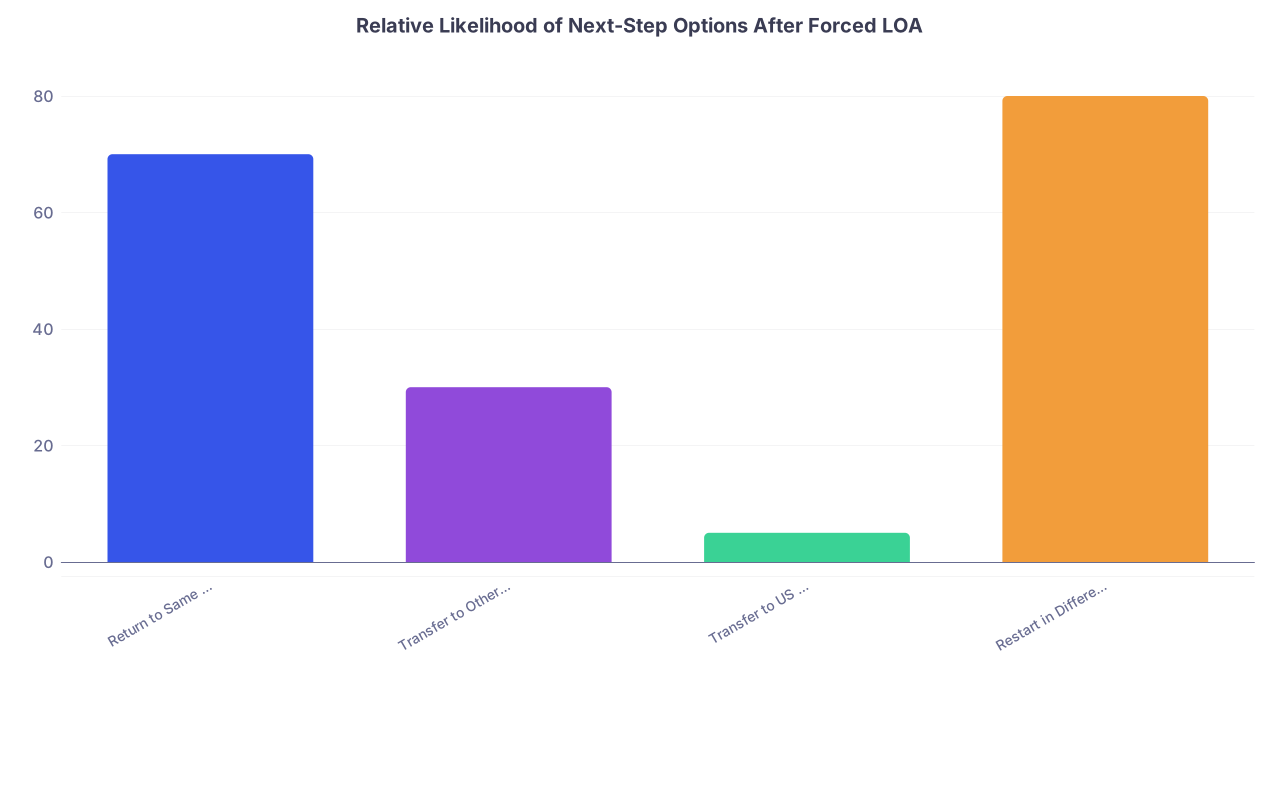
| Category | Value |
|---|---|
| Return to Same School | 70 |
| Transfer to Other Caribbean | 30 |
| Transfer to US DO/MD | 5 |
| Restart in Different Field | 80 |
Those percentages aren’t official statistics. They’re meant to show approximate difficulty based on what I’ve actually seen: returning to your own school or pivoting fields is far more common than making a clean transfer into a U.S. medical program.
About other Caribbean schools: many will happily take your tuition, but residency prospects may be even worse. Also, your academic record follows you. You will have to disclose prior enrollment and LOA/dismissal. Any school that doesn’t ask is one you should be suspicious of, because residency programs will ask.
Step 5: Build a “Salvage or Pivot” Plan for the Next 6–12 Months
Whether you fight to stay or move on, you now have an unexpected block of time. Don’t waste it spiraling.
You should be doing 3 things during this period:
- Actually fix the root problem
- Generate evidence that you’re functional and improving
- Pre-position yourself for your next application (medicine or not)
If the LOA was academic
Stop pretending it was “just a bad exam day” if you failed multiple courses.
You need:
- A structured content review plan (not random YouTube binges)
- Possibly a formal post-bacc or upper-level science coursework to show you can handle content again
- Objective proof of improvement: retaken prereqs with A’s, MCAT improvement (if applicable), structured board-prep scores when relevant
- Month 1–2: Full diagnostic of your study system. Work with a legitimate tutor or academic coach who understands medical curricula.
- Month 3–6: Enroll in 2–3 tough science courses at a reputable U.S./Canadian institution and crush them.
- Parallel: Weekly mental health check-ins if burnout, anxiety, or depression were factors (they usually are, even if you don’t want to admit it yet).
If the LOA was health/mental health related
You need a documented treatment arc:
- Regular visits with a psychiatrist/therapist or relevant specialist
- Adherence to a treatment plan
- At least one clinician who, in the future, would be comfortable writing: “Student sought care, engaged well, and is now stable to return to rigorous training.”
Future schools will want to see that the problem is treated, not just that “things are better now.”
Step 6: Think Hard About Whether Medicine Is Still the Right Goal
This is the part you’ll want to skip. Don’t.
A forced LOA is a flashing red light that says: reassess everything.
You need to get brutally honest about a few questions:
- Are you still in medicine because you want it, or because you’re terrified of “quitting”?
- Can you realistically handle the academic and emotional load with the health, family, financial, and cognitive bandwidth you actually have—not the imaginary version of you?
- If you ended up with $250k debt and no residency, would you say, “It was still worth trying”? If the answer is “absolutely not,” you should pause.
Here’s a comparison table of realistic next-step categories you might consider if you decide to pivot:
| Path | Training Length | Uses Medical Background? |
|---|---|---|
| U.S. PA school | 2–3 years | Yes, strong overlap |
| Nursing/NP | 2–4+ years | Yes |
| Public health (MPH) | 1–2 years | Yes, indirectly |
| Clinical research coordinator | On-the-job | Yes |
| Non-medical grad programs (MBA, MS) | 1–2+ years | Maybe, depends |
None of these are “consolation prizes.” I’ve seen people leave shaky Caribbean tracks, pivot to PA or research careers, and end up with stable jobs and far less debt than their classmates who stubbornly stayed.
Step 7: If You Do Reapply Anywhere, Handle the LOA Head-On
If you eventually apply again—to another med school, PA, NP, MPH, anything—you’ll have to answer the “What happened?” question.
Do not lie. Do not minimize so much that it sounds like denial. But don’t give a 5-page sob story either.
Your explanation needs four pieces:
- Clear, factual description of what happened
- Ownership of your part
- Demonstrated change (concrete actions, not “I matured a lot”)
- Why you’re now safe to bet on
Here’s the rough structure:
During my second term at [School], I was placed on a mandatory leave of absence due to [academic performance / unmanaged depression / a combination of health and academic challenges]. I struggled with [brief specifics], and my performance did not meet the school’s progression standards.
I take responsibility for not seeking help sooner and for underestimating the demands of the curriculum. Since that time, I have [seen a therapist weekly, completed 12 credits of upper-level biology with a 3.8 GPA, adjusted my study approach significantly, etc.].
This period forced me to reassess my goals and habits. I’m now approaching training with [concrete changes: structured schedule, documented treatment, time-management tools, accountability supports]. My recent performance in [courses/work roles] better reflects my current capabilities and commitment.
You don’t have to sound perfect. You do have to sound like a risk‑managed investment.
Step 8: Manage Your Finances and Paper Trail Now, Not Later
People ignore this part, then regret it badly.
During your LOA:
- Get a complete itemized transcript and financial statement from your Caribbean school.
- Confirm if loans are federal, private, or foreign. If you have U.S. federal loans (some post-bacc or prior programs), know when repayment triggers.
- Talk to a loan servicer or financial advisor who actually understands medical education debt.
Also:
- Save every email and letter related to your LOA, appeals, and status.
- Keep a timeline document: dates of matriculation, terms completed, LOA start date, any hearings or decisions.
Future applications—medical or not—will often ask:
“Have you ever been dismissed, suspended, or placed on leave from any educational program?” You want your answers consistent, accurate, and supported by documents.
Step 9: Protect Your Mental Health and Identity
Forced LOA feels like public failure, even if almost no one actually knows. You’ll be tempted to isolate, lie (“I’m just studying from home right now”), or bury it.
That usually makes things worse.
At minimum:
- Tell 1–2 trusted people the full story—no spin.
- Set a very basic weekly structure: work, study, exercise, one social thing.
- If this triggered or worsened depression/anxiety, do not try to “tough it out.” Get professional help. This isn’t a character flaw issue; it’s a survival issue.
You’re not the first person to get knocked out of a Caribbean program. I’ve seen students come back from much worse situations—but only when they stopped pretending everything was fine and dealt with it directly.
A Possible 12-Month Timeline If You’re Unsure What to Do
If you’re frozen, here’s a template timeline you can adapt:
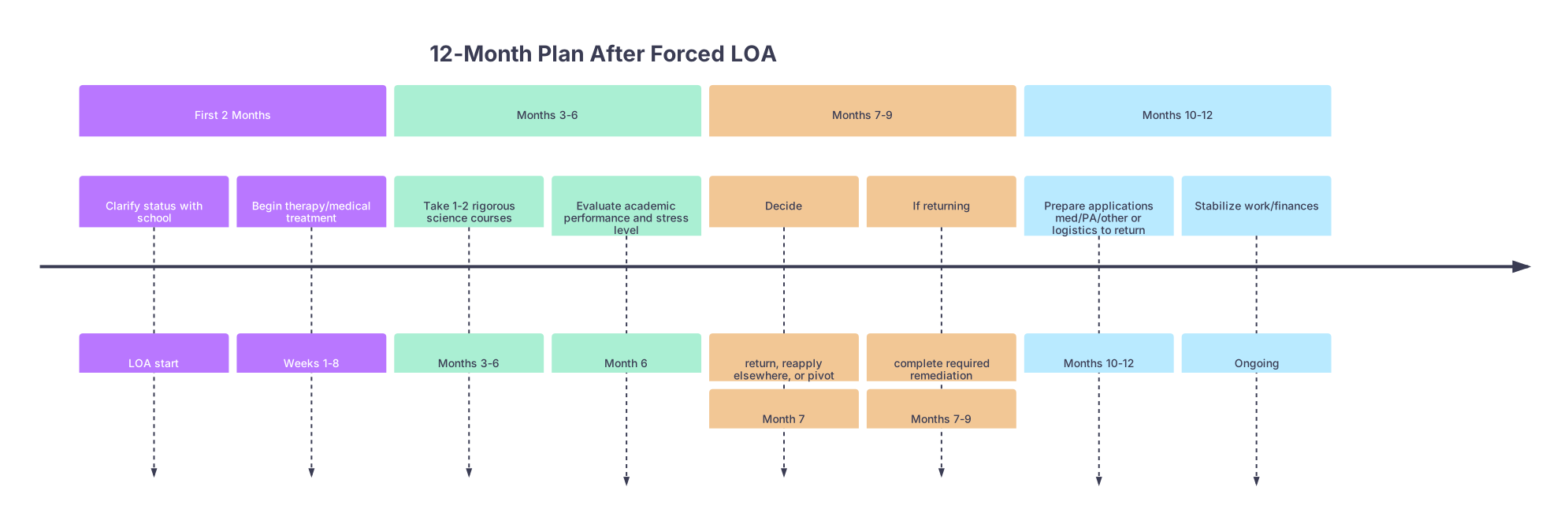
| Period | Event |
|---|---|
| First 2 Months - Clarify status with school | LOA start |
| First 2 Months - Begin therapy/medical treatment | Weeks 1-8 |
| Months 3-6 - Take 1-2 rigorous science courses | Months 3-6 |
| Months 3-6 - Evaluate academic performance and stress level | Month 6 |
| Months 7-9 - Decide | return, reapply elsewhere, or pivot |
| Months 7-9 - If returning | complete required remediation |
| Months 10-12 - Prepare applications med/PA/other or logistics to return | Months 10-12 |
| Months 10-12 - Stabilize work/finances | Ongoing |
You’re not locked into this, but you do need some structure. The worst outcome is wandering for a year, then realizing you have nothing productive to show.
Key Points to Walk Away With
- Do not guess your status. Get in writing exactly what your LOA means, whether you can return, and under what conditions.
- Decide intentionally: either rebuild within this path (with real changes and evidence) or pivot to a different track where you can actually thrive—don’t just drift.
- Whatever you do next, build a record that shows recovery, responsibility, and stability. You’re not defined by this LOA, but you will be judged on what you do after it.


