
The blunt truth: for most U.S.-focused students, an international medical school is a high‑risk, narrow‑payoff path. It can work—but only if you understand the numbers, pick strategically, and accept a tougher road to a U.S. residency.
This is not about scaring you. It is about making sure you are not the person who spends $300,000+ abroad and then cannot match into any U.S. residency.
Let’s walk through what actually matters, and how to decide if going international is worth it for you.
Step 1: Understand the Match Reality for IMGs
If you want to practice in the U.S., your bottleneck is not medical school. It is residency. No residency = no license = no practicing physician.
Here is what you are up against as an international medical graduate (IMG):
- You will be on the IMG side of the match statistics.
- You will compete against:
- U.S. MD seniors
- U.S. DO seniors
- U.S. grads who did not match last year
- Other international graduates from all over the world
And the match data is not subtle. Historically, U.S. MD seniors match somewhere around 90%+ overall. IMGs? Way lower, even when you split out U.S. citizen vs non‑U.S. citizen IMGs.
You need to assume three things if you go international and want to match in the U.S.:
- You must score well above average on USMLE (or now Step 2 CK, with Step 1 being Pass/Fail).
- You must target less competitive specialties (FM, IM, psych, peds) to keep your odds reasonable.
- You must treat every year of med school as an audition for U.S. residency programs—through scores, rotations, networking, and letters.
If that already sounds exhausting, that’s the point. This path is doable. It is not easy.
Step 2: Know the Types of International Schools (They Are Not All the Same)
Lumping all international medical schools together is a mistake. Some are semi‑established pipelines to U.S. residencies. Others are essentially degree mills that will leave you stranded.
Broadly, you’ll see:
- Caribbean “off-shore” schools primarily marketing to U.S. and Canadian students
- European/Asian/Latin American schools that mainly train local doctors, with some foreigners mixed in
- A small handful of internationally known programs (e.g., in Ireland, Israel) that have real track records with U.S. placements
You should be asking one ruthless question for any school:
“What percentage of graduates who actively pursue U.S. residency actually match into a U.S. residency within 1–2 years of graduation?”
If the school cannot or will not give you hard numbers—run.
Here is how to think about the major categories:
| Category | Typical Match Outlook to U.S. |
|---|---|
| Top-tier Caribbean (e.g., SGU, AUC, Ross, Saba) | Possible but not guaranteed; mostly primary care, strong students do best |
| Mid/low-tier Caribbean | High risk of no match; inconsistent outcomes |
| Irish/Israeli/UK programs with U.S. tracks | Better for strong students; still mainly primary care + some specialties |
| Local/regional schools with little U.S. focus | Very challenging; usually only top few grads reach U.S. |
| “New” or unproven schools | Avoid; no reliable track record |
You are not just choosing a school. You are choosing a statistical neighborhood.
Step 3: Compare This to Your Realistic U.S. Options
Too many students treat “international med school vs Harvard” as the comparison. That’s fantasy.
The real choice is usually:
- Option A: Keep improving your U.S. application—reapply to MD and/or DO, consider SMP/post‑bacc, fix GPA/MCAT, add clinical exposure.
- Option B: Go international now and accept a more uncertain U.S. residency outcome.
If you have:
- GPA ≥ 3.3 and MCAT ≥ 505
- Or a strong upward trend + willingness to do a special master’s/post‑bacc
Then, in my opinion, bailing to an international school too fast is a bad move. You are likely leaving U.S. DO and some U.S. MD options on the table.
Where international starts to look more reasonable:
- cGPA in the low 3.0s or below with limited realistic repair options
- Multiple unsuccessful U.S. application cycles after serious improvement
- Personal constraints (family, finances, visas) that make further years of reapplication unrealistic
Again: “I’m tired of applying” is an emotional reason. Not a good strategic one. Be honest but not impulsive.
Step 4: What Actually Makes an International School “Worth It”?
Let me be concrete. An international medical school might be worth it if and only if these are mostly true for you:
You are comfortable targeting primary care or relatively less competitive specialties.
Internal medicine, family medicine, pediatrics, psychiatry, maybe neurology or pathology. If you are fixated on derm, ortho, plastics, neurosurgery—going international for U.S. practice is essentially betting against the odds.You are confident you can be near the top of your class.
Not average. Not “I’ll work hard and see.” You need to be the person who always over‑prepares. The one who crushes exams, not just passes.You’re willing to live with immigration, exam, and policy uncertainty.
Every few years, something changes: USMLE scoring, ECFMG rules, state licensing quirks, program bias against IMGs. You do not control any of that.You have a clear plan for financing.
Many Caribbean and foreign schools are extremely expensive. Loans may be limited or come with brutal terms. And if you fail out or don’t match, that debt doesn’t vanish.
If you cannot nod along to most of that, the “worth it” calculation tilts hard toward staying in the U.S. system and grinding it out.
Step 5: Key Factors That Actually Matter (Beyond the Brochure)
I’ve seen students buy hard into marketing lines like “95% residency placement.” Then you read the fine print: only counting those who passed all exams on time, only those who applied to any country, or only after 3+ cycles.
What you should verify:
1. Match Data – Real, Not Polished
You want school‑provided data broken down like this:
- Number of graduates in a given year
- Number who attempted U.S. residency that cycle
- Number who matched in the U.S. in PGY-1 spots
- Specialties they matched into
- Programs/locations (community vs university, geographic spread)
If they’ll only show you a glossy list of “selected matches,” assume heavy cherry‑picking.
2. USMLE / Step 2 CK Outcomes
Ask specifically:
- First‑time pass rates for Step 1 (if still applicable to your cohort) and Step 2 CK, by year
- Average Step 2 CK score, if they track it
- Structured support: question banks, dedicated prep time, faculty with U.S. exam experience
If a school dodges this, or if their pass rates are dramatically below U.S. averages, that is a serious red flag.
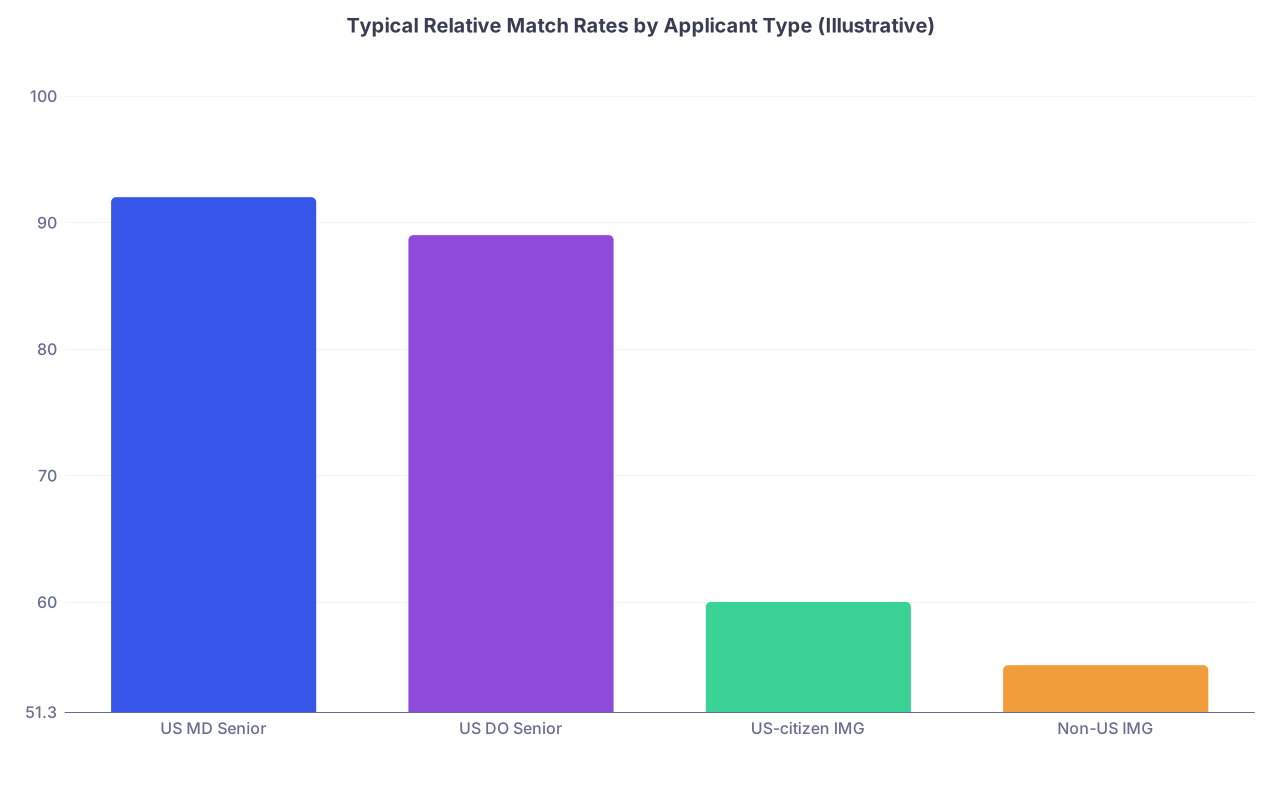
| Category | Value |
|---|---|
| US MD Senior | 92 |
| US DO Senior | 89 |
| US-citizen IMG | 60 |
| Non-US IMG | 55 |
(Numbers above are illustrative, not exact current NRMP data—but the pattern is real: IMGs match at significantly lower rates than U.S. MD/DO seniors.)
3. Clinical Rotations in the U.S.
This is a huge one. Programs in the U.S. want to see:
- U.S. clinical experience
- U.S. letters of recommendation
- Some sense you can function in the U.S. system
So you need to know:
- Where are core rotations? (Hospital names, city, state—not just “affiliations.”)
- Are they guaranteed or is there a lottery/fight for spots?
- Are they ACGME‑affiliated teaching hospitals or small community sites with minimal teaching?
- Are away/audition rotations in the U.S. supported or encouraged?
If a school keeps you doing almost everything abroad, your U.S. match will be harder.
Step 6: Tradeoffs You’re Actually Making
Let’s be explicit about what you trade by going international vs U.S. MD/DO.
| Factor | U.S. MD/DO | International (IMG Path) |
|---|---|---|
| Match odds to U.S. residency | High overall | Moderate to low, highly variable |
| Specialty flexibility | Wide, including competitive | Mostly primary care / less competitive |
| Cost predictability | High (federal loans, known ranges) | Variable, often high tuition + living |
| System familiarity | Trained where you’ll practice | Must adapt later, extra exams |
| Stigma/bias | Minimal | Real bias at some programs |
None of this means “never go international.” It means “do not pretend these tradeoffs do not exist.”
Step 7: When an International School Does Make Sense
Here are situations where I’ve seen it be a rational, thought‑through choice:
- A 29‑year‑old with a low 3.0 GPA from years ago, strong MCAT already, couple of U.S. cycles with only a few MD/DO interviews and all rejections, limited time and money for more years of post‑bacc and reapplying.
- A U.S. citizen deeply committed to family medicine, with a clear track record in underserved care, who understands they’re signing up for a tough but focused road.
- A non‑U.S. citizen who ultimately wants the option of U.S. training but would also be content practicing in their home country if U.S. residency doesn’t pan out.
Notice what’s missing: “I don’t feel like rewriting my personal statement again.” “I just want to start med school now.” Those are emotional drivers, not strategy.
Step 8: Red Flags That Should Make You Walk Away
If you see any of these, be skeptical:
- Admissions that feel like a sales pitch: “We can get almost anyone in, don’t worry about stats.”
- No clear, recent U.S. match list by year.
- Heavy emphasis on “students go all over the world!” instead of hard U.S. numbers.
- Pressure tactics: “Spots are filling fast, you must commit this week.”
- Vague clinical rotation details: “We have a network of hospitals” with no names or locations.
A legit school recruiting U.S.-bound students should be transparent on outcomes. If it feels like a timeshare presentation, it probably is.
Step 9: How to Make the Decision in a Structured Way
Do not “vibe” your way into or out of this. Use a simple framework.
Ask yourself:
- Timeline reality
How many more years could you reasonably spend improving your U.S. application? One? Two? Zero? - Academic ceiling
Given your track record, do you honestly see yourself scoring top‑tier on standardized exams with the right environment and effort? - Specialty flexibility
Are you truly okay with primary care as your most likely outcome? - Financial risk tolerance
If you ended up $250k in debt and unmatched, how catastrophic is that for you and your family? - School‑specific data
Does the school you’re considering have hard evidence of getting people like you into U.S. residencies in the last 3–5 years?
If you walk through those questions in writing, it becomes much clearer whether this is a calculated risk or wishful thinking.
Step 10: If You Go International, How to Maximize Your U.S. Chances
Let’s say you decide: yes, you’re going international. Then you do not have the luxury of coasting.
Here’s the general playbook I’d insist on:
From Day 1:
Treat every preclinical exam as board prep. Use UWorld, Amboss, NBME–style questions early. Do not rely only on school slides.Step Exams:
Aim to not just pass—aim to stand out. Given Step 1 is now pass/fail, Step 2 CK becomes your scoreboard. Schedule serious, protected study time.Clinical rotations:
Prioritize U.S.-based core and elective rotations as much as your school allows. Get to know residents and attendings. Ask for feedback. Earn strong letters.Specialty targeting:
Start with primary care–oriented fields in mind. If you end up over-performing, you can adjust. Doing the reverse (aiming for ortho then “falling back” to FM late) is how people end up with no interviews.Applications volume:
Expect to apply broadly—often 80–100+ programs in your chosen specialty as an IMG, sometimes more.Backup plans:
Consider dual‑applying (e.g., IM + FM) if your profile is borderline. You cannot assume things will magically break in your favor.
You’re basically playing residency on “hard mode.” People beat hard mode. But they do not beat it by accident.
The Bottom Line: Is an International Medical School Worth It If You Want to Practice in the U.S.?
Here’s the tight answer:
If you have reasonable prospects of getting into a U.S. MD or DO program within 1–2 more cycles by improving your profile, an international school is usually not worth the increased risk.
If your academic record is such that U.S. MD/DO is extremely unlikely even after repair—and you’re willing to accept:
- Higher odds of primary care
- Lower overall match probability
- Higher financial and emotional risk
then a carefully chosen international school with a proven U.S. match record can be a rational, though risky, path.
The key is to stop asking, “Can I become a doctor somewhere?” and instead ask, “Given who I am and where I want to practice, is this route a smart bet or a desperation move?”
Today’s actionable step:
Open a blank document and write down three specific schools you’re considering (U.S. or international). For each, list: (1) their last 3 years of U.S. match data (you may need to dig), (2) Step pass rates, and (3) where core rotations occur. If you cannot find that information in under an hour, treat that as your first loud warning sign.