
Most students check the wrong things when vetting an overseas medical school—and miss the ones that actually determine if their degree is usable.
Let me be blunt: glossy websites, happy Instagram posts, and “USMLE pass rate 95%!” banners do not tell you if a school is truly recognized or safe. The only questions that matter are:
- Can you legally become a physician in the country where you plan to practice?
- Will you be eligible for licensing exams and postgraduate training (residency)?
- Is the school stable, properly accredited, and not a diploma mill?
Here’s exactly how to verify those things step-by-step.
Step 1: Start With Your Endgame – Where Do You Want to Practice?
You cannot judge an overseas medical school in a vacuum. Recognition is country-specific.
You need to answer this first:
“Where do I realistically want to practice medicine long-term?”
Different countries have different rules:
- United States → ECFMG certification, USMLE, specific accreditation requirements.
- Canada → Very limited recognition of foreign schools, highly competitive.
- UK, Ireland, Australia, New Zealand → GMC/AHPRA-type recognition and lists.
- Home country → Local ministry of health / medical council rules.
If you want options in multiple countries, you must check each one. A school that’s acceptable in the UK might be nearly worthless for the US, and vice versa.
So before you even Google a single school name, pick your target practice countries and keep them written at the top of your notes. Every check you do should be tied back to those destinations.
Step 2: Verify the School Exists in Official Global Directories
You’d be surprised how many “medical schools” do not even appear in legitimate databases.
Your first stop is the World Directory of Medical Schools (WDMS).
Search here: https://www.wdoms.org/
You want to see:
- The exact official name of the school.
- Its location (city, country).
- The year it started and if it’s still listed as operational.
- The “Formerly listed by IMED/AVICENNA” status if applicable.
If a school is NOT in WDMS:
- For most countries and for US/Canada pathways, that’s basically a non-starter.
- Some new schools may be added later, but banking your future on a “maybe” is a bad plan.
If it is in WDMS, click through to the details and look for any noted restrictions or special comments.
This step doesn’t prove the school is good. It just proves it’s real and recognized at a basic national level.
Step 3: For the US Route – Check ECFMG and 2024+ Accreditation Rules
If you want to practice in the United States, you cannot skip this part. If you do, you risk completing 6+ years of education and discovering ECFMG will never certify you.
Key facts:
- ECFMG (Educational Commission for Foreign Medical Graduates) controls eligibility for USMLE and US residency for international grads.
- Starting with the 2024 requirements (now active), ECFMG requires that your school is accredited by a recognized accrediting agency that meets WFME (World Federation for Medical Education) standards.
Here’s what you must check:
Go to ECFMG site: https://www.ecfmg.org/
Look under “Medical School accreditation” / 2024 requirements.Confirm:
- Your country’s accrediting body is WFME-recognized
- Your specific school is accredited by that agency, not just “nationally approved” in vague language.
Then cross-check:
- Your school in WDMS will often list the accrediting body. Confirm that name matches the WFME-recognized one.
If the school is in WDMS but the accrediting agency is not WFME-recognized, your ECFMG certification path may be blocked.
Let me say that again because this is where people get burned:
“Listed in WDMS” is not enough anymore. The accreditation agency behind the school must meet ECFMG/WFME standards.
Step 4: Confirm National Accreditation and Legal Status in Its Own Country
You don’t want a school that’s essentially operating in a legal gray zone.
You need to find out:
- Is the school officially accredited by the country’s Ministry of Education and/or Ministry of Health?
- Is it recognized by the national medical council (if the country has one)?
- Is the degree they grant legally accepted for licensure within that country?
How to do it:
- Google “[country] medical council recognized medical schools” or “[country] ministry of education list of universities”.
- Find the actual government website, not a random blog or school marketing page.
- Locate their list of recognized medical schools.
- Confirm:
- The school name appears exactly (no “planned” or “proposed” campuses).
- It’s not in a “probation” or “provisionally approved” category unless you fully understand what that means.
If the government itself is not clearly listing the school as recognized, walk away. I’ve seen “universities” that only exist on their own website and in agents’ brochures.
Step 5: For Your Target Country – Check Licensing Body Rules Explicitly
Now zoom into the countries where you want to practice.
You’re not asking “Is this school good?” You’re asking:
“Will graduates of THIS specific school be eligible to apply for licensing / registration in THIS country?”
Different examples:
US
- ECFMG + USMLE eligibility, then NRMP residency eligibility.
- No official school blacklist, but ECFMG/WDMS/accreditation status is the gate.
Canada
- Very restrictive. Check the Medical Council of Canada and provincial colleges.
- Some provinces pay attention to whether your school is listed in certain historical lists.
UK (GMC)
- General Medical Council (GMC) maintains rules around acceptable overseas qualifications.
- They care about the school’s status, the program structure, and sometimes the year you started.
Australia / New Zealand
- Medical Board of Australia / Medical Council of New Zealand have clear documentation for international graduates.
Practical move:
Go to the licensing body website and literally search your school name in their pages. If you can’t find it, email them directly with:
- School name, country
- Degree name (e.g., MD, MBBS)
- Program duration
- Year you expect to graduate
And ask: “Will this degree, if completed, make me eligible to apply for licensure/registration in your country, assuming I meet all other standard requirements (exams, internships, etc.)?”
Keep those replies. They matter.
Step 6: Check the School’s Track Record – Not Just Its Claims
Accreditation gets you eligibility. But “safe” also means the school can actually carry you from Day 1 to a residency.
You want evidence of:
- Graduates successfully matching into residency in your target country.
- USMLE or other board exam performance that isn’t obviously manipulated.
Do this:
Search “[School Name] residency match list”
- Look for actual program names (e.g., “Internal Medicine – NYU Langone” not just “New York”).
- Be skeptical if the list is anonymous or doesn’t show year-by-year detail.
Search for third-party data:
- Reddit (r/medicalschool, r/IMG, r/premed)
- Student Doctor Network (international forum sections)
- Student associations, alumni pages.
Talk to real current students/grads:
- Ask them:
- “Are you ECFMG certified / in the process?”
- “Any issues with school paperwork for licensing?”
- “Does the school help with ECFMG/USMLE logistics or are you on your own?”
- Ask them:
Red flag:
If a school keeps boasting “500+ graduates in the US” but you can’t find a single current resident from that school on LinkedIn or forums, something doesn’t match.
Step 7: Watch for These Red Flags
Some things I’ve seen again and again from problematic schools:
- They promise: “You can practice in the US, UK, Canada, and everywhere in the world” without citing actual licensing body references.
- They overuse words like “approved”, “listed”, “recognized” without specifying by whom.
- They can’t clearly answer: “Are you accredited by a WFME-recognized agency for ECFMG eligibility?”
- They push hard through “agents” who make money per student placed.
- They open “new campuses” in different countries that aren’t in WDMS yet.
Also watch out for:
- Programs that are suspiciously short (e.g., 4-year MD straight out of high school in a country where the norm is 6 years).
- Mandatory expensive “clinical rotations in the US” run through shady third-party companies.
A legitimate school will be transparent about accreditation, licensing pathways, and match outcomes—and will cite official sources, not marketing slogans.
Step 8: Use a Simple Verification Framework
If you want a quick way to compare multiple schools, use this checklist.
| Checkpoint | Status Options |
|---|---|
| Listed in WDMS | Yes / No |
| Accredited by WFME-recognized agency | Yes / No / Unclear |
| Recognized by host country government | Yes / No / Unclear |
| ECFMG eligibility (for US) | Yes / No / At risk |
| Eligible for target country licensure | Yes / No / Need clarification |
| Published match/placement data | Solid / Weak / None |
If you have more than one “No” or multiple “Unclear” boxes—and the school or authorities can’t fix that with hard documentation—it’s not a safe bet.
Step 9: Understand That “Lower Bar to Entry” Comes With Tradeoffs
Many students look overseas because of rejected applications or lower stats. That’s real. But do not confuse “easier to get into” with “easier to become a doctor.”
Lower barriers up front usually mean:
- Less selective peers.
- More students who struggle on exams.
- Less institutional support for boards/licensing.
None of that is fatal if the school is legitimate and you’re disciplined. It just means you can’t rely on brand name or school prestige to save you. You’ll be building your career on your own performance.
Step 10: Ask Direct Questions—And Demand Specific Answers
When you talk to admissions or representatives, use targeted questions:
- “Are you accredited by [name of WFME-recognized accreditor]? Since what year?”
- “Do your graduates currently get ECFMG certification? Any recent changes?”
- “Can you send me a link (not a PDF brochure) to your recognition page on the Ministry of Education or Medical Council website?”
- “Can you provide a recent, year-specific match or placement list for US/UK/other residencies?”
If they:
- Dodge the question.
- Send you only marketing material.
- Promise to “get back to you” and never do.
That’s your answer. Move on.
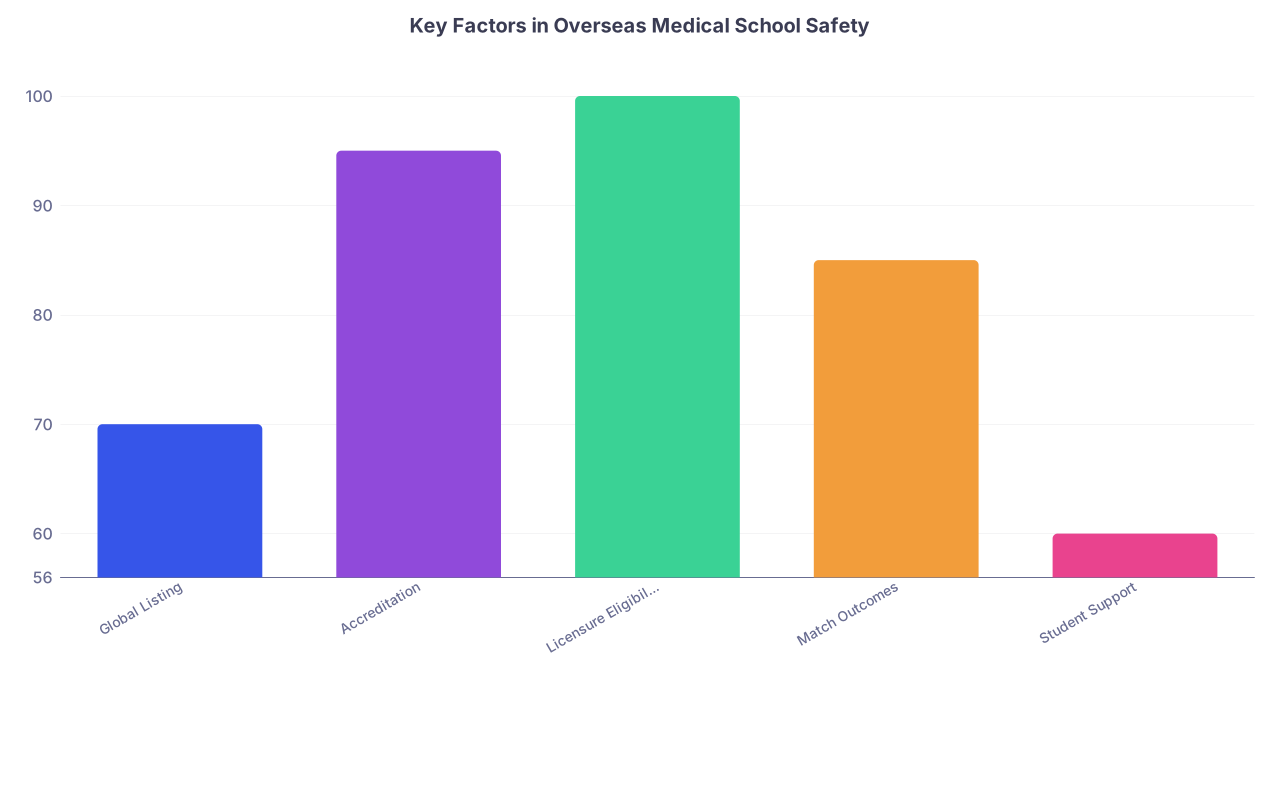
| Category | Value |
|---|---|
| Global Listing | 70 |
| Accreditation | 95 |
| Licensure Eligibility | 100 |
| Match Outcomes | 85 |
| Student Support | 60 |
Sample Decision Flow
Here’s the basic logic tree most smart applicants follow when looking at an overseas program.

| Step | Description |
|---|---|
| Step 1 | Identify Target Practice Country |
| Step 2 | Check WDMS Listing |
| Step 3 | Do Not Apply |
| Step 4 | Check WFME/Accreditation |
| Step 5 | Check Host Country Gov Recognition |
| Step 6 | Check Target Country Licensure Rules |
| Step 7 | Review Match Outcomes and Student Reports |
| Step 8 | Consider Applying |
| Step 9 | High Risk - Think Carefully |
Use this as your sanity check. If you hit a hard “No” and still try to argue yourself into yes, that’s not strategy. That’s wishful thinking.
FAQ (Exactly 7 Questions)
1. If a school is listed in the World Directory of Medical Schools, is it automatically safe?
No. WDMS listing means the school exists and is recognized at a basic national level. It does not guarantee ECFMG eligibility, WFME-compliant accreditation, or acceptance by your target country’s licensing body. WDMS is step one, not the finish line.
2. How do I know if a school will let me take USMLE and get ECFMG certified?
You must confirm two things: the school is in WDMS and it’s accredited by a WFME-recognized agency that ECFMG accepts. Check the ECFMG website, review the list of recognized accrediting agencies, and confirm your school’s accreditor is on that list. If the school can’t clearly document this, assume risk is high.
3. Agents say graduates from this school match in the US all the time. Should I trust that?
Never take an agent’s word at face value. Ask for: an official match list from the school; specific residency program names and years; and talk directly to recent graduates in US residencies. If the proof is always vague—“hundreds of grads in the US”—and you can’t verify anyone, don’t believe it.
4. Are Caribbean medical schools generally recognized and safe?
“Caribbean” is not one thing. Some Caribbean schools have long histories of ECFMG certification and US residency placements. Others are unstable or poorly regarded. You must vet each school individually using the same framework: WDMS, WFME accreditation, government recognition, and real match data. The worst mistake is assuming all Caribbean schools are interchangeable.
5. Can a new overseas medical school be a good choice?
Possible, but risky. New schools may not yet have full accreditation, match data, or stable affiliations for clinical rotations. You’d be a test case. If your margin for error is low—and for most people it is—you’re better off choosing a school with a proven track record unless you have very strong reasons and clear written confirmation on future eligibility.
6. My home country recognizes this school, but the US/Canada might not. Is it still “safe”?
It depends on your goals. If you’re absolutely committed to practicing only in your home country, and that pathway is guaranteed with this school, it can be reasonable. But if you even might want to go to the US/Canada/UK later, choosing a school that closes those doors is a serious limitation. You’re trading short-term access for long-term flexibility.
7. What’s the single biggest mistake students make when picking an overseas school?
They confuse “can I get in?” with “can I get licensed and employed later?” They focus on tuition cost, beach photos, and friendly recruiters instead of hard facts: accreditation, licensing eligibility, and outcomes. If you flip that—start with where you want to practice and work backward through official criteria—you avoid 90% of the horror stories.
Key takeaways:
Focus on where you want to practice, then verify—using official sources—that your chosen school is WDMS-listed, properly accredited (WFME-compliant), and explicitly acceptable to licensing bodies in that country.
Do not trust marketing; demand hard documentation and real outcomes.