
What if you could skip four years of U.S. premed and jump straight into medical school after high school—would that actually put you ahead, or quietly trap you in a harder path to U.S. residency?
Here’s the blunt answer:
A 6-year European medical program can be fantastic if:
- You’re certain you want medicine
- You’re comfortable long-term abroad
- You’re okay with extra hurdles to get a U.S. residency
For most students who want to practice in the U.S., however, a European 6-year program is not “better” than U.S. premed + U.S. MD/DO. It can still be right for you—but calling it better is a stretch.
Let’s break this down like a real decision, not brochure fantasy.
First: What Are We Actually Comparing?
On one side: the classic U.S. route.
- 4 years U.S. undergrad (premed track, any major)
- 4 years U.S. medical school (MD or DO)
- Then residency in the U.S.
On the other side: the 6-year European route.
- Enter after high school (or A-levels/IB/strong high school diploma)
- 6-year integrated MD-equivalent program abroad (often in English)
- Then attempt U.S. residency as an international medical graduate (IMG)
Programs you’re probably looking at:
- Poland: Jagiellonian, Medical University of Warsaw, Poznan
- Hungary: Semmelweis, University of Szeged
- Czech Republic: Charles University
- Italy: Pavia, Humanitas, Bologna (English tracks)
- Ireland: RCSI, UCD (some are 5-6 year tracks depending on background)
They all sell the same pitch: “Skip premed. Start medicine now. Cheaper tuition. Study in Europe.”
Nice pitch. Incomplete story.
The Big Picture: Pros and Cons at 30,000 Feet
If you want a quick comparison, here’s how I’d frame it.
| Factor | 6-Year European Med Program | U.S. Premed + U.S. Med School |
|---|---|---|
| Time to MD degree | ~6 years total | ~8 years total |
| U.S. residency chances | Lower, especially for competitive | Higher, especially for competitive |
| Upfront difficulty | Early intense science/clinical load | Gradual: college then med school |
| Cost predictability | Varies by country; often lower tuition | High tuition; big debt, more predictable |
| Flexibility to change paths | Low once you start | Higher during undergrad |
| Lifestyle/social | Expat life, culture shift | More familiar, closer to home |
You’re trading:
- Time saved (2 years)
- Possibly lower tuition
- Adventure / international experience
For:
- Harder U.S. residency match
- Less flexibility if you change your mind
- More paperwork, exams, and verification hassle
Match Reality: U.S. Residency as a European Grad
This is the part most 17-year-olds don’t fully get—because no one tells them straight.
If you train in Europe and want to come back to the U.S., you’re an IMG (international medical graduate). That’s true even if you’re a U.S. citizen.
The U.S. Match data is crystal clear: being an IMG makes your odds worse.
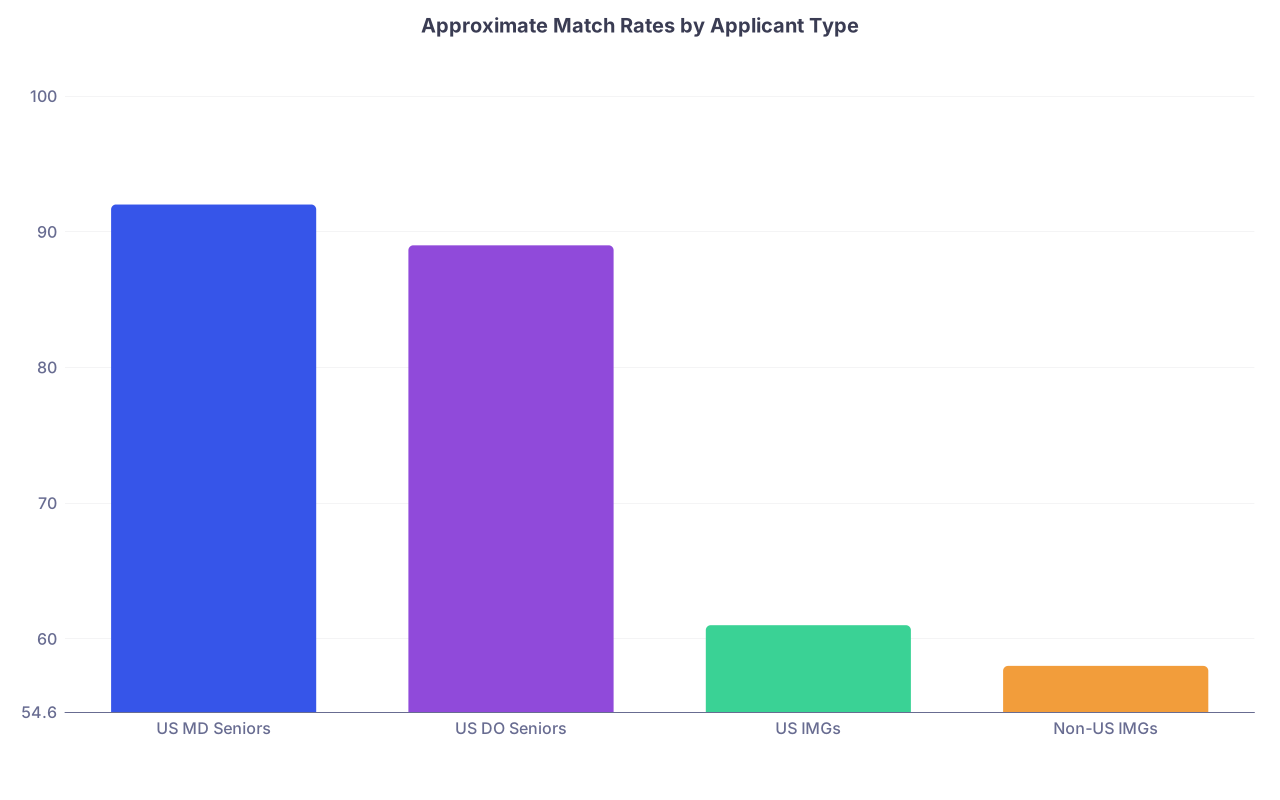
| Category | Value |
|---|---|
| US MD Seniors | 92 |
| US DO Seniors | 89 |
| US IMGs | 61 |
| Non-US IMGs | 58 |
Numbers shift a bit year to year, but the pattern doesn’t. You’re in the tougher categories if you go abroad.
Where this hits hardest:
Competitive specialties (derm, ortho, plastics, ENT, neurosurgery, rad onc):
As an IMG? Nearly closed doors. Not literally zero, but close enough that planning on it is delusional.Mid-competitive (EM in some regions, anesthesia, radiology, urology):
Real uphill fight. You’d need stellar USMLEs, U.S. clinical experience, connections.Core fields (internal medicine, family medicine, peds, psych):
Much more realistic. Plenty of IMGs match here, especially into community programs.
If you say “I don’t care, I just want any residency in the U.S.”—then Europe could be workable.
If you say “I want maximum choice and competitive options”—go U.S. premed + U.S. med.
Academic and Training Differences That Actually Matter
People obsess over trivial differences like “European anatomy dissection is better.” Fine. Not the real issue.
Here’s what actually changes your life:
1. Entry Level and Academic Maturity
European 6-year programs drop you into hardcore preclinical science in your late teens. No buffer.
In the U.S., you get:
- Time in undergrad to grow up, adjust, learn how you study best
- A chance to decide if you genuinely like science and clinical exposure
- More space to build a strong application gradually
In Europe, I’ve seen:
- 18-year-olds drowning in biochemistry, histology, anatomy, and physiology all at once
- People realizing in year 2 or 3 that they hate medicine… with few exit options and credits that don’t transfer
If you are 100% sure and unusually mature, this may not scare you. If you’re unsure? That uncertainty will get multiplied overseas.
2. Curriculum Alignment With U.S. Exams
You will need to pass USMLE Step 1 and Step 2 CK to match back in the U.S.
Some European programs are USMLE-aware and will tell you that. Others happily pretend the U.S. doesn’t exist.
Issues you will face:
- Different exam style: Many European schools love oral exams, essay questions, and cumulative final orals. USMLE is MCQ, concept integration.
- Timing: You might not get all the systems-based integrated teaching in a clean Step 1-ready format.
- Self-study burden: You’ll probably need UWorld, NBME practice tests, dedicated USMLE prep on top of your regular exams.
I’ve watched students essentially live two curriculums:
One for their European school, and a parallel one for USMLE.
If your goal is absolutely U.S. residency, that is a real tax on your time and sanity.
Money: Cheaper Doesn’t Automatically Mean Better
You’re probably thinking: “But these programs are cheaper.”
Sometimes they are. Sometimes they aren’t, once you add everything.
Major cost buckets:
- Tuition (often lower than U.S. private med schools, comparable or a bit higher than in-state public)
- Living expenses (some cities are cheaper than U.S. big cities, some aren’t)
- Flights, visas, health insurance, immigration paperwork
- Licensing exams (USMLE), travel for U.S. observerships or electives
Some countries:
- Poland/Hungary/Czech Republic: tuition ~€12,000–€18,000 per year for English programs
- Italy (public schools): much cheaper tuition if you get in, but cost of living in big cities adds up
- Ireland: often more expensive, closer to U.S. private med tuition
Plus: U.S. federal loans for foreign schools are limited to certain approved lists. Many programs are not eligible, which means:
- You’re relying on private loans, family money, or mixed financing
- Interest rates and terms may be worse than federal loans
The U.S. path is expensive, yes. But at least the financing structure and career outcomes are stable and predictable.
Lifestyle, Language, and Sanity
This part is underrated, especially by students who’ve never lived abroad.
You’re not going to Europe for a semester. You’re going for six years.
You’ll deal with:
- Different healthcare systems and patient expectations
- Bureaucracy in another language (residency permits, banking, housing)
- Homesickness, especially during exam and holiday seasons
- Building all new social support networks with people you might not share a language or culture with
On top of that, language for clinical years:
- Even if your coursework is in English, your patients may not be
- You’ll need at least functional proficiency to do proper history and physicals
- Some programs will quietly push you to pass a local language exam for clinical practice
Some students love this. They become bilingual, more independent, culturally competent.
Others struggle for years and feel perpetually “behind” compared to friends in U.S. schools.
Who Should Strongly Consider a 6-Year European Program?
The people for whom I say “Yes, this might actually be a smart path” look like this:
You are absolutely, obsessively sure you want medicine
Not “maybe,” not “I think so,” but you’ve shadowed, worked in healthcare, understand the grind.You’re okay if you end up practicing outside the U.S.
Canada, Europe, your home country—those are all acceptable endpoints for you.You’re realistic about specialty choice
You’re fine with IM, FM, peds, psych, maybe anesthesia or rads if everything goes perfectly. You’re not fixated on neurosurgery at Mayo.You actually want the expat life
You’re curious, adaptable, not terrified by being far from home.Your financial situation makes it clearly better
Either:- You avoid insane U.S. private tuition, or
- You’d be blocked from U.S. schools but can afford Europe
For this group, a 6-year program can be a solid move—especially in well-known schools with a clear track record of U.S./UK placements.
Who Is Better Off Doing U.S. Premed First?
Most U.S. high-achieving high schoolers. Honestly.
Choose U.S. premed + U.S. med school if:
You want maximum shot at:
- Competitive specialties
- Academic centers
- Prestigious residencies
You’re not 100% sure about medicine
You want room to switch to engineering, business, CS, or something else without throwing away years.You care about networking and mentoring in the U.S. system
You want U.S. research, U.S. letters, U.S. clinical experiences baked into your path rather than stitched together from across an ocean.You’re already reasonably competitive
Strong GPA potential, good standardized test performance, capable of building a solid application with time.
Yes, it’s longer. Yes, it’s expensive. But if your endgame is successful, flexible, U.S.-based medical career, this route is almost always safer.
A Simple Decision Framework
If you’re still torn, walk through this honestly.

| Step | Description |
|---|---|
| Step 1 | Want to be a doctor? |
| Step 2 | Do U.S. undergrad first |
| Step 3 | U.S. premed + U.S. med is better |
| Step 4 | 6-year Euro program could work |
| Step 5 | 100% sure? |
| Step 6 | Must practice in U.S.? |
| Step 7 | OK with limited specialty options? |
| Step 8 | Comfortable living abroad 6 years? |
If at multiple decision points you’re hesitating or saying “I’m not sure”… you’re giving yourself your own answer: don’t lock into a 6-year foreign program yet.
How to Evaluate Specific European Programs (If You’re Still Interested)
If you’re still considering Europe, don’t just choose the school with the prettiest campus photo.
Seriously investigate:
- Percentage of graduates getting U.S. or UK residencies/fellowships
- Their USMLE support: integrated prep, pass rates, advising
- Language requirements for clinical years
- Visa/immigration track record for non-EU students
- Alumni you can actually talk to (not just handpicked marketing stars)
And compare 3–5 options methodically:
| Factor | School A | School B | School C |
|---|---|---|---|
| USMLE prep built-in? | Yes/No | Yes/No | Yes/No |
| Language for clinicals | English/Local | English/Local | English/Local |
| U.S. Match alumni? | Many/Few | Many/Few | Many/Few |
| Tuition per year | $ | $ | $ |
| Federal loan eligible? | Yes/No | Yes/No | Yes/No |
If they can’t answer your questions clearly, that’s already data.
FAQ (Exactly 7 Questions)
1. Will going to a 6-year European med program hurt my chances of matching into a U.S. residency?
Yes, compared to being a U.S. MD/DO graduate, it hurts your chances. You’ll be classified as an IMG, and IMGs have lower match rates overall. You can still match, especially into internal medicine, family medicine, peds, and psych, but competitive specialties and big-name academic programs become much harder.
2. Do European 6-year programs save me time overall?
On paper, yes—you get an MD-equivalent in 6 years instead of 8. But you may add:
- Extra time for USMLE prep
- Extra time for U.S. clinical electives/observerships
- Possible delays if you need to retake exams or deal with licensing paperwork
So it’s not always a clean 2-year advantage in practice.
3. Is the education quality in European programs worse than in U.S. schools?
Not automatically. Many European faculties have strong academics and solid clinical training. The issue isn’t “quality” in a simple sense. The problem is alignment with U.S. exams, residency expectations, and networking. You can be very well trained clinically and still struggle to get into a U.S. program if your school isn’t well-known or supportive of U.S.-bound students.
4. Can I switch from a European med program back into a U.S. medical school?
Almost never. U.S. med schools do not typically accept transfers from foreign medical schools. If you decide after 2 years in Europe that you want to go to a U.S. school, you’ll likely have to start from scratch: reapply as if you had never started med school, and your previous credits won’t transfer.
5. What if I want a competitive specialty like derm or ortho—should I still consider Europe?
If you’re already fixated on derm, ortho, plastics, neurosurgery, or ENT and your main goal is U.S. practice, I would not recommend starting overseas. It’s not impossible, but the odds are poor and you’re deliberately giving yourself extra obstacles. You’re better off building the strongest possible application for a U.S. MD/DO school.
6. Are there any “best” European countries or schools for U.S.-bound students?
Some schools in Poland, Hungary, Czech Republic, Ireland, and Italy have long-running English programs and more alumni in the U.S. and UK. But “best” depends on your goal. You want a school that:
- Has a documented track record of U.S./UK placements
- Offers structured USMLE support
- Has English clinical teaching and reasonable language requirements
Blindly picking a random “English-taught MD in Europe” is a bad idea.
7. If I’m not competitive for U.S. med schools right now, is Europe a smart backup plan?
It can be, if you understand the trade-offs. If your stats or finances make U.S. schools unrealistic but you’re dead set on becoming a physician, Europe might be a viable route—especially if you’re open to practicing outside the U.S. But you should go in with eyes open: less flexibility, harder U.S. match, and more responsibility on you to build a U.S.-compatible profile.
Bottom line:
- For a U.S.-based, flexible, competitive medical career, U.S. premed + U.S. med school is almost always the stronger path.
- A 6-year European program can be right for a very specific type of student: absolutely committed, adaptable, and realistic about U.S. residency limitations.
- Don’t get seduced by “shorter and cheaper” without honestly weighing the match data, your specialty goals, and how sure you really are at 17 about the rest of your life.
If you treat this as a branding choice (“Europe sounds cool”) instead of a career-defining decision, you’ll regret it.