

The social media narrative about IMGs is dangerously distorted.
If you take Instagram reels, TikToks, and YouTube vlogs at face value, you would think that going to any offshore or foreign medical school is a quick side door into U.S. residency. It is not. And the people pushing that fantasy are usually leaving out exactly the information that would change your decision.
You are not just fighting competitiveness. You are fighting misinformation.
Let me walk you through the most common social media “IMG success” traps I see premeds fall for — and how to dissect them before you blow six years and six figures on a bad decision.
1. The “I Matched!” Post With All the Critical Details Missing
The single most misleading piece of IMG content: the generic “I matched!!!” post with a white coat selfie, confetti emojis, and exactly zero context.
Here is what those posts rarely tell you up front:
- Their exact USMLE scores (or even whether they passed on first attempt)
- Whether they are a U.S. citizen or international
- How many programs they applied to
- How many cycles they applied for
- What specialty they actually matched into
- Whether the program is community vs university, new vs established, or at risk of closure
- How many of their classmates quietly did not match
The absence of detail is not an accident. It is the product doing what it was designed to do: sell you a story.
Red flags in “success” posts
Watch for these phrases. They are code for “I am hiding something important”:
- “Hard work pays off” → usually replacing real data like Step scores, number of attempts, or failure history.
- “IMGs can do anything!” → technically true for a tiny minority, wildly misleading for the average applicant.
- “I did not let my past define me” → sometimes equals academic dismissals, failed exams, or transfers.
- “Dream achieved!” with no specialty named in text or caption → often means they switched to a much less competitive specialty than they originally intended.
If a post claims success but gives you no way to calibrate how reproducible that success is, treat it as marketing, not guidance.
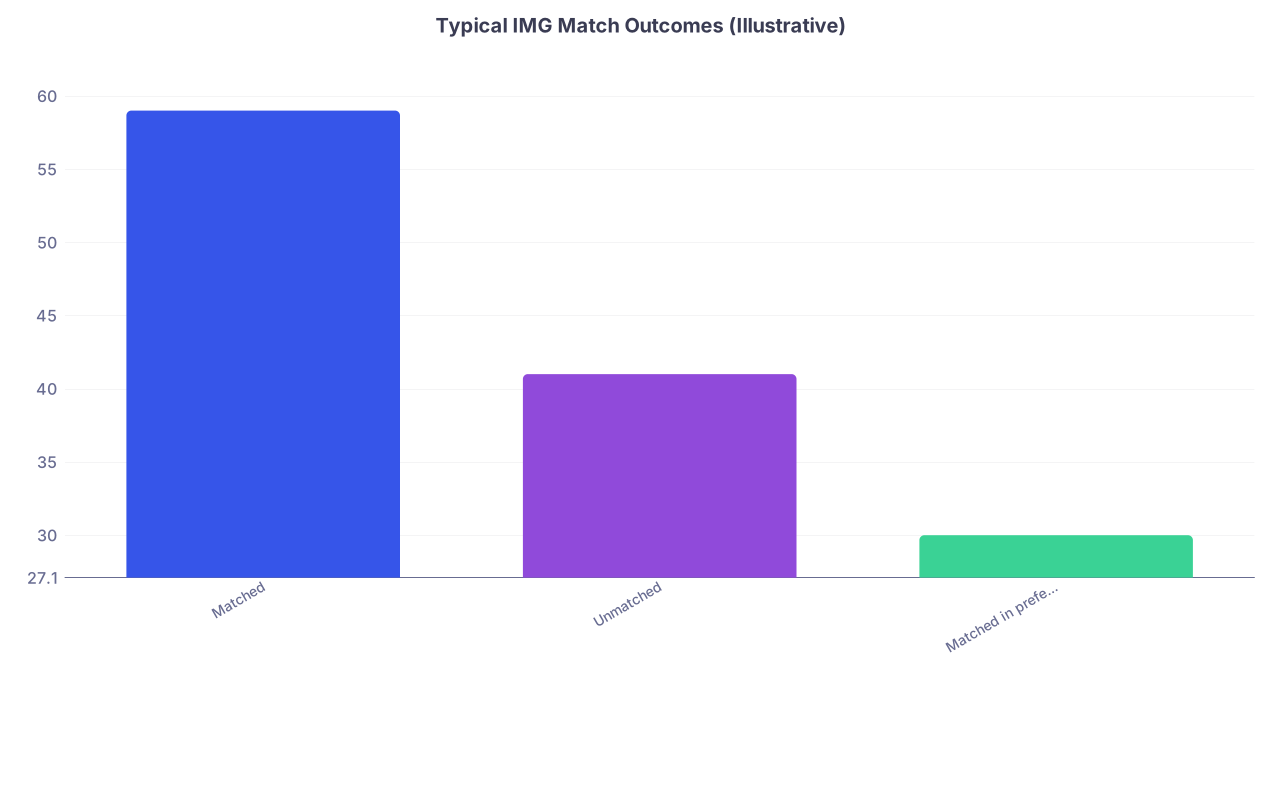
| Category | Value |
|---|---|
| Matched | 59 |
| Unmatched | 41 |
| Matched in preferred specialty | 30 |
Do not let a single smiling face on Match Day erase the reality of the 40% who do not post.
2. The “Anyone Can Match From Here” School Marketing Trap
A lot of offshore and lesser-known international schools have pivoted to social media because traditional reputation is not on their side. So they lean hard into anecdotal success.
You will see:
- School accounts reposting every single graduate who matched, as if they represent the average
- Short-form videos featuring “Top Match Successes!” — all in internal medicine or family medicine — framed as if neurosurgery is next
- Influencer-style “student ambassadors” loudly praising the school while quietly receiving scholarships, fee waivers, or stipends
Here is what they will not highlight in the same reel:
- Their actual match rate for U.S. citizen IMGs vs non-U.S. citizens
- The percentage of students who drop out or are dismissed before graduation
- The number of graduates who never sit for USMLE or never apply for residency
- Average number of attempts per USMLE step
- How many graduates are in prelim-only positions or non-categorical spots
If a school repeatedly posts success stories but never posts aggregate data, assume the aggregate does not look good.
How to sanity-check a school’s claims
Do not trust their reels. Look for hard numbers and external validation.
Ask:
- What is your 5-year NRMP match rate for U.S. citizens, by specialty?
- What percentage of matriculants (not just graduates) match into any residency in the U.S. or Canada?
- How many students fail out or withdraw before graduation?
- Do you publish your USMLE pass rates with cohort sizes?
- Are you listed in the World Directory of Medical Schools with ECFMG eligibility?
- For Caribbean schools: are they New York and California approved?
If they dodge, redirect, or only give cherry-picked numbers, you have your answer.
| Signal | What You See Online | What It Often Means |
|---|---|---|
| Constant match posts | Daily celebration of “another match!” | Very small denominator, heavy cherry-picking |
| No published match list | Only a few screenshots of social media posts | Outcomes likely poor or inconsistent |
| Vague USMLE claims | “High pass rates!” with no numbers | Small subgroup data, not full class |
| Heavy influencer presence | Student “takeovers”, sponsorships | Marketing budget > academic outcomes |
| Aggressive DMs to prospects | “We think you’d be a great fit!” | Enrollment crisis, not selective admissions |
You are not just choosing a school. You are choosing a statistical profile. Know which profile you are buying.
3. The Outlier Story Sold as Standard Path
Another chronic distortion: taking a genuine outlier and presenting them as proof of concept.
You will see videos like:
- “How I matched Derm as an IMG!”
- “From low GPA to U.S. cardiology fellowship as a Caribbean grad!”
- “Non-traditional IMG matched ortho after 3 attempts at Step 1!”
I am not saying these people do not exist. They do. I have met some. They are usually:
- Exceptionally driven
- Exceptionally lucky
- Exceptionally well-connected
- Willing to tolerate multiple years of research, lower pay, and delayed training
- The exact opposite of a “typical” candidate
The danger is not their story; it is the framing.
When someone presents a 99th percentile outcome as a realistic target for the average premed with a 3.0 GPA and no research, they are selling fantasy.
How to recognize an outlier
Look for these features:
- Multiple years of U.S. research with dozens of publications
- U.S. citizenship with strong networking opportunities
- Family in medicine or direct connections to program leadership
- Step scores in the 250+ range back when Step 1 was scored
- Graduating at the very top of their class
- Matching in a niche or under-subscribed track that does not generalize
If the storyteller never discusses how rare their trajectory is, or never compares to their classmates’ outcomes, assume they are unknowingly (or knowingly) misleading you.
A practical rule:
If 80–90% of people from that school are going into primary care or non-U.S. practice, but the reels only show competitive specialty success stories, you are looking at highlight bias.
4. The “IMG-Friendly” Specialty Myth Recycled on TikTok
The phrase “IMG-friendly” is one of the most abused terms on med Twitter and TikTok.
Here is how the hype goes:
- “Internal medicine is IMG-friendly, so you will be fine.”
- “Psych is easy as an IMG — so many programs!”
- “FM always needs people, you cannot go wrong.”
They take a kernel of truth (some specialties do accept more IMGs) and stretch it into “you are safe here.” You are not automatically safe anywhere.
Even in “IMG-friendly” fields:
- U.S. grads are still favored in many programs.
- Program quality and training environment vary wildly.
- Visa status can dramatically change your odds.
- Failing Step exams or having gaps can still sink you.
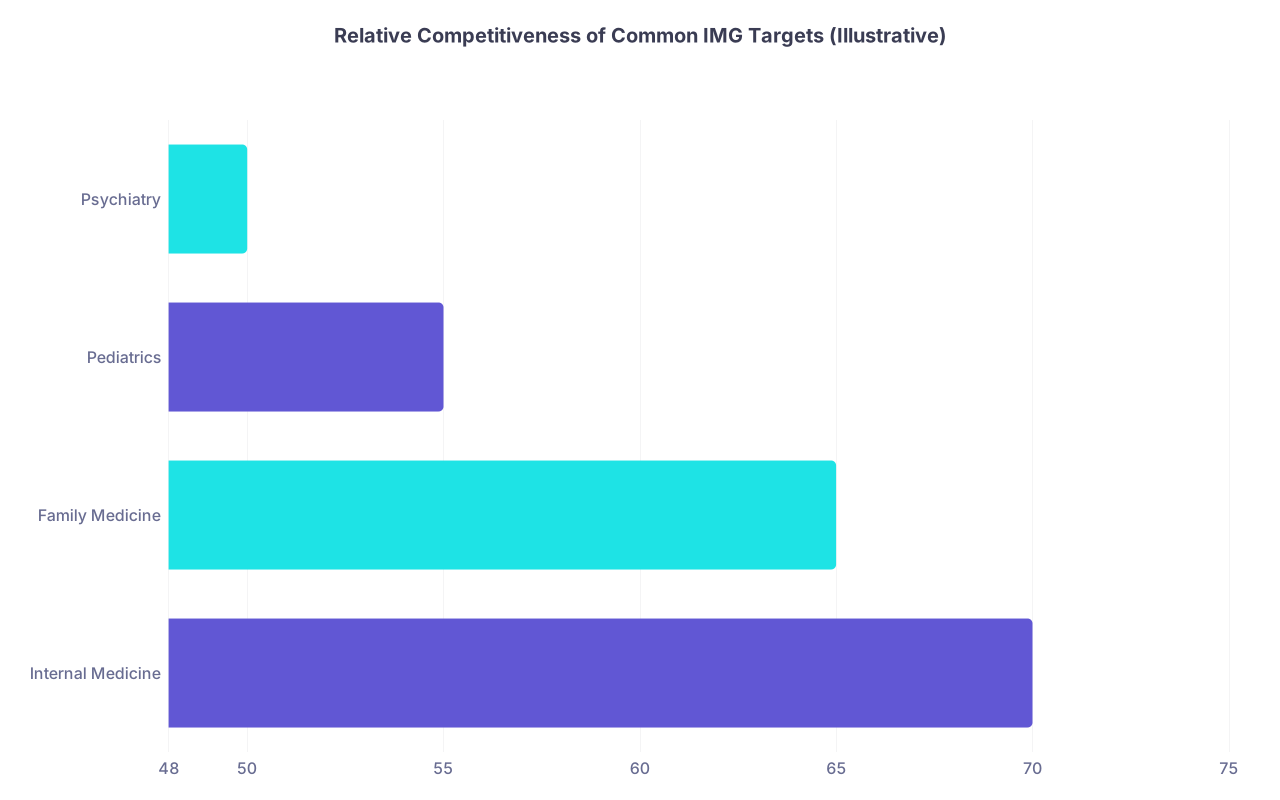
| Category | Value |
|---|---|
| Internal Medicine | 70 |
| Family Medicine | 65 |
| Pediatrics | 55 |
| Psychiatry | 50 |
(Here, higher numbers represent more IMG presence, not easy match rates.)
What you never see in the 30-second video:
- The applicant applied to 150+ programs.
- They had U.S. clinical experience in strong hospitals.
- They had no exam failures and strong letters of recommendation.
- They were willing to move literally anywhere in the country.
“Friendly” does not mean “guaranteed” or even “likely.” It means “possible if you have everything else lined up.” Many IMGs misinterpret that word and pay for it on Match Day.
5. The Hidden Denominators: Survivorship Bias on Steroids
The nastiest distortion of all: survivorship bias.
People who succeed are far more likely to:
- Post about it
- Be interviewed
- Be featured by schools
- Be pushed by algorithms
People who do not match:
- Delete their med Instagram
- Stop talking publicly about their path
- Quietly pivot to another career, often with massive debt
So your feed fills up with:
- “Caribbean med student matched IM!”
- “Polish med grad matched peds!”
- “Ukrainian school grad matched surgery prelim!”
While the dozens who did not match at all disappear from your view.
How social media amplifies the lie
The algorithm is not on your side. It promotes:
- Emotional content (crying on Match Day with happy resolutions)
- Dramatic arcs (“Everyone doubted me, but…”)
- Shareable hope (“If I can do it, you can too!”)
It does not promote:
- 40-year-olds with $300k in loans, no residency, and a job unrelated to medicine
- Students who left an offshore school after failing Step 1 twice
- Parents warning others not to repeat their child’s mistake
If you do not actively seek out the “failure stories,” you will barely see them. But they exist. In numbers large enough to be terrifying.
6. The Sponsored “Student Ambassador” You Think Is Just Being Nice
A lot of “helpful” IMGs on social media are not neutral.
They are:
- Paid student recruiters
- Official or unofficial ambassadors
- Getting tuition discounts, rent support, or travel stipends
- Offered extra consideration for internal positions or teaching roles
They might genuinely like their school, but they also have a financial or career incentive to say nice things and downplay risks.
Watch for these patterns:
- Constant positive content about one specific school or network
- Discount codes, referral links, “mention my name” in applications
- Fuzzy disclaimers like “partnered with” or “collaborating with”
- Very little discussion of classmates who struggled or failed out
- Rehearsed talking points about “supportive faculty” and “amazing community”
If they never post:
- Actual match lists
- Aggregate failure rates
- Visa challenges
- Any real criticism of the institution
…then you are looking at marketing, not mentorship.

Do not confuse access to a content creator with access to reality. Those are different products.
7. The “I Was a 2.7 GPA Premed and Now I’m an MD” Oversimplification
Some of the most damaging stories start with “I messed up as a premed, but look at me now.”
You will see:
- “2.5 GPA to MD in 4 years!”
- “MCAT 495, still became a doctor!”
- “Rejected from U.S. med schools, thriving as a Caribbean grad!”
These are catnip for struggling premeds. You feel seen. You feel hope. And hope is exactly what can be monetized.
Here is the missing nuance:
- They might be “an MD” but not in residency yet.
- They might hold an MD from a country where they cannot (or very rarely) practice in the U.S.
- They might be years into SOAP cycles, prelim positions, or research fellowships with no categorical spot.
- Their GPA/MCAT were not the real limiter; their work ethic, maturity, or time management were, and those did not magically fix themselves by moving islands.
A low undergraduate GPA is not automatically fatal. But it is a symptom of something. Poor study skills. Life chaos. Health issues. Lack of discipline.
If nothing about your approach changes, switching to an international school does not solve the problem. It amplifies the consequences.
8. How to Do a Reality Check Before You Believe Any IMG Success Story
You do not need to stop watching these stories. You need to stop believing them uncritically.
Here is a simple dissection framework.
Step 1: Extract the facts they are not emphasizing
Write down:
- School name and country
- Specialty matched
- Visa status (U.S. citizen, permanent resident, or needing visa)
- Any disclosed exam failures or gaps
- Whether they matched first try or re-applied
If any of these are missing, that is your first warning sign.
Step 2: Benchmark against typical outcomes
Look up:
- School’s published (or leaked) match lists
- NRMP data for IMGs in that specialty
- Visa match rates for non-U.S. citizens
- Step requirements (some specialties quietly expect 240+ even if they never write it)
If their story is far above average on all metrics, flag it as an outlier — inspirational, maybe, but not a basis for your plans.
Step 3: Identify what they had that you may not
Ask yourself:
- Do I have their research pedigree?
- Do I have their exam performance?
- Am I as geographically flexible as they were?
- Do I have similar networking opportunities?
- Am I actually willing to grind as hard as they describe?
If the honest answer to two or more of those is “no,” you should not expect the same result from the same school.

| Step | Description |
|---|---|
| Step 1 | See IMG Success Story |
| Step 2 | Assume heavy selection bias |
| Step 3 | List school, scores, specialty |
| Step 4 | Compare to school-wide outcomes |
| Step 5 | Classify as outlier inspiration |
| Step 6 | Still verify risks and costs |
| Step 7 | Are key details given? |
| Step 8 | Matches typical? |
This is unglamorous. But it is how you avoid becoming the cautionary tale someone else posts about ten years from now.
9. Safer Ways to Learn From IMGs Without Falling for Hype
You do not need to unplug from everything. You need to curate.
Better sources than TikTok hype:
- Anonymous forums where people share failures as well as wins (but cross-check; those have their own pathologies).
- Alumni from multiple graduation years at the same school, not just brand-new grads on Match Day.
- Physicians who work in U.S. residency programs and see IMG performance firsthand.
- Official match lists cross-referenced with program reputations, not just specialty labels.
When you talk to real IMGs, ask questions that cut through the marketing:
- “How many classmates did not match or gave up?”
- “How many repeated Step exams?”
- “Would you attend the same school again knowing everything you know now?”
- “If you had a U.S. DO offer and this IMG offer at the same time, which would you choose?”
- “What do attendings or PDs actually say about your school?”

The honest IMGs will not tell you “never do this.” They will say something more like: “This path is survivable for the right person with eyes wide open. It is a disaster for people chasing an easy shortcut.”
That is the line you need to understand.
10. The Core Mistakes to Avoid
Let me strip this down to the errors I see repeating over and over.
Do not:
- Treat one person’s success story as a reproducible formula.
- Assume “IMG-friendly” means “guaranteed match if you breathe.”
- Believe any school that refuses to publish clear, cohort-wide outcome data.
- Let a low GPA or MCAT push you into a low-information, high-risk decision.
- Confuse influencer marketing with mentorship.
- Ignore opportunity cost — the years, money, and limited loan flexibility you are locking in.
If your plan relies on being the exception, it is not a plan. It is a bet. And the house, in this case, is very comfortable taking your tuition.
Key Takeaways
- Most IMG “success stories” on social media are heavily filtered, missing key details, and shaped by survivorship bias and marketing incentives. Treat them as inspiration, not evidence.
- Before you consider an international medical school, base your decision on hard data: match rates, USMLE outcomes, visa realities, and total cost — not individual anecdotes or school-sponsored influencers.
- If your plan depends on being an outlier, you are stepping into a hype trap. Design a path that still makes sense even if your outcome is average, not exceptional.


