
The horror stories about Caribbean med schools are wildly oversimplified—and that’s exactly why they’re so terrifying.
You’ve probably heard it all: “Caribbean equals no residency,” “You’ll never match in the U.S.,” “It’s career suicide.” And now you’re sitting there wondering if one decision—because of one MCAT score, one GPA, one bad semester—is about to lock you into permanent regret.
Let’s not sugarcoat this: going Caribbean can absolutely make your U.S. residency path harder. A lot harder. But “harder” is not the same as “impossible,” and the people who talk in absolutes usually haven’t actually looked at the numbers… or they’re ignoring all the nuance.
I’m going to walk through this the way your anxious brain is doing it at 2 a.m. Worst case first. Then the actual data. Then what to do if this is your only/realistic option.
The Worst-Case Scenario You’re Afraid Of
Here’s the nightmare version you’re probably replaying in your head:
You go to a Caribbean med school because your GPA and MCAT aren’t competitive enough for U.S. MD or DO. You take out a ridiculous amount of loan money—maybe private loans because federal options are limited or school isn’t eligible. You move to a tiny island. You’re suddenly in a class of 300–600 mostly U.S. students who “also had no other options.”
The classes are brutal. The school doesn’t really care if you pass or fail—because they already got your money. People start disappearing after first semester. You scrape by, or maybe you fail an exam or a course and repeat. You eventually take Step 1 (now pass/fail), maybe Step 2. You come back to the U.S. for clinical rotations, but some hospitals treat you like second-tier compared to U.S. MD/DO students.
Then Match Day: you don’t match into anything. Not even prelim. Your debt is in the six-figure range. You’re technically a doctor with an MD degree from an offshore school, but you have no residency spot, no license, and you’re stuck.
That scenario? It happens. I’ve seen versions of it. Not rare enough to ignore.
But you know what no one says out loud? That some students from those exact same schools do match—every single year. Internal medicine, family medicine, psych, peds, sometimes even anesthesia or surgery. It’s just that:
The floor is much lower. The ceiling is much harder to reach.
The Numbers: How Bad Is It Actually?
Let’s look at the part everyone loves to quote without context: match rates.
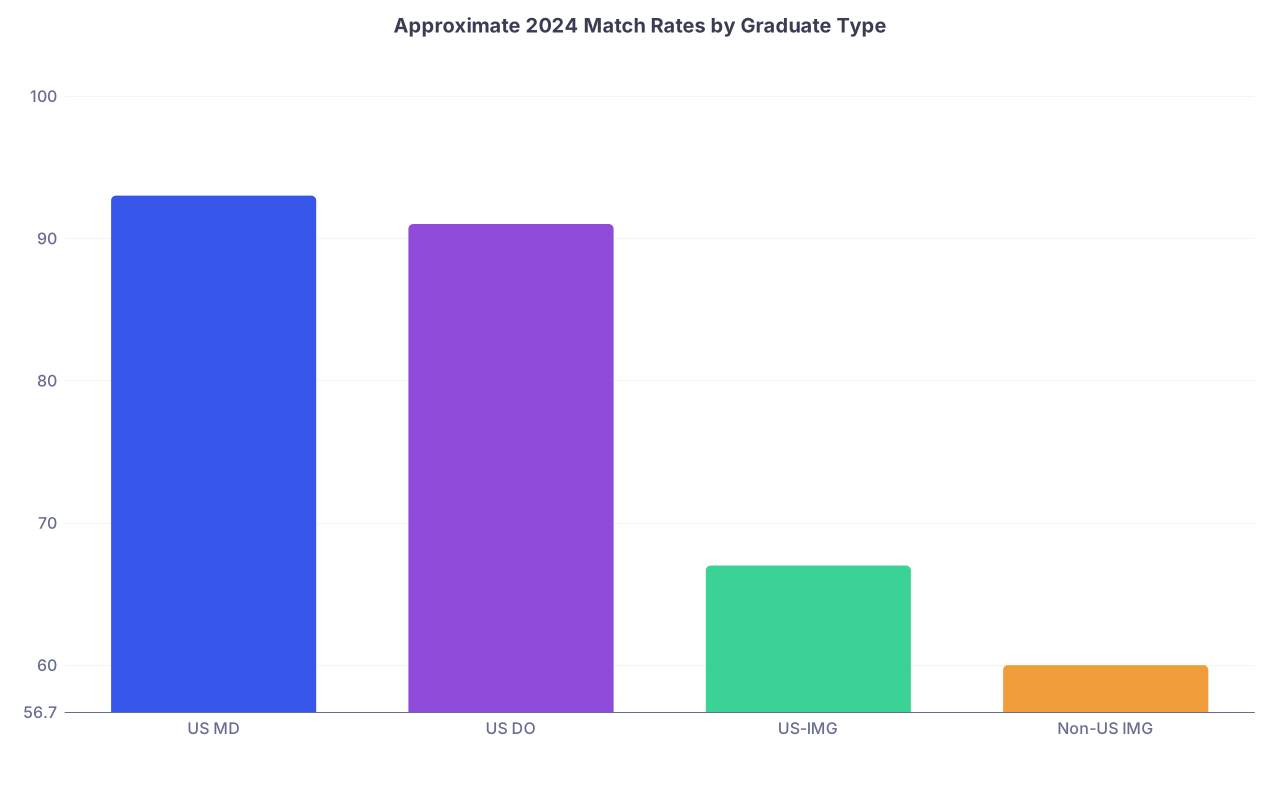
| Category | Value |
|---|---|
| US MD | 93 |
| US DO | 91 |
| US-IMG | 67 |
| Non-US IMG | 60 |
These are ballpark NRMP numbers (they shift year to year, but the pattern is the same):
- U.S. MD seniors: ~93% match
- U.S. DO seniors: ~90–91% match
- U.S. citizen IMGs (includes many Caribbean grads): ~65–70% match
- Non-U.S. citizen IMGs: lower than that
So no, “Caribbean = zero chance” is wrong. But “Caribbean = close to U.S. MD” is also fantasy.
Here’s the important part people gloss over: “US-IMG” is not just “Caribbean.” It’s also Americans who went to schools in Ireland, Israel, Mexico, etc. The strong ones in that group often have better outcomes than the bottom half of some Caribbean schools. So your actual odds will depend heavily on:
- Which Caribbean school
- Your exam scores (especially Step 2 now)
- Your grades and clinical performance
- Specialty choice
- How ruthlessly realistic your application strategy is
To put it bluntly: you can’t behave like a borderline U.S. MD applicant and expect U.S. MD results if you go Caribbean. The bar you have to clear is higher because the default suspicion is higher.
Not All Caribbean Schools Are the Same (Even If It Feels That Way)
This is where the nuance gets lost in Reddit horror threads.
There’s a difference between the “big four” (people argue about exactly which are included, but usually: SGU, Ross, AUC, Saba) and some random offshore school with almost no match data, unstable accreditation, and a history of students being stranded when loans or approvals suddenly change.
Here’s the kind of comparison you should actually be doing:
| Factor | U.S. MD | U.S. DO | Caribbean (larger schools) |
|---|---|---|---|
| Match rate (approx) | ~93% | ~90–91% | ~50–70% (varies) |
| Class size | 100–200 | 100–200 | 300–600+ |
| Federal loans | Yes | Yes | Only at some schools |
| Step 1 pass rate | Very high | Very high | Highly variable |
| [Access to U.S. rotations](https://residencyadvisor.com/resources/international-med-schools/the-idea-that-us-clinical-rotations-guarantee-img-matches-debunked) | Built-in | Built-in | Contract-dependent |
If a school:
- Can’t clearly show multiple years of match lists (with actual program names, not just “Internal Medicine” vaguely)
- Has weirdly low Step pass rates
- Has constant drama in forums about losing clinical sites or eligibility
…that’s a red flag, especially when you already know you’re going in with an uphill battle as an IMG.
The Big Fear: “Will Programs Just Toss My Application?”
Sometimes? Yes. Let’s be honest.
There are residency programs that auto-filter out IMGs. No interview. No explanation. They might “consider” them officially, but their filter says “US MD/DO only.” You’ll never see that posted on their website—it just happens behind the scenes.
Here’s the twist though: those aren’t the only programs in the country. There are hundreds that interview IMGs every year and match them consistently. They’re often community programs, less “prestigious,” more service-heavy. But they are ACGME-accredited training programs, and people graduate from them and become fully licensed physicians.
The programs more likely to ignore Caribbean grads:
- Competitive specialties (derm, ortho, plastics, ENT, urology, etc.)
- Big-name academic centers obsessed with Step scores and publications
- Hyper-research-heavy places where they want PhDs, not “I did a poster once”
So if your dream is Harvard anesthesia or Mayo derm and you’re already going Caribbean… that combo is almost delusional. Not impossible, but so unlikely you’re basically betting your entire life on a lottery ticket.
If your dream is to actually practice as a physician in the U.S. in a core specialty and you’re willing to be flexible on geography and prestige, it’s harder but not inherently doomed.
Step Scores, Specialty Choice, and Brutal Reality
Here’s the ugly piece of this: as an IMG, you typically need to outperform U.S. MD/DO averages to get the same looks.
Step 1 is now pass/fail, so Step 2 CK matters even more, especially for IMGs.
Typical pattern:
- U.S. MD: can sometimes match IM with an “okay” Step 2 score, strong letters, decent app.
- Caribbean IMG: often needs a clearly strong Step 2 to even get the interview pile glance.
And then specialty choice. Programs look at “IMG” and instantly think: internal med, family med, peds, psych. Those are the lanes where they’ve historically taken and trained IMGs.
If you’re telling yourself, “I’ll go Caribbean and just crush Step and match ortho,” I’ll be very clear: this is how people end up devastated in their fourth year. It’s not about your potential as a doctor. It’s about the system’s brutal filters and biases.
I’ve seen:
- Caribbean grads match IM at solid community programs, work their tails off, then do fellowships in cards, GI, pulm.
- Caribbean grads with good scores match psych and be very happy.
- Caribbean grads with mediocre scores and no real advising apply to 20 programs in EM, don’t match, then don’t SOAP successfully either.
Your margin for error from an offshore school is tiny. You don’t get to be casual about Step, or about grades, or about applying broadly.
Debt, Burnout, and the Emotional Cost No One Talks About
The anxiety you’re feeling about “ruining your chances” isn’t just about the Match. It’s also about:
- Crushing debt with limited safety net
- Being far from family and support systems on an island
- Feeling like you already “failed once” by not getting into a U.S. school
- Watching classmates drop out or fail and wondering if you’re next

U.S. med students get burned out and anxious and depressed too. But if you’re Caribbean, there’s this extra layer of, “If I screw this up, I don’t get a second chance.”
And that feeling? It can actually make it harder to perform, to focus, to keep going when things get rough. So yes, this choice isn’t just about statistics. It’s about whether you can carry that psychological load for four very intense years and then push even harder for residency.
When Caribbean Does Make Sense (Even If It Still Scares You)
Caribbean is not automatically a “bad decision.” It’s a high-risk, high-commitment path that can be rational in some specific situations.
It starts to make sense if:
- You’re 100% certain you want to be a physician, not just vaguely “interested in healthcare.”
- You’ve already seriously tried the U.S. path: MCAT retake, post-bacc or SMP, applied broadly to MD/DO.
- Your undergrad GPA is dug-in low and even with repair, you’re looking at years of delay.
- You understand you’ll probably need to aim for a less competitive specialty and be okay with that.
- You’re ready to treat med school like a full-contact sport: daily grind, no coasting.
And even then, I’d still say: try U.S. DO hard before you decide it’s Caribbean or nothing. DO match rates and residency opportunities are closer to MD than to IMGs, and the U.S. training environment is just… more stable.
Questions You Need to Ask a Caribbean School (Instead of Just Hoping)
This is where you stop thinking in vibes and start acting like a detective.
Before committing, directly ask (and get in writing if possible):
- What are your last 3–5 years of match lists, with programs and specialties?
- What are your Step 1 and Step 2 pass rates and averages?
- Are you eligible for U.S. federal loans? If not, what are realistic annual costs?
- How many students start in each cohort? How many actually graduate on time?
- Which hospitals are your core clinical sites in the U.S.? Are these guaranteed?
If they dodge, give vague answers, or send pretty marketing brochures instead of data—that’s your sign.
What If I’ve Already Chosen Caribbean and I’m Panicking?
Okay, so maybe you’re already accepted. Or already there. Or your GPA/MCAT combo basically screams “no realistic U.S. MD/DO shot” and this feels like your only door.
You’re not doomed. But you don’t have room to be naive anymore.
Here’s what “survival mode but strategic” actually looks like:
- Treat preclinical like it’s Step 1 prep from day one, not “just classes.”
- When clinical years come, be the student residents and attendings trust. Those letters matter.
- Decide early if you’re going for a realistic specialty (IM, FM, psych, peds) versus chasing a near-impossible dream.
- When applying, go broad. I mean hundreds of programs broad, especially as an IMG.
- Be ready to SOAP. With a plan. Not in blind panic.

| Step | Description |
|---|---|
| Step 1 | Start Caribbean Med School |
| Step 2 | Good Step 2 Score |
| Step 3 | Remediation/Delay |
| Step 4 | Apply Broadly to IM/FM/Psych/Peds |
| Step 5 | Apply to Competitive Specialty |
| Step 6 | Higher Match Chance |
| Step 7 | SOAP or Reapply |
| Step 8 | Very Low Match Chance |
| Step 9 | Increased Risk of Attrition |
| Step 10 | Strong Preclinical Performance? |
| Step 11 | Realistic Specialty Choice? |
| Step 12 | Interviews? |
You can’t undo where you are. But you can absolutely decide not to drift passively and hope the system is kind. It won’t be. You’ll have to force it to take you seriously.
Quick Reality Check: Are You Actually Out of U.S. Options?
Before you sign anything with an offshore school, ask yourself brutally:
- Have I talked to a premed advisor who’s not trying to sell me anything?
- Have I shown my stats to someone who actually knows admissions (not just a friend on Reddit)?
- Have I seriously explored post-bacc/SMP and DO programs?
- Have I improved my MCAT as much as realistically possible?
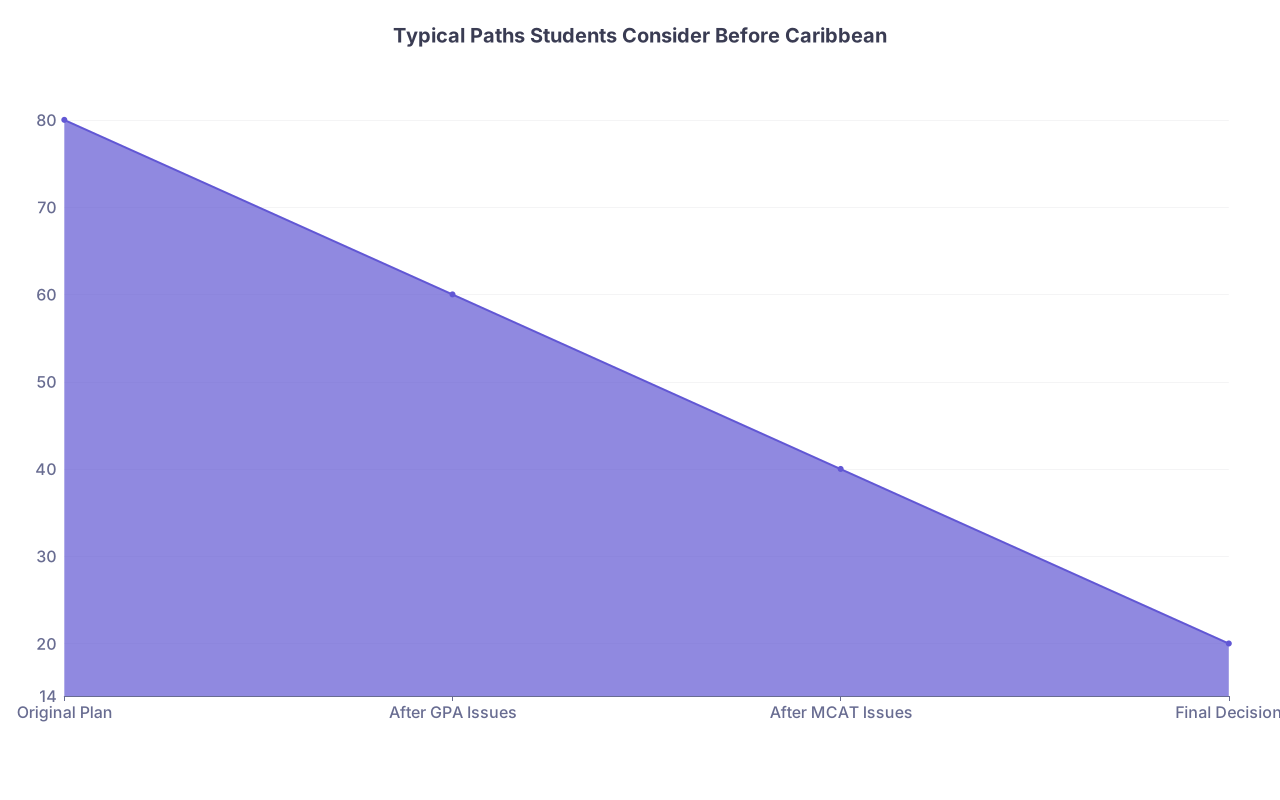
| Category | Value |
|---|---|
| Original Plan | 80 |
| After GPA Issues | 60 |
| After MCAT Issues | 40 |
| Final Decision | 20 |
Tons of people jump straight to Caribbean out of panic—one bad cycle, one bad MCAT—and then find out later they probably could’ve done a structured post-bacc or DO route and had way better odds.
Don’t let fear make the decision for you just because you’re tired and want this phase to be over.
So… Will Choosing a Caribbean Med School Ruin My Chances?
No. It won’t automatically ruin your chances at a U.S. residency.
But it absolutely:
- Lowers your baseline odds compared to U.S. MD/DO.
- Crushes your margin for error.
- Makes competitive specialties basically fantasy for most people.
- Increases financial and emotional risk dramatically.
The people who do well from Caribbean schools usually have three things in common:
- They’re brutally honest about what specialties are realistic.
- They treat every exam and evaluation like there are no do-overs.
- They go in knowing the risk and decide it’s still worth it.
You’re allowed to decide that’s not a trade-off you’re willing to make. That’s not weakness. That’s just clarity.
Your next step today: open a blank doc and write two columns—“If I go Caribbean now” and “If I spend 1–2 years trying to repair and reapply U.S. MD/DO.” Fill them with specifics: costs, odds, time, specialties, mental health. If you can’t fill in the rows with real numbers and data yet, that’s your homework before you say yes to any island.
FAQ (Exactly 6 Questions)
1. Is it true that some states won’t let Caribbean grads get licensed?
Partly. Some states have more restrictive rules about which international schools they recognize, how many years of training you need, or what type of residency counts. A few are picky about specific schools or when they were accredited. It’s rarely “no Caribbean ever,” but it can be “not from that specific school or cohort.” Before choosing a school, check state board rules in places you might want to practice (California, Texas, New York tend to have more scrutiny).
2. Can a super high Step 2 score “cancel out” the Caribbean stigma?
It can soften it. It doesn’t erase it. A strong Step 2—think clearly above average—definitely moves you up in the pile and can get you interviews that you’d otherwise miss. But programs don’t see “260 Step 2” and forget “IMG.” They see “strong applicant, but still IMG, still from a school we might not know well.” You’ll still be competing with U.S. MD/DO students with decent scores, research, and home programs backing them.
3. Are the “big four” Caribbean schools actually safe bets?
“Safe bet” is too generous. They’re safer comparatively. They have longer track records, more established clinical sites, and better-documented match lists than many tiny offshore schools. But they also have huge classes, high attrition, and plenty of students who don’t match. You’re not buying a residency seat. You’re buying a shot that still requires you to do really well academically and strategically.
4. If I really want a competitive specialty, should I just not go Caribbean at all?
Honestly, if your heart is dead set on derm, ortho, plastics, ENT, neurosurg, or similar and you’re already struggling to get into U.S. MD/DO, Caribbean is almost never a smart path for that goal. You’d be stacking multiple layers of low probability. If what you truly want is to be a physician and you could be happy in IM, FM, psych, or peds, then offshore might still be on the table. But if it’s competitive specialty or nothing, you probably need to rethink or rebuild from the U.S. side first.
5. Do residency programs look down on all IMGs equally?
No. There’s hierarchy there too. Some programs are very familiar with certain international schools (Ireland, Israel, some Caribbean schools) because they’ve had good residents from them before. Others see an unfamiliar school name and just move on. Caribbean schools with long histories and consistent match patterns usually fare better than tiny, newer schools. But at the end of the day, IMGs as a group are still at a disadvantage compared to U.S. grads.
6. If I don’t match as a Caribbean grad, do I have any backup options?
You have options, but none are great. You can try to SOAP into prelim or less competitive spots. You can reapply next year with more applications, better strategy, sometimes extra research or observerships. You might look at non-physician roles (research, pharma, consulting), but many don’t fully value an MD without residency. The problem is, your loans don’t care that you didn’t match. That’s why going Caribbean without a hard, realistic plan—and without accepting the real risk—is so dangerous.
Now: open the website of any Caribbean school you’re considering and find their last three years of actual match results. If you can’t, or if what you find looks thin and vague, don’t move forward until you understand exactly why.


