

Two in the morning. Your roommates are asleep, your eyes are burning, and you’re refreshing SDN and Reddit like some kind of punishment. Every stats thread you open just confirms the same thing: “cGPA 3.9, sGPA 3.92, MCAT 519… got into 10 MD schools.” You stare at your 3.2 or 3.3 and your stomach just drops.
You start thinking the scary thought: “Is this it? Did I already blow my chance at U.S. MD? Is going international literally my only shot at being a doctor?”
Let me say this bluntly because I know how your brain works when you’re spiraling:
No. An international school is absolutely not your “only shot” just because you have a lower GPA.
But also: this isn’t a fairy tale. There are lines you can’t cross without consequences. And some international options are way, way riskier than the glossy brochures say.
Let’s untangle this.
First: How “Low” Is “Too Low” for U.S. MD?
Here’s the part you’re probably obsessing over. Numbers.
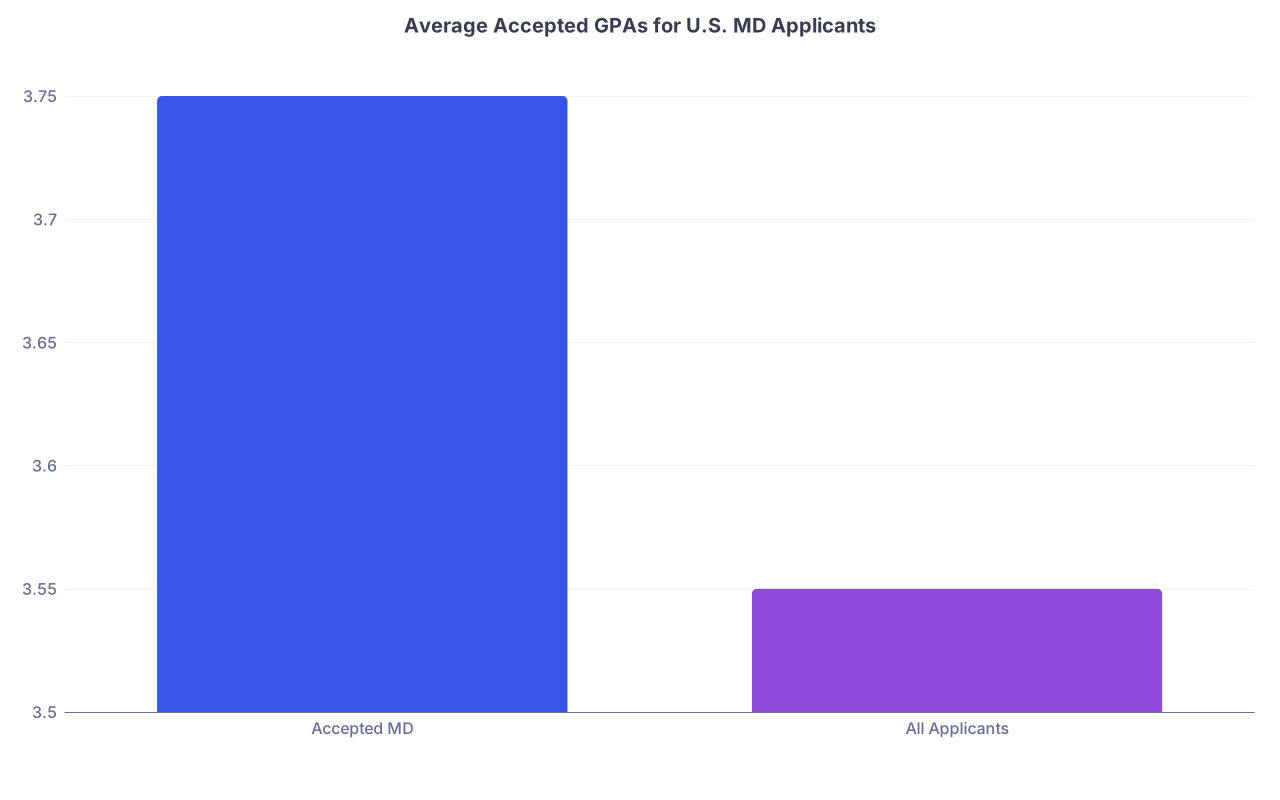
| Category | Value |
|---|---|
| Accepted MD | 3.75 |
| All Applicants | 3.55 |
Rough ballpark (varies slightly year to year, but this is the vibe):
- Average accepted MD GPA: around 3.7–3.8
- Average overall applicants: mid 3.5s
So if you’re sitting at:
- 3.6–3.7: Not doomed. You’re in range, especially for mid-tier and state schools, if your MCAT and story pull weight.
- 3.3–3.5: Harder, but not “forget it” territory. This is repairable with a strong MCAT and academic reinvention (post‑bacc, SMP, strong trend).
- Below 3.3: Now you’re in serious uphill territory for MD, but not necessarily shut out forever. You may need several years of repair and you should be thinking MD + DO, not MD-only fantasies.
Here’s what your anxiety is doing though: taking “harder” and translating it straight into “impossible.”
That’s wrong. But you can’t pretend you’re a 3.9 applicant just by wanting it more.
The Ugly Truth About International Medical Schools (That Brochures Don’t Shout)
You’re tired. You’re ashamed of your GPA. Then an ad pops up:
“Study medicine in the Caribbean! U.S.-style curriculum. U.S. residency eligible.”
Feels like a lifeline. Like a way to bypass the judgement of U.S. admissions committees that you’re convinced already hate you.
Here’s what I need you to see clearly: these schools are businesses first, educational institutions second.

There are a few categories of “international schools” people talk about:
| Type | Realistic U.S. Residency Prospects |
|---|---|
| [Big 4 Caribbean (SGU, AUC, RUSM, Saba)](https://residencyadvisor.com/resources/international-med-schools/do-only-top-ranked-caribbean-schools-match-in-the-us-nuanced-truths) | Moderate, but very risky |
| Other Caribbean schools | Very poor |
| Irish/UK/Australian schools | Mixed, better than most Caribbean |
| Eastern Europe/Other | Usually very poor |
Reality check:
- Caribbean schools accept tons of students U.S. schools would reject. That’s the appeal. They’ll often take a 2.8–3.2 without blinking.
- But then comes the attrition. People fail out. People don’t pass Step. People can’t get U.S. residencies.
- The ones who “make it” love to post their match lists online. The ones who don’t… just disappear from the conversation.
I’ve seen people go down there with a 2.7, thinking they’ve found a cheat code. A few years later, they’re home with six figures of debt, no MD, and no real path forward in medicine. That is not rare.
Does everyone crash and burn? No. But the risk is way higher than premed forums and shiny websites make it seem. And if you’re already anxious, you’re probably underestimating how bad this can be.
Are You Actually Out of U.S. Options? (Probably Not)
Before you mentally ship yourself off to some island, ask a more honest question:
“Have I actually exhausted all realistic U.S. paths, or am I just impatient and ashamed of my GPA?”
There are usually more options than your 2 a.m. brain is acknowledging.
1. U.S. DO Schools (That You’re Probably Ignoring)
People love to say, “I only want MD.” I get it. Ego. Reputation. Family expectations.
But if your GPA is on the lower side, DO schools are not your “consolation prize.” They’re your very real path to being a practicing physician in the U.S.
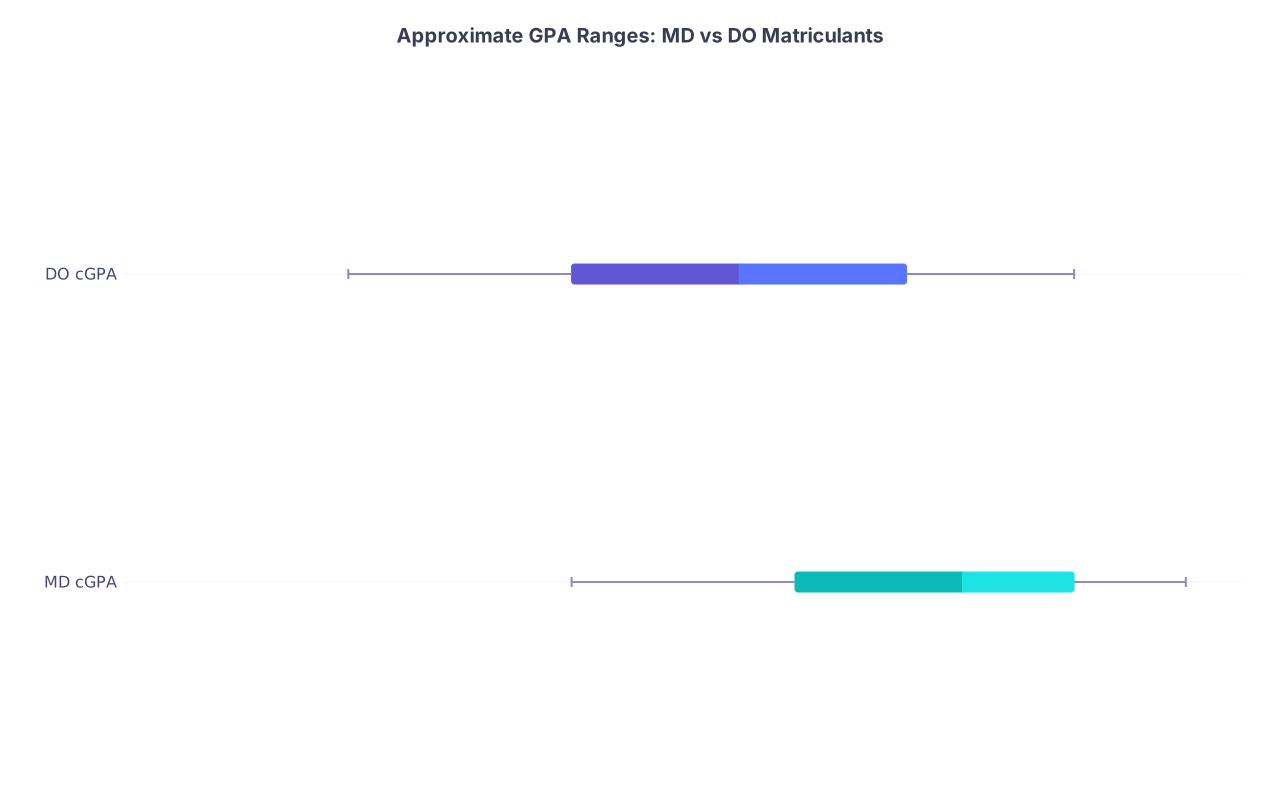
| Category | Min | Q1 | Median | Q3 | Max |
|---|---|---|---|---|---|
| MD cGPA | 3.4 | 3.6 | 3.75 | 3.85 | 3.95 |
| DO cGPA | 3.2 | 3.4 | 3.55 | 3.7 | 3.85 |
Typical DO matriculant stats skew lower than MD. Not garbage, just more forgiving. They also tend to value:
- Upward trends
- Strong MCATs
- Real clinical exposure
- Non-traditional paths
If you’re sitting at a 3.3 with an upward trend and manage, say, a 508–510 MCAT? You might be a realistic DO applicant, especially with a smart school list.
Could you still target some lower-tier MDs with that? Maybe. But if your frame is “MD or I failed,” you’re artificially boxing yourself into a corner you really don’t need to be in.
2. Post‑bacc or SMP: The “Second Chance” Route
Here’s the path almost nobody wants because it doesn’t feel glamorous: slow, boring, methodical GPA repair.
If your GPA is:
- Around 3.0–3.3: A structured post‑bacc or good upper‑division DIY program with a 3.8+ in a solid load of hard sciences can shift how committees read your file.
- Below 3.0: You’re likely looking at a longer road and possibly a Special Master’s Program (SMP) or multiple years of repair.
This path sucks emotionally. You have to admit you messed up. You lose “time.” You watch your friends move on while you retake orgo and biochem.
But you know what? It’s also the path where you stay in the U.S. system, keep doors open, and don’t gamble your life on a “maybe” island pipeline.
The Big Question: When Does an International School Make Sense?
Notice I’m not saying “never.” I’m saying “not automatically, and not as Plan A just because you’re scared.”
There are scenarios where going abroad isn’t completely irrational:
- You’ve already done extensive GPA repair over several years, your GPA is still weak, your MCAT is decent but not stellar, and you’ve been rejected from both MD and DO two or three cycles with a reasonable school list.
- You fully understand the risk: lower match rates, possible bias against IMGs, huge financial risk, limited specialty options.
- You’d rather be a doctor somewhere than accept not being a doctor at all, even if that means primary care in a less competitive region and a long grind.
And even then, I’d still tell you: you better know those match statistics cold.

| Step | Description |
|---|---|
| Step 1 | Low GPA Applicant |
| Step 2 | Consider Post-bacc/SMP & DO |
| Step 3 | Research Match Rates, Debt, Attrition |
| Step 4 | Select Only Well-Established Intl Programs |
| Step 5 | Tried U.S. Repair/DO Yet? |
| Step 6 | Understand IMG Risk? |
The people who end up truly stuck are usually the ones who did this:
“I didn’t want to wait, I didn’t want to do more classes, I didn’t apply DO, I just jumped to the Caribbean because they said yes first.”
That’s not strategy. That’s panic.
What About UK/Ireland/Australia? Are They “Better” Than Caribbean?
Short answer: sometimes. But they’re still international medical graduates (IMGs) in the eyes of U.S. residency programs.

In general:
- These programs often have stricter entry standards than random Caribbean schools.
- Training can be excellent.
- But your ability to return to the U.S. and match into residency still isn’t guaranteed. You’re competing as an IMG.
You will likely have:
- More difficulty getting certain specialties (derm, ortho, plastics, etc. basically fantasy-level hard).
- More pressure to absolutely crush board exams and have a spotless record.
- Visa issues depending on the country and program type.
Are they better than some random for-profit island school that opened five years ago? Usually, yes.
Are they equivalent to U.S. MD/DO in residency directors’ minds? No.
If your dream is “any residency, any specialty, any location,” you’re not thinking about reality. If your dream is “I’m okay fighting hard for internal medicine or family med in a non-competitive region,” that’s more honest.
The Part You Don’t Want to Hear: Patience vs Panic
Your brain keeps saying:
“If I go international, at least I’ll be doing something. I won’t be stuck.”
But that’s not how this works. You’re not choosing between “stuck” and “doctor.” You’re choosing between:
- A slower, more annoying, but safer U.S.-based path with more control.
- A faster-feeling, more exciting, but much riskier path with way more ways to lose.
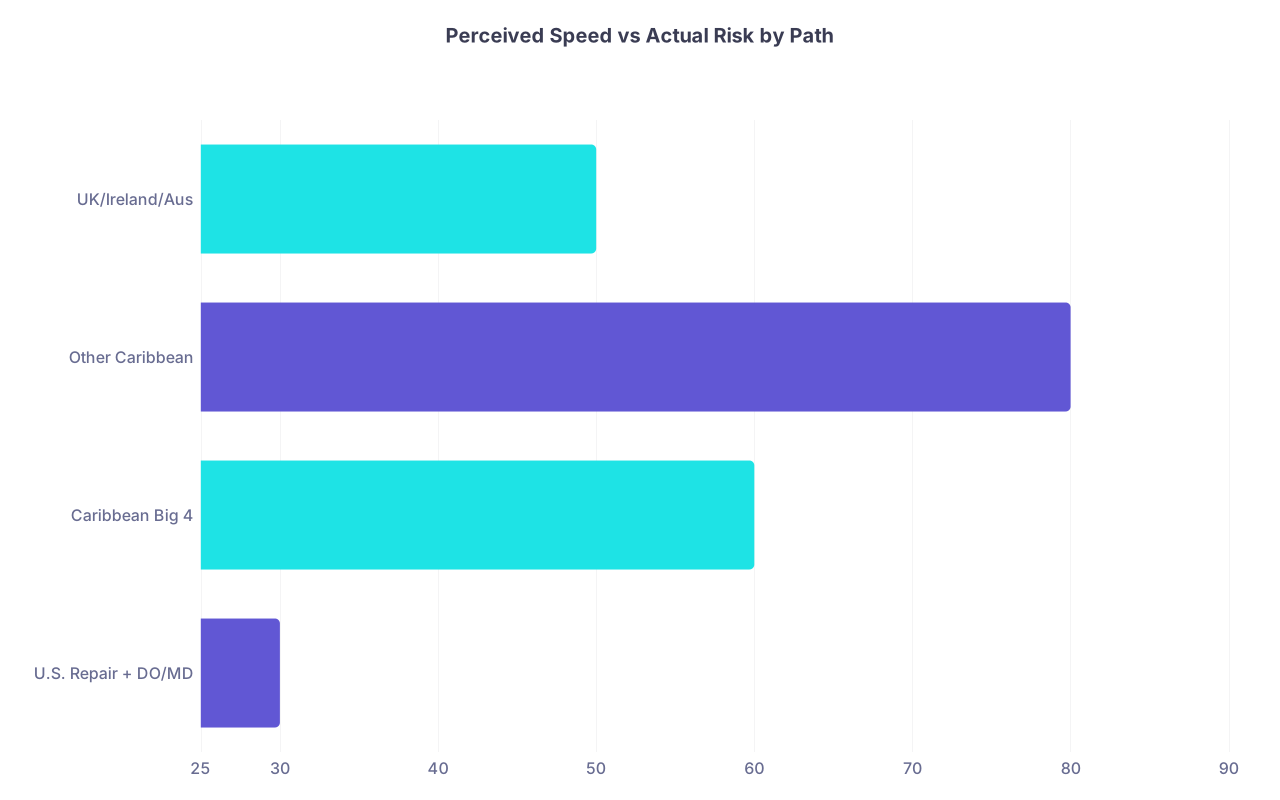
| Category | Value |
|---|---|
| U.S. Repair + DO/MD | 30 |
| Caribbean Big 4 | 60 |
| Other Caribbean | 80 |
| UK/Ireland/Aus | 50 |
(Think of the numbers as “risk level” out of 100. Higher = more risk. This is conceptual, not precise data.)
I’ve watched people who waited 2–3 years, did post‑baccs, crushed MCATs, and ended up at solid DO or even MD schools. They felt miserable during the wait. But they’re now residents, attendings, or MS4s about to match.
And I’ve watched people who couldn’t tolerate the shame of staying back another year, jumped to the Caribbean, and are now stuck with $250,000+ debt and no residency. That shame they were trying to avoid? It’s a drop in the bucket compared to what they feel now.
You’re scared your GPA has already ruined everything. It hasn’t. But you absolutely can ruin things by reacting impulsively to that fear.
So What Should You Actually Do If Your GPA Is Low?
Here’s the less dramatic, more annoying answer:
- Get a cold, honest assessment of your stats from someone who knows what they’re doing. Not Reddit randos. A pre‑health advisor who actually understands MD/DO/IMG realities.
- If you’re under ~3.4 and you don’t have a killer upward trend yet, plan real GPA repair. That might be 1–2+ years of post‑bacc/SMP.
- Commit now that you’ll apply broadly to DO unless you literally make yourself into a perfect MD candidate with stellar repair and MCAT.
- Treat international schools as a last-resort, fully-informed choice, not your emotional escape hatch.
And in the middle of that, yeah, you’re going to have nights where you think, “I’m behind, I ruined my life, everyone’s passing me.”
You’re not alone in that. A ridiculous number of successful residents had a semester where they bombed orgo, a year where their GPA tanked, a cycle where they didn’t get in anywhere. You just don’t hear those stories as loudly as the 4.0/522 guy.
FAQ (Exactly 4 Questions)
1. My GPA is around 3.2. Is U.S. MD basically impossible?
Not “impossible,” but very, very uphill. At 3.2, if you apply straight to MD without repair, you’re essentially buying lottery tickets. Programs see hundreds of applicants with 3.6–3.9 GPAs and strong MCATs. You’re not competing against a 3.2 average; you’re competing against the applicant pool.
If you pair that 3.2 with a steep upward trend, a 515+ MCAT, and maybe a stellar SMP/post‑bacc performance (3.8+ in hard sciences), you might claw your way into MD consideration at some schools. But that’s years of work. If you’re not willing to do that, you should absolutely be planning on DO in your school list.
2. Are Caribbean “Big 4” schools (SGU, AUC, RUSM, Saba) actually that risky?
Yes. Better than the random no-name Caribbean schools? Absolutely. Still risky compared with U.S. MD/DO? Very.
You’ll see match lists that look decent, but they’re not showing you how many students started and never got that far. Attrition exists. Step failures exist. People who graduate and never match into residency exist. If you go that route, you need to be brutally honest with yourself: you’re taking on a high six-figure gamble where the downside is catastrophic.
3. Will going DO hurt my chances for competitive specialties?
For the ultra-competitive stuff (derm, ortho, plastics, ENT, some surgical subs), yes—being DO vs MD, and especially DO vs strong MD, can make the path harder. But for primary care, internal medicine, pediatrics, psych, and many other fields, DOs match all the time.
Your chances are way higher as a strong DO student in a U.S. program than as an IMG (Caribbean or otherwise) trying to claw into the match. If you’re already coming from a position of lower stats, DO is usually the smarter bet than chasing competitive specialties from an international program.
4. I’m scared of “wasting time” doing a post‑bacc instead of going straight to an international school. Is that irrational?
It feels irrational because you’re watching the clock and comparing yourself to everyone else. But honestly? Taking 1–3 years to fix your foundation, stay in the U.S. system, and keep MD/DO doors open is usually less of a waste than jumping straight into a high‑risk, high‑debt international program.
You’re not just buying time; you’re buying control. More options, more safety, and a better chance of actually ending up a practicing physician instead of someone with massive debt and no residency. That extra time feels awful now, but future‑you will absolutely care more about the outcome than the age you graduated.
Key takeaways:
- A low GPA makes U.S. MD harder, not automatically impossible—and definitely doesn’t mean international is your “only shot.”
- International schools, especially Caribbean, carry serious risk: attrition, poor match rates, massive debt. They are not an easy workaround.
- The safer, smarter move for most low‑GPA applicants is boring: GPA repair, strong MCAT, and a realistic MD + DO strategy before even thinking about going abroad.


