
You’re sitting there at midnight, staring at some Caribbean school’s website. Tuition in bold, palm trees in the background, “USMLE-focused curriculum” plastered everywhere. Your GPA isn’t where you wanted, your MCAT is… fine but not great, and US MD feels like it’s slipping away. DO is a maybe, but your advisor already did that tight smile and said, “You might want to cast a wider net.”
And then the fear kicks in:
What if I go abroad, spend six figures, and then fail the USMLE?
What if I can’t match?
What if I end up back at my parents’ house at 30, no residency, no license, and a mountain of debt?
You’re not asking “Is the IMG path possible?” You’re asking, “Is this actually a massive, life‑ruining mistake if it goes wrong?”
Let’s talk about that. Honestly. Not sugar‑coated brochure nonsense. Not Reddit doom spirals either.
How risky is the IMG path really?
Here’s the uncomfortable truth I wish more premeds heard early:
The IMG path isn’t automatically a death sentence. But it is a high‑variance gamble. The highs can be just as high as US grads (I’ve seen IMGs in top fellowships, academic jobs, you name it). The lows, though? Brutal. You can end up locked out of residency with no safety net.
Some context first. Very rough ranges, ballpark, to frame your anxiety:
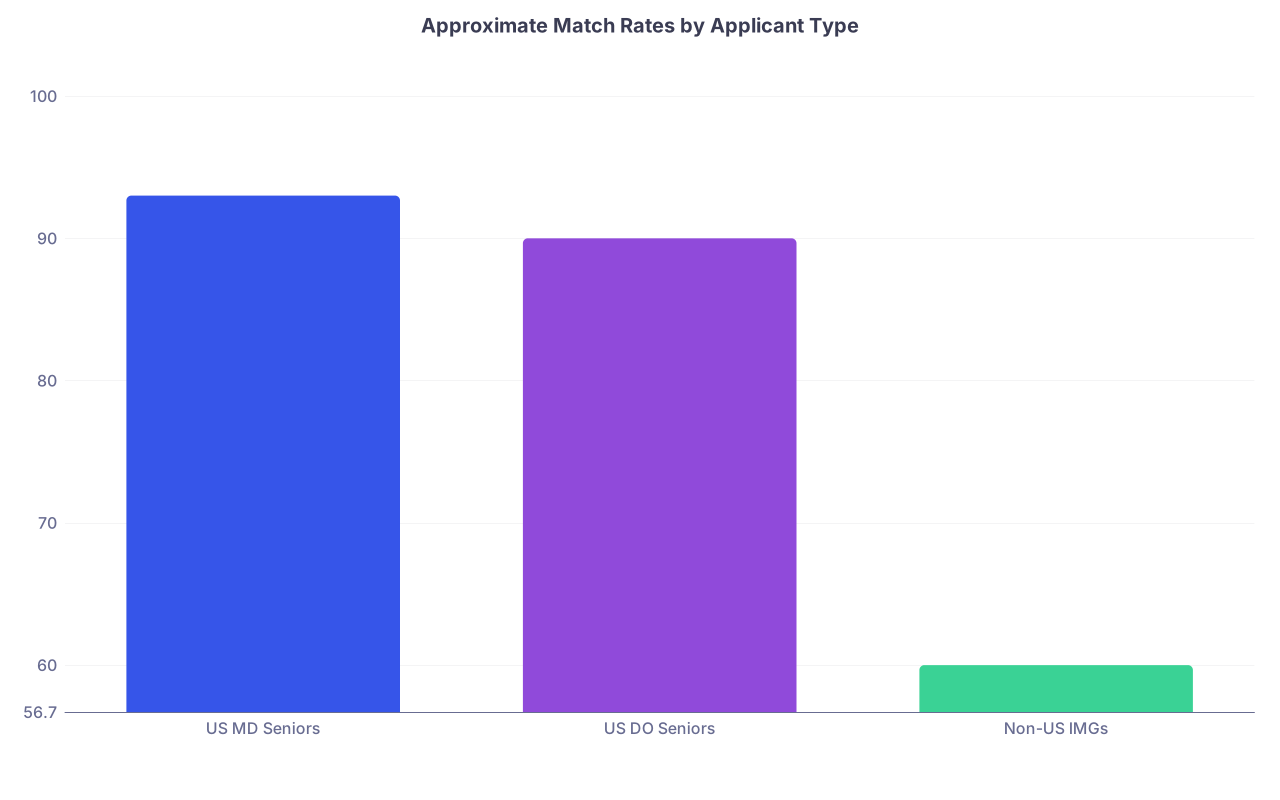
| Category | Value |
|---|---|
| US MD Seniors | 93 |
| US DO Seniors | 90 |
| Non-US IMGs | 60 |
US MD seniors: usually mid‑90% match rate.
US DO seniors: around high‑80s to low‑90s depending on year and specialty.
Non‑US IMGs: typically around ~55–65% match. Some years higher, some lower.
So if you’re a non‑US citizen going to an offshore school? You’re walking into a world where, statistically, 3–4 out of 10 classmates may never match. That’s not fear‑mongering. That’s math.
But here’s what the numbers don’t show: the people who do make it through as IMGs usually aren’t “average effort” people. They’re the obsessive ones. The “I treat Step 1 like it’s life or death” people. So your personal risk depends a lot on whether you’re actually that person, or you just like to think you will be.
The big USMLE fear: “What if I fail abroad?”
You’re imagining the worst version: you go to some island, the teaching is chaotic, you’re on your own with UWorld and YouTube, fail Step 1, and suddenly your entire future is over.
Is that possible? Yeah. I’ve seen it.
But the more precise question is: how does going abroad change your odds of failing or underperforming on USMLE compared to going to a US school?
Here’s the harsh difference:
- US MD/DO schools are built around getting you through Step 1/Step 2. Their whole brand depends on those pass rates.
- Many international schools say they are. Some actually are decent. Some are disorganized, over-enrolled, and absolutely will let you sink if you can’t swim.
A lot of IMGs who struggle on Step didn’t suddenly become dumb. They ended up in an unstable environment: high class sizes, minimal academic support, bad basic science foundation, and tons of stress about visas/finances on top of it.
So if you choose the IMG path, your margin for error on USMLE is smaller. You don’t have the same institutional “safety net” that a solid US school gives you.
Here’s roughly how risk shifts with different paths:
| Path | USMLE Prep Support | Match Risk Level |
|---|---|---|
| US MD | Strong | Low |
| US DO | Moderate-Strong | Low-Moderate |
| Top EU/UK school | Variable | Moderate |
| Big-name Caribbean | Weak-Moderate | High |
| New/unknown IMG | Weak | Very High |
This isn’t perfect, but you get the idea: you’re not just picking “US vs abroad.” You’re picking a risk tier.
The ugly part: what actually happens if it goes wrong?
Let’s play out the nightmare scenario your brain keeps replaying, because pretending it doesn’t exist won’t help.
You go to an offshore school. You’re paying, what, $250k+ in tuition/living by the time you’re done? You grind through basic sciences, maybe need a repeat semester (that’s common). You take Step 1 and either:
- Fail outright
- Or pass, but with a low score back when it was scored, or a weak Step 2 now that Step 1 is pass/fail
Then the dominoes:
Clinical rotations might be scattered, sometimes last‑minute arranged, sometimes in lower‑tier hospitals with less teaching. You apply for residency and get:
- Few or no interviews
- Or interviews only at very limited programs, often in IM, FM, psych, etc.
If you don’t match after one try, you’re now:
- Older
- More anxious
- And your application is now “stale” for some programs
Could you try again? Yes. People do. Sometimes they add research, do observerships, rewrite their personal statement, retake exams if allowed. But every reapplication year, your odds usually go down unless something major improves.
The truly brutal outcome: you finish med school, never match, and now have MD/MBBS + debt + no residency = no clinical practice. Maybe you pivot to research, industry, consulting, something totally outside medicine. But you’re not the practicing doctor you imagined.
Is that rare? Not rare enough. If that scenario sounds like your absolute worst nightmare, then you’re asking the right question: “Am I okay taking on a path where this is on the table?”
But also: the silent side you don’t see on Reddit
Here’s the part your anxiety conveniently ignores: all the IMGs who do match and move on with their lives.
They’re not on forums posting daily. They’re doing night float and complaining about Epic notes. They exist. Lots of them. Internal medicine in community hospitals, family medicine in the Midwest, psych in state programs, pediatrics in less competitive regions. Some even go into cardiology, GI, heme/onc later. I’ve seen Caribbean grads in solid fellowships. It’s not fantasy.
So what separated the ones who made it from the ones who didn’t? Pattern I keep seeing:
- They treated Step 1 and Step 2 like a full‑time job, not like “I’ll just wing it with lecture slides.”
- They picked schools with at least some track record of placing grads in US residencies, not the newest shiny campus.
- They were realistic with specialty choice. Not dreaming about neurosurgery from an offshore school with a 2.8 undergrad GPA.
- They hustled for US clinical experience, letters, networking.
Still stressful. Still high‑risk. But not blind luck.
Pre‑med reality check: are you really “forced” into the IMG path?
A lot of premeds say, “I have no choice but to go abroad.” Sometimes that’s true. But often what they mean is, “I don’t want to wait, or retake MCAT, or consider DO, or rework my application.”
Before you commit to the IMG route, you need a brutally honest self‑audit:
- GPA: is it absolutely unrecoverable for US MD/DO? Or are you sitting on, say, a 3.3–3.4 that might be salvageable with a post‑bacc or SMP?
- MCAT: did you actually give it a full effort? Or did you go in half‑prepared because you were tired of studying?
- Application quality: shadowing, clinical, letters, personal statement—are these genuinely strong, or just “I did the checklist”?
I’ve watched people jump to Caribbean schools who later admitted, “I kind of panicked. I could have taken an extra year and done a DIY post‑bacc.”
On the flip side, there are people who’ve already burned multiple cycles, maxed out MCAT attempts, have GPAs that even a post‑bacc won’t fully fix, or are older with family/visa/time pressures. For some of them, IMG truly is the only remaining path to being a physician.
The key difference is: are you choosing IMG as a last informed resort after maxing your US options, or as an impatient shortcut?
Because it’s not a shortcut. It’s a longer, riskier road with prettier beaches on the brochure.
How to think about “risk” like a grown‑up, not a panicked premed
You’re not actually just afraid of “IMG.” You’re afraid of making an irreversible choice with incomplete information. Fair. But you can make the decision a bit less blind.
Here’s a practical way to structure the chaos in your head.
1. Ask: “What is my realistic ceiling and floor in each path?”
For you specifically. Not some imaginary 4.0/525 applicant.
Scenario A: You reapply US with improvement (post‑bacc, higher MCAT, stronger ECs).
- Ceiling: US MD/DO, solid Step scores, match in IM/FM/psych/peds, maybe more if you crush it.
- Floor: still don’t get in, lose 1–2 years, some money on apps, but no six‑figure loan disaster yet.
Scenario B: You go IMG now.
- Ceiling: you grind hard, pass USMLE comfortably, match in IM/FM/psych, maybe fellowship later.
- Floor: fail exams, or pass but don’t match, end up with very high debt and no US residency.
When I stack those up, I usually tell people: if you have a plausible shot at improving and applying US again, it’s rational to try that first. IMG makes more sense when your US chances are basically near zero.
2. Stop treating all IMGs as the same
A British grad from a well‑known UK school ≠ a student at a for‑profit offshore startup. An Irish grad who does clinical years in big teaching hospitals ≠ someone whose school is 2 years old with no match data.
If you’re really considering going abroad, you need to be borderline obsessive about data:
- Actual USMLE pass rates (not “>95% of students who sit for exam” when they quietly weed half the class before that).
- Actual US match lists by school, by specialty, by citizenship status.
- Attrition rates: how many people don’t make it to graduation?
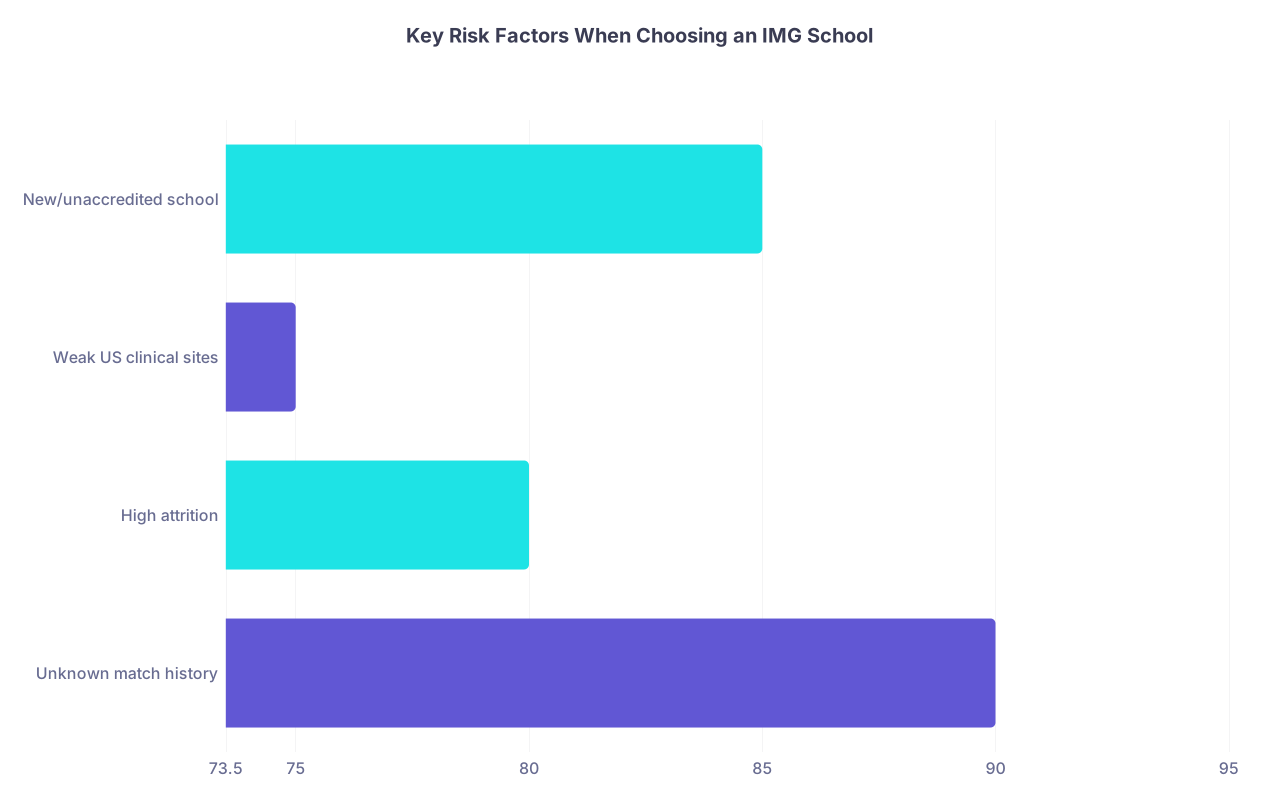
| Category | Value |
|---|---|
| Unknown match history | 90 |
| High attrition | 80 |
| Weak US clinical sites | 75 |
| New/unaccredited school | 85 |
Those numbers aren’t real stats; they’re me basically screaming: these things matter a lot.
If a school’s website looks like a travel brochure and has vague stats? Red flag. If it’s hard to find real match lists or alumni outcomes? Red flag. If everyone who talks about it online says “lots of people left or failed out”? Giant red flag.
3. Be honest about your work ethic under stress
USMLE studying at an IMG school isn’t just “hard.” It’s hard + chaotic + isolating + usually far from home + money anxiety.
If in undergrad you were already barely hanging on when life got stressful, that doesn’t mean you’re doomed. But it should make you respect how thin the margin will be. You won’t have the structured support of a solid US school. You will need to be your own dean, tutor, and coach.
The people who survive this path don’t just say “I’ll work hard.” They have receipts: they’ve already turned around grades, already stuck to study schedules, already handled pressure without totally collapsing.
Actually terrified of failing USMLE? Here’s what that fear is telling you.
The fear itself isn’t the enemy. It’s data.
If your body is screaming, “I cannot handle the possibility of failing Step and being stuck with six‑figure debt and no residency,” that’s not something you ignore because a recruiter told you “lots of our grads are in residency!”
It might mean:
- You’re risk‑averse and need a path with higher baseline safety (reapplying US, considering DO, pausing to strengthen your app).
- You don’t actually know your own tolerance for uncertainty yet—and that’s okay, but then don’t sign a promissory note based on vibes.
- The picture you have of “doctor or nothing” is so rigid that any non‑linear path feels like a catastrophe.
You don’t fix that by pretending IMG is secretly low‑risk. You fix it by being brutally honest about where you stand academically and emotionally, and then choosing the option where failure, if it happens, is survivable.
Because yes, failure is possible on any path. But the cost of failure is not equal across them.
So… is the IMG path “too risky”?
My answer, if you forced me to commit?
For many premeds considering it as a “backup” because they’re impatient: yes, it’s too risky.
For some who have exhausted realistic US options and are willing to live with the downside: no, it’s not too risky—but it’s serious, and you have to treat it like a high‑stakes investment, not a vacation with a stethoscope.
I don’t think the IMG path is evil. I do think it’s wildly mis-sold to anxious premeds who feel cornered.
If the thought of failing USMLE abroad keeps you up at night, your brain is doing you a favor. It’s forcing you to actually weigh consequences instead of just chasing the first acceptance email.

| Step | Description |
|---|---|
| Step 1 | Premed with weak stats |
| Step 2 | Strengthen app, reapply US |
| Step 3 | Consider alternate careers/health paths |
| Step 4 | Carefully select IMG school and commit to high effort |
| Step 5 | Any realistic chance to improve for US MD/DO? |
| Step 6 | Willing to accept high IMG risk? |
FAQ – Exactly what you’re scared to ask out loud
1. If I go IMG, what Step 2 score do I need to not be dead in the water?
There’s no magic cutoff, but you should assume that as an IMG you need to be above the average of US MD seniors applying in your target specialty to be competitive. For primary care fields, that often means at least solidly above passing and ideally in a comfortably “strong” range. You can’t play the “just pass and I’m fine” game. The lower your score, the more you’re relying on luck, personal connections, and stellar everything‑else to get interviews.
2. Is Caribbean automatically worse than European/Asian schools for US match?
Not automatically, but the typical mass‑market Caribbean schools are heavily for‑profit, over-enrolled, and have a long list of students who never finish. Some European schools have stronger clinical training and reputations locally but less structured USMLE support. The real question: how many grads from that specific school match into US residencies every year, and in what fields? You can’t rely on geography alone. You need data.
3. Can I “fix” a bad IMG situation by doing research or a US master’s later?
Sometimes you can improve your odds, yes. I’ve seen IMGs salvage an application with strong research, US clinical experience, and a rock‑solid Step 2. But it’s more “clawing back from a deficit” than “upgrade acquired.” If your Step exams are weak and your school’s reputation is poor, a random master’s won’t magically reset the board. It can help at the margins, not erase structural disadvantages.
4. What if I genuinely can’t get into US MD or DO at all—is it still insane to go abroad?
Not insane. But it’s serious. If you’ve applied strategically across MD and DO, maybe multiple cycles, tried to address your weaknesses, and it’s still no across the board, then yeah, IMG might be the only doctor path left. In that case, you go in with your eyes open: you pick the strongest school you can, you commit to over-prepping for USMLE, and you accept that there is a non‑trivial chance you might not match. Some people decide that risk is acceptable; others decide they’d rather pivot now than roll those dice.
5. Do programs really care that much that I’m an IMG if I crush Step and have great letters?
They do and they don’t. Some programs have historical bias or institutional limits on IMG slots. Others are more open if your file is strong. A fantastic Step 2, US clinical experience with strong letters, and a clean professionalism record can absolutely get you looked at and interviewed. But you’re not on equal footing with a US MD with similar stats at most places. You’re climbing uphill. That doesn’t mean it’s unwinnable. It means you can’t afford weak links.
6. What should I do today if I’m seriously considering IMG but terrified of failing?
Pull up three specific IMG schools you’re considering and do a ruthless reality check. For each one, find: USMLE pass rates, US match lists (by year), attrition rates, and honest student/alumni reviews. If you can’t find that info or what you find scares you, don’t ignore that. Then, in a separate document, outline what it would take to spend 1–2 years improving your US MD/DO chances (post‑bacc, MCAT retake, more clinical work). Compare those two plans side‑by‑side. That exercise alone will usually make it very clear whether you’re running toward IMG with intention, or just running away from discomfort.
Open a blank page right now and write this at the top: “If I don’t go abroad this year, here’s what I could realistically do in the next 12–18 months to strengthen my US chances.”
Force yourself to fill that page before you click on another glossy international med school website.


