

What actually happens if your Caribbean med school emails you out of nowhere: “We have lost affiliation with X hospital. Your rotation will be relocated.” And you’re sitting there thinking: relocated where? when? how? and… am I screwed?
That’s the nightmare, right? You bet it is. And it’s not even hypothetical. This happens. Not constantly, but enough that people trade horror stories on Reddit and SDN about “my rotation disappeared two months before it started” or “our whole core site in New York collapsed.”
Let’s walk through the worst-case thinking, because I know your brain is already there: delayed graduation, no US rotations, not meeting licensing requirements, Match ruined, loans piling interest while you just… wait.
I’m going to go through what actually tends to happen, what can go wrong, and what you can do before you enroll to not be totally at the mercy of one email from some dean you’ve never met.
And yes, I’m anxious too when I think about this. Because the power imbalance here is real.
How Common Is Losing a Clinical Site… Really?
You’re not crazy for worrying about this. Caribbean schools don’t own most of the hospitals they rotate through. They rent them. With contracts. Contracts that can be changed, ended, or not renewed.
Sometimes hospitals drop schools because of:
- New leadership deciding they want US med school partners instead
- Local residency programs expanding and crowding out students
- State regulations changing
- Money. Always money.
The part that makes my stomach drop: they don’t always give students much warning.
Here’s the pattern I’ve seen over and over:
- Students think they’re locked into a site in, say, Brooklyn or Chicago.
- Email comes: “Due to unforeseen circumstances, we are no longer able to offer rotations at X hospital.”
- Followed by vague promises: “We are working diligently to secure alternate placements.”
You know what “alternate placements” often means? Different city, different state, worse hours, or sitting at home waiting.
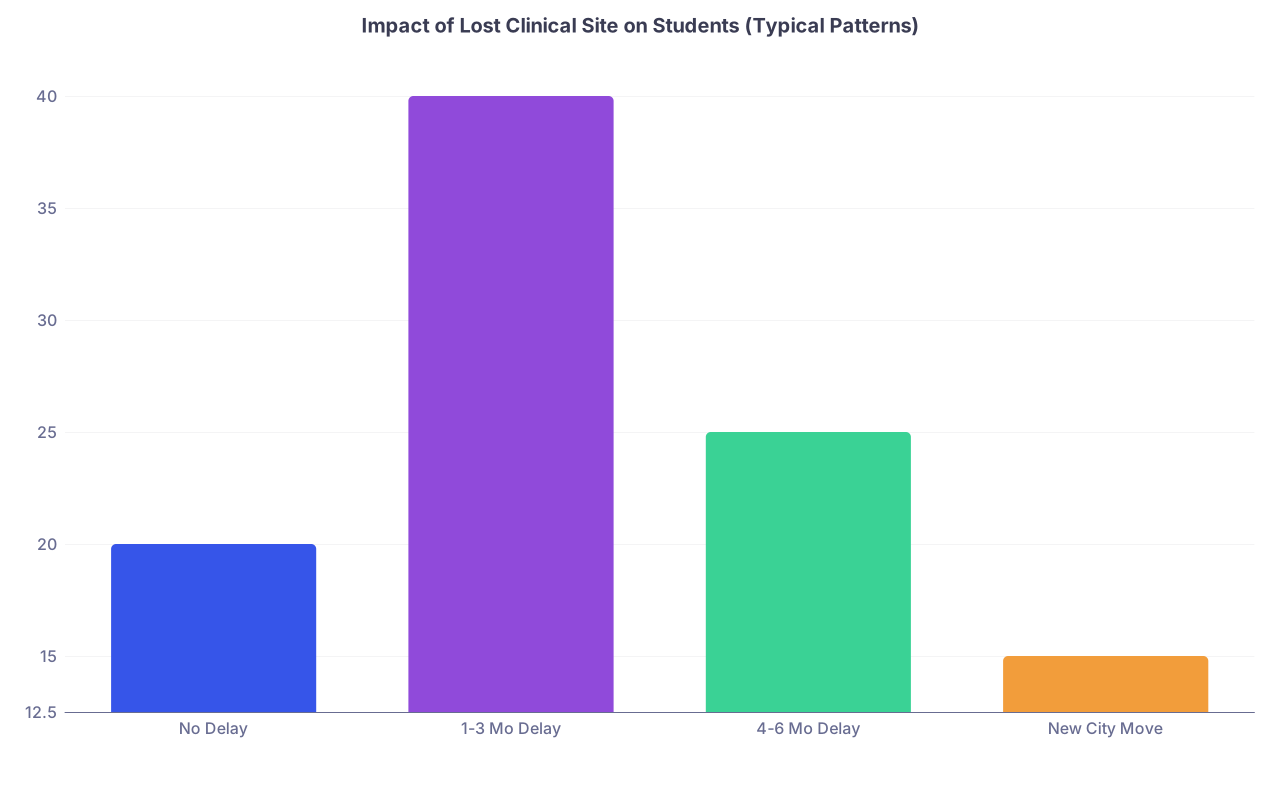
| Category | Value |
|---|---|
| No Delay | 20 |
| 1-3 Mo Delay | 40 |
| 4-6 Mo Delay | 25 |
| New City Move | 15 |
Is this exact data published somewhere? No. This is the rough breakdown I’ve seen across anecdotes, forums, and people I’ve talked to. The point: delays and forced moves are very real.
What Actually Happens To You If a Site Is Lost?
Let’s say you’re a third-year at a mid-tier Caribbean school. You’re scheduled for Internal Medicine at a New Jersey affiliate. Then boom: site gone.
What happens next?
Usually some messy combo of:
Scrambling for replacements
The school will tell you they’re “working to secure alternative sites.” Translation: staff are calling their other contracted hospitals asking, “Can you take more students?”You are not the priority. The contract is.
Unpaid time off you didn’t want
If they can’t immediately plug you into another spot, you sit. You don’t collect clinical hours. You don’t progress. But your loans? Still very real. Your rent? Still due.Some students end up with 4–12 week gaps that were never part of the plan.
Out-of-nowhere relocation
Maybe your New Jersey rotation gets “solved” by magically becoming a site in Michigan, Ohio, or some random community hospital in a state you’ve never even visited.
Now you’re paying for last-minute flights, new housing, transportation, and adjusting to a totally different setup. No one is reimbursing you.I’ve literally seen posts like: “They told us 2 weeks before that our core moved from Brooklyn to Saginaw, MI. Half my class had leases they couldn’t break.”
Delayed graduation
If the scheduling gap gets bad enough, your graduation date can push back. That can then affect when you take Step 2, when you apply for residency, and whether you end up skipping a whole Match cycle.Visa/logistics nightmare (if you’re international yourself)
If you’re not a US citizen and your school suddenly shoves you to a different state or slower rotation schedule, your visa timing or work authorization can get ugly fast.
So yeah, this isn’t just “mild inconvenience.” It can be life-altering.
Could This Destroy Your Chances at Matching?
This is the real fear, right? Not just inconvenience. Actual career damage.
There are a few ways losing a clinical site can poison your Match chances if it’s handled badly:
You end up with weak rotations
Not all clinical sites are equal. Some are robust teaching hospitals with residents, structured didactics, and attendings who actually know what an evaluation form is.
Others are… let’s say “paper mills.” You show up, you shadow, maybe you write a note or two, no formal teaching, and at the end someone you barely saw gives you a generic eval.Move from a solid site to a weak one, and your clinical letters can suffer. Badly.
You get delayed into a worse application cycle
If a lost site pushes your graduation date, you might have to either:- Apply to residency with fewer completed cores and weaker letters, or
- Delay your application cycle entirely and sit a year.
Both are brutal, mentally and financially.
You rotate in non–ACGME settings or weird locations
Some state licensing boards (California, Texas, etc.) are picky about where your clinical rotations happened. They care whether the hospital and preceptors meet their standards.
If your new site doesn’t meet certain state criteria, you can be locked out of those states later. And yes, some Caribbean schools are sketchy about this.You lose continuity and momentum
Taking multiple random breaks or bouncing between states hurts more than people admit. You lose confidence. You forget stuff. Studying for Step 2 becomes harder when your clinical exposure is scattered and inconsistent.
Can you still Match? Absolutely. Lots of Caribbean grads do. Even ones who’ve lived through rotation chaos.
But if you walk into this blind and just hope the school will “take care of you,” you’re putting your whole future in someone else’s hands. Which is… not comforting.
How To Tell If a School Is at Higher Risk of Losing Sites
Not all Caribbean schools are equal. Some have long-term, relatively stable partnerships. Others feel like they duct-tape a new hospital contract together every six months.
Here are red flags that make me nervous:
- The school won’t show you a current, specific list of core clinical sites by name and location.
- Everything they say is “in the US” but vague: “We have many quality sites across several states.”
- Students online keep saying: “Rotations are fine… once they finally schedule you.”
- Big variability in what different students report. One person in Florida, another in rural Ohio, another “still waiting for IM.”
- They’re rapidly expanding class sizes without clearly expanding sites.
If you get the sense the school is taking in more students than they have reliable rotation slots for, guess who pays the price? Not the dean.
| School Type | Clinical Site Stability | Typical Transparency |
|---|---|---|
| [Top 3–4 Caribbean (SGU, AUC, Ross, Saba)](https://residencyadvisor.com/resources/international-med-schools/do-only-top-ranked-caribbean-schools-match-in-the-us-nuanced-truths) | Higher but not perfect | Moderate–High |
| Mid-tier Caribbean | Variable | Low–Moderate |
| Newer / unproven Caribbean | Low | Low |
This table isn’t gospel. It’s reality-adjacent. I’ve seen top programs lose sites too. But the lower you go down the food chain, the more likely you are to be the one paying for their instability.
Questions You Must Ask Before You Enroll
If you’re still premed or not yet locked in, this is where you actually have leverage. Once you’re enrolled and deep into loans, your ability to “walk away” is almost zero.
You need to ask ugly, specific questions to admissions and current students. Stuff like:
- “Name the hospitals where your students currently do core rotations in Internal Medicine, Surgery, Peds, OB/GYN, Psych, and FM.”
- “What percentage of students finish all cores on time, without delays caused by the school not having a site ready?”
- “What happens when a clinical site is lost mid-year? Do you have a written policy on how quickly you must reassign students?”
- “Have any of your major core sites been lost, reduced, or changed locations in the last 3 years?”
- “Do students ever have to arrange their own rotations? If so, for which rotations and in what circumstances?”
Then, separately, you talk to current students and recent grads on Reddit, SDN, Facebook groups, or just DM them on LinkedIn. Ask:
- “How many times has your rotation schedule changed last-minute?”
- “Did you ever sit at home waiting for a new site?”
- “Did anyone in your class have their graduation delayed because of clinical scheduling?”
Cross-check what the school says with what the students say. If there’s a big mismatch? That’s your answer.
If You’re Already Enrolled and This Just Happened To You
Okay, worst-case: you’re not planning. You’re living it. Your email just came through. Site gone.
Your anxiety is probably screaming: “I have no control.” That’s not totally true. You don’t have much control, but you have some.
Here’s how I’d play it, step-by-step, even in full panic mode:
Get everything in writing
Don’t rely on phone calls or vague assurances. Email your clinical coordinator and CC the dean of clinical sciences or whoever’s above them.Ask very directly:
- Why was the site lost?
- What is the projected timeline for reassignment?
- What options do I have to avoid delaying graduation?
- Will I be moved as a group or individually?
Push for a concrete timeline
Don’t accept: “We’re working on it.” That’s useless.
Ask: “Can you commit in writing that I’ll be placed at an equivalent core site within X weeks so my graduation is not delayed?”Talk to upperclassmen who’ve survived this
Someone ahead of you has almost definitely gone through some clinical chaos. Ask them:- How long did it actually take to get a new site?
- Were they able to keep their original graduation date?
- Did they have to pay extra rent, flights, etc.?
Consider whether you can safely front-load Step 2 studying
If you’re in a delay period and you’ve already done several cores, sometimes students use that gap to grind UWorld and prep for Step 2.
It doesn’t fix the rotation issue, but at least the time isn’t pure waste. Just be careful not to burn out if the delay becomes longer than promised.Document how this affects you
If later you need to explain gaps on your ERAS application or in interviews, it helps to have clear notes about what happened: dates, sites, emails, delays.
PDs are more sympathetic to “my school lost a clinical contract; here’s how I adjusted” than total mystery gaps.
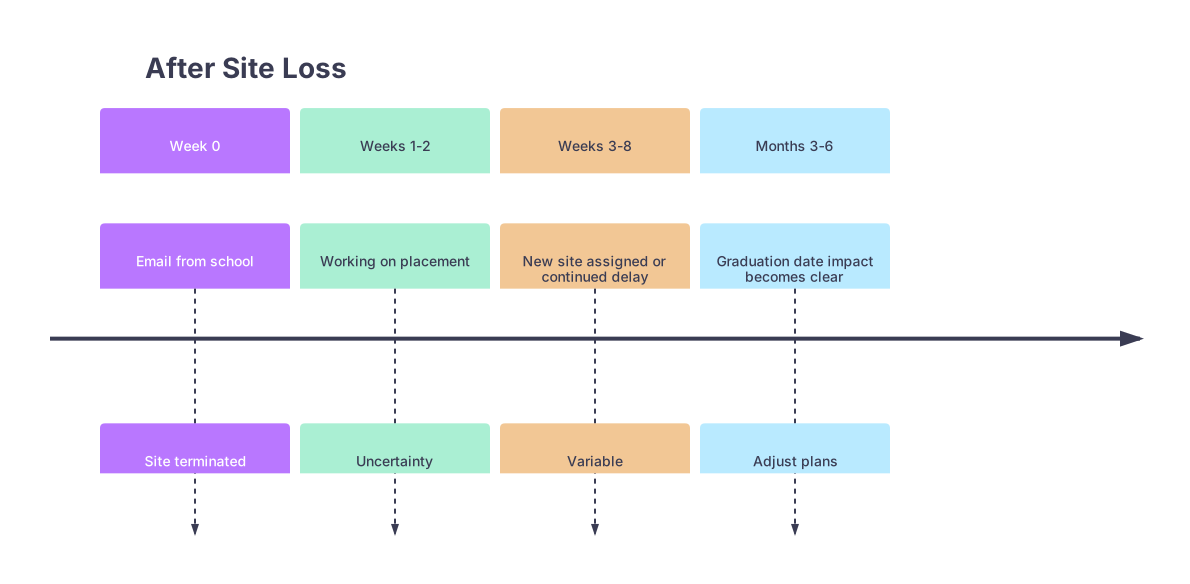
| Period | Event |
|---|---|
| Week 0 - Email from school | Site terminated |
| Weeks 1-2 - Working on placement | Uncertainty |
| Weeks 3-8 - New site assigned or continued delay | Variable |
| Months 3-6 - Graduation date impact becomes clear | Adjust plans |
Notice that big ugly “variable” window. That’s the part that causes all the 3 a.m. doom-scrolling.
The State Licensing Trap No One Talks About Enough
Here’s the quiet killer: you can technically “finish” med school, do rotations, get your MD… and then discover some state won’t license you because of where your rotations happened.
Some states want:
- Rotations only at approved hospitals
- Limits on how many weeks can be done outside approved networks
- Certain ratios of inpatient vs outpatient
- No “independent” or student-arranged preceptors without agreements
If your school panics after losing a site and sticks you into a random private practice or a non-teaching hospital just to log your hours, that might check your school’s graduation box… but not a state’s licensing rules.
So while you’re negotiating or asking about new sites, you should be quietly checking:
- Does this hospital show up on any state “approved” or “disapproved” lists (California, New York, Texas are big ones)?
- Are these ACGME-affiliated settings?
- Have alumni from my school who rotated there gotten licensed in the states I might want to practice in?
If the answer is “no idea” across the board, that’s a problem. It doesn’t mean your career is over, but it shrinks your future options.
How To Protect Yourself Before This Happens
You can’t make a Caribbean school magically stable. They’re at the mercy of hospitals just like you are at the mercy of them. But you can stack the deck a bit.
Stuff I’d absolutely do before committing:
- Favor schools with a paper trail of stable US core sites in a few key cities, not 20 random solo contracts.
- Look up whether their rotations are approved in New York and recognized by big licensing states. Schools that went through that vetting process usually have more structured affiliations.
- Ask about graduation rate on time. Not just “we graduate people,” but “what percentage of entering students finish within 4–5 years?” Low numbers usually mean either academic failure or massive logistical chaos. Often both.
- Look at their own promotional materials skeptically. If every photo is some random hospital with no names, and they never say “Our students rotate at [named hospitals] in [cities]”? That’s not an accident.
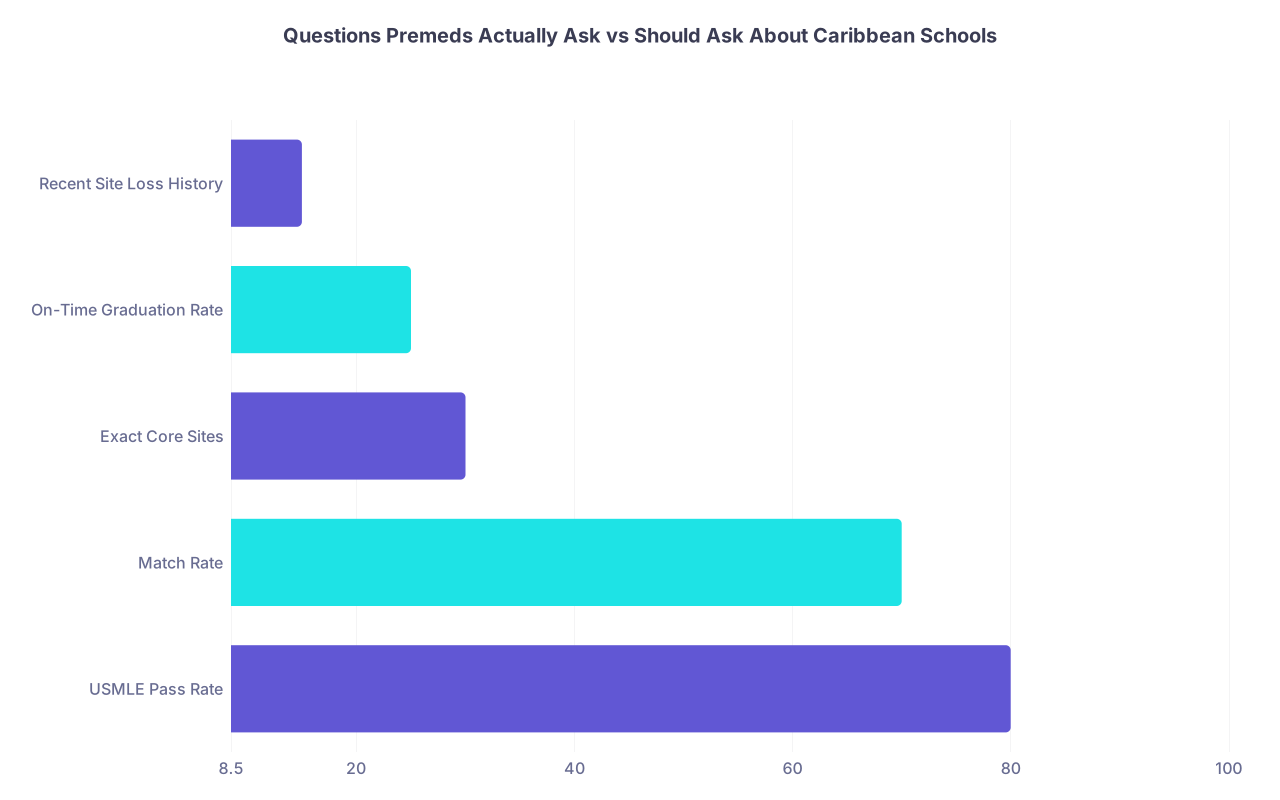
| Category | Value |
|---|---|
| USMLE Pass Rate | 80 |
| Match Rate | 70 |
| Exact Core Sites | 30 |
| On-Time Graduation Rate | 25 |
| Recent Site Loss History | 15 |
Most people obsess over the first two. The last three are what will wreck you if they’re bad.
Mental Health: The Part Everyone Pretends Doesn’t Matter
We can talk logistics all day, but let’s be honest: this kind of uncertainty destroys your mental bandwidth. You’re expected to study for major exams, care about patient care, and think about residency… while not even knowing where you’ll be living in three months.
So yeah, you’re going to:
- Refresh your email way too often
- Panic when you see “update from clinical office” in the subject line
- Compare yourself to US MD friends who have fully mapped-out third-year schedules and never worry about sites collapsing
Here’s the uncomfortable truth: Caribbean paths demand a higher tolerance for chaos. If that instability already makes you feel like your chest is tightening just reading this, you need to be brutally honest about whether this route is acceptable for you.
Not “can I survive it if I must” but “do I want a system where at any moment my life can be rearranged by an admin in another country.”
That’s not weakness. That’s self-preservation.
If You’re Deciding Right Now Whether To Risk It
Let me be blunt.
Can you get through a Caribbean school, survive some rotation drama, and still Match into a decent residency? Yes.
Is there a non-trivial chance that losing a clinical site mid-training delays you, drains you, costs you thousands extra, and limits your career options? Also yes.
You’re not wrong to worry. You’re not “negative” or “fearful” or “overthinking it” when you ask, “What happens if my school loses a clinical site while I’m enrolled?” That’s a rational question that too many people only ask after the disaster email arrives.
So if you’re premed right now, still in the choosing phase, this is your one moment where your anxiety is useful. It’s trying to protect you from a future where every semester feels like standing on a cliff edge, waiting for someone else to decide whether the ground stays solid.
Key Takeaways
- Caribbean schools can and do lose clinical sites while students are in the middle of training, causing delays, forced moves, and sometimes graduation changes.
- You have some power before you enroll by demanding specifics about core sites, on-time graduation, and what happens when a contract fails. Use it.
- If this already happened to you, document everything, push for timelines in writing, talk to older students, and quietly double-check licensing implications of any new site you’re offered.


