

You’re sitting in front of your laptop. Ten tabs open: “IMG match rates,” “US vs Caribbean med school,” “Should I study medicine in Europe,” “Did I ruin my chances.”
You already started or committed to a school in another country… and now the panic is hitting you like a truck.
You’re thinking:
What if I picked the wrong country?
What if I can’t come back home?
What if I did all this, took loans, moved away… and it just doesn’t work?
Let me say this plainly: you’re not the only one spiraling like this. I’ve seen people at every stage asking the same question—week 2 of M1 in the Caribbean, third-year in Eastern Europe, even during Step prep back home:
“Did I mess up at the country level?”
Let’s walk through the signs you might need to reassess early—and the point where you’re just catastrophizing and need to zoom out.
First Reality Check: Why “Country” Matters More Than You Think
This isn’t just “vibes” or cultural fit. The country you pick sets:
- Your licensing exam path
- How hard it is to go back to your target country (US, Canada, UK, etc.)
- Your clinical exposure and language barriers
- Your visa/immigration headaches
- How residency directors perceive your school name
You’re not crazy for worrying. Some choices really are harder to unwind.
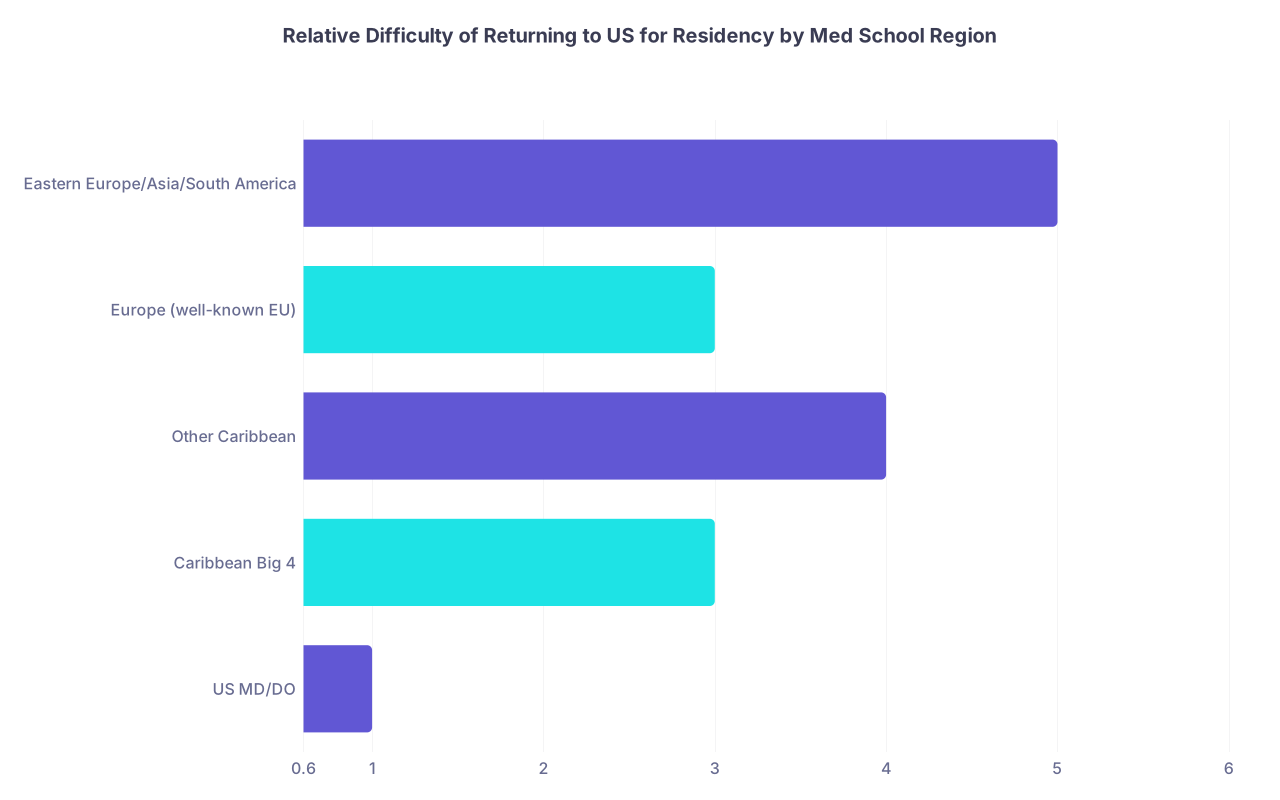
| Category | Value |
|---|---|
| US MD/DO | 1 |
| Caribbean Big 4 | 3 |
| Other Caribbean | 4 |
| Europe (well-known EU) | 3 |
| Eastern Europe/Asia/South America | 5 |
(1 = easiest, 5 = hardest, assuming average student; yes, there are exceptions, but exceptions don’t set the rule.)
So yeah—country choice matters. But let’s separate fixable concern from fatal decision.
Sign #1: Your Target Country’s Licensing Path Is A Mess (Or You Didn’t Understand It)
If you’re already in or about to start and suddenly realize:
- You’re not totally sure which exams you need (USMLE / MCCQE / PLAB / AMC / etc.)
- You have no idea when in your curriculum you can actually take them
- The school is vague or dismissive when you ask about pass rates or support
That’s not just anxiety. That’s a red flag.
If you chose, say, a med school in Eastern Europe but want US residency and:
- Nobody around you even knows what Step 2 CK is
- No structured time off for exams
- No alumni that actually matched where you want to go
…you may not have picked the wrong country as much as you picked the wrong pipeline.
Here’s something I’ve seen play out more than once:
A student goes to a school in a country that primarily feeds into local residency spots, not the US/UK/Canada. The school technically says “yes, our grads can take USMLE,” but that’s where the support ends. No built-in dedicated study time. No advisors who understand ECFMG certification. No culture of doing away rotations in the US.
By third year, they’re trying to grind for Step while also dealing with clinics in a different language, local exams, and chaos. They’re exhausted, behind, and asking, “Did I choose the wrong country?”
What actually happened?
They picked a country + school combo not aligned with their actual end goal.
If that’s you, you need to:
- Map out the exact exam path for your target country
- Ask your school specific questions:
- How many grads matched into X country in the last 5 years?
- What’s your USMLE/PLAB/MCCQE pass rate?
- Do you have scheduled time off for those exams?
- Do you have official affiliations for clinical rotations in my target country?
If the answers are vague, evasive, or “you’re on your own,” that’s a genuine sign you may need to rethink early—before you sink too many years and too much money.
Sign #2: The Language Barrier Is Crippling Your Clinical Future
Let’s be blunt: going to a non-English-speaking country where:
- Lectures are partly in local language
- Patients only speak the local language
- Exams or documentation are in that language
…and you barely know it? That’s not “challenging.” That’s sabotaging your clinical growth.
I’ve watched students in, say, Germany, Poland, Italy, or Latin America who thought, “I’ll pick up the language once I get there.” Two years later:
- They’re still awkward with patients
- They rely on classmates to translate key instructions in wards
- They’re zoning out during rounds because they catch 40% of what’s said
And they’re terrified:
“How am I going to impress anyone on rotations?”
“How can I write good letters if I never fully connected with attendings?”
If your main target is to eventually practice in that country long term? Then sure, you invest heavily in language and ride it out. But if your goal is actually to leave (e.g., study in Romania but practice in the UK/US)?
You’re eating the worst of both worlds:
- Struggling clinically in a language you don’t fully speak
- Still having to sit foreign licensing exams later, in English, without strong clerkships
That’s when it’s fair to ask: Did I choose the wrong country for how realistic my language adaptation is?
If after 6–12 months:
- You’re not conversational at a basic medical level
- You feel shut out of clinical experiences
- You’re chronically embarrassed on the wards and avoiding patient interaction
That’s not just nerves. That’s structural. And yes, it might justify a serious reassessment while it’s still early.
Sign #3: The Country’s Match/Residency Odds Don’t Align With Your Stats (And You Never Did That Math)
Here’s the part nobody wants to say aloud: some of us are average. Not doomed—just not 270+ Step gods with PhDs.
Going to a tougher pipeline country when you’re a borderline applicant can be brutal. Think:
- Canadian citizen going Caribbean, hoping to match back to Canada
- US citizen going to a small offshore school with terrible match stats
- UK or Irish citizen going to Eastern Europe planning to come back to NHS, with barely any alumni doing it
If your academic history is already rocky—low GPA, weak MCAT—and you picked a country that already has:
- Lower match rates
- Weaker recognition
- Little institutional support
…you’ve stacked the deck against yourself more than you realize.
| Graduate Type | Relative Ease (1 easiest - 5 hardest) |
|---|---|
| US MD | 1 |
| US DO | 2 |
| Big 4 Caribbean | 3 |
| Other Caribbean/Non-EU IMGs | 4 |
| Smaller, unknown schools | 5 |
If you knowingly went in as an underdog and you’re ready to grind like hell? Okay, it’s a calculated risk.
If you’re only now realizing the uphill battle and your past performance has never hinted you’ll suddenly become hyper-disciplined… then yes. That’s a sign to reassess whether this country + school combo is realistic for your goals before you’re in too deep.
Sign #4: The Country’s Visa, Immigration, and Long-Term Path Is A Nightmare
Another thing that hits people way too late: immigration reality.
You might have chosen a country thinking: “I’ll just study here, then move to the US/UK/Canada later.”
Except:
- Some countries give you terrible post-grad options (no PGY, no training visas)
- Some pathways require citizenship or PR to access competitive residency spots
- Some have unpredictable political climates that suddenly change policies
Example I’ve seen:
A non-EU citizen goes to med school in a random EU country. They assume “EU degree = easy to work anywhere in Europe.”
Reality: licensing and recognition is messy, specialty selection limited, and they still face additional exams and local language demands elsewhere.
If you’re in a country where:
- Post-grad residency spots for foreigners are tiny
- There’s real risk of you graduating and being in immigration limbo
- You can’t get straightforward, up-to-date answers from official sources
That’s not just “worrying too much.” That’s your brain rightly screaming: this might not be sustainable.
Do a cold, bureaucratic check:
- As your nationality, what are your chances of staying in that country for training?
- If you have to leave after graduation, where exactly can you go, on paper?
- Are you stacking two nearly-impossible transitions (foreign med school → foreign residency → maybe another move)?
If you realize you have no clean landing spot, that’s a big sign to consider bailing early, if you still can.
Sign #5: No Alumni Track Record To Where You Want To Go
This one is brutally simple and brutally honest:
If almost nobody from your school/country ends up where you want to be, why do you think you will be the exception?
Not “one guy ten years ago.”
I mean consistent numbers. Recent graduates. With names and specialties and programs you can verify.
Red flags:
- School can’t provide a real list of recent matches / placements by country
- The few examples they give are vague: “Our grads are working in the US and UK!” (No details.)
- Forums and older students all say the same thing: “Most people just stay local or never finish”
You’re allowed to be ambitious. But you also have to be honest with yourself:
If the pipeline isn’t there, you’re not just swimming upstream; you’re swimming in a desert.
Early in the program (year 1–2), this is exactly the time to reevaluate if:
- Your dream is strong and specific (e.g., “I want IM residency in the US”)
- Your current country+school combo has essentially no track record of getting anyone there
That’s not “being negative.” That’s refusing to ignore data.
When You’re Probably Just Panicking (Not Actually in the Wrong Country)
Let’s flip it. Because not every freak-out means you chose wrong.
You’re probably not in the wrong country just because:
- You feel lonely and homesick in the first 6–12 months
- The system is different and disorganized and makes no sense yet
- Your classmates from that country seem more chill and adapted
- You miss familiar food, your own healthcare system, your family, your language
That’s just… being human and throwing yourself into a different system.
You’re also not necessarily doomed if:
- The match stats aren’t perfect, but there are recent alumni matching where you want to go
- You will have to work much harder than a domestic student—but there’s a path and people who’ve done it
- The language is hard but you’re actually improving, doing language classes, practicing with patients, and your attendings notice
Sometimes the meltdown is just the moment you realize medicine abroad is not a study-abroad vacation. It’s hard, isolating, and bureaucratic as hell.
That feeling doesn’t automatically mean “wrong country.” It might just mean “this is legitimately hard, and I’m not superhuman.”
If You’re Early: How To Reassess Without Burning Everything Down
You’re in premed or early med (M1/M2) abroad. You’re spiraling. Okay. Don’t just withdraw tomorrow in a panic.
Do this in a cold, structured way:
Define your non-negotiable endpoint
Not “I want to be a doctor somewhere.” Be specific:- “I want to be a physician in the US.”
- “I want to practice in Canada.”
- “I want to work in the UK NHS.” Everything depends on that.
Map your current realistic path from where you are to that endpoint
Include exams, visas, clinical experience, language, competition.Get real data from:
- School administration (match lists, affiliations, exam support)
- Alumni 1–5 years out (not just glossy brochures)
- Official licensing bodies (GMC, ECFMG, CaRMS, etc.)
Decide if your situation is:
- Hard but realistic
- Hard and nearly delusional given your stats, finances, and energy
If it’s truly misaligned:
- Look at transferring (within same country or region, or back home)
- Consider pausing and reapplying (yes, that sucks; yes, sometimes it’s smarter)
- Talk to advisors who understand IMG paths, not just random people with opinions

| Step | Description |
|---|---|
| Step 1 | In or Accepted to Foreign Med School |
| Step 2 | Define Target Country |
| Step 3 | Research Licensing & Match Data |
| Step 4 | Hard but Feasible |
| Step 5 | High-Risk Path |
| Step 6 | Stay, Double Down on Planning |
| Step 7 | Consider Transfer or Reapply |
| Step 8 | Salvage Plan: Exams + Alt Countries |
| Step 9 | School/Country Has Clear Path? |
| Step 10 | Early Enough to Change? |
You’re Not Trapped Yet (Even If It Feels Like It)
The worst part of this mental spiral is the feeling of being trapped.
“I already moved.”
“I already told everyone.”
“I already took loans.”
So your brain goes: “Well, guess I have to make this work even if it’s objectively a terrible pipeline.”
No. You don’t.
You’re allowed to:
- Cut losses early to avoid a much bigger loss later
- Admit that 18- or 20-year-old you made a rushed or poorly informed decision
- Change countries, change schools, even take a step back and reapply
I’ve seen multiple people:
- Leave a low-tier international school in year 1
- Reapply and get into a better-aligned program (sometimes even at home)
- End up thanking their past self for not sinking more years into a bad setup
Is it simple? No. Emotionally, it’s brutal. Logistically, it’s a mess. But it’s not impossible.
On the flip side, I’ve also seen students stay in a tough foreign system, grind like crazy, use every resource, and still carve out a path to the US/UK/Canada. They didn’t pick the “optimal” country, but they didn’t pick a lie either.
So your job right now isn’t to punish yourself. It’s to figure out which side you’re on.

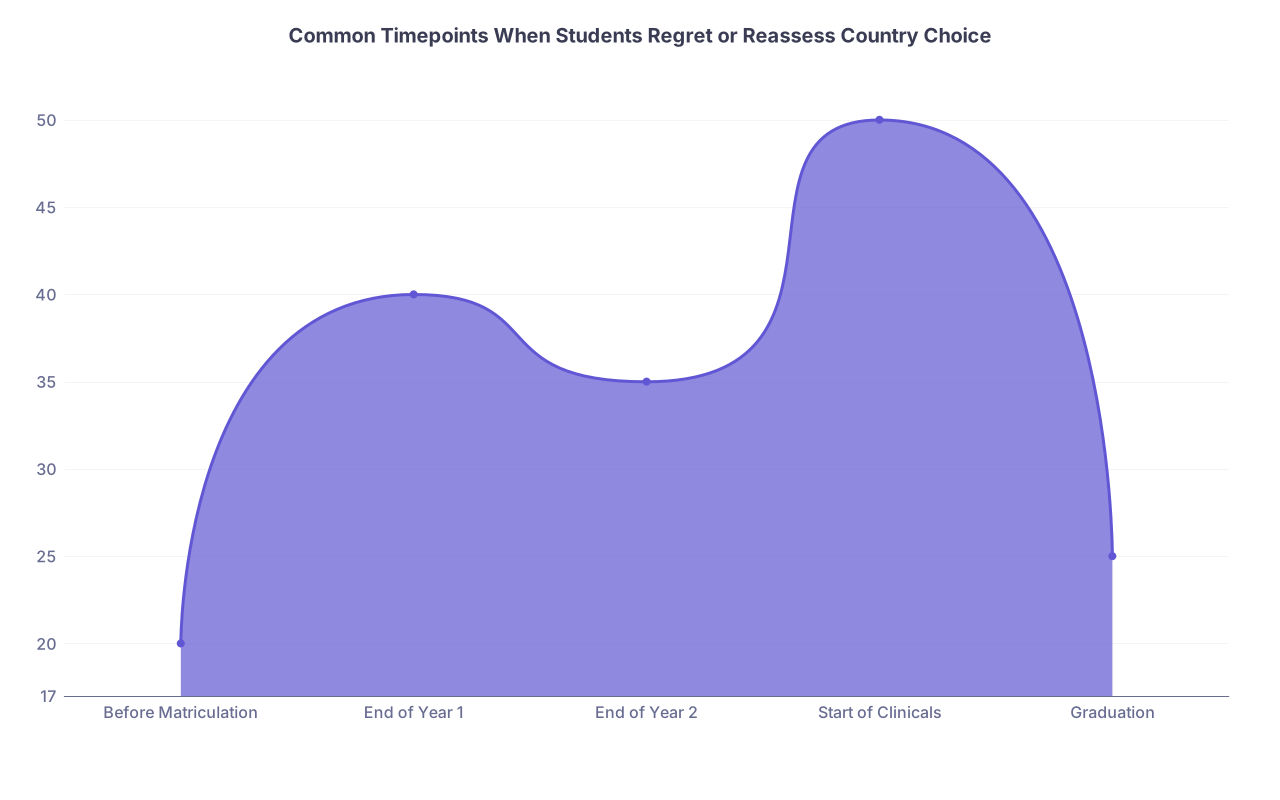
| Category | Value |
|---|---|
| Before Matriculation | 20 |
| End of Year 1 | 40 |
| End of Year 2 | 35 |
| Start of Clinicals | 50 |
| Graduation | 25 |


Bottom Line: Did You Pick the Wrong Country?
Strip away the panic and ask three blunt questions:
- Does my current country + school have a proven, recent track record of getting people where I want to end up?
- Is the language, licensing path, and immigration reality something I can realistically handle, not just optimistically hope for?
- Given my academic history and energy, is this path hard-but-fair or hard-and-borderline-impossible?
If your honest answers are:
- “No track record”
- “The system is stacked against me structurally”
- “I’m already drowning academically before the hard parts start”
Then yes, you may need to reassess early, seriously, and possibly get out.
If instead it’s:
- “There is a path, and others have walked it”
- “I’m scared but I understand the steps”
- “I’m struggling emotionally more than structurally”
Then you probably didn’t pick the “wrong” country. You picked a hard one. And now it’s about planning, not panicking.
Key points to keep in your head:
- The “country” decision is big, but not irrevocable. You can still course-correct early.
- Look at track record, exams, language, and visas—not just vibes or marketing.
- Don’t confuse normal fear and homesickness with an actually non-viable path.
You’re allowed to be scared. Just don’t let fear be the only voice in the room.


