

What happens if you uproot your entire life for a foreign med school… and then realize you can’t understand your professors, your patients, or even your roommates?
Because that’s the fear, right?
Not just “this might be hard.”
More like: “What if I move across the world, spend money my family doesn’t really have, and then mentally crash because I can’t function in the new culture or language?”
You’re not scared of being challenged. You’re scared of being trapped.
Let’s walk through this like someone who’s actually losing sleep over it. Because I am that person.
The Real Fear: Not Just Homesickness — Failure in Another Language
Everyone sells the “study medicine abroad” dream like it’s a travel brochure.
- “Global perspective!”
- “Cheaper tuition!”
- “English-taught curriculum!”
Sure. But you and I both know the brochure doesn’t show:
- You in pharmacology lecture, realizing you only caught 40% of what the professor said.
- A patient speaking rapid-fire in the local language, and you freezing because all you got was “pain” and “three days.”
- Being in a dorm kitchen where everyone slips into their native language and you’re suddenly invisible.
And the horror scenario in your head is very specific:
“I’ll fall behind academically because I don’t fully understand.
I’ll feel stupid every day.
I’ll be lonely.
And then I’ll have to explain to everyone back home why I came back early.”
You’re not being dramatic. I’ve watched versions of this happen. Some people don’t adapt well. But the reality is more nuanced than “you adapt” vs “you fail.”
How Big of a Risk Are You Actually Taking?
Let me be blunt: not all “international medical schools” are created equal. Some set you up pretty well. Some basically throw you into the deep end without a life jacket.
Here’s roughly how programs differ:
| Program Type | Teaching Language | Clinical Language | Day-to-Day Difficulty |
|---|---|---|---|
| Fully English-taught EU program (e.g., Poland, Hungary) | English | Often local language | Medium-High |
| [Caribbean school (US-focused)](https://residencyadvisor.com/resources/international-med-schools/what-if-choosing-a-caribbean-med-school-ruins-my-chances-at-us-residency) | English | Mostly English | Low-Medium |
| Non-English program (e.g., Germany, Italy local track) | Local language | Local language | Very High |
| “Hybrid” English/local program | Mix | Local language | High |
| English program w/ structured language course | English | Mix | Medium |
If your worst fear is “I’ll never adapt to the language/culture,” then these questions matter a lot more than glossy websites:
- Is all preclinical teaching in English?
- Are exams in English?
- Are clinical rotations with English-speaking doctors or mostly local-language?
- Do they require local language proficiency before clinical years?
- Do they actually teach the local language in a serious way, or is it a token class?
Because here’s the un-fun truth:
If you pick a school where clinical work is primarily in a language you don’t speak and they don’t give real support, you’re not “weak” for struggling. You’ve been dropped into a bad setup.
What Adapting Actually Looks Like (Not the Instagram Version)
People talk about “adapting” like it’s some switch that magically flips at 6 months.
It’s not. It’s messy and uneven.
Early pattern I’ve seen over and over:
Month 1–2: Overwhelm + regret.
Everything feels like too much: new city, new bureaucracy, new roommates, new teaching style. Language feels like noise. You question the whole decision. You Google flights home more than you’d admit.
Month 3–6: Partial functional adaptation.
You start memorizing bus routes, grocery store brands, how to order food without embarrassing yourself. You understand roughly what professors are saying, but details slip past you. Friends start to form, but you still feel like an outsider.
Month 6–12: Your brain finally starts catching patterns.
You catch more jokes. You start anticipating how people talk. You still miss stuff, but you’re no longer constantly drowning. Medicine vocabulary sticks faster than everyday slang.
Here’s the part no one tells you:
You don’t need to feel culturally “at home” to function. You just need a stable enough routine so you’re not constantly in survival mode.
The real problem is when:
- You’re not sleeping because of noise/roommates/housing issues.
- You’re isolated socially.
- You’re constantly anxious about understanding basic information.
That combo kills your bandwidth for studying and language learning.
Worst-Case Scenarios: What If You Really Don’t Adapt?
Let’s actually go there, because that’s what your brain is doing at 3 a.m. anyway.
Worst Case 1: You fall behind academically because of language gaps
You’re understanding concepts, but not fast enough. Lectures feel like puzzles, not teaching.
What this can lead to:
- Barely passing or failing key exams.
- Needing to repeat classes or a year.
- Losing confidence, starting to believe you’re “not smart enough.”
What this usually actually means: You’re trying to learn medicine and a language at the same time with zero adjustments in expectations from the school. That’s not a personal failure. That’s a structural problem.
Even then, people crawl out of this hole. How?
- Recording lectures (if allowed) and re-listening slowly.
- Studying from English-language textbooks/YouTube instead of relying purely on lectures.
- Getting notes from upper-year internationals who already decoded the accent/teaching style.
But yes, if you do nothing, this can spiral.
Worst Case 2: You mentally crash — anxiety, depression, burnout
You’re lonely. You feel dumb. You’re tired of being misunderstood, of having to repeat yourself.
Risk factors I’ve seen:
- You’re the only one from your country/region in your year.
- Your friend group mainly socializes in a language you don’t speak fluently.
- You’re under financial pressure (“I can’t fail; there’s no backup money”).
- The school is unsupportive, disorganized, or dismissive.
Could you hit a wall where you need to take a leave, go home, or transfer? Yes. That happens. Not constantly, but it’s not some imaginary scenario.
It’s not the most common outcome—but it’s also not zero. Pretending it never happens is dishonest.
Worst Case 3: You make it through preclinical but get wrecked in clinical years
This one scares me the most personally.
Preclinical: you survive on English notes, Anki, Pathoma, Boards and Beyond. You scrape by.
Clinical: suddenly you’re expected to take histories, explain diagnoses, give instructions… in the local language.
If your program didn’t:
- Seriously train you in the local language
and/or - Assign you to English-speaking attendings/residents
…you’re stuck.
You become the student in the corner who:
- Can’t properly speak to patients
- Gets ignored during ward rounds
- Feels useless and embarrassed
This can absolutely wreck your confidence and your evaluations.
So yes, your fear about “what if I can’t function with patients” isn’t paranoid. It’s very real in badly structured programs.
Red Flags That a Foreign Program Might Be a Bad Fit for You
You’re allowed to be strategic. You’re not obligated to “tough it out” in systems that don’t give a damn about your odds.
Pay attention to these:
- The school’s website says “English program”… but the fine print says “some classes/clinicals in local language.”
- No structured, long-term local language courses are built into the curriculum. Just a token 1st-year class.
- Students on Reddit/FB say: “You’ll be fine, you pick it up” but don’t give specifics about teaching/hospital language.
- No clear requirement or path for language capability before clinical years.
- You can’t find honest student feedback; everything seems overly polished.
And one big red flag:
You ask current students, “How are clinicals for non-native speakers?” and they respond with something like, “You manage” or “Depends on the attending,” but nobody says, “It’s well organized and they support you.”
Translation: You’re on your own.
What You Can Do Before You Go Abroad (So You Don’t Get Crushed)
You can’t control everything, but you’re not powerless. There are a few very un-glamorous steps that make a huge difference.
1. Research like a paranoid person, not a tourist
Talk to actual current students. Not agents. Not admissions brochures.
Ask very specific questions:
- “In 3rd year, how many hours per week are actually in English?”
- “Do your attendings speak to patients in English or local language?”
- “Can you pass exams if you only understand English?”
- “What’s the minimum language level students realistically have by clinical years?”
If people dodge specifics, that’s your answer.
2. Start the language early — months or a year before
You don’t need fluency before going, but here’s the line:
If you arrive knowing zero and you’re not someone who naturally soaks up languages quickly, you’re volunteering for misery.
Get to at least:
- Basic grammar
- Common verbs and tenses
- Numbers, body parts, symptoms, directions
- Polite phrases and basic small talk
Not to impress people. To avoid total helplessness.
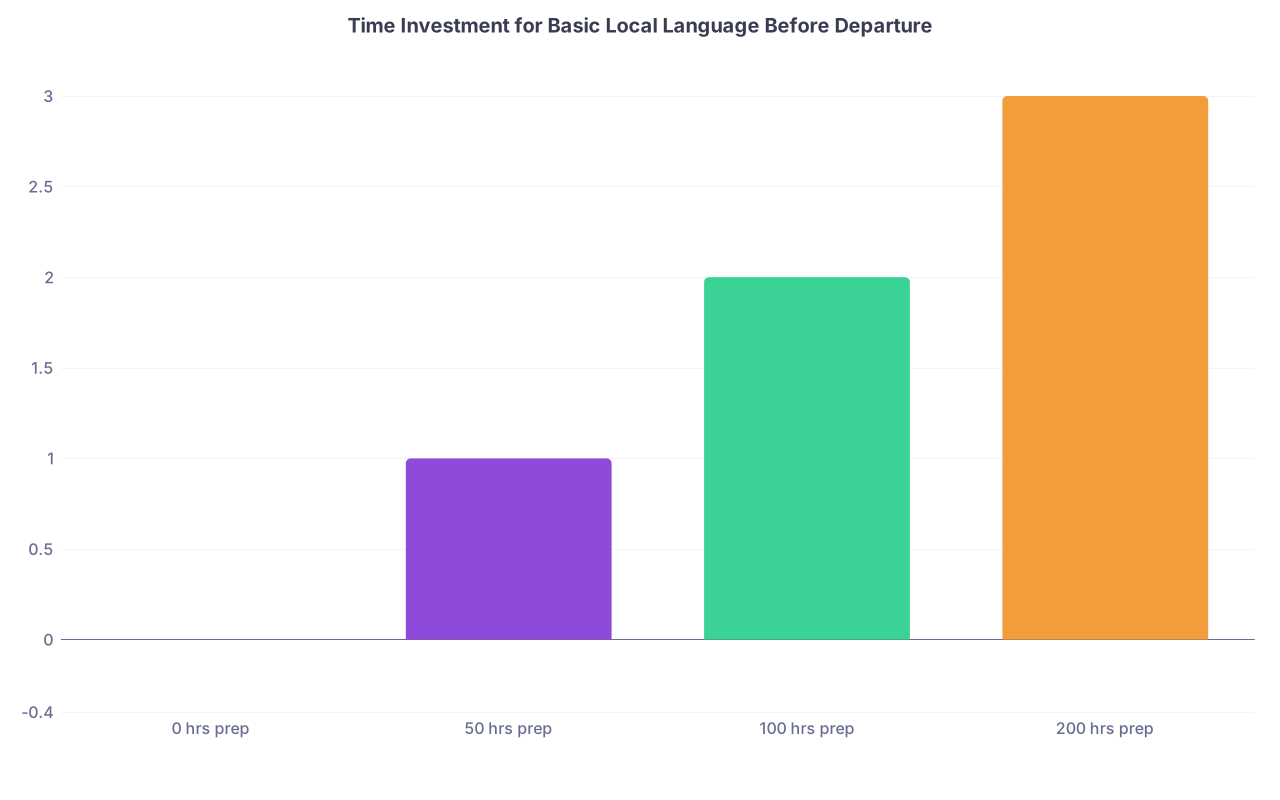
| Category | Value |
|---|---|
| 0 hrs prep | 0 |
| 50 hrs prep | 1 |
| 100 hrs prep | 2 |
| 200 hrs prep | 3 |
(That “value” scale is basically: 0 = Painful start, 3 = Manageable start.)
3. Build your “if this goes sideways” plan
Your brain calms down a lot when it knows there’s a backup.
Things to define now:
- Under what conditions would you leave/transfer? (e.g., failing multiple exams, severe mental health decline, unsafe housing)
- Which schools back home or elsewhere would you consider transferring to or reapplying to?
- Financial plan if you needed to take a year off or change routes.
You are not jinxing yourself by having a backup. You’re preventing that trapped feeling that makes everything worse.
If You’re Already There and Struggling: You’re Not Broken
Some of you reading this are probably already abroad, already in deep, already thinking “Did I completely screw up?”
You’re not alone. You’re also not doomed.
Concrete things that actually help, beyond “just try harder”:
- Find 1–2 upper-year students from your background. Ask them exactly how they survived the first year or two.
- Separate language learning from med learning.
Don’t try to “learn both at once” passively. Use real language resources: tutors, apps, conversation groups, not just “immersion by suffering.” - Carve out one safe zone. A WhatsApp group, weekly call home, or a couple of classmates you can be fully honest with. You need at least one space where you’re not “performing.”
- Be ruthless about mental health. If you’re crying daily, not eating, not sleeping, and grades are slipping—this is not a “you just need to push more” situation. This is a “talk to a therapist and consider structural changes” situation.
And no, coming home or transferring does not mean you “couldn’t hack it.” It means the setup wasn’t worth destroying yourself over.

| Step | Description |
|---|---|
| Step 1 | Struggling in foreign med program |
| Step 2 | Seek academic + language support |
| Step 3 | Talk to mental health professional |
| Step 4 | Meet with dean/academic advisor |
| Step 5 | Reassess and continue with support |
| Step 6 | Consider transfer/leave with backup plan |
| Step 7 | Failing multiple exams? |
| Step 8 | Severe mental health issues? |
| Step 9 | Any improvements in 3-6 months? |
So… Are You Too “Soft” to Study Abroad?
I know that’s the phrase floating around in your head.
“Other people handle this. Maybe I’m just not cut out for it. Maybe I’m too anxious, too attached to home, too bad with languages.”
Here’s my honest read:
- If you absolutely refuse to learn the local language at all? Then yes, a program where clinical care is in that language is a terrible idea.
- If you expect the new culture to adapt to you entirely? Also a problem.
- But if your fear is about failing rather than refusing, that’s different.
You’re allowed to be scared and still do this intelligently.
You’re also allowed to decide:
“I want to be a doctor, but not at the cost of spending 6 years feeling stupid and isolated in a place that doesn’t support international students.”
That’s not weakness. That’s picking a sane path.
FAQ (Exactly 6 Questions)
1. What if I really have zero talent for languages?
Then you need to be much more selective with programs. Choose:
- Fully English-taught curricula
- Clinical sites where English is used routinely
- Countries with high English proficiency (e.g., many Northern European countries, some Caribbean programs)
And be honest with yourself: if clinical work is mostly in another language and you’re historically awful with languages, that’s not a character flaw—it just means that specific setup might not be realistic.
2. How do I know if a school’s “language support” is real or just marketing?
Ask current students:
- “How many hours a week is the language course?”
- “Is it graded or just ‘for fun’?”
- “By 3rd year, are students actually able to take full histories in the local language?”
- “Do any students fail or struggle because of the language?”
If people say the class is a joke or optional and everyone just wings it, that’s not real support.
3. Is it better to wait a year and apply locally than rush into a foreign program I’m unsure about?
In a lot of cases, yes. One “lost” year is nothing compared to 6 years in a system that doesn’t fit you, plus the stress of matching back home. Waiting to improve your GPA/MCAT or apply to less risky programs is not failing. It’s strategic.
4. What if my family expects me to go abroad and “make it work” no matter what?
That’s brutal, but common. You need to separate:
- Their financial sacrifice and hope
from - The reality of your mental health and actual academic outcomes
If a situation is destroying you, staying just to satisfy expectations doesn’t magically turn into success. You might need to show them concrete data: grades, letters from advisors, or mental health concerns to help them understand it’s not just “you being soft.”
5. Will not adapting well abroad hurt my chances of becoming a doctor later?
Only if you let it turn into a permanent shutdown. Many people:
- Leave a foreign program,
- Regroup,
- Reapply locally or choose another health profession,
- And still end up with solid careers.
What hurts you more is pretending everything is fine until it blows up so badly that your record is a mess. Making earlier, honest course corrections looks better, not worse.
6. How do I tell the difference between normal adjustment stress and “this program is actually wrong for me”?
Rough rule of thumb:
- Normal: Anxiety, homesickness, confusion in first 3–6 months, but grades are okay or improving, and you see gradual progress in language and social life.
- Wrong fit: Persistent academic failure despite real effort, worsening mental health, constant isolation, and no meaningful institutional support.
If after a full academic year of consistent effort you’re still drowning on all fronts—academically, emotionally, linguistically—it’s not just “adjustment.” That’s a signal to seriously reassess.
Key points to walk away with:
- Your fear of “not adapting” isn’t irrational—some setups do make it almost impossible to thrive if the language/culture piece is mishandled.
- You have more control than it feels right now: pick programs carefully, start the language early, and define a backup plan.
- Struggling abroad doesn’t mean you’re weak or not cut out for medicine; it just might mean you need a different path than the fantasy everyone sells.


